Catamarans Explained: What Every Beginner Should Know
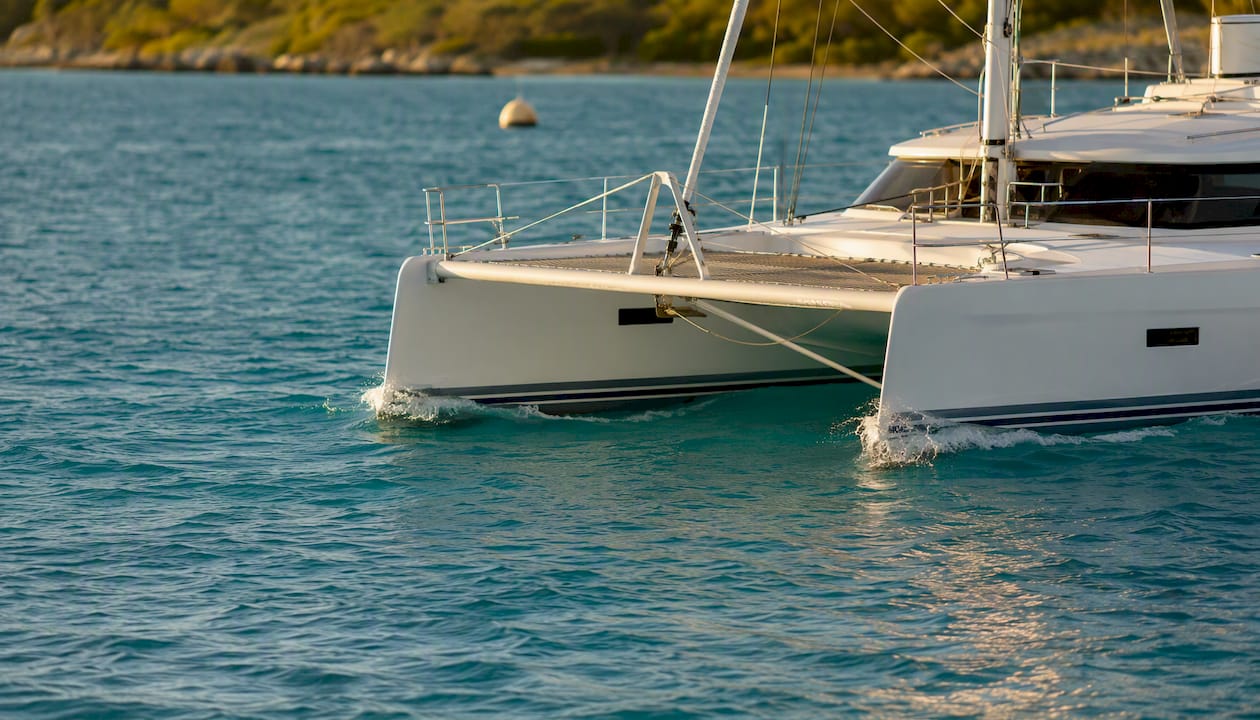
A catamaran is a watercraft with two parallel hulls of equal size connected by a deck or bridge structure. The wide hull spacing delivers stability without ballast, keeps draft shallow, and reduces heeling compared with a single-hull vessel. Three things to know immediately:
- Stability: The twin-hull stance resists rolling far better than a monohull under normal conditions.
- Draft: No deep keel means access to anchorages that deeper boats cannot reach.
- Motion: Reduced heeling and a smaller wake translate to a noticeably different ride, especially for passengers prone to seasickness.
The sections below cover anatomy, types, performance, safety, and how to get your first hands-on experience.
Key Takeaways
A catamaran’s twin-hull design delivers stability, shallow draft, and speed advantages that no single-hull vessel of comparable length can match, but those benefits require specific handling knowledge and formal training to use safely.
| Point | Details |
|---|---|
| Core definition | Two parallel hulls joined by a bridge deck; stability comes from hull spacing, not ballast. |
| Top performance advantage | Shallower draft and lower hydrodynamic resistance allow access to anchorages monohulls cannot reach. |
| Main tradeoff | Catamarans do not self-right after capsize; weather avoidance and seamanship are non-negotiable. |
| Marina cost factor | Wide beam means most marinas charge for two slips; confirm berth availability before buying. |
| Safeboatingamerica | State-approved certification courses in online, Zoom, and in-person formats satisfy licensing requirements before chartering or purchasing. |
Table of Contents
- Where did the word “catamaran” come from?
- What are the main parts of a catamaran?
- What types of catamarans are there?
- How does a catamaran perform compared with a monohull?
- What are the real advantages and tradeoffs?
- Who benefits most from a catamaran?
- Key safety considerations for catamaran operators
- How to choose the right catamaran for your needs
- How do beginners gain real catamaran experience?
- An informed perspective on catamaran training
- State-approved training for catamaran operators
- Sources
- FAQ
Where did the word “catamaran” come from?
The word traces directly to the Tamil kattumaram, meaning “logs bound together,” per the Cambridge Dictionary. That description fits the original craft precisely: small, lashed-log rafts used for shore transport, fishing, and lagoon travel across South Asia and the Indian Ocean for centuries.
Austronesian and South Asian seafarers refined the twin-hull concept long before European navigators encountered it. When European explorers arrived in the Indian Ocean and Pacific, they documented these vessels and eventually adopted the hull form for naval and commercial purposes. By the 20th century, fiberglass construction made production catamarans practical for recreational buyers, and carbon-fiber builds pushed racing designs into a different performance category entirely. Today’s molded twin-hull cruiser shares the same foundational geometry as those lashed-log rafts, scaled up and engineered for offshore passages.
What are the main parts of a catamaran?
Understanding the anatomy helps you evaluate any vessel you sail, charter, or inspect. The major components:
- Hulls: Two parallel hulls carry buoyancy, fuel, water tanks, and on larger vessels, sleeping cabins. Hull shape determines hydrodynamic resistance and speed potential.
- Bridge deck: The platform connecting the hulls. On sailing catamarans it typically houses the main saloon, galley, and helm station. Clearance between the bridge deck and the waterline matters; too little causes “slamming” in chop.
- Trampoline: The mesh netting stretched between the bows. It sheds water quickly, reduces weight forward, and gives crew a working platform.
- Crossbeams: Structural members that tie the hulls together and carry the loads from the rig and bridge deck. Inspect the crossbeam-to-hull joints carefully on any used vessel.
- Rig and sails: Most sailing catamarans carry a sloop or fractional rig on a single mast stepped on the bridge deck. Sailboat parts like the boom, shrouds, and forestay function the same as on a monohull, though mast placement and sail area ratios differ.
- Engines: Twin outboards or inboard diesels, one per hull. Two independent propulsion units allow pivot-style maneuvering at low speed.
Pro Tip: Wide beam is the catamaran’s greatest structural asset and its biggest marina headache. Measure the beam before booking a slip; many standard berths cannot accommodate vessels over 22–24 feet wide.
The table below summarizes each component’s role and what to check during a pre-purchase or pre-charter inspection.
| Component | Primary role | What to inspect |
|---|---|---|
| Hulls | Buoyancy, tankage, accommodation | Osmotic blistering, delamination, through-hull fittings |
| Bridge deck | Living space, structural load transfer | Underside for impact damage, slamming cracks |
| Crossbeams | Structural integrity between hulls | Bonding joints, corrosion at fasteners |
| Trampoline | Forward crew platform, weight reduction | Lashing tension, UV degradation, tears |
| Twin engines | Propulsion, low-speed maneuvering | Mounts, zincs, raw-water impellers, hours logged |
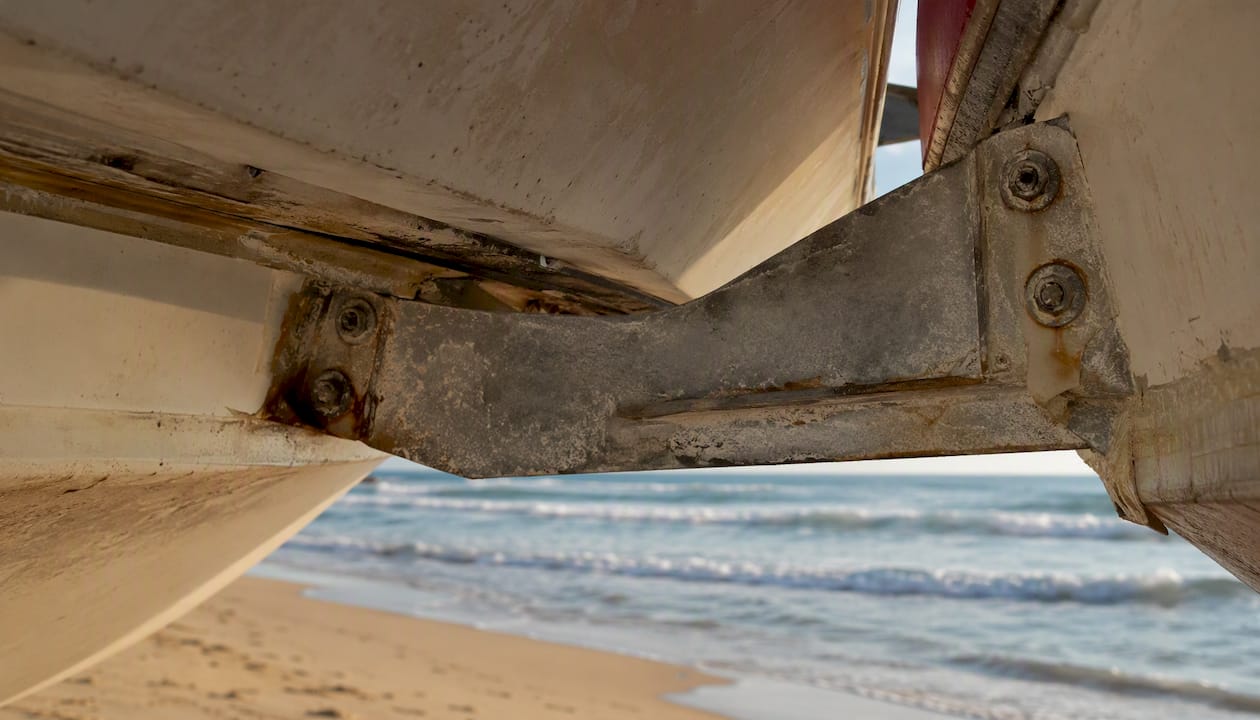
A thorough boat safety inspection covers all of these points and more before any first departure.
What types of catamarans are there?
The catamaran family covers a wide range of designs, each optimized for a different purpose.
Sailing catamarans are the most common type for recreational buyers and charter fleets. Sizes run from 30 feet to over 60 feet. Larger models carry full liveaboard amenities across both hulls. Best for: bluewater cruising, charter vacations, family liveaboard.
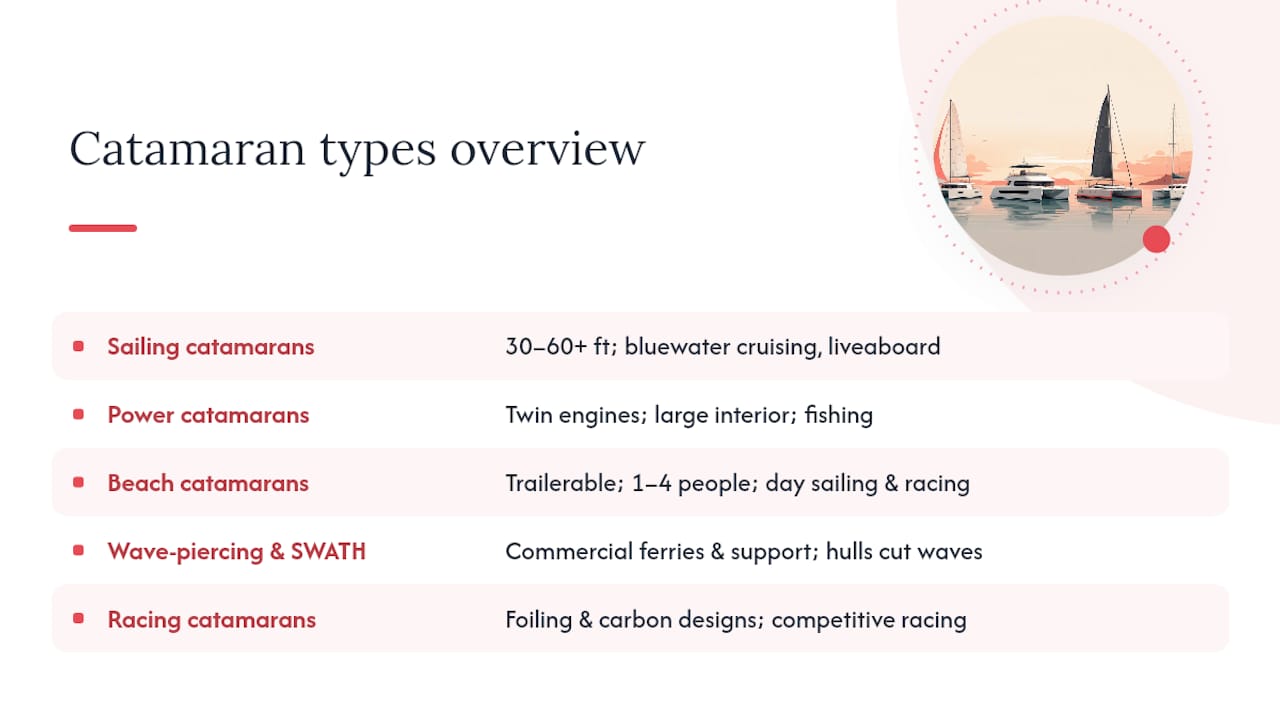
Power catamarans replace sails with twin engines and prioritize interior volume and fuel efficiency at planing speeds. The wide beam creates a stable platform for fishing, diving, or passenger transport. Best for: sport fishing, day charters, coastal cruising without sailing.
Beach catamarans are small, lightweight, trailerable designs like the Hobie Cat series. They launch directly off a beach, carry one to four people, and are built for speed and simplicity. Best for: day sailing, racing, learning the basics of multihull sail trim.
Wave-piercing and SWATH designs appear mainly in commercial applications: high-speed ferries, research vessels, and military patrol craft. The hulls are shaped to cut through rather than ride over waves, reducing passenger motion at speed. Best for: commercial ferry routes, offshore support.
Racing catamarans range from Olympic-class Formula 18 beach cats to the foiling AC75-style designs seen in the America’s Cup. Carbon construction and hydrofoils push these vessels well beyond conventional hull speeds. Best for: competitive racing, performance sailing events.
Industry associations like IYBA document the full range of commercial and leisure applications, from private cruising to charter fleet management, and note that sizing a catamaran to its intended use is one of the most consequential decisions a buyer makes.
How does a catamaran perform compared with a monohull?
The twin-hull geometry produces measurable differences across every performance dimension that matters to a new operator.
| Characteristic | Catamaran | Monohull |
|---|---|---|
| Draft | Shallow (no ballast keel) | Deeper (keel required for stability) |
| Displacement | Lower for similar length | Higher due to ballast |
| Hydrodynamic resistance | Lower (two narrow hulls) | Higher (single wider hull) |
| Speed potential | Higher at similar sail area | Lower |
| Heeling under sail | Minimal | Significant |
| Capsize recovery | Very difficult | Self-righting (ballasted) |
What a beginner notices on the water:
- Upright sailing: A catamaran rarely heels past 10–15 degrees in normal conditions. Drinks stay on the table; guests stay comfortable.
- Speed: The lower resistance and lighter displacement allow many sailing cats to average speeds that a comparable monohull cannot sustain.
- Shallow anchorages: With draft often under 4 feet, a catamaran can anchor in bays and lagoons inaccessible to keel boats.
- Reduced seasickness: Smaller wake and less rolling motion make a real difference for passengers with motion sensitivity.
The safety caveat is significant. Wikipedia’s catamaran entry notes that unlike ballasted monohulls, catamarans do not self-right after a capsize. Avoiding conditions that could lead to capsize requires specific seamanship knowledge and weather awareness, not just general boating experience.
What are the real advantages and tradeoffs?
Advantages worth knowing:
Space is the headline benefit. Two hulls plus a wide bridge deck give a 45-foot catamaran interior volume that a 45-foot monohull cannot match. Separate cabins in each hull provide privacy that matters on a week-long charter. The stable platform also makes cooking, sleeping, and moving around the boat far more comfortable at anchor or underway.
Shallow draft opens destinations. Catamarans regularly anchor in 3–4 feet of water, stern-to beaches, or inside reef lagoons where monohulls wait outside. That access is a practical advantage on any Caribbean or Pacific island itinerary.
Fuel efficiency on power cats is another factor. Two narrow hulls produce less resistance than one wide hull, so twin-engine power catamarans often burn less fuel per mile than comparable monohull powerboats at the same speed.
Tradeoffs that surprise new owners:
Marina fees are the most immediate financial shock. Most marinas charge by beam, and a 24-foot-wide catamaran pays for two standard slips. Budget accordingly before committing to a home port.
Upwind sailing performance is the sailing tradeoff. Catamarans are fast on a reach and downwind, but the lack of a deep keel limits pointing ability. Racing sailors and bluewater passage-makers who need to beat hard into the wind will find a well-designed monohull more efficient on that point of sail.
Capsize recovery is a serious consideration. A capsized catamaran floats upside down and is extremely difficult to right without professional salvage equipment. This is not a reason to avoid the design, but it is a reason to respect weather limits and invest in proper training.
Who benefits most from a catamaran?
Catamarans suit specific boating goals better than others. Ask yourself:
- Do you prioritize interior space and comfort over pointing ability?
- Do you want to anchor in shallow bays or near beaches?
- Are your passengers prone to motion sickness?
- Do you plan to charter in the Caribbean, Mediterranean, or Pacific islands?
- Do you want a stable platform for fishing, diving, or entertaining?
If most of those answers are yes, a catamaran fits your use case well. Common scenarios where they excel:
Skippered charter vacation: A 44–50 foot sailing cat with a professional skipper is the dominant format for Caribbean bareboat and crewed charters. Charter operators favor catamarans because the space, stability, and shallow draft suit island-hopping itineraries. Families with children particularly benefit from the wide deck space and stable platform.
Family liveaboard: Separate hull cabins, a large saloon, and the ability to anchor in calm, shallow bays make larger catamarans a practical choice for extended cruising families.
Day sailing with a group: A beach cat or small power cat handles a group of six to eight people with far less motion than a comparable monohull.
Commercial ferry and water taxi: Wave-piercing power catamarans dominate short-haul passenger ferry routes globally because of their speed, fuel efficiency, and passenger comfort.
Crew requirements scale with size. A 35-foot sailing cat is manageable for two experienced sailors. A 55-foot vessel with furling systems and autopilot can be handled by the same crew, but the systems complexity and docking challenges increase significantly.
Key safety considerations for catamaran operators
Catamaran handling differs from monohull operation in ways that matter from the first departure. California’s Division of Boating and Waterways and similar agencies specifically recommend accredited instruction for operators transitioning to multihull vessels because twin-hull dynamics introduce different docking and emergency considerations.
Six practical safety points:
- Docking with twin engines: Use differential throttle to pivot the boat rather than relying on a rudder. Practice slow-speed maneuvering in open water before approaching a tight slip. A detailed docking techniques guide covers the mechanics.
- Bridge-deck slamming: In steep chop, the underside of the bridge deck can slam hard against waves. Slow down and bear away in short, steep seas to reduce impact loads.
- Anchoring in shallow water: The shallow draft that opens up anchorages also means less scope is needed, but wind shifts can swing the boat onto a shoal. Use a proper anchoring technique and set a drag alarm.
- Weather windows: A catamaran’s wide beam and large sail area make it more vulnerable to squalls than its stability in calm conditions suggests. Check forecasts carefully and reef early.
- Capsize awareness: Avoid sailing in conditions that approach the vessel’s stability limits. Unlike a ballasted monohull, a capsized catamaran will not self-right. Carry a full complement of safety equipment and know your emergency procedures before leaving the dock.
- Engine redundancy: Two engines are an asset, but only if both are maintained. Run both engines regularly, check zincs and impellers on schedule, and know the single-engine handling characteristics of your specific vessel.
Pro Tip: Before soloing a larger catamaran, complete at least one skippered charter or instructor-led dock drill on a similar-size vessel. The wide beam and twin-engine dynamics feel intuitive in theory and genuinely different in practice.
How to choose the right catamaran for your needs
A structured decision process saves time and prevents expensive mismatches.
Decision checklist:
- Intended use: Coastal day sailing, offshore passages, charter, racing, or liveaboard?
- Crew size: How many berths do you need, and how many crew will typically handle the boat?
- Budget shape: Purchase with ongoing marina and maintenance costs, or charter access without ownership overhead?
- Marina fit: Confirm your home port has slips wide enough before shortlisting models.
- Maintenance capacity: Twin engines, two sets of through-hulls, and a larger sail inventory all multiply maintenance time and cost.
- Regulatory requirements: State boating certification requirements apply regardless of vessel type.
Sea-trial checklist:
- Test low-speed maneuvering in a confined space using differential throttle.
- Observe ride comfort in a chop: check for bridge-deck slamming and hull noise.
- Verify engine redundancy by running each engine independently.
- Check vibration at cruise RPM in both hulls.
- Open every storage hatch and assess access to engines, tanks, and bilges.
- Sit at the helm for 20 minutes and evaluate sightlines, ergonomics, and helm control layout.
Compare vessels of similar length and engine configuration. A 45-foot sailing cat and a 38-foot power cat are different tools; a like-for-like comparison requires the same size class and similar power.
How do beginners gain real catamaran experience?
Practical experience is the fastest path to competence. Several routes work well depending on your starting point:
- Accredited boating safety course: State-certified instruction covers navigation rules, emergency procedures, and vessel operation fundamentals that apply to all hull types. This is the required starting point in most states and the baseline for any insurance or charter company.
- Skippered charter: Sail with a professional skipper for a week. Watch how they dock, manage weather, and handle the twin engines. Most charter companies offer “learn to sail” skippered options specifically for this purpose.
- Day sails with experienced crew: Join a local sailing club or catamaran owner for day sails. Hands-on time at the helm in varied conditions builds confidence faster than classroom time alone.
- Instructor-led dock drills: Some marinas and sailing schools offer half-day catamaran handling clinics focused on docking and low-speed maneuvering. These address the skills most new owners find hardest.
- Bareboat charter progression: After completing a certified course and logging supervised hours, many charter companies will issue a bareboat endorsement for catamarans up to a specific size.
Safeboatingamerica offers state-approved boating safety courses in online, live Zoom, and in-person formats across all U.S. states. Completing a certified course satisfies state licensing requirements and gives charter companies the documentation they need before handing over keys. A beginner’s safety guide is a practical companion to any formal course.
An informed perspective on catamaran training
The catamaran’s stability in normal conditions creates a specific risk: it feels forgiving right up until it isn’t. New operators who transition from monohulls often underestimate the twin-engine docking challenge and overestimate how much the wide beam protects them in deteriorating weather. The vessel’s resistance to rolling is real, but it is not a substitute for seamanship.
Formal certification matters here for a reason beyond legal compliance. A structured course forces you to confront emergency procedures, weather limits, and capsize awareness before you are in a situation that requires them. The operators who handle catamarans most confidently are not the ones with the most natural talent; they are the ones who practiced docking in controlled conditions before they needed to do it in a crosswind.
The practical advice in this guide reflects the same priorities that state-certified instructors and USCG-licensed captains apply: understand the design, respect its limits, and build skills progressively rather than learning by incident.
State-approved training for catamaran operators
Safeboatingamerica delivers state-approved boating safety certification across all U.S. states, with course formats built for working schedules: online self-paced, live Zoom, and in-person classes taught by State Certified Instructors and USCG-Licensed Captains using NASBLA-approved materials.
Certification covers navigation rules, emergency procedures, docking, and safe vessel operation — the exact skills that make the difference when you first take the helm of a twin-hull vessel. Same-day certification options are available in many states. Register at Safeboatingamerica and complete your state-required course before your next charter or purchase.
Sources
FAQ
What is a catamaran in simple terms?
A catamaran is a boat with two parallel hulls connected by a deck or bridge. The wide stance provides stability without a heavy keel, resulting in shallower draft and less heeling than a comparable single-hull vessel.
How does a catamaran differ from a monohull?
Catamarans have lower hydrodynamic resistance, shallower draft, and minimal heeling compared with monohulls of similar length, but they cannot self-right after a capsize the way a ballasted monohull can.
What are catamarans most commonly used for?
Catamarans are widely used for charter vacations, family liveaboard cruising, day sailing, commercial ferry routes, and racing, with the specific design type varying by application.
Do I need a special license to operate a catamaran?
State boating certification requirements apply to all vessel types, including catamarans. Completing a state-approved course through a provider like Safeboatingamerica satisfies those requirements and is typically required by charter companies before issuing a bareboat endorsement.
Are catamarans safe for beginners?
Catamarans are stable in normal conditions, but their twin-engine docking dynamics and capsize behavior differ significantly from monohulls. Accredited instruction and supervised practice before solo operation are strongly recommended by agencies such as the California Division of Boating and Waterways.