How to Perform a Boat Safety Inspection Step by Step
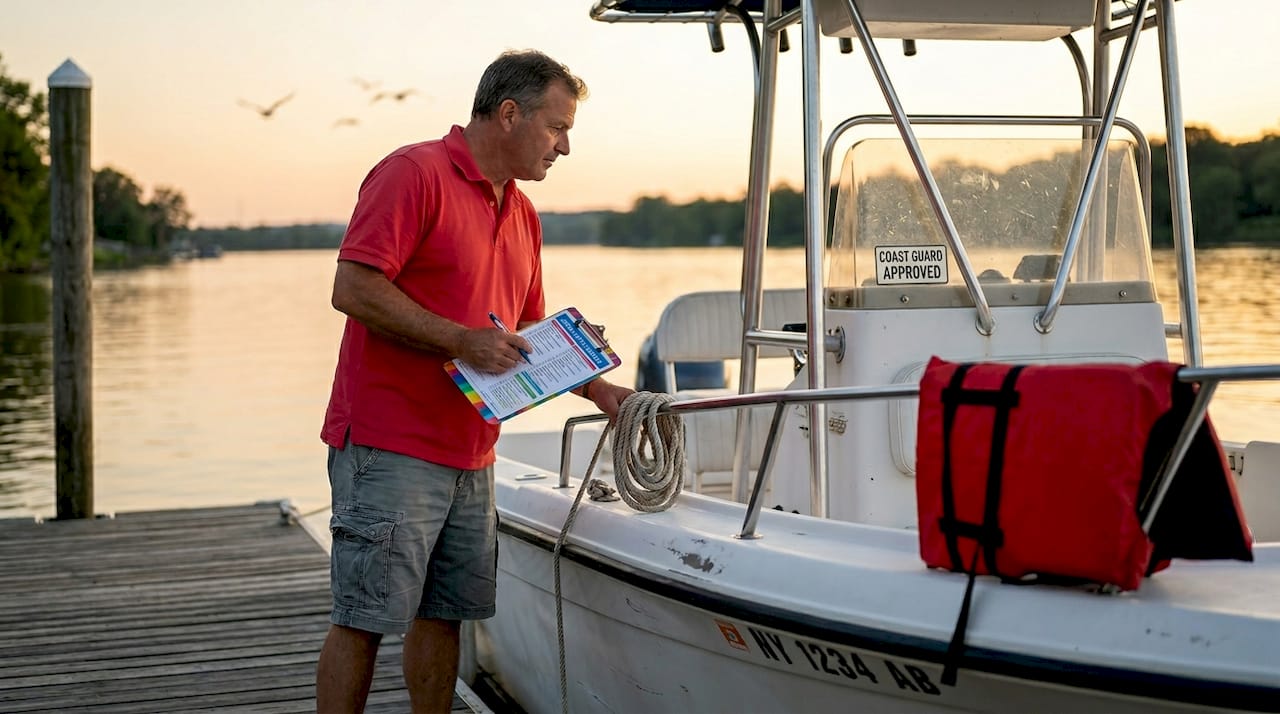
Missing one item during a routine law enforcement stop can mean a citation, a failed inspection sticker, or worse, an unsafe situation far from shore. Many boat owners assume their vessel is ready simply because it was fine last season, but regulations change annually, gear expires, and state-specific rules catch even experienced skippers off guard. This guide gives you a clear, methodical approach to boat safety inspections that satisfies federal requirements, state regulations, and real-world readiness standards, whether you operate a center console, a bass boat, or a personal watercraft (PWC).
Table of Contents
- Understand boat safety inspection basics
- What you’ll need: Tools, paperwork, and equipment checklist
- Step-by-step: How to perform your boat safety inspection
- State-specific rules and common pitfalls
- Resources: Official vessel safety checks and digital tools
- Our perspective: Why a layered approach beats a basic checklist
- Take the next step toward safer boating
- Frequently asked questions
Key Takeaways
| Point | Details |
|---|---|
| Follow a dual-layer method | Combine official equipment checklists with vessel-specific mechanical checks to ensure all-around safety. |
| State rules matter | Always verify the inspection requirements for your state and waterway, as these can change yearly and affect compliance. |
| Document everything | Keep current registration, operator certifications, and any required stamps or decals in your vessel at all times. |
| Official vs. self-inspection | Virtual self-checks are great for practice, but only official Vessel Safety Checks issue decals accepted by authorities. |
| Annual and pre-ride checks | Inspect thoroughly at season start and before every outing, especially for PWCs and new maintenance. |
Understand boat safety inspection basics
A boat safety inspection is not a single, uniform event. It exists on two levels: voluntary federal programs and mandatory state requirements. Understanding the difference protects you legally and keeps your vessel genuinely safe.
The U.S. Coast Guard Auxiliary runs the Vessel Safety Check (VSC) program. This is a free, no-penalty examination conducted by a trained vessel examiner at your boat. According to the USCG Auxiliary, a VSC is a practical way to perform a boat safety inspection, providing a free lookover for compliance with federal and state safety requirements and awarding a VSC decal when all requirements are met. Passing earns you a recognized decal. Failing results in a written report and zero fines—just corrections to make.
State requirements are a separate matter. Many states layer their own rules on top of federal baselines. For example, state boating laws in Connecticut now require boaters to purchase an aquatic invasive species (AIS) stamp in addition to standard federal safety gear. Other states require operator education certificates be carried onboard or require specific equipment for PWC that goes beyond federal minimums. As noted by Connecticut DEEP, some states impose specific inspection or verification requirements for boating compliance that go well beyond federal carriage items.
Federal VSC vs. state requirements at a glance
| Category | Federal VSC (USCG Auxiliary) | State Requirements |
|---|---|---|
| Cost | Free | Varies (stamps, fees possible) |
| Penalty for failure | None (written report only) | Fines, denied waterway access |
| Frequency | Voluntary, typically annual | Often annual or per-trip |
| Decal issued | Yes, if passed | Depends on state |
| Covers AIS rules | Sometimes | Yes, in many states |
| Operator certificate check | Sometimes | Yes, in many states |
Key items a standard boat inspection checklist should cover at the federal level:
- Current registration numbers and decals displayed correctly
- U.S. Coast Guard approved life jackets (PFDs) in correct sizes for all aboard
- Visual distress signals (flares or electronic equivalent)
- Fire extinguisher(s) of proper type and current charge
- Navigation lights operational for nighttime or reduced-visibility use
- Sound-producing device (horn or whistle)
- Vessel hull identification number (HIN) visible and legible
What you’ll need: Tools, paperwork, and equipment checklist
With a clear sense of scope, gather every item before you start the physical inspection. Hunting for documents mid-inspection leads to missed steps and wasted time.
The USCG Auxiliary’s virtual safety check page provides a self-inspection methodology aligned to the official Vessel Safety Check form, covering documentation, numbering, and key onboard safety equipment including PFDs and visual distress signals. Use it as your pre-inspection staging guide.
Core paperwork and documentation
- State registration certificate (original, not a photocopy in most states)
- Registration decals current for the year and affixed correctly
- Hull Identification Number (HIN) confirmed against registration
- Operator’s boating safety certificate (required in many states and mandatory under Brianna’s Law for New York operators)
- Invasive species stamp or decal if required by your state
- Insurance card or policy number (not federally required, but good practice)
Safety equipment inventory
| Equipment | Federal Requirement | PWC Specific |
|---|---|---|
| PFDs | One per person, USCG approved | Must be worn in many states |
| Fire extinguisher | Type B-I minimum for most vessels | Required; check state for type |
| Visual distress signals | Day and night rated for coastal waters | Same as boat |
| Sound device | Horn or whistle | Required |
| Navigation lights | Operational for low visibility | Required |
| Cut-off switch lanyard | Not federal for all boats | Mandatory for PWC in most states |
| Throwable device | Type IV for boats over 16 ft | Check state requirement |
For PWC operators, the cut-off switch lanyard is one of the most commonly forgotten items during a pre-ride check. It must be attached to the operator, not just stowed in a compartment.
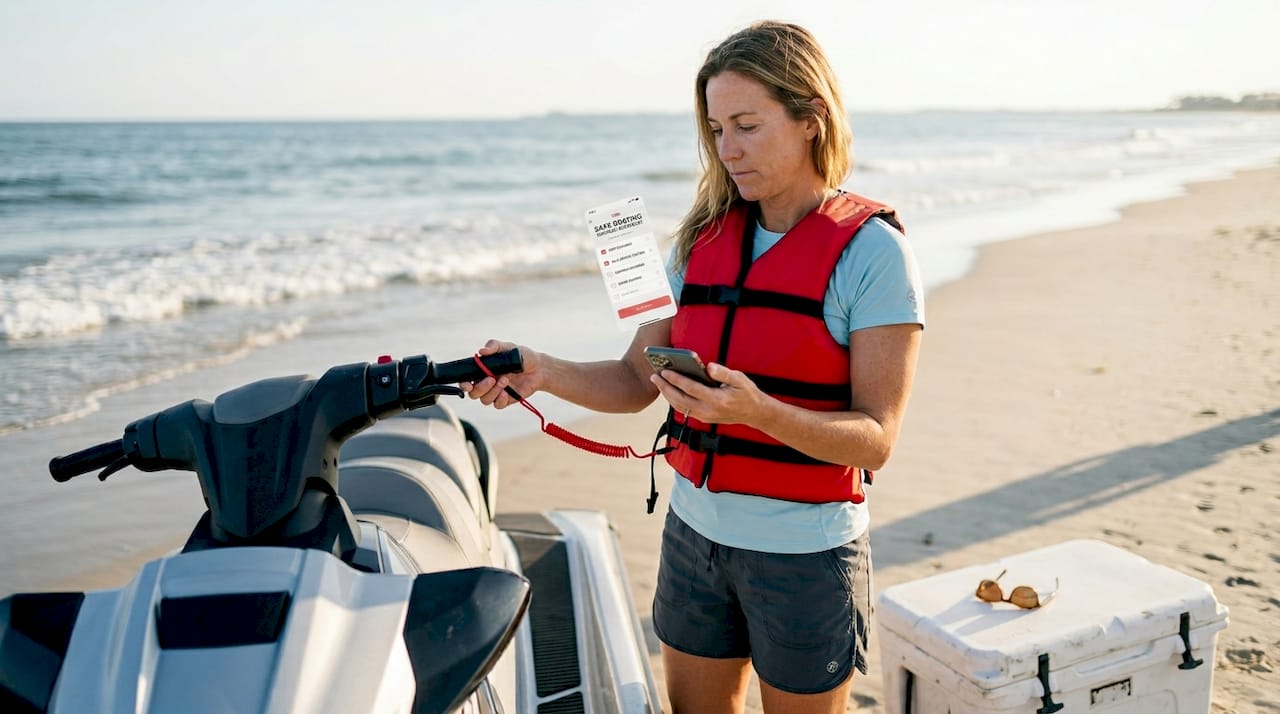
Pro Tip: Create a laminated checklist card to keep in your vessel’s documentation pouch. Review it before every outing, not just at the start of the season. You can find structured inspection checklists and guides on the Safe Boating America blog to use as a starting template.
Step-by-step: How to perform your boat safety inspection
Once you have everything staged, run through the inspection in a consistent order. Consistency eliminates the risk of skipping a section because you assumed it was already done.
VSCs are performed at the boat and typically take about 15 to 30 minutes. Trained vessel examiners look for registration and numbering, life jackets, distress signals, fire extinguishers, sound-producing devices, and navigation lights. Follow the same sequence yourself.
Inspection steps in order
- Verify documentation. Pull out registration, decals, and any required operator certificates. Check expiration dates on all items. Confirm the HIN on the vessel matches the registration.
- Check PFDs. Count and size-check each life jacket. Inspect for rips, mildew, waterlogged foam, or broken buckles. Confirm they are USCG Type I, II, or III approved for your vessel class.
- Inspect fire extinguisher(s). Check the pressure gauge needle is in the green zone. Verify the pin and tamper seal are intact. Confirm the expiration or service date has not passed.
- Check visual distress signals. Verify flare expiration dates (they expire 42 months from manufacture). Count the minimum required number. If using an electronic distress signal, confirm battery charge.
- Test the sound device. Activate the horn and confirm it produces a sustained, audible blast. Check the battery if it is electric.
- Test navigation lights. Turn on running lights at dusk or in a darkened area to confirm port (red), starboard (green), and stern (white) lights are functional.
- Run state-specific checks. Apply your state’s additional requirements. For Connecticut boaters, confirm the AIS stamp is displayed. For New York operators, confirm the safety certificate is onboard per NY boating license rules.
- Complete a mechanical readiness check. This step is separate from the compliance checklist but equally important. As Sea-Doo’s inspection guidance outlines, a proper mechanical review focuses on a quick visual inspection of key areas such as hull and pump intake, checking engine fluids per the operator’s guide, and confirming that storage compartment items and accessories are secured.
Important note for PWC operators: Federal and state compliance checks should happen before every ride, not just at the season’s start. PWC move fast and conditions change fast. A quick 10-minute pre-ride walkthrough using your manufacturer’s checklist is not optional—it is part of responsible ownership.
Pro Tip: Schedule your official USCG Auxiliary VSC at the start of the season, then use a self-inspection routine based on the same form before each outing. Completing boating safety training gives you the background knowledge to run these checks competently, not just mechanically.
State-specific rules and common pitfalls
State rules are where even experienced boaters get caught. Many violations happen not because someone ignored safety, but because they assumed last year’s rules still applied or that one state’s rules covered them in a neighboring state.
After understanding the federal and general process, do not overlook vital state-specific details that change frequently and vary widely.
State examples and specific requirements:
- Connecticut: Requires boaters to purchase and display an aquatic invasive species stamp and inspect vessels and trailers for visible aquatic invasive species before launching.
- Oregon: Requires mandatory AIS inspections at watercraft inspection stations, including checking the boat, trailer, and gear, with decontamination required if organisms are found.
- Pennsylvania: Requires PWC operators to have a Boating Safety Education Certificate, wear life jackets, and carry a fire extinguisher and sound-producing device.
- New York: Under Brianna’s Law, all operators born on or after January 1, 1993 must carry a boating safety certificate. Requirements are expanding to cover all operators regardless of birth year by 2025.
- Florida: New Florida boating laws have introduced updated requirements in recent years; always check current state guidance before launching in a new body of water.
Common pitfalls to avoid
- Forgetting to update invasive species permits at the start of each new season
- Carrying flares that expired during the winter storage period
- Assuming a VSC decal from last year is still valid without reconfirming current state-specific gear requirements
- Operating a PWC without carrying the operator’s boating safety certificate in states where it is required onboard
- Crossing state lines by water without checking the destination state’s specific rules
Pro Tip: Each time you plan to boat in a new state or a new waterway, spend 10 minutes reviewing the updated state requirements for that location. Rules around AIS checks, PWC age restrictions, and required equipment differ significantly from state to state.
Key reminder: A VSC decal does not guarantee compliance with all state rules. The decal reflects a point-in-time check against criteria the examiner applied at that moment. If state rules change or you cross into a state with stricter requirements, you are responsible for compliance regardless of the decal.
Resources: Official vessel safety checks and digital tools
Knowing what to check is only part of the equation. Knowing where to get official help and documentation makes the process faster and more reliable.
The USCG Auxiliary VSC program can include assessment of state and local requirements as a condition for awarding a decal, and it also evaluates overall boat condition items beyond just safety gear. That broader scope is part of what makes the official VSC more thorough than a simple self-inspection.
How to access official VSC services:
- Contact your local USCG Auxiliary flotilla to schedule a VSC at your marina or launch ramp
- Use the USCG Auxiliary’s online locator tool to find a vessel examiner near you
- Request the official VSC form to conduct a structured self-inspection using the same criteria
Digital self-inspection tools:
- USCG Auxiliary virtual safety check portal (linked above) for step-by-step self-inspection
- Manufacturer apps and owner portals (Sea-Doo, Yamaha WaveRunner, etc.) often include maintenance and pre-ride checklists
- State agency websites for current carriage requirements and downloadable inspection forms
Understanding the VSC decal:
| What a VSC decal means | What it does not mean |
|---|---|
| Vessel met compliance criteria at time of inspection | Continuous certification throughout the season |
| Examiner found no equipment deficiencies | Compliance with all state-specific rules in every waterway |
| Vessel was in good overall condition | Mechanical fitness or seaworthiness |
| Free, no-penalty process completed | Immunity from law enforcement inspections |
Staying current with boating regulations and scheduling annual VSCs, combined with following recommended maintenance cycles for safety, creates a reliable, documentable record of diligence that protects both you and your passengers.
Our perspective: Why a layered approach beats a basic checklist
Completing a VSC or checking off a federal list is the floor, not the ceiling, of genuine inspection readiness.
The real boater stories that end badly on the water rarely involve someone who ignored their flares or forgot their PFDs entirely. More often, incidents trace back to a mechanical failure that a quick pre-departure review of the operator’s guide would have caught, or an unfamiliar state rule that caught the operator by surprise. A two-layer system is more effective than a single checklist pass.
Layer one covers federal and state compliance: registration, PFDs, signals, fire extinguisher, sound device, lights, and all state-specific add-ons like AIS stamps or operator certificates. This layer answers the question, “Am I legal to operate on this waterway today?”
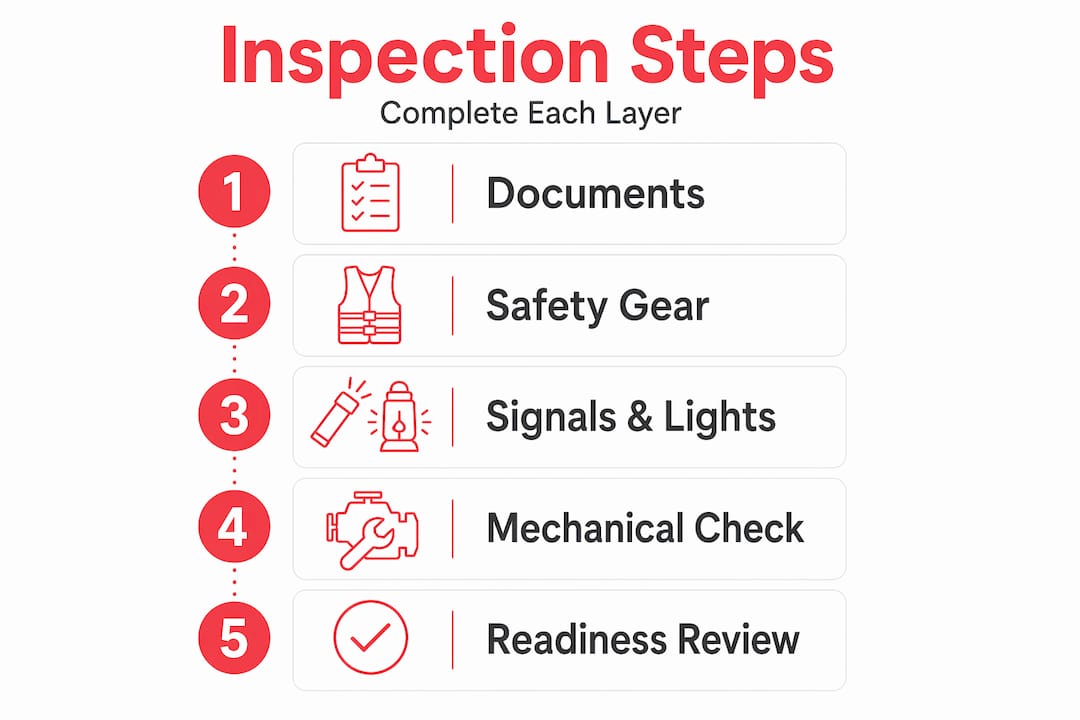
Layer two covers mechanical and operational readiness: hull integrity, fuel levels, engine fluids, battery charge, bilge pump function, and equipment accessibility. This layer answers the question, “Is this vessel actually ready to handle real conditions on the water?”
Passing layer one without completing layer two is like having a valid driver’s license in a car with bald tires. Legal, but unsafe. The most prepared boaters treat their manufacturer’s operator’s guide and their VSC checklist as two separate but equally essential documents. Neither replaces the other.
Take the next step toward safer boating
Conducting a thorough boat safety inspection takes knowledge that goes beyond a printed checklist. Understanding why each item matters, how state rules interact with federal baselines, and what mechanical checks to add to your routine comes from quality boating education.
Safe Boating America offers online boating courses covering required safety equipment, navigation rules, state-specific laws, and emergency procedures, all taught by USCG-licensed captains and state-certified instructors. Courses are available in every state, with same-day certification options and flexible scheduling. Whether you need a New York safety certificate, a Connecticut boating course, or PWC certification for a specific state, Safe Boating America has a program designed for your situation. Contact us today to find the course that meets your state’s requirements and builds the real-world knowledge to keep every inspection stress-free.
Frequently asked questions
What documents are required for a standard boat safety inspection?
Most inspections require current registration, the hull identification number, operator certification if the state mandates it, and sometimes invasive species permits or decals. The USCG Auxiliary virtual safety check form covers documentation and numbering as the first inspection category.
How often should I perform a boat safety inspection?
Conduct a thorough inspection at the start of each boating season, before every outing, and after any major maintenance or repairs. Manufacturer guidance recommends a pre-ride visual and fluid check every time you operate.
What happens if I fail a vessel safety check?
You receive a written report identifying deficiencies with no fines or penalties attached. The VSC program is designed to educate, not penalize, and you can schedule a recheck once corrections are made.
Are there special inspection steps for personal watercraft?
Yes. PWC require hull and pump intake checks, engine fluid verification, lanyard confirmation, and operator document review before every ride. Pennsylvania’s PWC regulations illustrate how state-specific operator education and equipment requirements apply specifically to personal watercraft operators.
Can I perform a virtual or self-inspection instead of an official VSC?
The USCG Auxiliary virtual checklist supports structured self-inspection aligned to the official form, but only a completed in-person VSC by a trained vessel examiner results in a recognized VSC decal.