Boat Safety Equipment: What Every Boater Must Carry
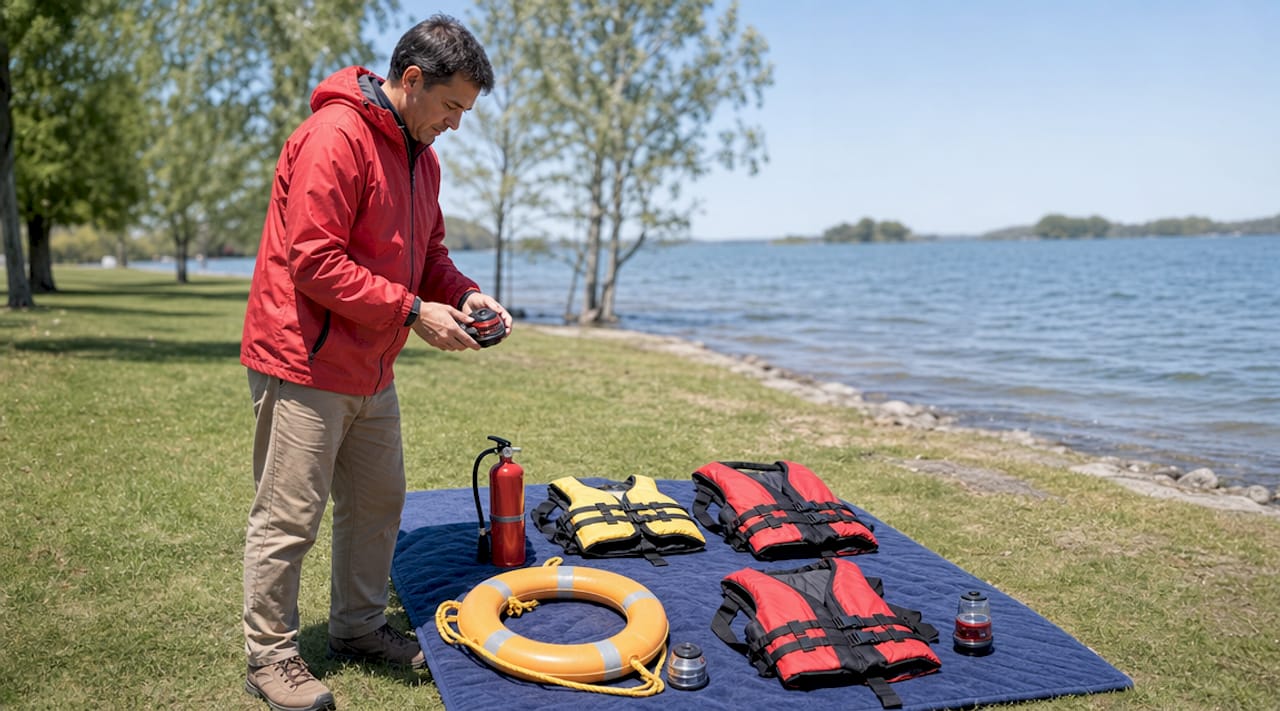
Boat safety equipment refers to the collection of legally required and recommended safety devices every vessel must carry to protect passengers and comply with U.S. federal and state law. The U.S. Coast Guard (USCG) sets the federal baseline, mandating specific gear based on vessel size, type, and operating area. Core categories include personal flotation devices (PFDs), fire extinguishers, visual distress signals (VDS), sound-producing devices, and navigation lights. Knowing exactly what your boat needs before you leave the dock keeps you legal, keeps your crew safe, and keeps a Coast Guard boarding officer from ruining your afternoon.
What boat safety equipment does federal law require?
Federal regulations mandate equipment based on vessel size and operation area, and every item must be USCG-approved and in serviceable condition. “Serviceable” is the word most boaters overlook. A fire extinguisher with a broken gauge or a PFD with a torn strap fails inspection even if it was purchased last season.
The table below summarizes the primary federal requirements by vessel length:
| Equipment | Under 16 ft | 16 ft and over |
|---|---|---|
| Wearable PFD | One per person on board | One per person on board |
| Type IV throwable device | Not required | Required |
| Fire extinguisher | At least one B-I type | At least one B-I; more for larger vessels |
| Visual distress signals | Required on coastal/Great Lakes waters | Required; must cover day and night use |
| Sound-producing device | Whistle or horn | Whistle or horn; bell required over 39 ft |
| Navigation lights | Required sunset to sunrise | Required sunset to sunrise |
Personal flotation devices and throwable devices
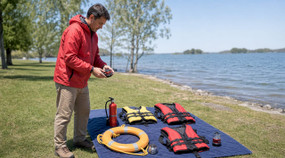
PFDs are classified as Types I through V, each designed for different conditions and activities. Type I offshore life jackets provide the most buoyancy and are built for open, rough water where rescue may be delayed. Type III flotation aids are the most common recreational choice for calm, inland waters where help is nearby. Every person on board needs a wearable PFD that fits them properly, which means children require child-sized devices, not adult jackets cinched tight.
Boats 16 feet and longer must carry one Type IV throwable device in addition to the wearable PFDs. A Type IV is a ring buoy or cushion you throw to a person in the water. It is a separate legal requirement, not a substitute for wearable PFDs. Type IV devices must be immediately accessible for man-overboard emergencies, meaning it cannot be buried in a storage locker under a cooler.
Fire extinguishers, navigation lights, and sound devices
Fire extinguisher requirements depend on vessel size, compartment type, and model year. Boats built after January 1, 2018 follow updated USCG rating standards using 5-B and 10-B classifications rather than older B-I and B-II designations. A vessel under 26 feet with no fixed extinguishing system requires at least one 5-B rated extinguisher. Larger vessels require more, and enclosed engine compartments trigger additional requirements regardless of boat length.
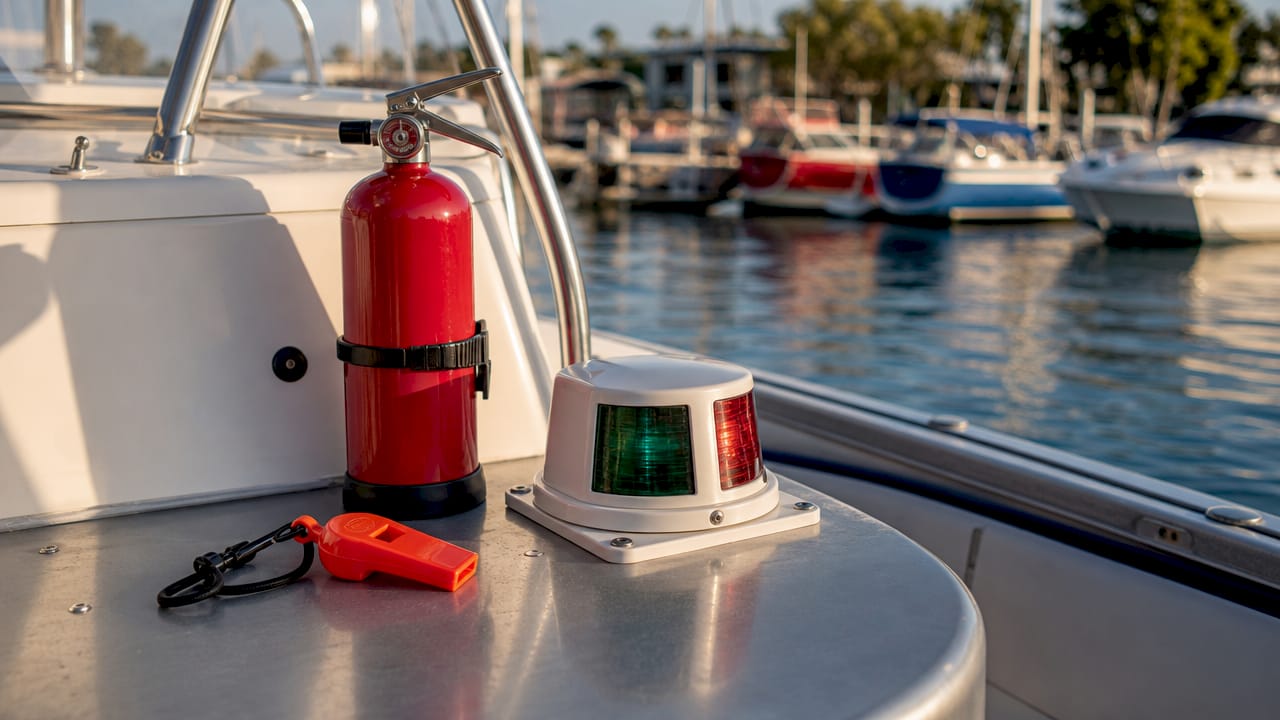
Navigation lights are mandatory between sunset and sunrise and during periods of reduced visibility such as fog or heavy rain. A powerboat underway must show a red light on the port side, a green light on the starboard side, and a white stern light. Sailboats and vessels at anchor have different configurations. Running without proper lights is one of the most common citations issued during nighttime patrols.
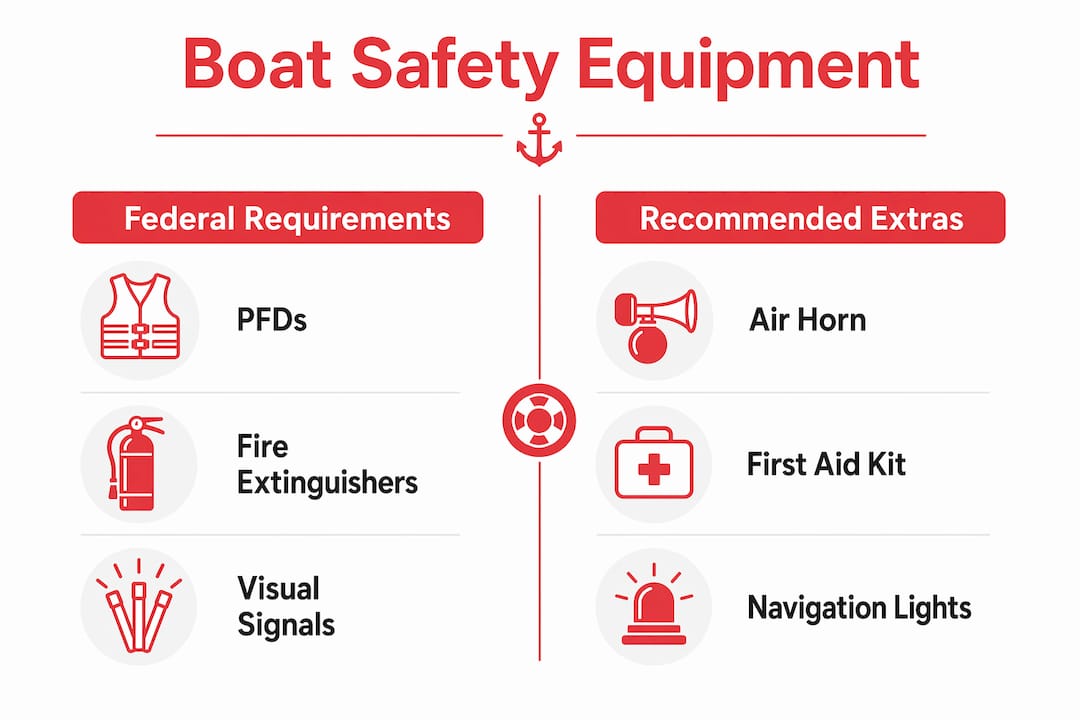
Motorboats under 65 feet require a sound-producing device capable of making audible signals for collision avoidance. In practice, this means a whistle or air horn. Vessels over 39 feet must also carry a bell. The requirement is not just about having the device. Sound signals on unpowered boats require specific 4 to 6 second prolonged blasts audible at sufficient distance to prevent collision, which means a small plastic whistle that barely carries 20 feet does not meet the standard.
Pro Tip: Buy a USCG-approved air horn with a spare canister. Compressed air canisters deplete faster than most boaters expect, especially in cold weather.
Visual distress signals
Boats 16 feet and longer operating on coastal or Great Lakes waters must carry USCG-approved visual distress signals with both day and night capability. Visual distress signals must cover both daytime and nighttime signaling needs, with non-pyrotechnic options available alongside traditional flares. Pyrotechnic flares expire and carry a printed expiration date. Carrying expired flares does not satisfy the legal requirement, though the USCG recommends keeping them as backups.
How do state laws differ from federal boat safety requirements?
Federal law sets the floor. States set their own rules on top of it, and those rules vary significantly. California, New York, Florida, and Connecticut each have requirements that go beyond the federal baseline in at least one equipment category. This matters because a boater who is federally compliant can still receive a citation from a state marine patrol officer.
Common areas where states add requirements include:
- Additional fire extinguishers for specific vessel types or older boats
- PFD requirements for children under a specified age, often requiring the device to be worn at all times while underway, not just present on the boat
- Carbon monoxide detectors on vessels with enclosed cabins or generator compartments
- Anchor and anchor line specifications for certain operating areas
- Registration and numbering rules that differ from federal vessel documentation standards
New York’s Brianna’s Law, for example, requires all recreational powerboat operators to complete an approved boating safety course regardless of age, phased in through 2025. That is a state-level education requirement layered on top of federal equipment mandates. Minnesota’s boating regulations include specific rules on state equipment compliance that differ from neighboring states, illustrating how local rules can catch out-of-state boaters off guard.
Pro Tip: Before any trip that crosses state lines or enters new waters, check the specific state’s boating authority website. The USCG’s Boating Safety Resource Center also maintains state-by-state equipment requirement summaries.
The practical takeaway: always carry gear that meets the strictest set of rules that applies to your trip. If you boat in multiple states, build your kit around the most demanding requirements you will encounter.
How do you keep safety gear accessible, maintained, and ready?
Owning the right gear is only half the requirement. The other half is keeping it functional and reachable when it matters. The most common compliance failures found during USCG and state marine patrol inspections are not missing equipment. They are equipment that is expired, inaccessible, or in poor condition.
Follow this maintenance routine to stay inspection-ready year-round:
- Inspect PFDs at the start of each season. Check for torn straps, waterlogged foam, broken buckles, and faded fabric. Inflate Type V inflatable PFDs manually to confirm the bladder holds air. Replace any device that shows structural damage.
- Check fire extinguisher pressure gauges monthly. The needle must sit in the green zone. Have extinguishers professionally inspected annually and replaced or recharged if the gauge reads low. Note the manufacture date: most portable marine extinguishers have a 12-year service life.
- Audit flares and pyrotechnic VDS before every season. Flares carry a 42-month expiration from the manufacture date. Mark the expiration date on your boating safety checklist and replace them before they expire, not after.
- Mount throwable devices where they can be grabbed in one motion. The Type IV ring buoy or cushion belongs on a bracket near the helm or stern, not in a bag below deck. Accessibility is a legal requirement, not a suggestion.
- Test navigation lights before every night departure. Carry spare bulbs or LED replacements for every light position. A burned-out stern light is a citation and a collision risk.
- Run a man-overboard drill at least once per season. Throw a fender or cushion overboard and practice the recovery sequence. Knowing where your throwable device is stored matters far less than being able to deploy it under stress.
Pro Tip: Schedule a full gear audit on the same date each spring, the day you renew your boat registration. Tying the two tasks together means you never skip the inspection.
What additional gear improves safety beyond legal requirements?
Legal compliance defines the minimum. Experienced boaters treat it as the starting point, not the finish line. The following supplemental marine safety gear addresses real-world emergencies that required equipment alone cannot resolve.
- Handheld VHF marine radio. Channel 16 is the international distress frequency monitored by the USCG and other vessels. A handheld VHF like the Standard Horizon HX210 or Uniden MHS75 floats, is waterproof, and works when your boat’s electrical system fails.
- GPS chartplotter or dedicated marine GPS. Garmin, Humminbird, and Lowrance all produce reliable units. A chartplotter shows your exact position relative to hazards, channels, and shallow water in real time.
- Emergency Position Indicating Radio Beacon (EPIRB). An EPIRB transmits your GPS coordinates to USCG rescue coordination centers via satellite. Offshore and bluewater boaters treat EPIRBs as non-negotiable. Coastal boaters increasingly carry personal locator beacons (PLBs) as a compact alternative.
- First aid kit rated for marine use. Standard kits from Adventure Medical Kits or Surviveware include wound care, trauma supplies, and seasickness medication. Waterproof packaging is mandatory.
- Anchor with adequate rode for your operating area. An anchor prevents a disabled vessel from drifting into traffic, rocks, or a lee shore. Carry at least 7:1 scope in rode length to water depth for adequate holding.
- Spare batteries and a waterproof flashlight. Electrical failures happen. A Streamlight or Pelican waterproof flashlight with fresh batteries covers navigation light failures and nighttime emergencies.
- Paddle or oar. Required by some states for small vessels, and genuinely useful when an engine fails close to shore.
Families boating with children benefit from reviewing kid-friendly boat safety practices, which address child PFD fit, supervision protocols, and age-appropriate safety briefings. Personal watercraft operators should also review PWC safety rules specific to Jet Skis and WaveRunners, since PWC equipment requirements and operating rules differ from conventional powerboats in several states.
Key takeaways
Proper boat safety equipment requires USCG-approved, serviceable gear matched to your vessel’s size, operating area, and applicable state laws, with accessibility and maintenance as critical as ownership.
| Point | Details |
|---|---|
| Federal baseline by vessel size | PFDs, fire extinguishers, VDS, sound devices, and navigation lights are all required; specifics vary by boat length. |
| Type IV throwable devices | Boats 16 feet and over must carry one, and it must be immediately accessible, not stored below deck. |
| State laws add requirements | States like New York, California, and Connecticut impose rules beyond federal minimums; verify before every trip. |
| Maintenance determines compliance | Expired flares, low extinguisher pressure, and inaccessible gear all constitute violations even if the item is present. |
| Supplemental gear closes gaps | VHF radios, EPIRBs, GPS chartplotters, and first aid kits address emergencies that required equipment alone cannot handle. |
What I’ve learned from watching boaters fail inspections
I have reviewed hundreds of boating inspection reports and sat through enough post-incident analyses to say this clearly: most equipment failures are not about ignorance. Boaters generally know they need PFDs and fire extinguishers. The failures come from complacency about condition and placement.
The throwable device is the single most misunderstood item on the required list. Boaters buy a Type IV cushion, toss it in a storage compartment, and consider the box checked. It is not checked. USCG compliance guidance is explicit: the device must be immediately accessible. In a man-overboard situation, you have seconds, not minutes, to deploy it. A cushion under a life jacket bag under a rope coil is useless.
The second pattern I see repeatedly is the expired flare problem. Boaters buy a flare kit, store it in the emergency bag, and never look at it again. Three seasons later, the flares are expired, the bag is damp, and the boat is out of compliance. The fix is a five-minute annual audit, not a new system.
My honest recommendation: treat your boating safety checklist the way a pilot treats a pre-flight checklist. Not as a formality, but as a genuine verification that every item is present, serviceable, and reachable. The USCG boat requirements exist because people have died when this gear was absent or unusable. That context makes the checklist worth taking seriously.
— Richard
Get certified and boat with confidence through Safe Boating America
Safe Boating America’s certification programs teach you exactly what required safety equipment on boats looks like in practice, not just on paper. Courses cover PFD selection, fire extinguisher use, VDS requirements, navigation rules, and emergency procedures, all taught by USCG-Licensed Captains and State Certified Instructors using NASBLA-approved materials.
Whether you need a New York boating safety certificate under Brianna’s Law, a Connecticut Safe Boating Certificate, or a state-approved course for California, Florida, Texas, or any other state, Safe Boating America offers online, Zoom, and in-person options with same-day certification available. Get your boating safety certification and go out on the water knowing your gear, your rules, and your responsibilities.
FAQ
What safety equipment is legally required on a boat?
Federal law requires one USCG-approved wearable PFD per person, a Type IV throwable device on boats 16 feet and over, at least one fire extinguisher, visual distress signals for coastal and Great Lakes operations, a sound-producing device, and navigation lights for use between sunset and sunrise.
Do all boats need visual distress signals?
Boats operating on coastal waters, the Great Lakes, and certain territorial seas must carry USCG-approved VDS with both day and night capability. Boats used only on inland waters may have different or reduced requirements depending on the state.
How often should boat safety gear be inspected?
PFDs, fire extinguishers, and flares should be inspected at the start of each boating season. Fire extinguisher gauges warrant monthly checks, and pyrotechnic flares must be replaced before their printed expiration date, typically 42 months from manufacture.
What is the difference between a Type III PFD and a Type IV device?
A Type III PFD is a wearable flotation aid designed to be worn by a person in the water. A Type IV device is a throwable ring buoy or cushion intended to be thrown to a person already in the water. Both are legally required on boats 16 feet and longer, and they serve different functions.
Do state boating laws override federal equipment requirements?
State laws supplement federal requirements rather than replace them. A boater must comply with both federal minimums and any additional state-specific rules that apply to the waters being navigated. When state rules are stricter than federal standards, the stricter rule applies.