Coast Guard Boat Requirements: What Boaters Must Know
Coast Guard boat requirements are federally mandated safety and compliance rules that every recreational vessel operator must follow on U.S. waters. These standards, enforced by the U.S. Coast Guard and developed in partnership with NASBLA (National Association of State Boating Law Administrators), cover everything from life jackets and visual distress signals to navigation rules and onboard documentation. Whether you are launching your first boat or refreshing your knowledge before the season, understanding these requirements protects your passengers and keeps you on the right side of federal law.
What safety equipment must a recreational boat carry?
Every recreational vessel must carry specific safety gear to meet coast guard requirements for boats. The U.S. Coast Guard defines minimum equipment standards by vessel length and type, and failing an inspection can result in fines, vessel detainment, or worse, a preventable fatality.
Personal Flotation Devices (PFDs)
Each person onboard must have a U.S. Coast Guard Approved wearable PFD of the appropriate size and in serviceable condition. That means no torn straps, no waterlogged foam, and no PFDs stuffed in a sealed plastic bag at the bottom of a storage locker. The law requires them to be readily accessible, meaning reachable in seconds, not minutes. Children under 13 must wear a PFD whenever the vessel is underway, with limited exceptions.
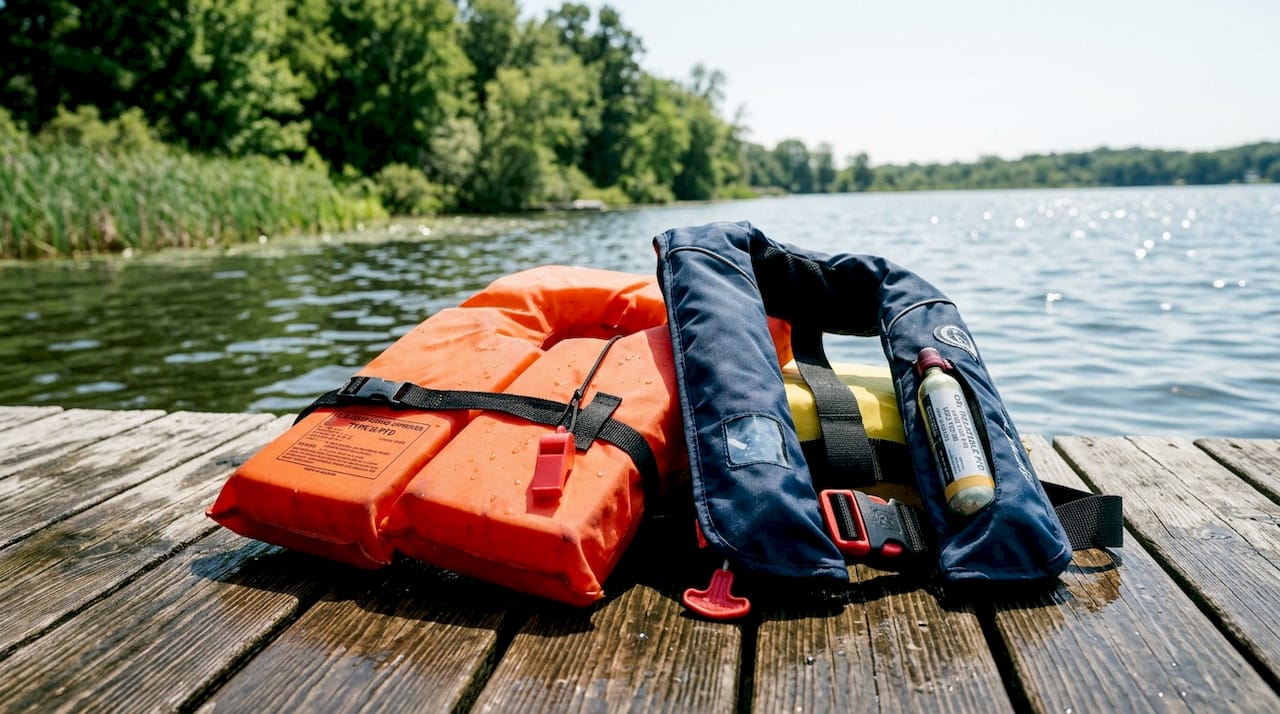
Inflatable life jackets carry an additional compliance burden. Inflatable PFDs require a fully charged cylinder and a visible green status indicator to count as approved equipment. A flat cylinder or a missing indicator renders the device non-compliant during a Coast Guard inspection, regardless of how new it looks.
Pro Tip: Inspect every PFD at the start of each season. Hold foam PFDs underwater briefly to check for water absorption. For inflatables, verify the green indicator and cylinder weight against the manufacturer’s specification.
Visual distress signals, throwables, and fire extinguishers
Required safety equipment beyond PFDs includes:
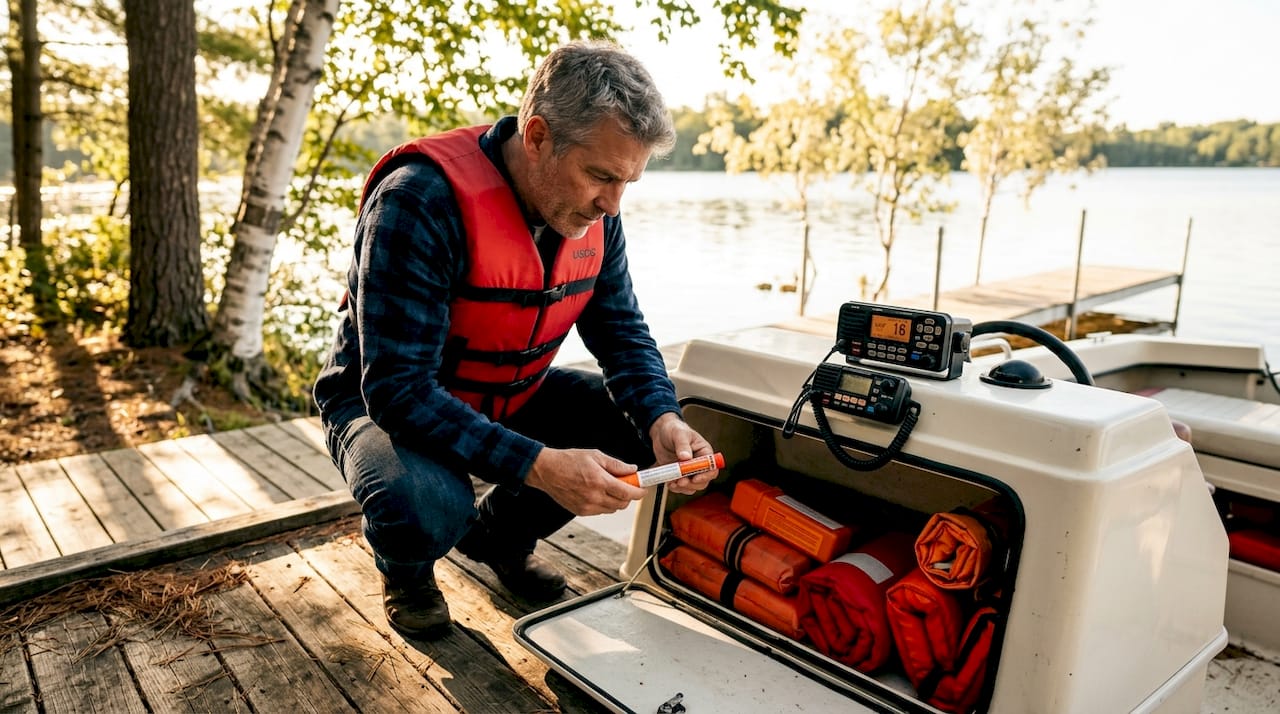
- Visual distress signals: Vessels 16 feet and longer operating on coastal waters, the Great Lakes, or territorial seas must carry both day and night signals. Acceptable options include USCG-approved flares, electric distress lights, and orange distress flags.
- Throwable flotation device: Vessels 16 feet and longer must carry at least one Type IV throwable device (a ring buoy or cushion) that is immediately accessible, not stowed under gear.
- Fire extinguishers: Motorized vessels require at least one B-I rated portable fire extinguisher. Vessels with enclosed engine compartments or built-in fuel tanks require more.
- Sound-producing devices: A whistle or horn is required on all vessels. Vessels 39.4 feet and longer must also carry a bell.
- Navigation lights: Required for operation between sunset and sunrise or in restricted visibility conditions.
What operational rules must boat operators follow?
Operational compliance under coast guard regulations goes beyond carrying the right gear. It governs how you operate the vessel, what documents you carry, and how you interact with other boats on the water.
The U.S. Coast Guard’s rules of the road, formally known as the Navigation Rules and Regulations (COLREGS for international waters, Inland Rules for U.S. inland waters), establish right-of-way, speed, and collision avoidance standards. These rules apply to every vessel, from a 14-foot aluminum fishing boat to a 60-foot cruiser.
Key operational requirements include:
- Navigation Rules book: Vessels 12 meters or longer must carry a physical copy of the Navigation Rules onboard for ready reference. Under 33 CFR 83.01(g), a digital copy on a phone or tablet may not satisfy an inspector’s requirement for a printed handbook.
- Children’s PFD wear: Federal law mandates that children under 13 wear a Coast Guard-approved PFD while the vessel is underway on federal waters.
- Reporting accidents: Operators must file a boating accident report with their state agency when an incident results in death, disappearance, injury requiring medical treatment beyond first aid, or property damage exceeding $2,000.
- Alcohol restrictions: Operating a vessel under the influence of alcohol or drugs is a federal offense. The legal blood alcohol limit is 0.08%, the same as driving a car.
Federal requirements set the floor, not the ceiling. State regulations frequently add requirements beyond federal minimums, including mandatory PFD wear for all ages, speed limits in specific zones, and boater education mandates. Always check the rules for the specific state waters you plan to operate on.
The USCG rules of the road are not optional guidelines. Violating them during a collision can expose you to criminal liability, civil suits, and loss of your vessel. A solid understanding of these rules is one of the clearest markers separating prepared boaters from unprepared ones.
How do requirements change by vessel size and commercial use?
Vessel size and intended use are the two variables that most dramatically shift your compliance obligations. Many first-time boat owners discover this only after they have already made a costly mistake.
Size-based equipment variations
Smaller vessels (under 16 feet) have lighter equipment requirements than larger ones, but the core PFD and fire extinguisher rules still apply. Vessels 26 feet and longer require additional fire extinguishers. Vessels 39.4 feet and longer trigger bell requirements and more detailed lighting configurations. The pattern is straightforward: more length means more equipment and more documentation.
Recreational vs. commercial vessel requirements
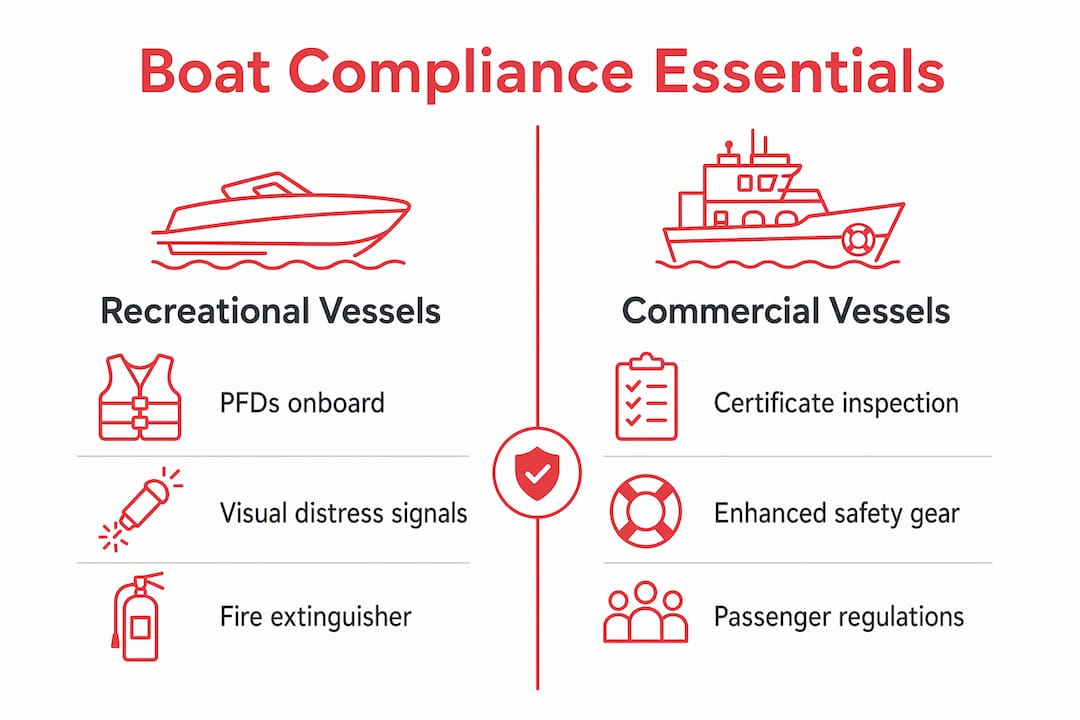
The distinction between recreational and commercial use is where many boat owners get into serious trouble. The moment you charge passengers for a ride, even informally, your vessel may be reclassified as a passenger-for-hire vessel subject to commercial Coast Guard vessel specifications.
| Requirement | Recreational vessel | Commercial/passenger-for-hire vessel |
|---|---|---|
| Certificate of Inspection | Not required | Required |
| Operator license | Not required (state education may apply) | USCG-issued captain’s license required |
| PFD standards | Type I, II, III, or V per person | Stricter type and quantity requirements |
| Safety equipment | Standard recreational minimums | Commercial-grade fire, life-saving gear |
| Annual inspections | Voluntary safety checks available | Mandatory federal inspections |
Illegal charter operations are a documented enforcement priority for the U.S. Coast Guard. In a 2026 case near Anna Maria Island, Florida, the Coast Guard stopped a vessel operating as an unlicensed charter, citing the absence of a valid Certificate of Inspection and a non-licensed operator. The consequences included vessel detainment and federal citations. This outcome is not unusual. Transitioning from recreational to commercial vessel use demands full reclassification and compliance with rigorous federal standards before a single paying passenger boards.
Pro Tip: If you plan to rent your boat through a peer-to-peer platform or take friends out for a fee, consult a maritime attorney or contact your nearest Coast Guard sector office before operating. The line between “splitting fuel costs” and “passenger-for-hire” is legally specific.
What practical steps ensure Coast Guard compliance?
Compliance is not a one-time checklist. It is an ongoing practice that requires regular attention before, during, and after every trip.
- Conduct a pre-season safety inspection. Walk through every piece of required equipment. Check PFD condition and accessibility, verify fire extinguisher charge levels, test navigation lights, and confirm your visual distress signals have not expired. A detailed boat safety inspection guide can help you structure this process systematically.
- Organize your onboard documentation. Keep your vessel registration, proof of insurance, and (if applicable) the Navigation Rules handbook in a waterproof folder stored in a consistent, known location. During a Coast Guard boarding, you need to produce these documents quickly.
- Install and test communication devices. A VHF marine radio is not federally required on recreational vessels, but it is the primary emergency communication tool on U.S. waters. Channel 16 is the international distress and calling frequency monitored by the Coast Guard at all times. Pair it with a registered EPIRB or PLB for offshore trips.
- Complete a certified boating safety course. Boating education directly reduces accident rates and ensures you understand both federal and state rules. The Coast Guard and NASBLA partnership has reduced boating fatalities by 77% since 1971, with 2024 recording 556 boating deaths, the lowest in program history. That reduction is directly tied to standardized safety education and enforcement.
- Monitor regulatory updates annually. Coast Guard regulations and state boating laws change. Check the federal boating regulations page for Connecticut, New York State Parks, and other jurisdictions you operate in to stay current.
Pro Tip: Schedule a free Vessel Safety Check through the U.S. Coast Guard Auxiliary or United States Power Squadrons. A trained examiner inspects your boat at no cost and provides a written report. Passing earns a VSC decal that signals compliance to inspectors.
Key takeaways
Meeting coast guard boat requirements demands the right equipment, proper documentation, and a clear understanding of how vessel use affects your legal obligations.
| Point | Details |
|---|---|
| PFD compliance | Every person needs a USCG-approved, accessible PFD; children under 13 must wear one underway. |
| Navigation Rules book | Vessels 12 meters or longer must carry a physical copy of the Navigation Rules handbook onboard. |
| Commercial use triggers reclassification | Charging passengers reclassifies your vessel and requires a Certificate of Inspection and a licensed captain. |
| State rules add to federal minimums | State boating laws frequently require more than federal standards; always verify local rules. |
| Education reduces fatalities | Boating safety certification directly correlates with the 77% reduction in boating deaths since 1971. |
Why compliance is more than carrying the right gear
I have spent years watching boaters treat their PFDs as cargo rather than safety equipment. The life jacket is in the locker, technically onboard, technically compliant. But PFDs stored in inaccessible places defeat the entire purpose of the requirement. In a capsize or sudden flooding situation, you have seconds, not minutes, to act.
The same logic applies to the Navigation Rules. Most recreational boaters have never read them. They know to stay right in a channel and yield to sailboats, but the full framework of stand-on and give-way vessel interactions, sound signals, and restricted visibility rules is unfamiliar territory. That gap in knowledge is where collisions happen.
What I find most telling is the data. The Coast Guard and NASBLA collaboration has driven a 77% reduction in boating fatalities since 1971. That is not an accident. It reflects what happens when education and enforcement work together consistently over decades. First-time boat owners who invest in a proper certification course before their first season are not just checking a legal box. They are joining a system that has demonstrably saved lives.
My honest recommendation: treat compliance as the starting point, not the finish line. Wear your PFD. Know the rules of the road. Understand what your vessel classification means. And take a course that covers all of it before you leave the dock.
— Richard
Get certified and meet every requirement before you launch
Safe Boating America offers state-approved boating safety certification courses that cover every element of Coast Guard compliance, from PFD requirements and visual distress signals to the USCG rules of the road and vessel documentation. Courses are taught by USCG-Licensed Captains and State Certified Instructors using NASBLA-approved materials.
Whether you need an online boating course available nationwide or a state-specific program for Florida, New York, Connecticut, or any other state, Safe Boating America delivers same-day certification options with convenient scheduling. Thousands of boaters have used these courses to get legally certified and genuinely prepared. Start your certification today and get on the water with confidence.
FAQ
What equipment is required on a recreational boat by the Coast Guard?
Every recreational vessel must carry a U.S. Coast Guard Approved PFD for each person onboard, visual distress signals (for vessels 16 feet and longer on coastal waters), at least one Type IV throwable flotation device, a fire extinguisher, a sound-producing device, and navigation lights for low-visibility operation.
Do children have to wear life jackets on a boat?
Federal law requires children under 13 to wear a USCG-approved PFD whenever a vessel is underway on federal waters, with limited exceptions. Many states extend this requirement or lower the age threshold, so check your state’s specific rules.
When does a recreational boat become a commercial vessel?
A recreational vessel is reclassified as a passenger-for-hire commercial vessel the moment you charge passengers for transportation. This triggers requirements for a Certificate of Inspection, a USCG-licensed captain, and commercial-grade safety equipment. Operating without these credentials is a federal violation.
Is a boating license required to operate a boat?
The federal government does not require a boating license for recreational operators, but most states now mandate a boating safety certificate for operators under a certain age or for all operators. Requirements vary by state, and boating education mandates are expanding nationwide.
Do I need to carry the Navigation Rules book on my boat?
Vessels 12 meters (approximately 39.4 feet) or longer must carry a physical copy of the Navigation Rules handbook onboard under 33 CFR 83.01(g). A digital version on a phone or tablet may not satisfy a Coast Guard inspector, so a printed copy is the safest approach.
Recommended
- Boat Captains: Certifications, Skills, and Duties - Safe Boating America
- USCG boating safety compliance: clear steps for safer boating - Safe Boating America
- How to Perform a Boat Safety Inspection Step by Step - Safe Boating America
- Essential boating electronics for safe and legal operation - Safe Boating America