How to Anchor a Ship: Recreational Boater’s Guide
To anchor a recreational boat safely, approach into the wind or current (whichever is stronger), reduce speed to near zero with slight sternway, lower the anchor under control, pay out the correct scope, then back down gently to set and monitor for drag. NASBLA-approved curricula, USCG guidance, and Safeboatingamerica’s state-certified instruction all reinforce this same sequence.
Before you drop the hook, have these ready:
- Anchor sized and typed for your vessel and bottom
- Chain leader plus rope rode, inspected and clear of tangles
- Adequate scope for conditions (minimum 5:1 calm, moderate in normal conditions)
- VHF radio on and engine ready for immediate maneuvering
- GPS anchor alarm set and crew roles assigned
Table of Contents
- What should you check before anchoring a ship?
- Step-by-step anchor deployment procedure
- How do you choose the right anchor, rode, and scope?
- How do you know if your anchor is dragging?
- How do you retrieve an anchor without damaging the windlass?
- Safety, legal, and courtesy rules for U.S. waters
- Common anchoring mistakes and how to avoid them
- What do state-approved boating courses teach about anchoring?
- Key Takeaways
- Why classroom instruction alone won’t make you a competent anchor handler
- Safeboatingamerica’s state-approved certification courses
- Useful sources and further reading
- FAQ
What should you check before anchoring a ship?
A 60-second pre-anchor check prevents most problems before they start.
- Seabed and swing room: Confirm bottom type via chart or depth sounder. Calculate swing radius at both high and low tide; overlap with other vessels or hazards is a no-go.
- Anchor and rode condition: Select the correct anchor for the bottom. Inspect chain links, shackles, and cotter pins. Confirm the snubber is rigged.
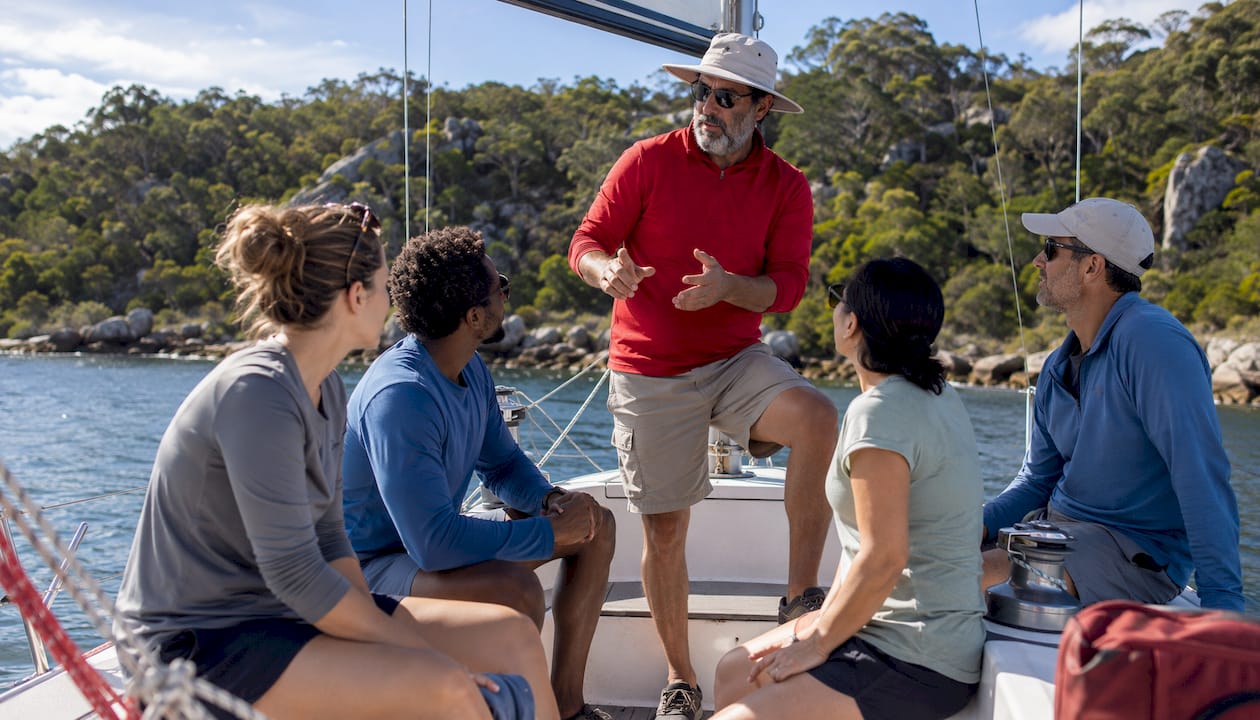
- Crew assignments: Designate a helm operator and a foredeck crew member. Agree on hand signals and verbal calls before leaving the cockpit.
- GPS and engine readiness: Set a drag circle on your GPS or chartplotter. Keep the engine in neutral and ready to engage immediately.
Pro Tip: Brief the entire crew before the approach, not during it. Communication failures between helm and anchor party cause the majority of avoidable fouls and collisions in crowded anchorages.
Step-by-step anchor deployment procedure
Follow this sequence every time, whether anchoring a 20-foot runabout or a larger cruiser.
- Approach into wind or current. Head into whichever force is stronger. This gives you control over speed and heading and prevents the rode from fouling under the hull.
- Reduce to near zero with slight sternway. A touch of reverse creates gentle backward movement. That sternway is what sets the anchor by pulling the flukes into the seabed rather than letting them pile up.
- Lower the anchor under control. Walk it out or let it run with the brake checked periodically. Never throw the anchor; a thrown anchor lands on a pile of chain and will not embed. Walking out reduces windlass stress and improves embedding, especially in deeper water.
- Pay out correct scope. Use the ratios in the gear section below. Maintain slight sternway or use the engine in reverse at low throttle while paying out rode.
- Back down to set. Once the target scope is out, apply the windlass brake and increase reverse throttle gradually. A solid “bite” registers as chain tension and a slight bow-down attitude.
- Confirm the set. Watch the chain angle: a slight catenary (sag) indicates holding. A taut, straight chain jumping under load signals dragging. Take GPS bearings to fixed landmarks.
- Post-set checks. Monitor position for 15–30 minutes after setting. Apply the chain stopper, set the anchor alarm, and plot your swing circle on the chart.
Pro Tip: After setting, apply controlled astern power for 30 seconds at normal cruising RPM. If the boat holds position and the chain stays in catenary, the anchor is properly set.
How do you choose the right anchor, rode, and scope?
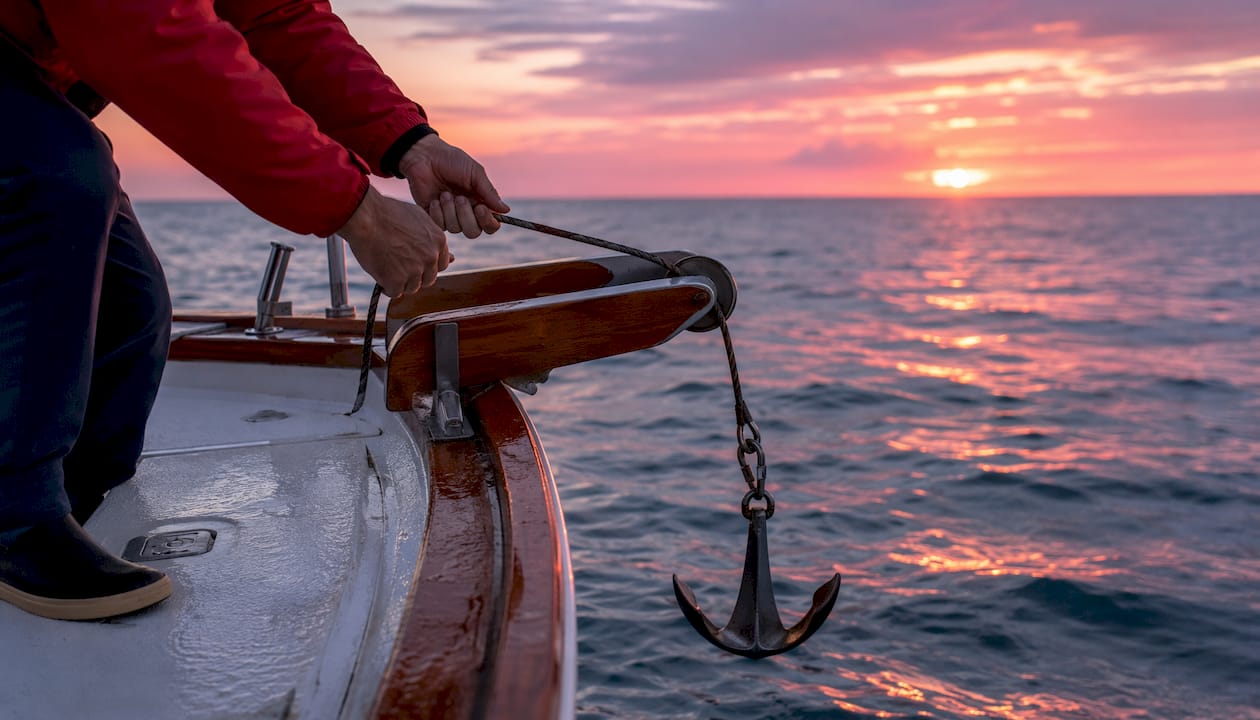
Matching anchor type to bottom type is a standard test topic in state-approved courses and a practical decision that directly prevents dragging.
Anchor families and bottom suitability:
- Fluke/plate anchors (Danforth-style): Excel in sand and mud; poor in rock or heavy weed.
- Plow anchors (CQR-style): Perform well in mixed bottoms, sand, and clay; re-set reliably after yawing.
- Claw anchors (Bruce-style): Good all-around performance in rock and weed; lower holding-to-weight ratio in soft mud.
For a deeper look at sizing these for smaller recreational boats, the small boat anchor guide covers weight and type selection by vessel length.
Rode composition: All rodes should include a chain leader. Chain resists abrasion from coral and rock, keeps the pull angle close to horizontal, and absorbs shock loads through its catenary curve. A rope-only rode loses horizontal pull and can fail quickly against an abrasive bottom.
Scope ratios — quick reference:
| Conditions | Scope Ratio | Notes |
|---|---|---|
| Calm | 5:1 | Minimum acceptable; sheltered anchorages only |
| Normal | 7:1–8:1 | Standard recreational use |
| Heavy wind/current | — | Tidal estuaries, exposed anchorages |
Scope ratios work by lowering the pull angle on the anchor. A flatter angle means more holding power and less risk of breaking out. In tidal rivers and estuaries, current reversal causes aggressive yaw; use tandem anchors in a V-configuration or a heavier single anchor with extra scope to compensate.
A 40-degree yaw can increase anchor load by a factor of three, which is why swing room and yaw control matter as much as scope ratio.
How do you know if your anchor is dragging?
Dragging is easier to catch early than to fix after the boat has moved. Watch for these indicators:
- GPS drift: Position moves outside the pre-set drag circle on your chartplotter.
- Bearing changes: Fixed landmarks or lights shift relative to your bow.
- Chain behavior: The chain goes taut and straight, vibrates, or jumps. A healthy anchor shows a slight catenary sag.
- Unexpected heading changes: The bow swings erratically without a corresponding wind shift.
Immediate actions:
- Pay out more scope if sea room permits. Additional rode often allows the anchor to re-dig.
- Motor forward slowly to reset, then back down again with increased scope.
- If re-setting fails, heave anchor and move to a better holding position.
- Head to a marina or call for assistance if fuel is low, hazards are close, or the anchor will not hold after two re-set attempts.
How do you retrieve an anchor without damaging the windlass?
Retrieval errors cause more windlass damage than any other single operation.
- Motor slowly toward the anchor while the foredeck crew heaves in the rode. Keep pace with the boat’s forward movement so the chain stays nearly vertical under the bow.
- Never use the engine to pull the boat to the anchor. Motoring forward while hauling rode is correct; using engine thrust to drag the boat to the anchor strains the windlass and risks mechanical failure.
- Use the windlass only when the chain runs vertical. Once the bow is directly over the anchor, engage the windlass to break the anchor free from the bottom.
- If the anchor is stuck: Circle slowly to change the pull angle, or reverse direction to apply tension from a different bearing. A pre-rigged trip line attached to the anchor crown is the cleanest solution for rocky bottoms.
- If permanently fouled: Cut the rode only as a last resort after all other options are exhausted. Record the position and report lost gear to the relevant authority.
Safety, legal, and courtesy rules for U.S. waters
Anchoring in U.S. waters carries specific legal obligations alongside practical safety requirements.
- Restricted areas: Never anchor in a marked channel. Use only designated anchorage areas shown on NOAA charts, and check local harbor master or port authority notices for temporary restrictions.
- Anchor lights: Any vessel anchored between sunset and sunrise must display the correct white anchor light visible 360 degrees. This is a federal requirement under USCG Navigation Rules.
- PFDs and watchkeeping: Wear PFDs when conditions deteriorate. Maintain an anchor watch, monitor VHF Channel 16, and keep the engine ready to start.
- Environmental rules: Avoid anchoring over eelgrass beds, coral, or other sensitive habitats. Many coastal areas have posted no-anchor zones; check local charts before deploying.
- Swing room courtesy: Give neighboring anchored boats enough room to swing through a full circle. The first boat anchored has priority; if you arrive later, you are responsible for avoiding it.
For a full inventory of required onboard safety gear, the boat safety equipment checklist covers USCG-mandated items by vessel class.
Anchoring is intended for temporary stays in sheltered water. It is not a substitute for seeking a marina in deteriorating conditions; planning for swing circle and under-keel clearance is a core navigation responsibility.
Common anchoring mistakes and how to avoid them
Errors instructors see most often:
- Throwing the anchor instead of lowering it under control
- Using insufficient scope, especially when conditions change overnight
- Relying on the windlass brake as the primary load-bearing component instead of the chain stopper
- Skipping the crew brief and using no agreed hand signals
Pro Tip: Fit a short chain snubber between the chain and a bow cleat. It absorbs shock loads, protects the windlass, and lets the boat lie more quietly at anchor. Inspect shackle cotter pins before every trip.
Deep-water anchoring adds another layer of risk. Windlass systems on recreational vessels are not rated for unlimited depth; attempting recovery from very deep water without proper equipment can overload the windlass motor and damage the brake. When in doubt, move to shallower holding ground.
What do state-approved boating courses teach about anchoring?
State-approved courses cover anchoring as a core seamanship topic, not an optional module.
- Anchor selection and sizing for vessel type and bottom
- Scope calculation and when to increase rode in changing conditions
- Approach, deploy, and re-set sequence with tidal and current variables
- Emergency anchor procedures, including dragging response and re-anchoring
- Communication protocols between helm and foredeck
Courses taught by State Certified Instructors and USCG-Licensed Captains using NASBLA-approved materials give learners direct feedback on timing, chain behavior, and crew coordination. That live feedback is what separates classroom knowledge from on-water competence. Safeboatingamerica’s programs cover all of these topics and satisfy state-specific legal requirements, including same-day certification options for qualifying students. For context on why certification is legally required in most states, the boating safety education overview explains state-by-state mandates.
Key Takeaways
Proper anchoring requires the right sequence, correctly sized gear, and active monitoring: approach into wind or current, lower under control, pay out adequate scope, back down to set, then watch for drag.
| Point | Details |
|---|---|
| Core sequence | Approach into wind/current, lower anchor under control, pay out scope, back down to set, monitor. |
| Scope ratios | Use 5:1 in calm, 7:1–8:1 in normal conditions, and 10:1 or more in heavy wind or current. |
| Yaw and load | A 40-degree yaw triples anchor load; swing room and yaw control are as critical as scope. |
| Retrieval rule | Motor forward while hauling rode; use the windlass only when the chain runs vertical. |
| Safeboatingamerica | State-approved courses with NASBLA materials and USCG-Licensed Captains cover anchoring, scope math, and emergency procedures. |
Why classroom instruction alone won’t make you a competent anchor handler
Reading the steps and executing them under real conditions are two different skills. Scope math is straightforward on paper; applying it at dusk in a tidal current with a crew member waiting for your signal is where most errors happen. The timing of the “let go” order, reading chain catenary in real time, and coordinating a re-anchor after a drag are all skills that require live feedback to internalize.
Pairing a state-approved course with on-water practice under a State Certified Instructor or USCG-Licensed Captain closes that gap faster than self-study alone. Safeboatingamerica offers exactly that combination, with formats that fit different schedules and state requirements.
Safeboatingamerica’s state-approved certification courses
Safeboatingamerica offers state-approved boating safety certification in every U.S. state, with course formats designed for different schedules and learning preferences: in-person classes, live Zoom sessions, and online self-paced options. Anchoring, scope calculation, emergency procedures, and seamanship are all covered using NASBLA-approved materials delivered by State Certified Instructors and USCG-Licensed Captains.
New York students can complete Brianna’s Law-compliant training and add a boating endorsement to their NYS driver’s license. Connecticut, Long Island, and nationwide students have access to the same curriculum, with same-day certification available for qualifying courses.
Register for a state-approved boating course at Safeboatingamerica and get certified with confidence.
Useful sources and further reading
The following authoritative references support the procedural and technical claims in this article. Consult your state’s official boating authority for jurisdiction-specific anchoring restrictions and licensing requirements.
- The Science of Anchoring — Nautical Institute: anchor loading, yaw effects, windlass limits, and catenary behavior.
- Anchoring Techniques and Procedures — Ships Business: standard approach and deployment sequence.
- How to Anchor a Boat Safely in Different Water Conditions — US Nautics: scope ratios, tidal current techniques, and post-set monitoring.
- Anchoring Procedures for Large Vessels — BulkersGuide: site selection, execution, and monitoring protocols.
- Anchoring Procedures: A Seafarer’s Guide — The Seafarer: bridge-to-deck communications and crew briefing standards.
- Anchoring Techniques — Active Boater — BoatTest: retrieval best practices and windlass protection.
- Anchor — Wikipedia: anchor types, rode composition, and scope fundamentals.
- NASBLA and USCG: consult official state boating pages for jurisdiction-specific anchoring restrictions, lighting requirements, and certification mandates.
FAQ
What is the correct scope ratio for anchoring a recreational boat?
Use a 5:1 scope in calm conditions, 7:1–8:1 in normal conditions, and 10:1 or more in heavy wind or current. A larger scope lowers the pull angle on the anchor and increases holding power.
How do you set an anchor properly?
Lower the anchor under control at near-zero speed with slight sternway, pay out the correct scope, then apply reverse throttle gradually until the chain holds in catenary and the boat stops moving astern.
What are the signs that an anchor is dragging?
GPS position moves outside the drag circle, bearings to fixed landmarks shift, the chain goes taut and straight or vibrates, or the bow swings erratically without a wind shift.
Do U.S. boating safety courses cover anchoring procedures?
Yes. State-approved courses using NASBLA-approved materials cover anchor selection, scope calculation, approach and deployment, tidal anchoring, and emergency procedures. Safeboatingamerica’s courses include this content and satisfy state certification requirements.
Can you anchor anywhere in U.S. waters?
No. Anchoring in marked channels is prohibited under USCG Navigation Rules. Many harbors and coastal areas have designated anchorage zones and no-anchor areas for environmental protection; check current NOAA charts and local harbor master notices before deploying.