Boat Capacity Plate: What It Says and Where to Find It

A boat capacity plate is the label that states the most people, the most total weight and the most engine horsepower a boat is rated to carry. Federal rules require it on most monohull boats under 20 feet. It must be permanently fixed where the operator can see it from the helm. Treat the numbers as a ceiling for fair weather, not a target.
This guide covers which boats need a plate, how to read each line, how to count load, what to do when the plate is missing, and how capacity applies to larger boats and personal watercraft.
TL;DR
- Federal rules require a capacity plate on monohull boats under 20 feet, except sailboats, canoes, kayaks and inflatable boats.
- The plate shows maximum persons, maximum weight capacity (persons, gear and motor) and maximum horsepower, or a statement that the boat is not rated for a motor.
- When a plate lists both a person count and a weight, you reach the limit when either one is reached.
- The plate must be permanently affixed and clearly visible from the helm. If it is missing, start with the manufacturer and your state boating agency.
- Rough water, wind, cold and inexperienced passengers all justify a load below the plate figure.
Table of Contents
- Which boats are required to have a capacity plate
- How to read a boat capacity plate
- Where the plate has to be
- How to count your load against the limit
- Conditions that lower your safe load
- If the capacity plate is missing, damaged or unreadable
- Personal watercraft: Jet Skis and WaveRunners
- What about the boat’s own weight?
- Our perspective
- Get certified and load your boat correctly
- FAQ
- Sources
Which boats are required to have a capacity plate
The federal requirement sits in 33 CFR Part 183. Under Subpart B, section 183.21, it applies to monohull boats less than 20 feet in length. Sailboats, canoes, kayaks and inflatable boats are excepted.
The USCG Auxiliary National Help Desk adds the date: the rule traces to the Federal Boat Safety Act of 1971 and covers boats built after October 31, 1972. Discover Boating reports that the regulation took effect on August 1, 1973.
Quick reference
| Boat type | Federal capacity plate required? |
|---|---|
| Monohull powerboat under 20 ft | Yes |
| Monohull open fishing or runabout boat under 20 ft with an outboard | Yes |
| Sailboat | No |
| Canoe or kayak | No |
| Inflatable boat | No |
| Monohull 20 ft or longer | Not under the federal rule |
State rules add to the federal rule
Many states write the capacity plate into their own boating law. Ohio’s Revised Code Section 1547.39 bars the sale of covered watercraft under 20 feet that are designed to carry two or more persons unless a plate is firmly attached. It also prohibits operating such a watercraft without the plate attached. Wisconsin’s statute 30.51 similarly calls for a permanently affixed plate showing weight, recommended persons and maximum horsepower.
Overloading is a state matter in practice. The USCG Auxiliary notes that federal regulations do not prohibit an operator from exceeding the capacities, while state law may. Arkansas, for example, defines overloading or overpowering as loading or powering a vessel beyond the capacity or horsepower shown on the manufacturer’s plate. The same handbook states it is also illegal to load a vessel without a plate in a way that is unsafe or that results in sinking or capsizing.
Check your own state’s boating law for the exact wording. Our guide to Coast Guard boat requirements lists the other equipment and labeling rules that apply alongside the plate.
Boats the plate rule does not cover
Boats 20 feet and longer do not need a federal plate, but many carry one anyway. Grady-White states that it follows NMMA and ABYC standards by installing plates on boats smaller than 26 feet. It also states that boats of 26 feet and over are considered Yacht Certified, and the captain decides the number of passengers. On those larger boats, its rule of thumb is to host only as many guests as you have dedicated seats for.
How to read a boat capacity plate
Section 183.23 of the federal regulation sets what the marking must show. There are three numbers, plus the label wording.
Maximum persons capacity
The plate gives the number of persons in whole numbers, with the weight in pounds. J.D. Power explains that the notation refers to full-size adults. In most cases manufacturers assume an average adult weight of 150 pounds per person.
Example: a plate that reads “7 persons or 1,050 lbs” uses that 150-pound assumption (7 x 150 = 1,050).
Maximum weight capacity
This is the total load in pounds. It covers more than people. J.D. Power states that the maximum gross load includes the weight of all passengers plus equipment, fuel, supplies and other goods aboard. Rhode Island’s boating course material likewise says maximum weight includes passengers, gear and motors.
Maximum horsepower
The plate shows the largest engine rating the hull is rated for. Where a boat is not meant to carry a motor, the plate carries the statement “This Boat Not Rated for Propulsion by a Motor.” The Rhode Island material instructs outboard operators never to exceed the horsepower rating on the plate.
The label wording
Discover Boating notes that boats under 20 feet carry plates labeled “U.S. Coast Guard Maximum Capacities,” while boats up to 26 feet carry the “Maximum Capacities” wording alone. Either way, the content is the same three limits.
Where the plate has to be
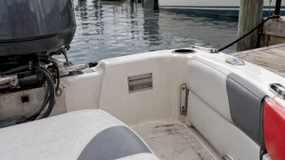
The rule on placement is specific. Section 183.25 requires the marking to be permanently displayed, legible, and clearly visible to the operator when getting the boat underway. The Coast Guard’s Boating Safety Circular 68 explains that clearly visible means the operator does not need to get down on hands and knees to see the label. For manually propelled or outboard-powered boats without remote starting or controls, it should be on or near the inside of the transom, readily visible to the seated operator.

The 2020 USCG Safety Circular names common mistakes. The label should not be hidden in storage, on the side of a center console, under seat cushions, or behind canopy poles or T-top supports. The operator should not have to look behind, below or around other objects to read it from the helm.
Check these points on your boat:
- The plate is readable from the helm without moving anything.
- Nothing you added later covers it: a cushion, a bimini frame, a seat box.
- The text is intact and not faded or scraped.
- The figures are the same as those in the owner’s manual.
Section 183.27 requires the marking to withstand water, oil, salt spray, sunlight, heat, cold and wear without losing legibility, and to resist removal or alteration without an obvious sign. A plate that peels or fades is a problem to fix, not cosmetic wear.
How to count your load against the limit
The plate is only useful if you add up the real load. Most overloading happens because the headcount looks fine and the weight is ignored.
What counts
- Every person aboard, children included. Boatncrew points out that children still count as persons even when they weigh less than adults.
- Fuel and fresh water.
- Coolers, food and drinks.
- Safety equipment, anchors and lines.
- Fishing and diving gear.
- Water toys, tenders and portable equipment.
- The motor and any batteries, when the plate’s weight figure includes them. The owner’s manual clarifies what your plate includes.
Grady-White warns that it is easy to focus on headcounts and forget that heavy coolers, extra fuel, water toys and fishing gear all count against the weight limit.
Both limits apply
When a plate lists a person count and a weight, you reach the limit when either is reached. Seven people at 220 pounds each is 1,540 pounds, far above a 1,050-pound rating, even though the headcount matches the plate.
Worked example
A 17-foot boat is rated “6 persons or 900 lbs, 1,100 lbs persons, motor and gear.” A day on the water:
| Item | Weight |
|---|---|
| 4 adults (average 180 lbs) | 720 lbs |
| 2 children (average 70 lbs) | 140 lbs |
| Two coolers with ice and drinks | 120 lbs |
| Fishing and safety gear | 60 lbs |
| Total | 1,040 lbs |
The headcount is 6, within the person limit. The total is under the 1,100-pound figure, but the persons alone (860 lbs) leave little margin for a rough afternoon. This is a boat that should carry fewer people when conditions turn. Use your plate’s own wording; the layout varies by manufacturer.
Boats without a plate
A boat under 20 feet without a plate still has a safe limit. The Rhode Island course material gives a calculation for such vessels: length in feet times width in feet, divided by 15, gives the number of people. Applied to a 16-foot boat that is 6 feet wide, that is 96 divided by 15, or about 6 people. Ask your state agency whether it recognizes this formula, since states differ.
Conditions that lower your safe load
The plate number assumes good weather. Boatncrew states that a listed capacity is an upper limit, not a goal. The safe load is lower with:
- rough water or strong wind
- limited visibility or cold weather
- strong current or long distance from shelter
- inexperienced passengers
- significant fuel or equipment aboard
- weight carried high in the boat
- any mechanical, structural or stability concern
Boatncrew’s Captain Ben Haddadnia explains that exceeding the limits can reduce stability and freeboard, affect steering and performance, and raise the risk of swamping or capsizing. The Coast Guard circular describes the label and standards as guidance for an often inexperienced operator who does not know a particular boat. Passenger limits are never separate from the conditions.
To reduce swamping and capsizing risk, see our capsizing and swamping safety checklist. Weight placement matters as much as total weight: keep heavy items low and near the centerline, and have passengers stay seated while underway.
If the capacity plate is missing, damaged or unreadable
A plate that is gone or illegible is a compliance gap, and in some states a sale problem. Work through these steps.
- Find the hull identification number (HIN). It is on the starboard side of the transom. See our boat registration numbers guide for how registration and identification numbers differ.
- Contact the manufacturer. The USCG Auxiliary advises going back to the maker to see whether it can supply a replacement plaque.
- If the maker is gone, contact your state boating agency. Your State Boating Law Administrator has the final say on what is acceptable.
- Use a similar vessel as a reference. The Auxiliary says that if you can find a similar vessel, you can copy its information onto a 3x5 card, laminate it and secure it inside the boat. Treat this as a stopgap and confirm with your state first.
- Mount it correctly. Once you have a replacement, place it where the operator can see it from the helm.
Wisconsin’s statute is an example of how states handle this: a vessel without a conforming plate may have one affixed by another person under department rules, but that does not relieve the manufacturer of liability.
Do not fabricate a plate or copy figures from a different hull class. A made-up number gives false assurance and will not hold up with a marine patrol officer.
Personal watercraft: Jet Skis and WaveRunners
Personal watercraft are not the typical capacity-plate boat, since the rules for monohull boats under 20 feet were written around conventional hulls. The manufacturer still sets seating and load limits for each model. Look for the capacity information on the craft’s labels and in the owner’s manual, and never carry more riders than the craft has seating positions for. Rental operators usually state a rider limit too.
Riders on a PWC must also meet state education and age rules. See our guide to boating license age and PWC rules for the typical ranges.
What about the boat’s own weight?
The capacity figure and the boat’s weight are different numbers. The plate’s weight limit describes the load the boat can carry: people, gear, fuel and in many cases the motor. It does not include the hull’s own weight. Boat weight varies widely with length, hull type and engine, and the owner’s manual or the builder’s specification sheet gives your exact figure. When you tow a boat, the trailer rating is a separate limit with its own label.
For small powerboats, our USCG rules for 14-foot powerboats shows how size and equipment requirements work together.
Our perspective
We teach boat operators every week, and the capacity plate is the item most people have never read. Owners know their engine and their fuel burn. Many cannot say how many people their boat is rated for.
Our position is simple: read the plate before the first trip of the season, and read it again whenever the boat is loaded differently. The figure is a limit under good conditions, and the operator decides what is safe on the day.
This is why our courses cover loading, stability and the legal duties of the operator alongside navigation. State-approved instruction taught by State Certified Instructors and USCG-Licensed Captains gives a new owner the habits that prevent overloading, not just the certificate. We also offer on-water training and local boating knowledge for operators who want to practice with their own boat.
If you are new to boat ownership, take the course first, then load the boat.
Richard
Get certified and load your boat correctly
A capacity plate tells you what the boat can carry. A boating safety course tells you how to operate it within those limits and within your state’s law. Safe Boating America offers state-approved courses online, by live Zoom class and in person.
- Online boating safety courses for operators in states across the country, including Ohio and Oregon.
- The Zoom Online 1-Day Class at $75.
- The NYS Safe Boating Class at $85.
- A private Connecticut boating course for Connecticut boaters.
A course also makes a practical gift for a new boat owner: see our gift certificates, listed at $75 to $85.
For an overview of what the law expects of every operator, read what every U.S. boater must know.
FAQ
What boats need a capacity plate?
Federal rules require one on monohull boats under 20 feet. Sailboats, canoes, kayaks and inflatable boats are excepted. The USCG Auxiliary says the rule applies to boats built after October 31, 1972. Some states add their own plate requirements, so check your state’s law.
How many people can my boat carry?
Read the maximum persons figure on your capacity plate, then check the weight figure too. You reach the limit when either the person count or the total weight is reached. Children count as persons. Lower the load in rough water, wind or cold.
Is it illegal to exceed the capacity plate?
The USCG Auxiliary says federal regulations do not prohibit an operator from exceeding the capacities, but state law may. Arkansas, for example, makes overloading beyond the plate figures illegal. Check your state’s rules, and treat the plate figures as a hard limit either way.
Where should the capacity plate be mounted?
It must be permanently fixed where the operator can clearly see it when getting underway. On many small outboard boats that is the inside of the transom. It should not be hidden behind cushions, canopy poles or a console side.
What should I do if my capacity plate is missing?
Record your hull identification number and contact the manufacturer for a replacement. If the maker no longer exists, ask your state boating agency what it accepts. Do not guess the figures.
Sources
- eCFR: 33 CFR Part 183 Subpart B, Display of Capacity Information
- USCG Boating Safety Circular, Spring 2020
- USCG Boating Safety Circular 68
- USCG Auxiliary: Capacity Plate Requirement On Boats
- Ohio Revised Code Section 1547.39
- Wisconsin Statutes 30.51
- Arkansas Boating Laws and Responsibilities, 2024 Edition
- Rhode Island DEM Safe Boating course
- Discover Boating: All about Capacity Plates
- J.D. Power: Load Limits and Capacity Plates
- Grady-White: Know Your Boat’s Capacity Limits
- Boatncrew: Boat Capacity Plates Explained