
Boat Registration Numbers: U.S. Legal Requirements Guide

What are boat registration numbers and why do they matter?
Boat registration numbers are state-issued alphanumeric identifiers required on virtually every motorized vessel operating on U.S. public waterways. Under 33 CFR 173, these numbers must be displayed in a specific format on both sides of the forward hull before any legal operation begins. They function as the primary identification tool for search and rescue operations, theft prevention, and law enforcement boarding checks.
Key facts every boater needs to know:
- Registration numbers are unique to each vessel and issued by the state of principal operation.
- The number stays with the boat for its lifetime in many states. In Ohio, for example, the OH number assigned at first registration remains with that hull regardless of how many times ownership changes.
- All motorized vessels, including personal watercraft (PWC) like Jet Skis, must display registration numbers before operating on public water.
- The certificate of number must be carried onboard in hard copy or digital form at all times.
- Numbers must be updated with the issuing authority within 15 days of any ownership transfer, address change, or vessel destruction.
Table of Contents
- How to display boat registration numbers correctly
- State registration rules, timelines, and grace periods
- USCG-documented vessels vs. state registration: what’s different?
- How boating safety education supports registration compliance
- How to obtain your boat registration numbers
- Penalties for improper or missing boat registration numbers
- Registration requirements by boat type
- Key Takeaways
- FAQ
How to display boat registration numbers correctly
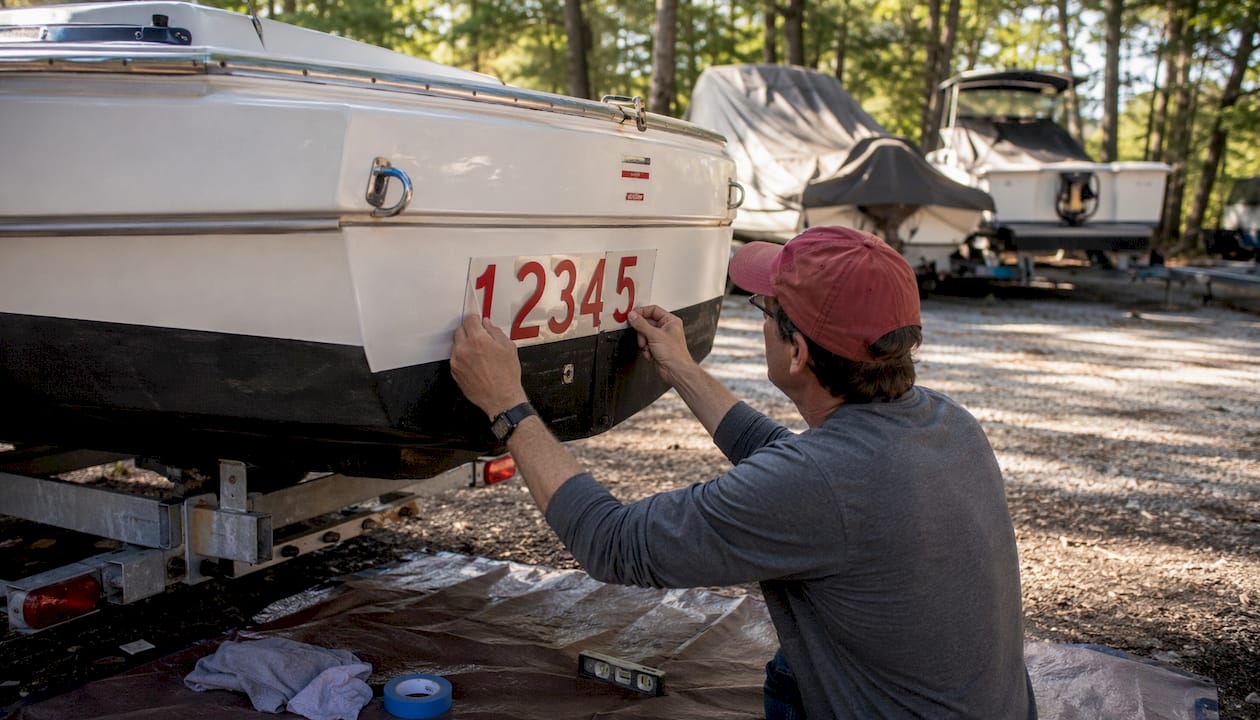
Federal regulation 33 CFR 173.27 sets the baseline display standard that all states follow, and most states add their own specifics on top of it. Getting the display wrong is one of the most common reasons boaters receive citations on the water.
Display requirements at a glance:
- Placement: Forward half of the hull, both port and starboard sides.
- Size: Block letters at least 3 inches tall, vertical orientation.
- Color: Must contrast with the hull background — dark letters on a light hull, or light letters on a dark hull.
- Spacing: Hyphens or spaces equal to the width of a standard letter between letter and number groupings.
- Validation stickers: Must be placed within 6 inches of the registration number, typically aft of the number on both sides.
- No competing markings: No other numerals or letters may appear near the registration number on the bow.
Common mistakes that lead to citations include using decorative fonts, placing numbers too far aft, failing to display numbers on both sides, and letting validation stickers expire without replacement.
State registration rules, timelines, and grace periods
Every state sets its own registration fees, renewal cycles, and grace periods, though all must meet the federal floor established by 33 CFR 173. Most states issue registrations for two or three years. New York, for instance, issues boat registrations for three-year terms, with fees that vary depending on the length of the vessel.
Key state-level rules to understand:
- Grace periods: Most states allow 15 to 60 days to register a boat moved from another state before fines apply. Verify your specific state’s window immediately upon relocating.
- Texas transfers: In Texas, owners must transfer registration within 90 days and pay applicable use tax within 45 working days of bringing a vessel from another state.
- Mandatory registration before operation: No state permits operation on public water with an expired or out-of-state registration beyond the grace period.
- Renewal timing: Hawaii and Texas both allow renewal up to 90 days before expiration, giving owners flexibility to avoid lapses.
- Ownership transfers: Federal regulation requires notification to the issuing authority within 15 days of any transfer of interest in the vessel.
Pro Tip: When you move to a new state, contact the state marine division on day one. Grace periods sound generous, but they run from the date you establish residency, not the date you first launch the boat.
USCG-documented vessels vs. state registration: what’s different?
USCG documentation is a federal system that applies primarily to vessels over five net tons used in commercial trade or coastwise operations, though recreational owners sometimes choose it for financing or international travel purposes. The distinction matters because USCG-documented vessels do not display state registration numbers on the bow.
What applies to documented vessels instead:
- The vessel’s name and hailing port must appear on the stern in clearly visible lettering.
- Federal documentation papers must be carried onboard at all times.
- Most states still require documented vessels to obtain state registration stickers. In New York, USCG-documented boats receive state registration stickers only, placed 18 inches from the bow on both sides where numbers would normally appear.
- Texas requires USCG-documented vessels to renew state registration in person or by mail, since online renewal requires showing current documentation.
- Ohio requires documented vessels operating in-state to display one validation tag on each side.
The most common misconception: USCG documentation does not replace state registration. It replaces the state-issued hull number on the bow, but the state’s decal and fee requirements still apply in most jurisdictions.
How boating safety education supports registration compliance
Understanding registration rules is one component of broader boating law knowledge that certified instructors cover in structured safety courses. Safeboatingamerica is a nationally recognized leader in this space, offering NASBLA-approved courses taught by State Certified Instructors and USCG-Licensed Captains across every U.S. state.
Course content directly relevant to registration compliance includes:
- Display standards for registration numbers and validation stickers.
- State-specific boating laws and documentation requirements.
- Responsibilities after ownership transfer or vessel changes.
- Legal operation requirements for PWC and motorboats.
- Emergency procedures and search-and-rescue identification protocols.
Training is available online, via live Zoom sessions, and in person, making it accessible regardless of location. Completing a state-approved boating course helps boaters avoid the citations that most commonly result from display errors and registration lapses.
Pro Tip: Many states now require boating safety certification for operators under a certain age. Completing a NASBLA-approved course satisfies that requirement and gives you a working knowledge of registration rules that most boaters learn only after their first citation.
How to obtain your boat registration numbers
The application process follows a consistent structure across states, though the specific forms and fees vary.
- Determine your state of principal operation. Registration goes through the state where the vessel is used most, not necessarily where the owner lives.
- Gather proof of ownership. New vessels require a Manufacturer’s Statement of Origin. Used vessels require a properly endorsed title or out-of-state registration documents.
- Submit the application. Most states accept applications online, by mail, or in person at a marine division office or county tax office. Texas uses Form PWD 143 for new registrations, transfers, and renewals.
- Pay the applicable fee. Fees are calculated by vessel length in most states.
- Display the number before operating. Once issued, the number must be affixed and the certificate carried onboard before the vessel touches public water.
For vessels already registered in another state, the process adds a title transfer step and, in states like Texas, a use tax payment. Hawaii requires proof of ownership before any number is assigned, and DOBOR staff will work with owners when standard documents are unavailable.
Penalties for improper or missing boat registration numbers
Operating without valid registration numbers or displaying them incorrectly carries real financial and legal consequences. Fines range from $25 to $500 depending on the state and the nature of the violation, and some states authorize vessel impoundment for repeated or egregious violations.
Specific violations that draw enforcement attention:
- Numbers not displayed on both sides of the forward hull.
- Characters below the 3-inch minimum height.
- Expired or missing validation stickers.
- Numbers obscured by equipment, canvas covers, or fading paint.
- Operating with another state’s registration beyond the grace period.
Beyond fines, an impounded vessel creates logistical and financial problems that far exceed the cost of a timely registration renewal. Law enforcement officers on the water can identify expired decals from a distance because most states change decal colors annually.
Registration requirements by boat type
Not every vessel follows the same rules. The boat registration process and display standards differ based on vessel category.
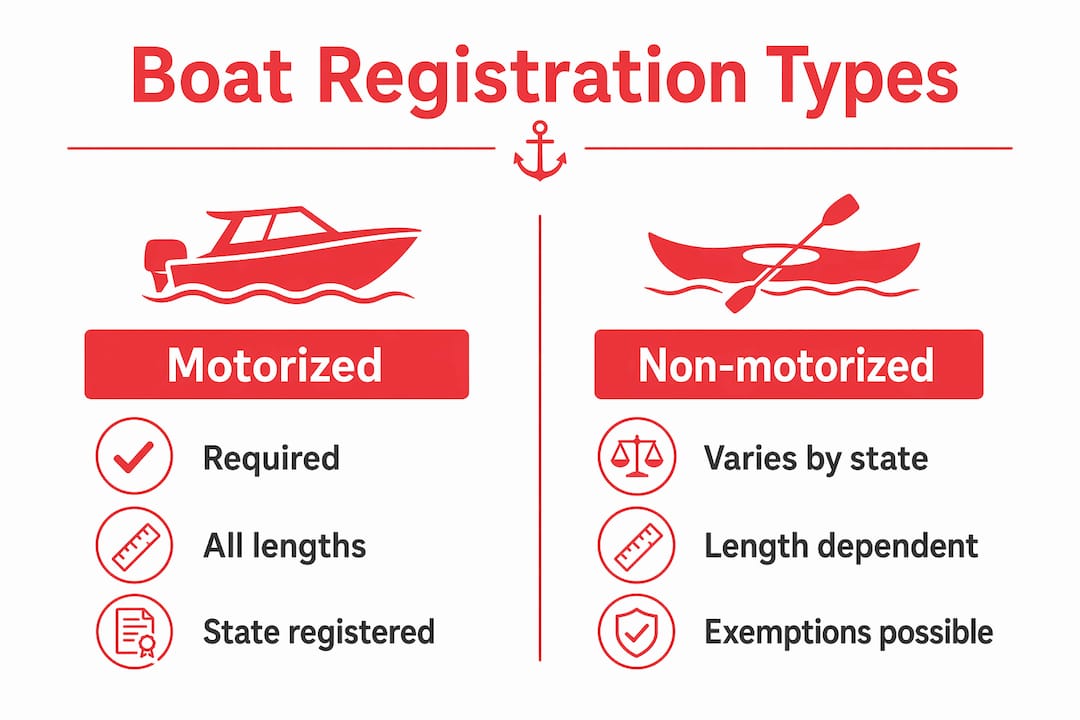
Recreational motorboats: All motorized recreational vessels, regardless of length, require state registration and must display numbers per 33 CFR 173.27. This includes trolling-motor-powered fishing boats.
Personal watercraft (PWC): Jet Skis, WaveRunners, and similar craft carry identical display requirements to motorboats. The 3-inch block letter standard applies, and validation stickers must appear within 6 inches of the number on both sides. This detail catches many PWC owners off guard.
Non-motorized vessels: Requirements vary by state and vessel length. Texas exempts non-motorized canoes, kayaks, and rowboats. Massachusetts requires registration for any boat operated on a public waterway, including motorized canoes and sailboats with motors.
Commercial vessels: Commercial vessels over a certain tonnage typically fall under USCG documentation rather than state registration, removing the bow-number requirement but adding federal documentation obligations.
Sailboats with auxiliary engines: Treated as motorized vessels in most states, including Texas, and subject to full registration and display requirements.
Tenders: A vessel under 10 horsepower used solely as a tender for a numbered vessel may display the parent vessel’s number followed by the suffix “1,” per 33 CFR 173.13.
Key Takeaways
Boat registration numbers are federally regulated identifiers that must be displayed in block letters at least 3 inches tall on both sides of the forward hull, with validation stickers placed within 6 inches of the number.
| Point | Details |
|---|---|
| Federal display standard | 33 CFR 173.27 requires 3-inch block letters, contrasting color, forward hull placement on both sides. |
| Validation sticker placement | Stickers must be within 6 inches of the registration number on each side of the vessel. |
| State grace periods | Most states allow a grace period of weeks to a couple of months to register a boat moved from another state before fines apply. |
| USCG documentation distinction | Documented vessels skip the bow number but still need state decals and must carry federal papers onboard. |
| Penalties for violations | Fines range from $25 to $500, with possible vessel impoundment for serious or repeated violations. |
FAQ
What do boat registration numbers look like?
Registration numbers consist of a two-letter state prefix, numerals, and a two-letter suffix, separated by hyphens or spaces — for example, TX 5678 EF. They must appear in plain vertical block characters at least 3 inches tall.
Do personal watercraft need registration numbers?
Yes. PWC like Jet Skis carry the same registration number display requirements as motorboats, including the 3-inch minimum height and placement on the forward hull on both sides.
How long does boat registration last?
Registration duration varies by state. New York issues three-year registrations; Hawaii issues one-year registrations renewable up to 90 days before expiration. Check your state’s marine division for the exact term.
Does USCG documentation replace state registration?
No. USCG documentation replaces the state-issued bow number, but most states still require documented vessels to obtain and display state validation stickers and pay registration fees.
What happens if you operate with expired registration numbers?
Fines range from $25 to $500 depending on the state, and repeated violations can result in vessel impoundment. Expired validation stickers are visible to enforcement officers from a distance because decal colors change annually.
Recommended
- Boat Requirements: What Every U.S. Boater Must Know - Safe Boating America
- Boat Lighting Requirements: 2026 Compliance Guide - Safe Boating America
- USCG Rules for 14-Foot Powerboats: 2026 Guide - Safe Boating America
- 50-State Boating License & Jet Ski Certification Guide (2026) - Safe Boating America