
USCG Rules for 14-Foot Powerboats: 2026 Guide

USCG regulations require that a 14-foot powerboat carry navigation lights, personal flotation devices (PFDs), a sound-producing device, and an engine cut-off switch (ECOS) lanyard when operating on navigable U.S. waters. These are federal minimums under Title 33 of the Code of Federal Regulations, and they apply regardless of where you launch. A 14-foot vessel falls into the USCG’s Class A category, which covers recreational boats under 16 feet. That classification shapes which equipment rules apply and which exemptions exist.
What safety equipment must a 14-foot powerboat carry?
Federal powerboat safety requirements for Class A vessels are specific and non-negotiable. The USCG divides required gear into several categories, and missing any one item can result in a citation during a boarding inspection.
Personal flotation devices
Every person aboard requires one wearable, USCG-approved PFD. The PFD must be the correct size for the wearer and in serviceable condition. Faded straps, broken buckles, or waterlogged foam disqualify a PFD from compliance. A throwable Type IV PFD is not required for vessels under 16 feet, which is one of the few equipment breaks Class A boats receive.
Navigation lights
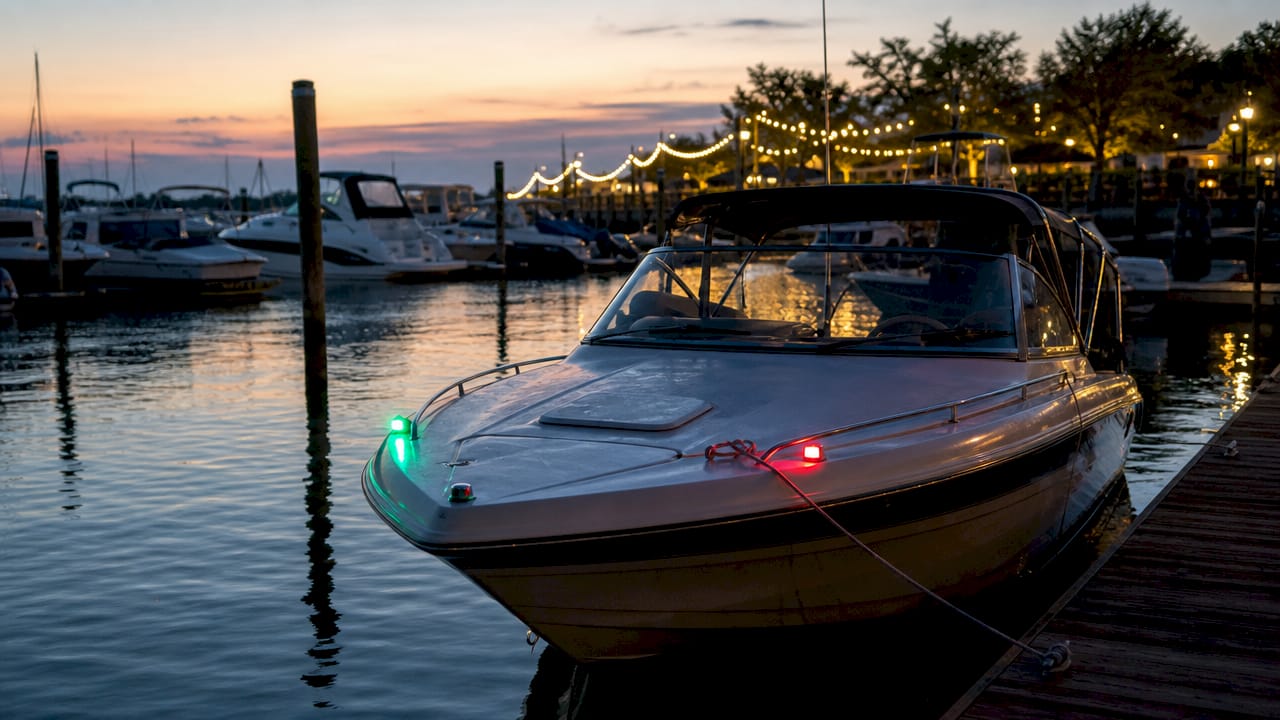
Navigation lights are legally required between sunset and sunrise on all vessels, including 14-foot powerboats. Red and green sidelights must each be visible through 112.5 degrees, and a white stern light must be visible through 135 degrees. These angles align with the International Regulations for Preventing Collisions at Sea, known as COLREGS.
Sound-producing devices
A sound-producing device is required on all recreational vessels. For a 14-foot powerboat, a whistle or horn that can be heard at a reasonable distance satisfies this requirement. The device must be operable and accessible to the operator.
Visual distress signals
Visual distress signals are required for nighttime operation on coastal waters. USCG-approved flares are the most common option. They must be current and unexpired to count toward compliance.
Fire extinguishers
Fire extinguisher requirements apply when a 14-foot boat has an enclosed engine compartment or a permanently installed fuel tank. In those cases, at least one 5-B rated extinguisher is required. Many owners assume their small boat is exempt, but the trigger is the boat’s construction, not its size.
Engine cut-off switch
The ECOS lanyard rule has been federal law since april 1, 2021. Operators must wear the ECOS lanyard when the vessel is on plane or above displacement speed. Having the switch installed is not enough. Boarding officers check that the lanyard is physically attached to the operator.
Pro Tip: Before every outing, run a five-point check: PFDs, lights, horn, flares, and ECOS lanyard. It takes under two minutes and covers the most common citation triggers.
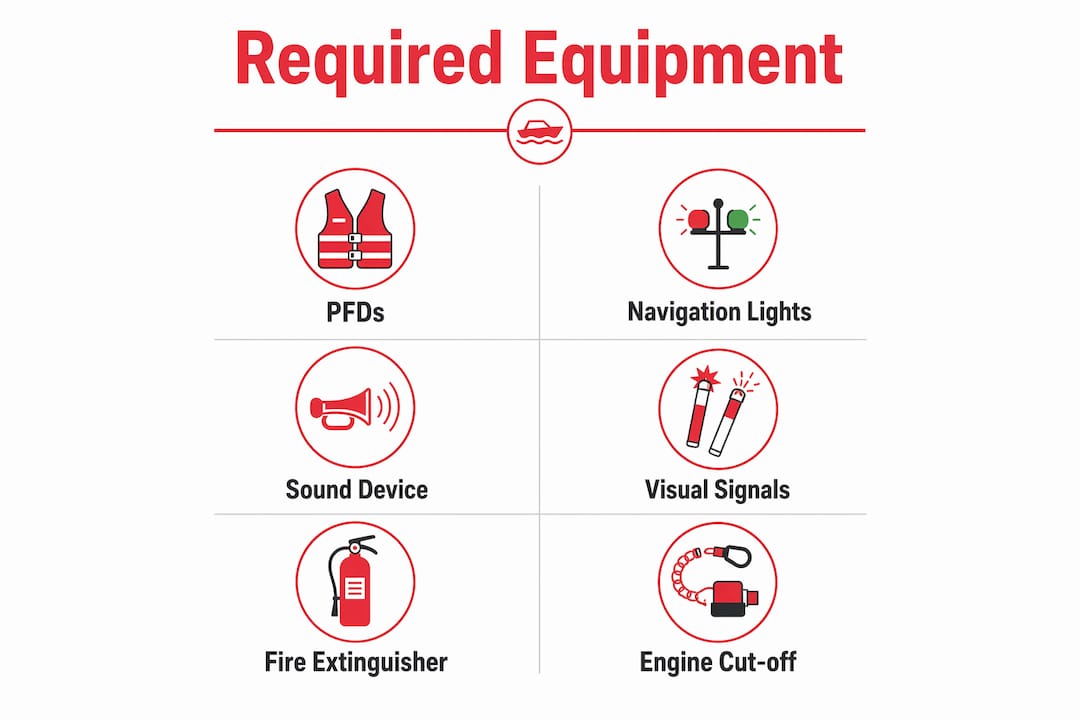
Here is a quick reference for required gear by category:
- PFDs: One wearable, USCG-approved device per person aboard
- Navigation lights: Red/green sidelights and white stern light for sunset to sunrise operation
- Sound device: Whistle or horn, operable and accessible
- Visual distress signals: Required for nighttime coastal operation; must be unexpired
- Fire extinguisher: Required if enclosed compartment or permanent fuel tank is present
- ECOS lanyard: Must be worn by the operator when on plane or above displacement speed
How do federal rules differ from state requirements?
Federal USCG rules set the minimum baseline for 14 foot boat regulations. States are free to add requirements on top of those minimums, and most do. The result is that full compliance means satisfying both layers.
State-level 14 foot powerboat rules commonly include:
- Registration: Most states require motorized vessels to be registered, even at 14 feet. Pennsylvania, for example, mandates titling for motorboats 14 feet or longer built in 1997 or later.
- Operator certification: Many states require boating safety certificates for operators under a certain age, and some require them for all operators regardless of age.
- PFD wear rules: Several states require children to wear PFDs at all times while aboard, and some extend that rule to all operators in cold water conditions.
- Additional equipment: Some states require specific types of fire extinguishers, anchor lights, or registration numbers displayed in a particular format.
Ignoring state rules creates real risk. A USCG boarding officer may clear you on federal gear, but a state wildlife officer can still cite you for missing a state-required item at the same launch ramp.
Pro Tip: Check your state’s boating agency website before the season starts. Rules change, and a quick annual review takes less time than paying a fine.
Why are navigation lights critical, and what are the rules?
Navigation lights are the primary tool other vessels use to identify your position, direction, and status at night. A 14-foot powerboat without proper lights is invisible to larger vessels operating in the same water. The consequences range from a citation to a fatal collision.
Required light types and placement
The USCG requires three lights for a small powerboat underway at night:
- Red sidelight (port): Mounted on the left side, visible from directly ahead to 112.5 degrees aft on the port side
- Green sidelight (starboard): Mounted on the right side, visible from directly ahead to 112.5 degrees aft on the starboard side
- White stern light: Mounted at the rear, visible through 135 degrees centered on the stern
Visibility and COLREGS compliance
COLREGS governs the visibility arcs for navigation lights on all vessels, including recreational boats. A 14-foot powerboat must meet these arc requirements to be legally compliant on any navigable waterway, including inland lakes and rivers.
| Light | Color | Arc of Visibility |
|---|---|---|
| Port sidelight | Red | 112.5 degrees |
| Starboard sidelight | Green | 112.5 degrees |
| Stern light | White | 135 degrees |
Practical maintenance tips
Check navigation lights before every nighttime trip. Bulbs burn out without warning, and LED replacements are inexpensive. Mount lights where they are not obstructed by gear, passengers, or the boat’s own hull. A light blocked by a cooler or tackle box fails the visibility test even if it is technically installed.
Pro Tip: Carry a spare set of navigation light bulbs in your gear bag. A burned-out stern light at dusk can turn a legal trip into a citation before you reach the dock.
What are the most common compliance pitfalls for 14-foot powerboat operators?
Most citations arise from expired or missing equipment rather than a complete absence of safety gear. Operators who think they are prepared often discover gaps only when a boarding officer points them out.
The most frequent compliance failures include:
- Expired flares: USCG-approved flares must be replaced every 42 months from the manufacture date. Many operators overlook this during annual checks. An expired flare does not count toward compliance, even if it would still ignite.
- ECOS lanyard not worn: The 2021 federal law requires the lanyard to be attached to the operator’s body. Having the switch installed but not wearing the lanyard is a violation. Citations for this are common because the rule is still relatively new.
- PFDs in poor condition: A PFD stored in a wet compartment for years may look intact but fail a compression test. Boarding officers squeeze foam panels to check for waterlogging. A failed PFD is treated the same as no PFD.
- Fire extinguisher misconceptions: Owners of small boats with enclosed spaces often assume they are exempt. The enclosed space definition includes any area where fuel vapors can accumulate, even without a cabin.
- Missing or unreadable registration numbers: State registration numbers must be displayed in a specific format and size. Faded or incorrectly spaced numbers are a common citation trigger.
“Federal law sets the floor. What gets operators cited most often is not ignoring the law entirely. It is assuming their gear is still good when it expired two seasons ago.”
Pro Tip: Photograph your safety gear at the start of each season with dates visible. It takes 30 seconds and gives you a clear record of when items need replacement.
A step-by-step boat safety inspection before each season catches most of these issues before a boarding officer does.
Key takeaways
USCG regulations require a 14-foot powerboat to carry wearable PFDs, navigation lights, a sound device, and an ECOS lanyard, with state laws frequently adding registration and operator certification on top of those federal minimums.
| Point | Details |
|---|---|
| PFDs are mandatory per person | Every person aboard needs one wearable, USCG-approved PFD in serviceable condition. |
| ECOS lanyard must be worn | Wearing the lanyard is required by federal law since 2021; installation alone is not enough. |
| Flares expire every 42 months | Replace visual distress signals before the manufacture date plus 42 months passes. |
| State rules add to federal minimums | Registration, titling, and operator certification are common state-level additions. |
| Fire extinguishers depend on boat design | Any enclosed compartment where fuel vapors accumulate triggers the extinguisher requirement. |
My take on what actually keeps small boat operators out of trouble
Most operators who get cited are not reckless. They are simply operating on outdated assumptions. They bought a 14-foot boat, loaded it with gear once, and never revisited the checklist. The ECOS lanyard law is a perfect example. It became federal law in 2021, but a large share of small boat operators still do not wear the lanyard consistently. The rule is clear, the enforcement is real, and the habit takes about three seconds to form.
The bigger issue I see is the gap between federal and state compliance. Operators who study federal rules often feel confident, then get cited at the state level for an unregistered vessel or a missing operator certificate. State DMV and wildlife agencies handle the bulk of enforcement for smaller vessels. Federal law does not override state registration and titling requirements. Knowing both layers is the only way to operate without exposure.
My practical recommendation: carry a waterproof VHF radio and a basic first aid kit on every trip, even though neither is federally required for a 14-foot boat. Waterproof communication devices and first aid kits represent the gap between minimum legal compliance and actual safety. A boarding officer will not cite you for missing them, but they matter when something goes wrong a mile from shore. Exceeding the minimum is not overcaution. It is good seamanship.
If you are new to operating a 14-foot powerboat, formal boating safety education is the fastest way to close the knowledge gap on both federal and state requirements at once.
— Richard
Safeboatingamerica courses for 14-foot powerboat operators
Safeboatingamerica offers USCG-compliant boating safety courses that cover every federal and state requirement relevant to 14-foot powerboat operators, including PFD rules, navigation lights, ECOS compliance, and operator certification.
Courses are taught by USCG-Licensed Captains and State Certified Instructors using NASBLA-approved materials. Operators can complete training online, via live Zoom sessions, or in person, with same-day certification options available in most states. Whether you need a Florida boating certificate or a license valid in your home state, Safeboatingamerica delivers the training that satisfies both federal and state compliance requirements. Visit Safeboatingamerica to find the course that fits your state and schedule.
FAQ
What does USCG require a 14-foot powerboat to carry?
A 14-foot powerboat must carry one wearable PFD per person, a sound-producing device, navigation lights for nighttime operation, and an ECOS lanyard worn by the operator when on plane. Visual distress signals and a fire extinguisher are required depending on operating conditions and boat design.
Do I need a license for a 14-foot boat?
Federal law does not require a boating license for operating a 14-foot powerboat, but most states require a boating safety certificate or operator card. Requirements vary by state and often depend on the operator’s age and the boat’s engine size.
When must navigation lights be used on a 14-foot powerboat?
Navigation lights are required between sunset and sunrise and during periods of restricted visibility such as fog or heavy rain. Red and green sidelights and a white stern light are the minimum configuration for a small powerboat underway.
How often do visual distress signals need to be replaced?
USCG-approved pyrotechnic flares must be replaced every 42 months from the manufacture date printed on the device. Expired flares do not satisfy the visual distress signal requirement even if they are still functional.
Does a 14-foot boat need a fire extinguisher?
A fire extinguisher is required if the boat has an enclosed engine compartment or a permanently installed fuel tank. Any space where fuel vapors can accumulate triggers this requirement, regardless of the boat’s overall size.
Recommended
- Coast Guard Boat Requirements: What Boaters Must Know - Safe Boating America
- USCG boating safety compliance: clear steps for safer boating - Safe Boating America
- Boat Requirements: What Every U.S. Boater Must Know - Safe Boating America
- Boat Safety Equipment: What Every Boater Must Carry - Safe Boating America