
Boat Requirements: What Every U.S. Boater Must Know

Boat requirements are the legally mandated registrations, safety equipment, operator certifications, and vessel standards necessary to operate a boat lawfully on U.S. waterways. The U.S. Coast Guard sets federal minimums, but individual states layer additional rules on top. Whether you operate a 14-foot aluminum fishing boat on a freshwater lake or a 30-foot cruiser on coastal waters, you are subject to both federal and state boat safety regulations. Failing to meet any one of these requirements can result in fines, vessel detainment, or worse, a preventable accident.
What are the registration and titling requirements for boats?
Registration is mandatory for all motorized vessels in the United States, and some states extend that requirement to larger sailboats and non-motorized craft used on public waters. The boat registration process involves submitting documents to your state’s boating or motor vehicle authority, paying applicable fees, and displaying the assigned registration number on the hull. Registration fees vary significantly by state, vessel size, and horsepower, typically ranging from $5 to $150 or more, while titling fees run from $15 to $75. That cost spread reflects how differently each state values and taxes watercraft.
Titling and registration are not the same thing. Titling proves legal ownership and is distinct from registration, which authorizes operation on public waters. Confusing the two is a common administrative mistake that delays the process. Not every state requires a title for smaller vessels, but if your state does, you will need the Manufacturer’s Certificate of Origin (MCO), a bill of sale, or a title transfer document from the previous owner.
Common documents required during registration include:
- Manufacturer’s Certificate of Origin or existing title
- Completed state registration application
- Bill of sale or proof of purchase
- Hull Identification Number (HIN) verification
- Payment for applicable fees
HIN errors are the most common cause of registration application rejection, causing avoidable delays. Double-check the 12-character HIN on your transom before submitting any paperwork. Processing times fluctuate seasonally, and online applications are faster, but errors still cause delays regardless of the submission method.
Pro Tip: Store your original boat title in a fireproof safe at home, and keep your registration card onboard the vessel at all times. This document storage practice protects you from loss while satisfying onboard inspection requirements.
What safety equipment is required onboard under federal and state regulations?
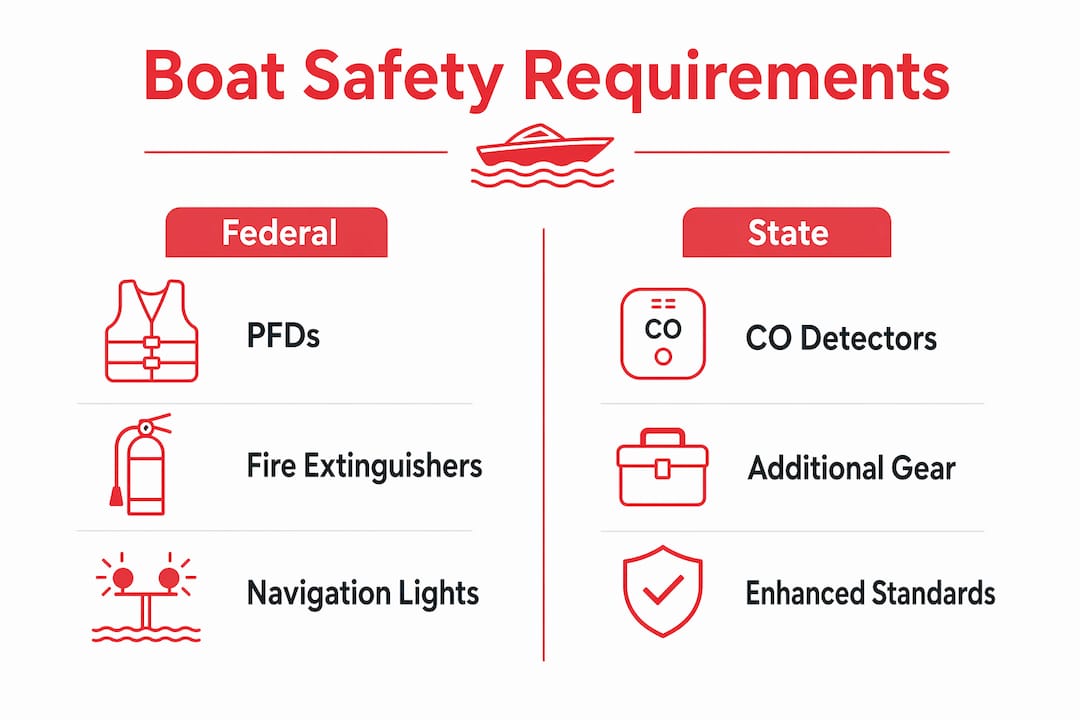
Federal law, enforced by the U.S. Coast Guard, defines the minimum safety gear every recreational vessel must carry. USCG mandates PFDs for each person onboard, a throwable flotation device for boats 16 feet or longer, serviceable fire extinguishers, proper navigation lights, and sound-producing devices. These are not optional recommendations. They are enforceable legal standards, and a Coast Guard boarding officer will check each item.
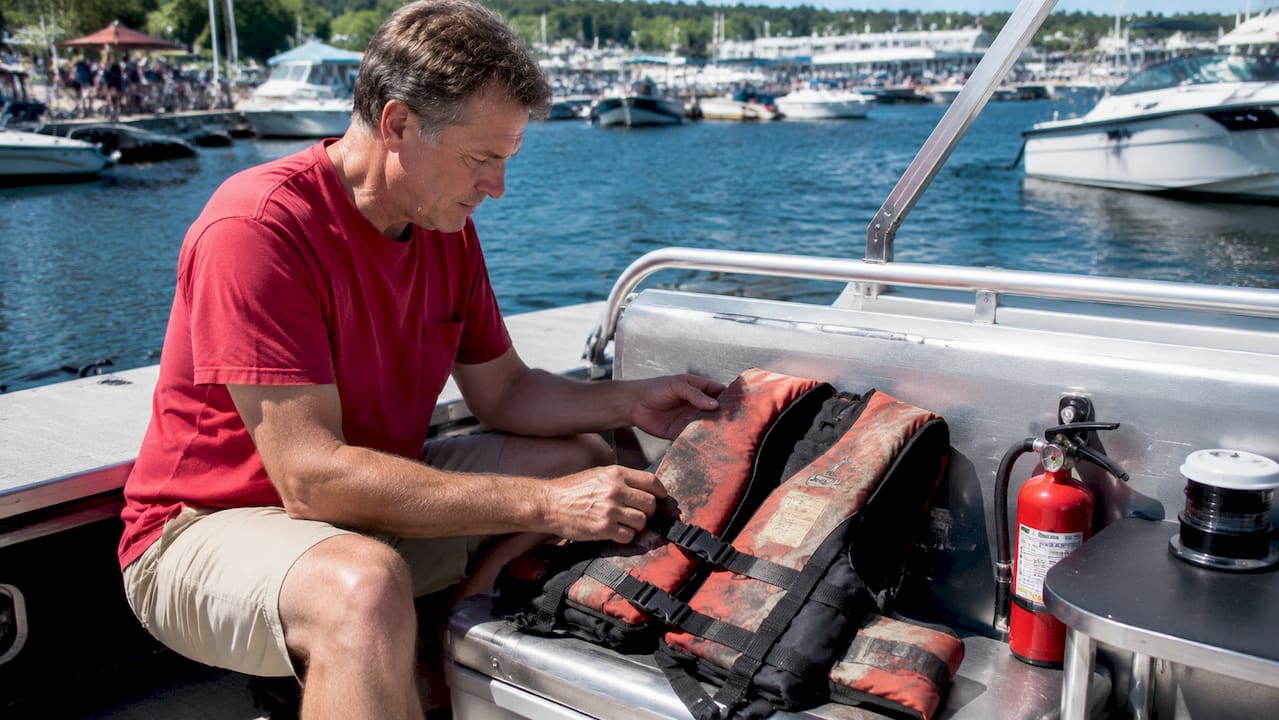
Fire extinguishers deserve special attention. Extinguishers older than 12 years are non-compliant regardless of what the pressure gauge reads. The manufacture date stamped on the cylinder governs legality, not the gauge needle. Many boaters discover this fact during a surprise inspection, not before one.
Navigation lights are another frequently overlooked requirement. Every recreational vessel must display proper navigation lights between sunset and sunrise and during periods of reduced visibility. Light configurations differ by vessel size and type, so verify the correct setup for your specific boat.
| Equipment | Federal requirement |
|---|---|
| Personal flotation devices (PFDs) | One USCG-approved wearable PFD per person onboard |
| Throwable device | Required on all vessels 16 feet or longer |
| Fire extinguisher | Required based on vessel size; must be under 12 years old |
| Visual distress signals | Required on coastal and Great Lakes waters |
| Sound-producing device | Whistle or horn required; air horn for vessels 39+ feet |
| Navigation lights | Required from sunset to sunrise and in reduced visibility |
Many boaters fail safety inspections due to “serviceable condition” violations, including expired fire extinguishers and PFDs stored in inaccessible locations. Serviceability is a strict legal standard. A PFD stuffed under a seat cushion beneath gear and luggage does not meet the accessibility requirement, even if it is otherwise in perfect condition.
State regulations often add to this federal baseline. Some states require carbon monoxide detectors on enclosed cabin vessels, additional flare kits, or specific anchor and line configurations. Check your state’s boating authority website before heading out, especially if you are new to a region.
Pro Tip: Conduct a full equipment audit at the start of each boating season. Check manufacture dates on fire extinguishers, inspect PFD straps and buckles for wear, and verify that flares have not passed their expiration date. Replacing gear before the season starts costs far less than a citation on the water.
Who needs a boating license or safety certificate?
Boating license requirements vary by state, but the national trend is moving firmly toward mandatory operator certification. Most states now require completion of a NASBLA-approved boater safety course to operate a motorized vessel, with age thresholds and phase-in deadlines differing by jurisdiction. The 50-state certification guide from Safeboatingamerica provides current requirements for every state in one place.
Massachusetts is the most recent state to expand its mandate. The Hanson-Milone Boater Safety Act, effective April 2026, requires all motorboat operators born after 1989 to obtain a boating safety certification, with grace periods granted for those in the process of completing their course. This law closes a gap that previously exempted many adult operators from any formal education requirement.
Steps to obtain your boating safety certificate:
- Confirm your state’s specific age and vessel-type requirements.
- Enroll in a NASBLA-approved course, available online, via live Zoom, or in person.
- Complete the course and pass the final examination.
- Receive your official boating safety certificate, often the same day.
- Carry the certificate onboard during all vessel operations.
- Check renewal requirements, as some states require periodic recertification.
Minimum age requirements also vary. Many states set 12 or 16 as the minimum age to operate a motorized vessel independently, with younger operators required to have a certified adult onboard. Personal watercraft like Jet Skis and WaveRunners often carry stricter age minimums than standard motorboats.
Exemptions exist for certain operators. Merchant mariner credentials and military licenses often satisfy civilian certification requirements, though the specific exemption rules differ by state. Non-residents can typically use a valid certificate from their home state or another approved jurisdiction when boating in a different state.
Pro Tip: Keep a laminated copy of your boating safety certificate onboard and a digital photo of it on your phone. If the original gets wet or lost during an outing, you still have proof of certification available for any inspection.
How do boat requirements vary by state and operating region?
Federal regulations set safety minimums, but many states require additional equipment or apply tougher standards. This layered system means that meeting federal requirements alone does not guarantee compliance in every state. You must cross-reference federal, state, and sometimes local rules before operating in any new region.
The range of state-specific rules is wider than most boaters expect. Alaska requires cold-water survival gear, and Utah mandates Aquatic Invasive Species (AIS) training before launching on certain bodies of water. These requirements have no federal equivalent, and ignorance of local law is not a defense during an inspection.
Key areas where state rules commonly diverge from federal minimums:
- Age and certification thresholds: Some states require certification for all operators regardless of age; others set thresholds at 16 or 18.
- Additional safety equipment: Carbon monoxide detectors, anchor requirements, and specific flare configurations vary by state.
- Speed and wake restrictions: Many lakes and coastal areas impose no-wake zones and speed limits not covered by federal law.
- Invasive species protocols: Several states require vessel inspections or decontamination before launching in protected waterways.
- Event permits: Large group boating events require permits planned months in advance, reflecting that operational requirements scale with the number of vessels and participants.
The most reliable way to verify current requirements is to visit your state’s official boating authority website or the USCG’s Boating Safety Resource Center. Safeboatingamerica’s resource on USCG boating compliance also consolidates key federal and state guidance in one place. If you are boating across state lines, check the rules for every state whose waters you plan to enter.
Key takeaways
Meeting all boat requirements means satisfying federal safety equipment standards, completing state registration, and holding valid operator certification before operating any motorized vessel on U.S. waters.
| Point | Details |
|---|---|
| Registration is mandatory | All motorized vessels require state registration; fees range from $5 to $150+ depending on state and vessel size. |
| Safety gear must be serviceable | Fire extinguishers over 12 years old are non-compliant; PFDs must be accessible, not just present. |
| Certification requirements are expanding | The 2026 Hanson-Milone Act in Massachusetts now mandates certification for operators born after 1989. |
| State rules exceed federal minimums | Alaska, Utah, and other states impose requirements with no federal equivalent; always verify local rules. |
| Documentation storage matters | Keep your title at home in a safe and your registration card onboard at all times. |
Why compliance is harder than most boaters expect
Most boaters I encounter focus on whether they have the gear, not whether the gear still qualifies. That distinction is where most compliance failures happen. A fire extinguisher that looks fine and reads full pressure can still be illegal if it was manufactured more than 12 years ago. A PFD that fits perfectly can still fail an inspection if it is buried under a cooler. The law does not grade on effort.
The certification side of compliance is also moving faster than many recreational boaters realize. Massachusetts is the latest state to close the adult operator loophole, but it will not be the last. States that currently exempt operators over a certain age are under increasing legislative pressure to follow suit. If you have been boating for years without formal certification, the window to get ahead of a mandate in your state is narrowing.
What I consistently recommend is treating compliance as a seasonal checklist, not a one-time task. Registration renewals, equipment expiration dates, and certification requirements all have calendars attached to them. Build a simple annual review into your pre-season routine, the same way you would check engine oil or inspect the hull. The connection between boating education and accident prevention is well documented, and staying current on requirements is the most direct way to protect yourself, your passengers, and your vessel.
— Richard
Get certified and compliant with Safeboatingamerica
Safeboatingamerica offers state-approved boating safety courses designed to meet 2026 requirements, including the Hanson-Milone Act in Massachusetts and Brianna’s Law in New York. Courses are available online, via live Zoom, and in person, taught by USCG-Licensed Captains and State Certified Instructors using NASBLA-approved materials. Whether you need a first-time certification, a Jet Ski license, or a state-specific safety certificate, Safeboatingamerica delivers same-day certification options with flexible scheduling. Get your boating safety certification through Safeboatingamerica and operate your vessel with full legal confidence on any U.S. waterway.
FAQ
What documents do I need to register a boat?
Most states require a completed registration application, proof of ownership such as a bill of sale or MCO, the vessel’s Hull Identification Number, and payment of applicable fees. HIN errors are the leading cause of application rejection, so verify the number carefully before submitting.
Do I need a boating license to operate a personal watercraft?
Most states require a boating safety certificate to operate a Jet Ski, WaveRunner, or other personal watercraft, often with stricter age minimums than standard motorboats. Check your state’s specific rules, as requirements for PWC operators frequently differ from those for motorboat operators.
How often do I need to renew my boat registration?
Registration renewal periods vary by state, typically running one to three years, and fees are recalculated at renewal based on current vessel specifications. Submit renewals before peak season to avoid processing delays caused by high application volume.
Are fire extinguishers on a boat subject to expiration?
Fire extinguishers older than 12 years are non-compliant under USCG standards regardless of their pressure gauge reading. The manufacture date on the cylinder determines legal status, not the physical condition of the unit.
Can I use my boating certificate from one state in another state?
Most states accept valid boating safety certificates issued by other states or NASBLA-approved jurisdictions, allowing non-residents to operate legally without obtaining a separate local certificate. Confirm reciprocity rules with the specific state you plan to boat in before your trip.