Boat Lighting Requirements: 2026 Compliance Guide
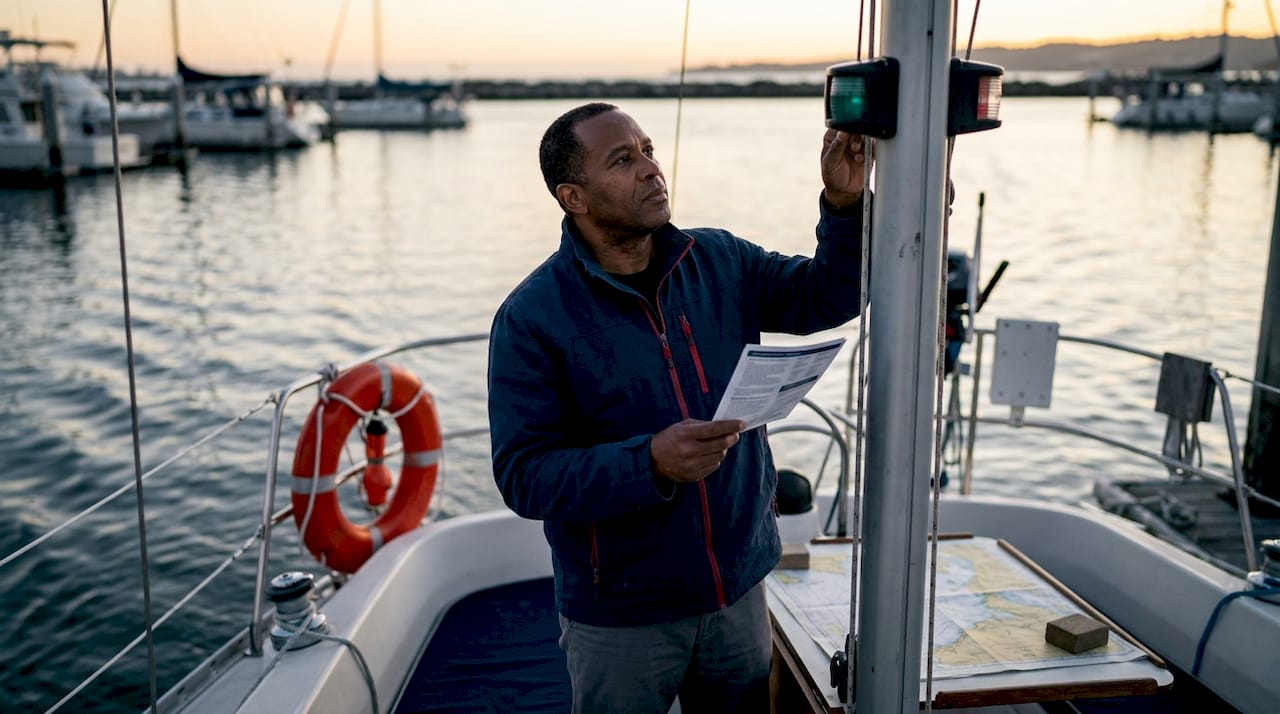
Boat lighting requirements are the mandatory rules that govern which navigation lights every vessel must display from sunset to sunrise and during any period of reduced visibility. These rules come from the 2026 COLREGS framework and are enforced by the U.S. Coast Guard. They apply to every boat on the water, from kayaks to commercial ships. The lights you show tell other mariners where you are, which direction you are heading, and what your vessel is doing. Getting them wrong is not just a fine risk. It is a collision risk.
What are the boat lighting requirements by vessel size and type?
Navigation lights fall into four core categories: sidelights, a sternlight, a masthead light, and an all-round white light. Each has a specific color, position, and arc of visibility. The combination you need depends on your vessel’s length, propulsion type, and operational status.
Sidelights, sternlights, and masthead lights
Sidelights are the red and green lights mounted on the port and starboard sides of your vessel. Red goes on the port (left) side, green on the starboard (right) side. Each covers a 112.5° visibility arc, sweeping from directly ahead to just past the beam. The sternlight is white and covers the remaining 135° arc behind the vessel.
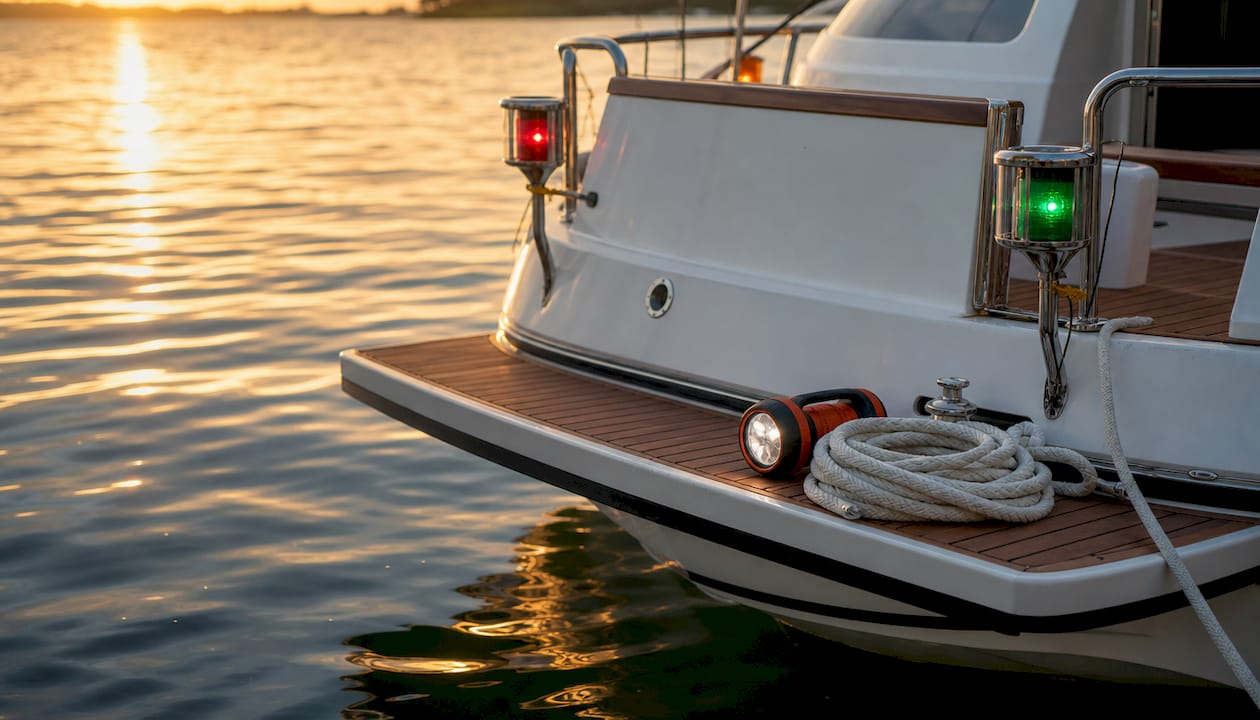
Power-driven vessels over 12 meters must also carry a masthead light. This white light faces forward and covers a 225° arc. It tells approaching vessels that a powered boat is underway. Vessels over 50 meters require two masthead lights stacked fore and aft, giving other mariners a clear sense of the ship’s size and orientation.
Visibility distance requirements by vessel size
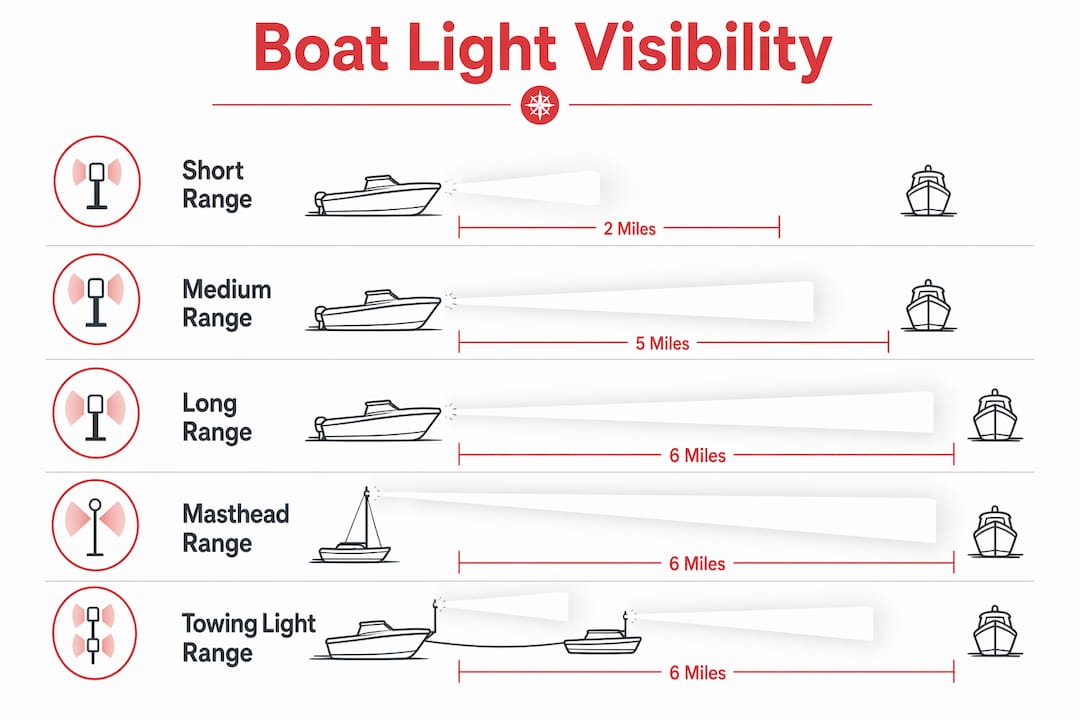
Visibility range is not optional. COLREGS visibility standards set specific minimum distances for each light type based on vessel length:
- Vessels under 12 meters: Sidelights must be visible at 1 nautical mile. Sternlights and all-round white lights must reach 2 nautical miles.
- Vessels 12–50 meters: Masthead lights must be visible at 5 nautical miles. Sidelights and sternlights must reach 2 nautical miles.
- Vessels over 50 meters: Masthead lights require visibility beyond 6 nautical miles.
These distances exist because reaction time on the water depends on how early you spot another vessel. A light visible at only half a mile gives you far less time to maneuver than one visible at 2 nautical miles.
Human-powered and small craft
Kayaks, canoes, and other small human-powered vessels have a practical alternative. A single portable white light, such as a flashlight or lantern, displayed when another vessel approaches satisfies the requirement. Fixed lighting is not mandatory for these craft, but the light must be shown in time to prevent a collision. Paddlers who skip this step entirely are operating illegally after dark.
When must boat navigation lights be displayed?
Navigation lights are mandatory from sunset to sunrise and during any period of reduced visibility, regardless of the time of day. That second condition catches many boaters off guard.
Reduced visibility conditions that trigger the lighting requirement during daylight hours include:
- Dense fog
- Heavy rain or snow
- Thick haze or smoke
- Any condition where visibility drops to a level that makes collision avoidance difficult
A boater caught in a sudden fog bank at 2:00 PM must turn on navigation lights immediately. The law does not require darkness. It requires impaired visibility. Failing to light up in daytime fog is the same violation as running dark at midnight.
Anchor lighting follows a separate rule. An anchored vessel must display an all-round white anchor light at the highest practical point, visible from 360 degrees. This signals to approaching traffic that your vessel is stationary. Small vessels under 7 meters anchored outside a fairway or anchorage may be exempt, but that exception is narrow and should not be assumed.
Pro Tip: Turn your navigation lights on before sunset, not after. Twilight creates deceptive visibility conditions, and other boaters may already be running lights. Being lit early costs nothing. Being unlit at the wrong moment can cost everything.
Do not display other lights that could interfere with or be confused for navigation lights. Running a floodlight or spotlight while underway can wash out your sidelights from another vessel’s perspective. The USCG rule is clear: no light that impairs the visibility or character of required navigation lights.
Common mistakes boaters make with navigation lights
The most dangerous lighting mistake is using uncertified LED lights. Many boaters install cheap LED fixtures that appear to be on but fail to meet the nautical mile visibility ranges required by COLREGS and the USCG. A light that glows is not automatically a compliant light. Certification matters.
Key best practices for maintaining compliant boating safety lights:
- Buy certified fixtures only. Look for lights that meet USCG or ABYC standards and specify their visibility range in nautical miles.
- Run a pre-sunset check. Experienced boaters walk the deck before dark, visually confirming every light is working and unobstructed.
- Carry spare bulbs and fuses. A burned-out sternlight at 10:00 PM with no spare is a compliance failure and a safety hazard.
- Check for obstructions. Gear, canvas covers, or poorly mounted equipment can block a light’s arc. A sidelight with a blocked arc is not providing its full 112.5° coverage.
- Manage interior lighting. Cabin white lighting can reflect through windows and obscure navigation lights from outside. Use red or dimmable cockpit lights to preserve night vision and keep your nav lights visible.
Pro Tip: Avoid running docking lights or high-intensity halogen bars while underway. These lights blind other boaters and can mask your required navigation lights entirely, which violates USCG rules and creates a direct collision risk.
Arc shielding deserves special attention. Proper shielding of red and green sidelights prevents signal bleed across the bow, which can cause another mariner to misread your heading and make the wrong right-of-way decision. This is not a cosmetic detail. It is a safety-critical specification.
How do lighting rules change for towing, anchoring, and restricted vessels?
Special operational states require specific lighting configurations beyond the standard underway setup. The table below summarizes the key differences.
| Vessel condition | Required lighting |
|---|---|
| Power-driven vessel underway | Masthead light, red/green sidelights, white sternlight |
| Anchored vessel | All-round white light at highest point, 360° visibility |
| Sailboat under engine power | Same as power-driven vessel of equivalent size |
| Vessel towing another vessel | Yellow towing light above sternlight; towed vessel shows sidelights and sternlight |
| Restricted maneuverability | All-round white, red, and white vertical lights plus standard underway lights |
| Vessel over 50 meters | Two masthead lights fore and aft, plus standard sidelights and sternlight |
Sailboats under engine power must display the same lights as a power-driven vessel of the same size. Many sailors assume that because they have a mast, they follow sailing vessel rules. Once the engine is running, that assumption is wrong.
Towing configurations add a yellow towing light above the sternlight on the towing vessel. The vessel being towed must show its own sidelights and sternlight so other mariners can identify both ends of the tow. Long tows at night are among the most misread situations on the water, and correct lighting is the only reliable way to communicate what is happening.
Restricted maneuverability vessels, such as dredges or vessels laying cable, display a vertical sequence of all-round lights: white over red over white. This pattern tells other mariners that the vessel cannot maneuver freely and has right-of-way priority. Recreational boaters who see this pattern must give way.
Key Takeaways
Boat lighting requirements are defined by COLREGS and enforced by the USCG, and every boater must display the correct lights from sunset to sunrise and during any reduced visibility condition.
| Point | Details |
|---|---|
| Lights are required day and night | Fog, rain, or haze during daylight hours triggers the same lighting obligation as nighttime operation. |
| Vessel size determines light type | Boats under 12 meters need sidelights, a sternlight, and an all-round white light; larger vessels add masthead lights. |
| Certification matters for LEDs | Uncertified LED lights may appear lit but fail COLREGS visibility distance standards, creating a legal violation. |
| Special conditions change the setup | Towing, anchoring, and restricted maneuverability each require specific light configurations beyond standard underway lights. |
| Pre-sunset checks prevent failures | Walking the deck before dark and carrying spare bulbs are standard practices among compliant, experienced boaters. |
What I have learned from years of watching boaters get lighting wrong
The arc of visibility is the detail most boaters never think about until something goes wrong. A sidelight that bleeds past the bow tells the approaching vessel it is looking at your port side when it is actually looking at your starboard. That misread can produce a head-on course correction instead of a crossing maneuver. The physics of the situation are unforgiving.
The other pattern I see constantly is the docking light problem. Boaters flip on a high-intensity light to see the water ahead, and in doing so, they blind every other vessel within a quarter mile and wash out their own sidelights. It feels like a safety measure. It is actually the opposite.
Minor lapses in vessel lighting standards carry real consequences. Coast Guard boarding officers check navigation lights. Fines are real. But the bigger cost is a collision that a compliant light setup would have prevented. Treating lighting as a legal checkbox misses the point entirely. These rules exist because they work. A properly lit vessel communicates its position, heading, and status to every other mariner within range. That communication is what keeps everyone on the water safe.
Carry spare bulbs. Run your pre-sunset check. Buy certified lights. These are not complicated steps. They are the difference between a safe night on the water and a preventable accident.
— Richard
Safeboatingamerica’s boating safety courses cover lighting and more
Understanding marine lighting regulations is one part of becoming a fully compliant, confident boater. Safeboatingamerica teaches navigation light rules, right-of-way decisions, and required safety equipment as part of its NASBLA-approved boating safety curriculum.
Courses are available online, via live Zoom sessions, and in person across the United States. State Certified Instructors and USCG-Licensed Captains lead every class. Whether you need a boating safety certification for New York, Connecticut, Florida, California, or any other state, Safeboatingamerica offers a format that fits your schedule. Students who complete the course receive their official boating safety certificate and leave with the knowledge to operate legally and safely after dark.
FAQ
What lights does a boat need at night?
A power-driven vessel underway at night needs red and green sidelights, a white sternlight, and a masthead light if it is over 12 meters. Smaller vessels under 12 meters may combine the sidelights and sternlight into a single all-round white light in some configurations.
Do boat navigation lights need to be on during fog in the daytime?
Yes. Navigation lights are required any time visibility is reduced, including fog, heavy rain, or haze, regardless of the time of day. Waiting for darkness to turn on your lights during a fog bank is a COLREGS violation.
Can I use LED lights on my boat for navigation?
LED lights are permitted, but they must be certified to meet USCG or COLREGS visibility distance standards. Uncertified LEDs may appear illuminated but fail to reach the required nautical mile visibility range, which makes them non-compliant even if they are on.
What light does an anchored boat need to display?
An anchored vessel must show an all-round white light at the highest practical point, visible from 360 degrees. Vessels under 7 meters anchored outside a fairway or anchorage may qualify for an exemption, but most recreational boaters should display the anchor light to be safe.
Do sailboats have different lighting rules than powerboats?
Sailboats under sail alone follow sailing vessel lighting rules, which differ from power vessel rules. However, a sailboat operating under engine power must display the same navigation lights as a power-driven vessel of equivalent size, including a masthead light if it is over 12 meters.