Nebraska Boating License Requirements: Who Needs a Certificate

Nebraska does not issue a boating license. It requires a boating safety certificate instead, and the rule depends on your birth date. Anyone born after December 31, 1985 must complete a state-approved boating safety course and carry the certificate while operating a motorboat or personal watercraft (PWC), according to the Nebraska Game & Parks Commission. Operators must also be at least 14 years old. This guide covers who is affected, the three ways to earn the certificate, what visitors from other states need, and the PWC rules that apply once you are on the water.
TL;DR
- Nebraska has no boating license. It has a boating safety certificate, proof that you passed a boater education course.
- The certificate is required for motorboat and PWC operators born after December 31, 1985.
- Residents take a course offered by the Nebraska Game and Parks Commission: a 6-hour class ($10), self-study with a proctored test-out ($10), or an online course ($44.95). The passing score is 75%.
- Non-residents may use a NASBLA-approved certificate from their home state, and must be able to show it on demand.
- Boaters who also operate in other states, such as New York or Connecticut, can complete those states’ approved courses with Safe Boating America.
Table of Contents
- Does Nebraska require a boating license?
- Who needs the Nebraska boating safety certificate
- Jet Ski and WaveRunner rules in Nebraska
- How to get a boating certificate in Nebraska
- Visiting Nebraska with a certificate from another state
- What to carry and what happens without it
- Boating in other states: where Safe Boating America fits
- Our view on boating education
- FAQ
- Sources
Does Nebraska require a boating license?
No. The Commission’s Boating FAQ states that Nebraska issues no boating license, and that a driver’s license has nothing to do with legally operating a boat. What the state requires is evidence that you completed a boating education course. That evidence is a card or certificate.
People use the words “boating license,” “boater card” and “boating safety certificate” interchangeably, and search results do too. In Nebraska the document is a certificate of completion. It does not expire the way a driver’s license does, and it is not renewed on a schedule. It shows that you passed the course.
Some states do add an endorsement to a driver’s license. New York is one example. Nebraska does not. Your certificate is a separate document, and you carry it when you operate.
Who needs the Nebraska boating safety certificate
The rule is set by Neb. Rev. Stat. 37-1241.06. It applies to a person who operates a motorboat or personal watercraft on Nebraska waters and was born after December 31, 1985. The statute defines the requirement as completion of a Commission-approved boating safety course and possession of a valid certificate.
The following table shows how the rule works in practice.
| Situation | Certificate required? |
|---|---|
| Born on or before December 31, 1985, operating a motorboat | No |
| Born after December 31, 1985, operating a motorboat | Yes |
| Born after December 31, 1985, operating a Jet Ski or WaveRunner | Yes |
| Operator under 14 | Not allowed to operate |
| Passenger only | No operator certificate needed |
The birth-date cutoff means that the rule gradually covers more of the boating population each year. A boater who turned 40 in recent years is covered. An older boater is not, although the Commission’s May 2026 boating safety release suggests that others consider taking the course to learn navigation and emergency response on Nebraska waters.
What counts as a motorboat
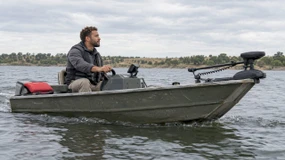
The definition is wider than many owners expect. The 2026 Boating Guide defines a motorboat as any vessel propelled by mechanical power, whether gas, electric or diesel. That includes a boat driven by an electric trolling motor. If you were born after the cutoff and run a small fishing boat with a trolling motor, the requirement applies to you.
Age minimums
Operators must be at least 14. The statute also sets 16 as the minimum age to operate while towing a person, such as a skier, tuber or wakeboarder. A 14-year-old with a certificate can run a boat, but cannot pull a tube.

Jet Ski and WaveRunner rules in Nebraska
Personal watercraft are covered by the same certificate rule. The Boating Guide defines a PWC as an inboard vessel under 16 feet that uses an internal combustion engine powering a jet pump, and is designed to be operated by a person sitting, standing or kneeling. Jet Skis and WaveRunners fall into this category.
The 2026 Boating Guide lists the following as unlawful on a PWC:
- Operating between sunset and sunrise.
- Operating without wearing the lanyard-type engine cutoff switch.
- Operating or riding as a passenger without wearing a U.S. Coast Guard-approved life jacket, regardless of age.
- Operating any boat, a PWC included, while under 16 and towing a skier, tuber or wakeboarder.
Two habits keep a rider within these rules. Clip the cutoff lanyard to your wrist or life jacket before starting the engine, and plan the last run of the day so you are docked before sunset, not after.
A course certificate is only part of operating a PWC legally. Safe operation also depends on knowing right-of-way rules, how to handle a jet pump with no steering at idle, and what to do after a fall. A good boater education course covers these, which is why the certificate is a requirement and not just paperwork. For background on what the course teaches and why states require it, see our guide on why boating safety education is mandatory.
How to get a boating certificate in Nebraska
Nebraska residents must complete the Nebraska course. The Commission states that only courses it offers currently satisfy the state’s education requirement. It lists three routes on its Boater Education page.
| Option | Format | Cost |
|---|---|---|
| A | 6-hour in-person classroom course with proctored exam | $10, cash or check to the instructor |
| B | Self-study, then a proctored test-out session | $10 |
| C | Online course | $44.95 |
A passing score is 75% or higher on every format. Students who pass receive a certificate of completion. The $10 figure for in-person courses reflects the cap in the statute, which limits the Commission’s fee for a required course to $10.
Choosing between the three options
Option A suits readers who learn best with an instructor and who can give up most of a day. You ask questions in the room, and the exam is proctored at the end.
Option B suits readers who prefer to study alone. According to the 2026 Boating Guide, the materials are available at BoatSafeNebraska.org, and you then attend a three-hour session that reviews the material before the proctored exam.
Option C is the online route for people who cannot get to a scheduled class. It costs more than the $10 options, but you can work through it on your own schedule and from home.
Step by step
- Confirm your birth date falls after December 31, 1985 and that you plan to operate a motorboat or PWC in Nebraska.
- Choose Option A, B or C on the Commission’s Boater Education page.
- Complete the course or study materials and prepare for the exam. Topics include navigation rules, required equipment, and emergency response.
- Pass the exam with 75% or better.
- Receive the certificate of completion. Under the state’s administrative code, the Commission issues these certificates to persons who finish a training program it approves.
- Keep the certificate with you whenever you operate. A photo kept on a phone is convenient as a backup, but ask the Commission whether a digital copy is accepted before you rely on it.
When you rent a boat or PWC, the same rule applies. The Boating FAQ states that anyone born after December 31, 1985 renting a gas, diesel or electric craft in Nebraska must have proof of a completed boating safety class.
Visiting Nebraska with a certificate from another state
Non-residents have more flexibility than residents. Under 163 Neb. Admin. Code § 017, the Commission may accept a completion certificate from the operator’s state, province or country of residence, provided the course meets or exceeds NASBLA standards. NASBLA is the National Association of State Boating Law Administrators, which sets the national standards for boating education courses.
The Boating FAQ confirms the practical result: an out-of-state certificate is acceptable for non-residents only if it comes from a NASBLA-approved course that the home state accepts. Nebraska residents cannot substitute an out-of-state course.
The regulation also places the burden on the visitor. It is the non-resident operator’s responsibility to provide proof, and the proof must be shown immediately upon demand to an enforcement officer.
If you live in another state and plan a trip to a Nebraska lake, the useful questions are these:
- Was I born after December 31, 1985?
- Does my home state require a certificate, and do I already have one?
- Was the course NASBLA-approved?
- Do I have the certificate with me, not at home?
If you hold a certificate that you cannot find, our article on replacing a boating license explains the process. For help confirming that your course is recognized by other states, read about NASBLA reciprocity and what counts as an approved boating course.
Neighboring Iowa has its own rules about who needs a certificate. If you cross the river to boat there, check Iowa’s boating license requirements.
What to carry and what happens without it
The administrative code makes it unlawful to fail to show proof of course completion immediately when an enforcement officer asks. It also prohibits anyone from permitting or knowingly authorizing the operation of a motorboat contrary to the statute. That second point matters for boat owners: if you hand the keys to a young operator who has no certificate, the violation is not only theirs.
A short checklist for a day on a Nebraska lake:
- Certificate of completion, if you were born after December 31, 1985.
- Registration documents for the boat, where registration applies. The Commission has a separate page on boat registration rules.
- A U.S. Coast Guard-approved life jacket for each person aboard. On a PWC, each rider must wear one.
- The engine cutoff lanyard attached, on a PWC.
Boating in other states: where Safe Boating America fits
Nebraska’s course for residents comes from the Commission, and that step belongs to the state. Many Nebraska boaters, though, also take trips to the coast, to the Great Lakes region, or to a lake house in another state. Rules differ sharply. New York’s Brianna’s Law covers all motorized and PWC operators, and California has phased in a requirement for all operators. A Nebraska certificate does not automatically meet those requirements for you in those states.
Safe Boating America offers state-approved boating license and safety certification courses for recreational boaters and PWC operators across the United States. Formats include online computer-based courses, live Zoom classes and in-person classes, taught by State Certified Instructors and USCG-Licensed Captains.
- The Zoom Online 1-Day Class costs $75.
- The NYS Safe Boating Class costs $85 and is built around New York’s requirements, including Brianna’s Law.
- Online boating safety courses are available nationwide.
- Gift certificates for boating education are sold at $75 to $85.
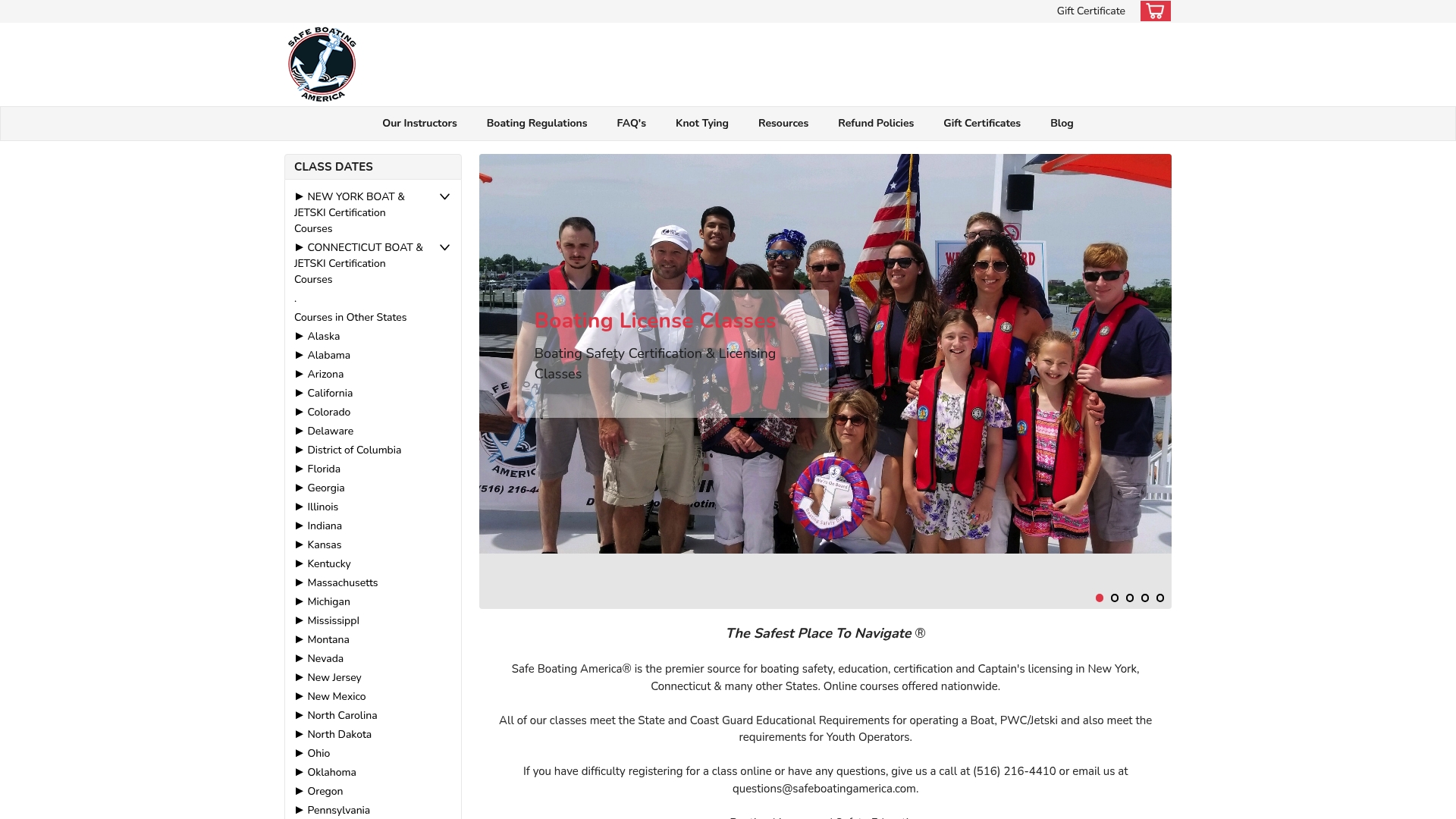
If you want one place to start, the Safe Boating America home page lists the course for each state. State-specific guides are also available for Oregon and Ohio.
Our view on boating education
A boating certificate is not a formality. It is the one hour, or six, in which a new operator learns the rules before the water teaches them the hard way.
We teach boaters in more than one state, and the pattern is plain: rules differ at every border, and the boater who understands why a rule exists adapts quickly. Nebraska’s birth-date cutoff, New York’s all-operator rule and the age rules in other states all come from the same idea. Operators should know right-of-way, equipment and emergency response before they take responsibility for passengers.
Our courses are taught by State Certified Instructors and USCG-Licensed Captains, and are designed to meet each state’s boating education requirements. For Nebraska residents, the Commission’s course satisfies the state requirement. For every other state you plan to boat in, we recommend completing that state’s approved course before you launch, so you can show proof the moment it is asked for.
Richard
FAQ
Do I need a boating license in Nebraska?
No, Nebraska issues no boating license. You need a boating safety certificate if you were born after December 31, 1985 and operate a motorboat or personal watercraft. The certificate is proof that you completed a boater education course.
How do I get a boating license in Nebraska?
Take one of the three Commission options: a 6-hour in-person class for $10, self-study plus a proctored test-out for $10, or an online course for $44.95. You must score 75% or higher, and passing students receive a certificate of completion.
Is a boating certificate different from a boating license?
In everyday speech people use the terms interchangeably. In Nebraska the document is a certificate of completion showing you passed a boating education course. It is not a permit tied to your driver’s license.
Does the Nebraska rule apply to Jet Skis and WaveRunners?
Yes. Personal watercraft are included. A rider born after December 31, 1985 needs the certificate, must be at least 14, and must be at least 16 to tow a person. PWC operation is also prohibited between sunset and sunrise.
Can I use my certificate from another state in Nebraska?
Non-residents can, if the course was NASBLA-approved and accepted by their home state. You must be able to show it immediately on request. Nebraska residents must complete the Nebraska course.
Sources
- Boater Education, Nebraska Game & Parks Commission
- Boating FAQ, Nebraska Game & Parks Commission
- Neb. Rev. Stat. 37-1241.06, Nebraska Legislature
- Boating Guide 2026, Nebraska Game & Parks Commission
- 163 Neb. Admin. Code ch. 3, § 017
- Boat safe this summer, Nebraska Game & Parks Commission
- Boating regulations, Nebraska Game & Parks Commission