
What Counts as an Approved Boating Course in 2026

An approved boating course is a state-recognized boater safety education program that meets NASBLA (National Association of State Boating Law Administrators) standards and is accepted by your specific state authority for legal compliance. Not every boating safety class on the market qualifies. The distinction between a general safety course and a legally valid boating course matters enormously when a marine patrol officer asks to see your certificate on the water. This article explains exactly how courses earn approval, what state-specific conditions apply, and how to verify compliance before you enroll.
What counts as an approved boating course for legal compliance?
An approved boating course is specifically a NASBLA-recognized program accepted by your state’s boating authority, not simply any class that covers water safety topics. NASBLA sets the national baseline curriculum standard, but each state independently decides which providers and delivery formats it will accept. This two-layer system is where most boaters get confused.
Virginia’s Department of Wildlife Resources makes this distinction explicit: an approved course in Virginia is the NASBLA-recognized and state-accepted option, and proof must be carried onboard at all times. A course can carry a NASBLA endorsement and still fail to satisfy Virginia’s requirements if the provider is not on the state’s approved list. The same logic applies in every other state.
Recognized providers that consistently appear on state-approved lists include Boat-Ed.com, BOATsmart!, and the BoatUS Foundation’s free online program. Safe Boating America also delivers NASBLA-approved courses accepted across multiple states, including online, live Zoom, and in-person formats. The safest enrollment strategy is to confirm your state’s approved provider list first, then select from those options.
How do states determine which boating courses are approved?
States use NASBLA standards as a floor, not a ceiling. Meeting NASBLA criteria qualifies a course for consideration, but individual states layer on additional requirements that determine final acceptance. These conditions vary widely and include:
- Provider authorization: Some states require courses to be offered only by agencies or providers they have explicitly approved. Massachusetts is the clearest example: the Massachusetts Environmental Police require completion of a course from an MEP-approved provider. A course can be NASBLA-approved and still be rejected in Massachusetts if the provider is not on their list.
- Delivery format restrictions: Certain states accept only instructor-led courses, either in-person or via live virtual formats. Others accept self-paced online courses with a proctored final exam.
- Proctored exam requirements: Several states require a supervised final exam regardless of how the course content is delivered.
- Age and engine size thresholds: Phased education mandates based on operator birth date or engine horsepower mean some operators are exempt while others are not. Virginia, for example, requires course completion for operators of motorboats with 10 or more horsepower and all personal watercraft operators.
Pro Tip: Before enrolling in any course, go directly to your state’s official boating or wildlife agency website and pull up their current approved provider list. Provider approvals can change year to year, and a course that was valid last season may not be accepted today.
The practical takeaway is that NASBLA approval is necessary but not sufficient. State acceptance is the deciding factor for legal compliance.
What are the core features of a valid boating safety course?
Approved boating education programs share a defined curriculum structure regardless of delivery format. NASBLA-approved courses generally cover the following topics in approximately 6 to 8 hours of instruction:
- Navigation rules and right-of-way on the water
- Required safety equipment, including life jackets, fire extinguishers, and distress signals
- Emergency procedures such as man-overboard response and capsizing protocols
- Environmental stewardship and regulations protecting waterways
- Boating laws specific to the state where the course is offered
- Personal watercraft operation and PWC-specific safety rules
Delivery formats for certified boating training options fall into three main categories:
| Format | Description | Common State Acceptance |
|---|---|---|
| Self-paced online | Student completes modules independently; may require proctored exam | Accepted in most states with conditions |
| Instructor-led virtual | Live Zoom or video class with a certified instructor | Broadly accepted; satisfies instructor-led requirements |
| In-person classroom | Traditional classroom setting with a state-certified instructor | Universally accepted across all states |
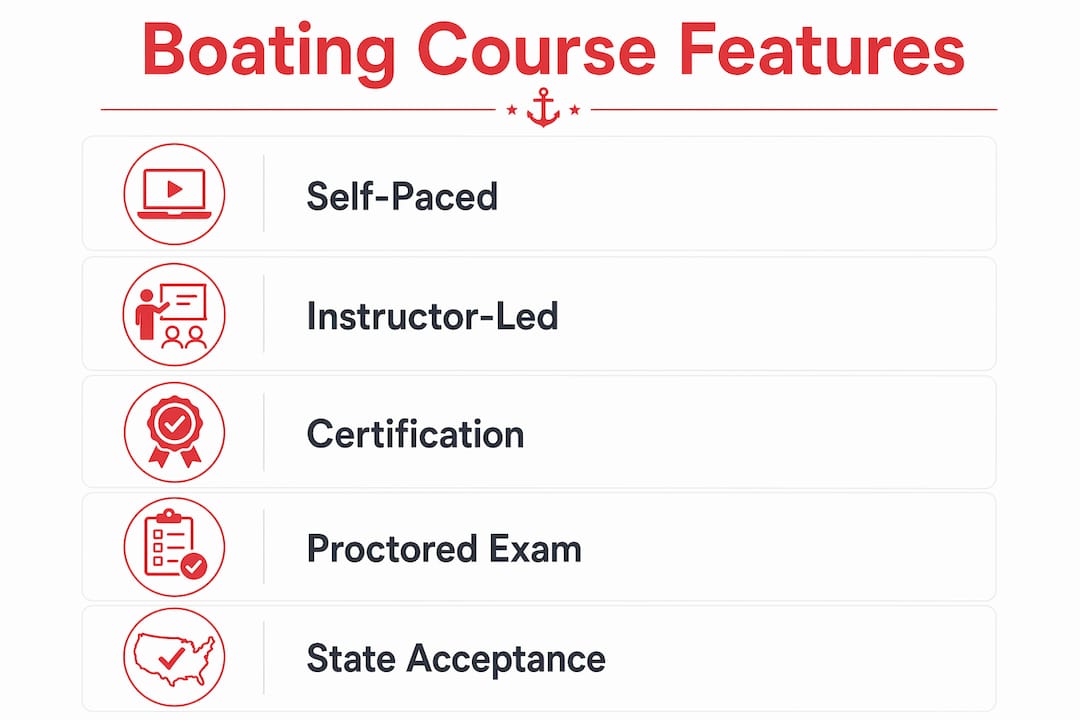
The certification outcome is the same across formats: a boating safety certificate that serves as your legal proof of completion. Safe Boating America offers all three formats, with courses taught by State Certified Instructors and USCG-Licensed Captains using NASBLA-approved materials.
Pro Tip: If you plan to boat in multiple states, an instructor-led course (live virtual or in-person) is the safest choice. It satisfies the broadest range of state-specific delivery requirements and reduces the risk of your certificate being rejected out of state.
How does reciprocity work for approved boating courses across states?
Reciprocity is the mechanism by which one state accepts a boating safety certificate issued by another state or provider. NASBLA approval is the primary basis for reciprocity, but state-by-state conditions create significant variation in how it works in practice.
Several common restrictions apply:
- Some states only accept certificates issued by their own state agency or an authorized in-state provider, regardless of NASBLA endorsement.
- Others require that the course included a proctored final exam before they will recognize an out-of-state certificate.
- A handful of states require instructor-led formats specifically, meaning a self-paced online certificate from another state will not satisfy their requirements.
Certificate format is equally critical. For a certificate to be accepted during a law enforcement inspection, it must include the operator’s full legal name, date of birth, course completion date, and an explicit NASBLA standards statement. Missing or incomplete information can result in non-acceptance even when the underlying course was fully NASBLA-approved. This is a detail most boaters overlook until they are stopped on the water.
Pro Tip: When boating out of state, look up that state’s boating agency website before your trip and confirm that your certificate format and provider meet their specific reciprocity conditions. Do not assume NASBLA approval alone guarantees acceptance.
The risk of non-compliance is real. Operating a vessel without a recognized certificate can result in fines, vessel impoundment, or being required to leave the water immediately. Planning ahead eliminates that risk entirely.
How to verify if a boating course counts as approved before enrolling
Confirming course legitimacy before you pay for enrollment takes less than 15 minutes and prevents the far larger problem of completing a course that does not satisfy your state’s requirements. Follow these steps:
- Step 1: Identify your state’s boating authority. This is typically the state’s department of natural resources, wildlife agency, or parks and recreation department. Search “[your state] boating education requirements” to find the official page.
- Step 2: Pull the state’s approved provider list. Most state agencies publish a current list of accepted course providers and formats. Confirm that the course you are considering appears on that list.
- Step 3: Cross-reference with NASBLA’s directory. NASBLA maintains a reference of approved courses that can serve as a secondary confirmation. Use it alongside your state’s list, not instead of it.
- Step 4: Confirm the delivery format is accepted. Verify whether your state accepts online self-paced, instructor-led virtual, or in-person formats. Check whether a proctored exam is required.
- Step 5: Review the certificate details you will receive. Confirm the certificate will include your full legal name, date of birth, completion date, and NASBLA endorsement language.
The safest enrollment workflow is to start with your state’s approved provider list and choose from those options directly. Relying solely on a provider’s claim of being “NASBLA-approved” without state verification can produce an invalid certificate. Once you complete the course, store your certificate digitally and carry a physical copy whenever you operate a vessel.
For operators in states like Virginia, proof of completion must be onboard the vessel at all times. Other states may allow you to present a digital copy on a smartphone. Knowing your state’s specific proof requirements is part of full compliance.
Key takeaways
An approved boating course requires both NASBLA curriculum alignment and explicit acceptance by your specific state authority, and the certificate must contain complete identifying information to be enforceable.
| Point | Details |
|---|---|
| NASBLA approval is the baseline | NASBLA sets the national curriculum standard, but state acceptance determines legal validity. |
| State provider lists are authoritative | Always confirm your chosen course appears on your state’s official approved provider list before enrolling. |
| Certificate format determines enforcement | Your certificate must include full name, date of birth, completion date, and NASBLA endorsement to be accepted. |
| Reciprocity has hidden conditions | Out-of-state certificates may be rejected if the delivery format or provider does not meet the destination state’s rules. |
| Verify before you enroll | Check state agency websites and NASBLA’s directory together to confirm both course and format acceptance. |
Why the “NASBLA-approved” label is not enough on its own
I have seen this mistake made repeatedly: a boater completes an online course, receives a certificate with a NASBLA logo, and assumes they are fully covered in every state they plan to visit. That assumption is wrong more often than people realize.
The NASBLA endorsement tells you the course content meets a national curriculum standard. It does not tell you whether your state’s boating authority has placed that specific provider on its accepted list. Massachusetts is the most instructive example. The Massachusetts Environmental Police maintain their own approved provider list, and a course can be NASBLA-approved yet completely invalid for Massachusetts certification if the provider is not on that list. The same dynamic exists in other states with strict provider authorization rules.
My practical advice: treat your state’s official approved provider list as the primary source of truth, and treat NASBLA approval as a necessary but secondary confirmation. If you boat across state lines regularly, choose an instructor-led course format from a provider with broad multi-state acceptance. The extra verification step takes minutes and eliminates the risk of carrying a certificate that does not hold up during an inspection.
Boating education is not just a compliance checkbox. The navigation rules, emergency procedures, and safety equipment knowledge covered in approved courses are the skills that prevent accidents. Choose a course that genuinely teaches those skills, not just one that issues a certificate.
— Richard
Get certified with Safe Boating America’s state-approved courses
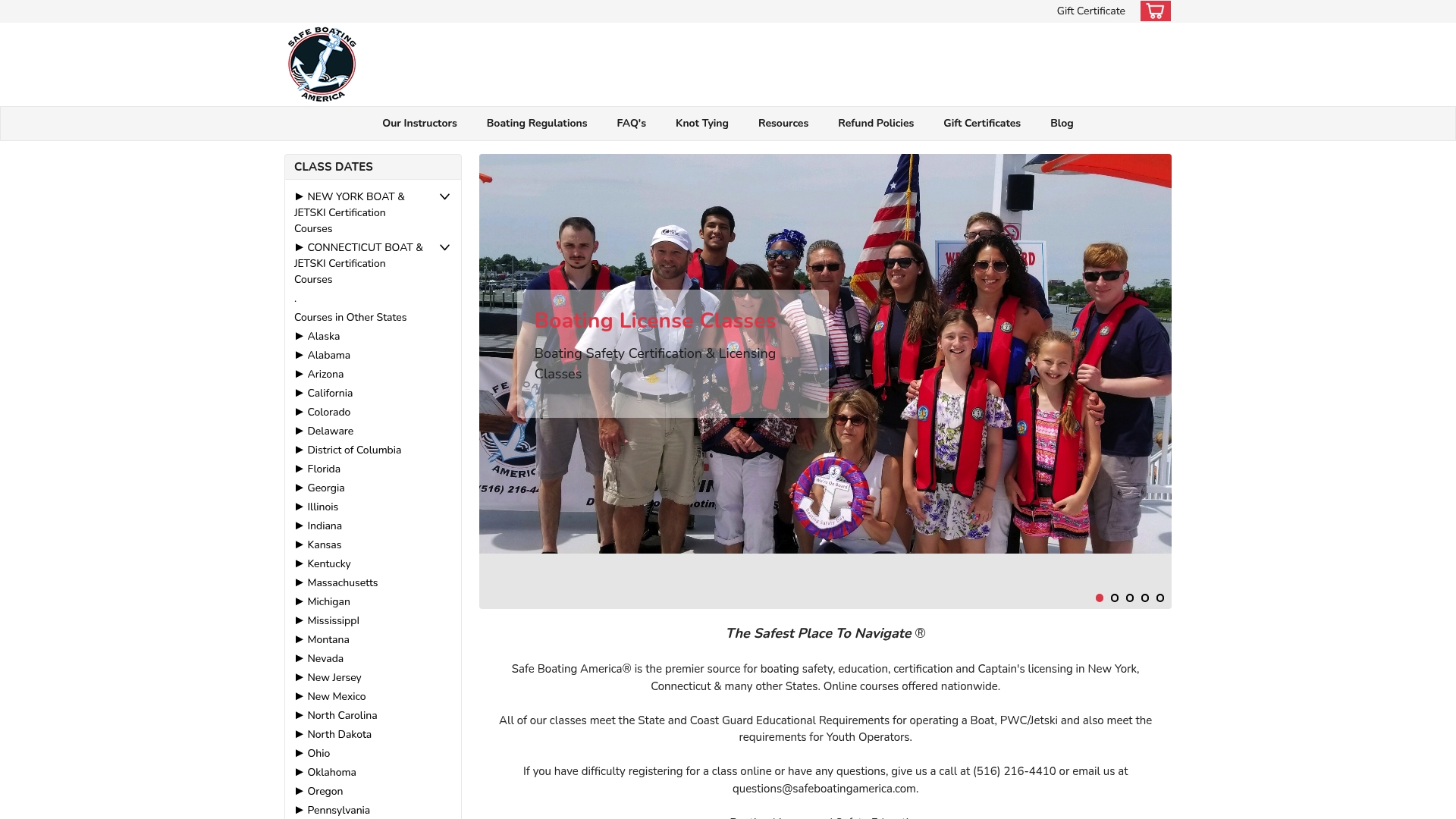
Safe Boating America offers NASBLA-approved and state-accepted boating safety certification courses in every U.S. state, with online, live Zoom, and in-person formats designed to meet each state’s specific requirements. Whether you need a Florida boating certification, an Arizona PWC course, or a nationwide online option, Safe Boating America’s courses are taught by State Certified Instructors and USCG-Licensed Captains. Same-day certification is available in many states. Visit Safe Boating America to find the approved course for your state and get on the water legally and confidently.
FAQ
What makes a boating course officially approved?
A boating course is officially approved when it meets NASBLA curriculum standards and is accepted by your state’s boating authority. Both conditions must be satisfied for the certificate to be legally valid.
Does a NASBLA-approved course work in every state?
Not automatically. Reciprocity conditions vary by state, and some states require specific delivery formats, proctored exams, or certificates issued by state-authorized providers before they will recognize an out-of-state certificate.
Can I take an online course and have it count as approved?
Online courses count as approved in most states, but some states require a proctored final exam or an instructor-led format. Confirm your state’s delivery format requirements before enrolling in a self-paced online program.
What information must my boating certificate include?
Your certificate must include your full legal name, date of birth, course completion date, and an explicit NASBLA endorsement statement. Incomplete certificates can be rejected during law enforcement inspections even if the course itself was valid.
Do boating education requirements apply to personal watercraft operators?
Yes. Most states require PWC operators to complete an approved boating safety course, and many apply the same NASBLA and state-acceptance criteria. Virginia, for example, mandates course completion for all personal watercraft operators regardless of engine size.
Recommended
- Jet Ski Certification Course Types: Your 2026 Guide - Safe Boating America
- In-Person vs Online Boating Course Differences Explained - Safe Boating America
- Minnesota Boating License: What You Need to Know in 2026 - Safe Boating America
- Jet Ski Course Zoom Class: Your 2026 Licensing Guide - Safe Boating America