Jet Ski Certification Course Types: Your 2026 Guide
Understanding which jet ski certification course types exist before you commit to one saves time, money, and legal headaches. Most states require a boater education certificate for PWC operation, but the path to getting it varies more than most people realize. Online self-paced courses, in-person classroom sessions, hands-on practical training, and same-day temporary certificates each serve different needs. This guide breaks down every major option, what each one delivers, and how to choose the right format for your state, timeline, and experience level.
Table of Contents
- Key takeaways
- 1. Understanding jet ski certification course types
- 2. NASBLA-approved online self-paced courses
- 3. Free and nonprofit boating education courses
- 4. State-specific certification courses
- 5. In-person classroom courses
- 6. Hands-on practical training courses
- 7. Same-day temporary certificate courses
- 8. Courses for minors and age-specific requirements
- 9. Comparing course types at a glance
- 10. Choosing the right course for your situation
- My take on what most people get wrong about jet ski certification
- Get certified through Safeboatingamerica
- FAQ
Key takeaways
| Point | Details |
|---|---|
| No universal jet ski license | Every state sets its own certification requirements; you need a state-approved boater education certificate. |
| NASBLA approval matters most | Choosing a NASBLA-approved course gives you the highest portability and legal recognition across multiple states. |
| Same-day certification is possible | Online courses often issue temporary certificates immediately, letting you operate legally while your permanent card ships. |
| Course type affects preparation | Online self-paced formats cover theory; in-person and hands-on courses build real-world operating skills. |
| Minors face separate rules | Age-specific requirements apply in most states, requiring younger operators to complete approved courses regardless of supervision. |
1. Understanding jet ski certification course types
There is no universal jet ski license in the U.S. What you are actually obtaining is a boater education certificate issued after completing a state-approved course and passing an exam. Most courses run 3 to 8 hours, covering navigation rules, emergency procedures, equipment requirements, and PWC-specific safety topics.
The distinction matters because it affects which course format works for you. A certificate earned in New York through a NASBLA-approved course may be recognized in Florida, but a state-specific online-only course may not travel as well. Knowing the difference before you enroll prevents having to repeat the process.
Evaluating any course comes down to six criteria:
- NASBLA approval and state agency recognition. NASBLA-approved courses are recognized by the U.S. Coast Guard and most states, giving you the broadest legal coverage.
- Format. Online self-paced, live virtual classroom, in-person, or hybrid. Each format carries different time commitments and learning outcomes.
- Duration and exam structure. Courses range from a few hours to a full weekend. Exam difficulty and pass requirements vary by state.
- Cost. Free options exist through nonprofit providers. State agency courses are often low cost. Third-party platforms typically charge $20 to $50.
- Temporary certificate availability. Many online platforms issue printable temporary certificates immediately upon passing the exam.
- Renewal and validity. Most boater education certificates are valid for life, but confirm this for your state before enrolling.
Pro Tip: Before you register for any course, contact your state’s boating authority or check their official site to confirm the course you are considering meets your state’s specific requirements. Not all online courses are accepted everywhere.
2. NASBLA-approved online self-paced courses
Online self-paced courses are the most popular format for how to get jet ski certified. You complete modules on your own schedule, take a proctored or online exam, and receive a certificate upon passing.
These courses typically take 3 to 6 hours and cost between $50 and $60. The content covers navigation rules, right-of-way, required safety equipment, and PWC-specific regulations. Most issue a printable temporary certificate immediately, so you can operate legally the same day you pass.
The main limitation is practical training. Online courses teach theory well but provide zero time on the water. If you have never operated a jet ski, completing an online course alone does not mean you are operationally prepared, even if you are legally certified.
Pro Tip: Look for courses that include state-specific content modules rather than generic national content. States like Florida, New York, and Connecticut have local laws that differ from federal minimums, and those specifics will appear on your exam.
3. State-specific certification courses
Some states publish their own approved courses, built around local laws and conditions. Florida is one of the clearest examples. Operators born after January 1, 1988, must carry a Florida Boating Safety Education ID when operating a PWC. The state approves specific course providers and formats, including online options that issue 90-day temporary certificates for around $8.99 to $11.95.
New York operates under Brianna’s Law, which has expanded mandatory boater education requirements to cover all motorized vessel operators. Connecticut has its own state-approved Safe Boating Certificate course. Both states accept NASBLA-approved courses from third-party providers, but the courses must meet specific content benchmarks.
If you operate in New York, Connecticut, or Florida, enrolling in a course built around those states’ laws rather than a generic national curriculum gives you better exam preparation and legal clarity. Safeboatingamerica offers state-specific courses for New York PWC operators and Connecticut boaters that are designed to meet each state’s exact requirements.
4. In-person classroom courses
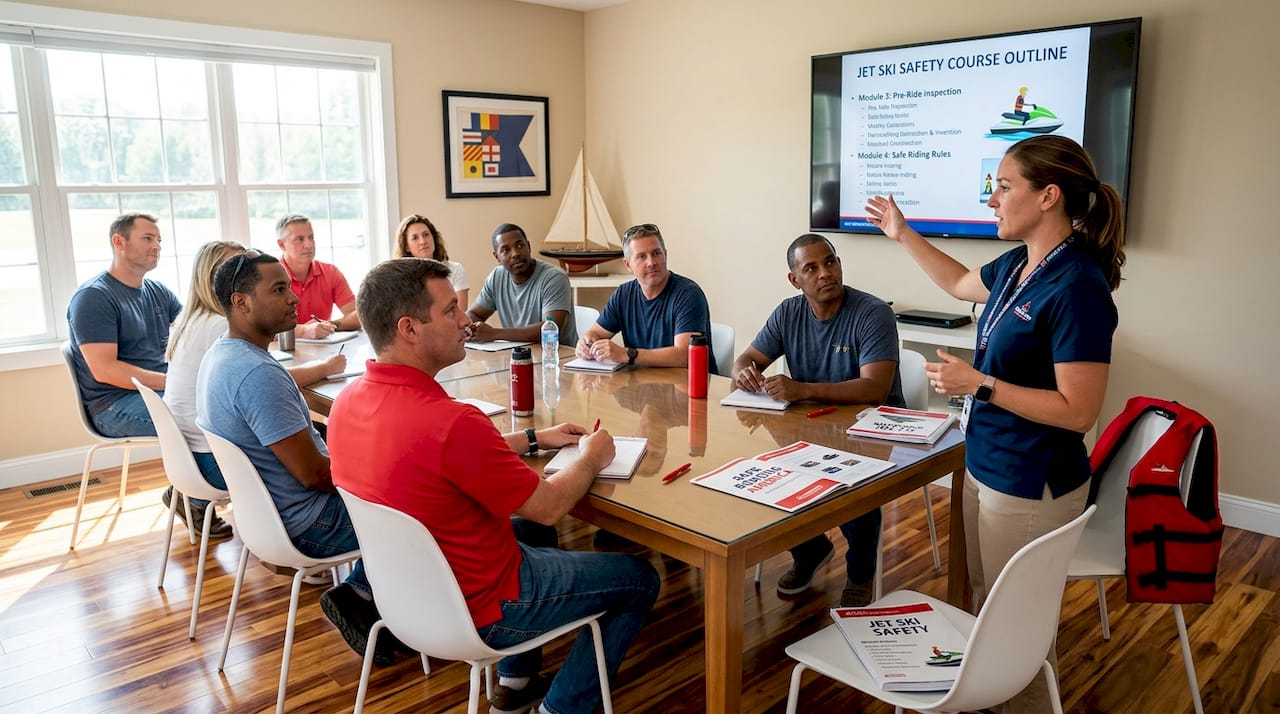
In-person jet ski training courses are taught by certified instructors in a classroom setting, typically over four to eight hours in a single day or across two evenings. These courses offer direct interaction with instructors, the ability to ask real-time questions, and a structured learning environment that many students find more effective than self-paced online modules.
The content covers the same material as online courses but the format allows instructors to address local waterway conditions, specific navigation hazards in your area, and region-specific regulations in detail. These courses also tend to include group exercises and scenario walkthroughs that reinforce retention better than reading alone.
For first-time operators or anyone who has struggled with online learning formats, in-person classroom instruction often delivers better outcomes on the certification exam. Cost is typically similar to online courses, ranging from $30 to $75 depending on the provider and state.
5. Hands-on practical training courses
Practical, on-water courses go beyond the classroom. These jet ski training courses put you on the water with an instructor and include direct operation experience, docking practice, emergency stop drills, and situational awareness exercises. Demand for this format is growing, particularly in states with stricter enforcement like New York, where real-world condition training is increasingly seen as a minimum standard for safe operation.
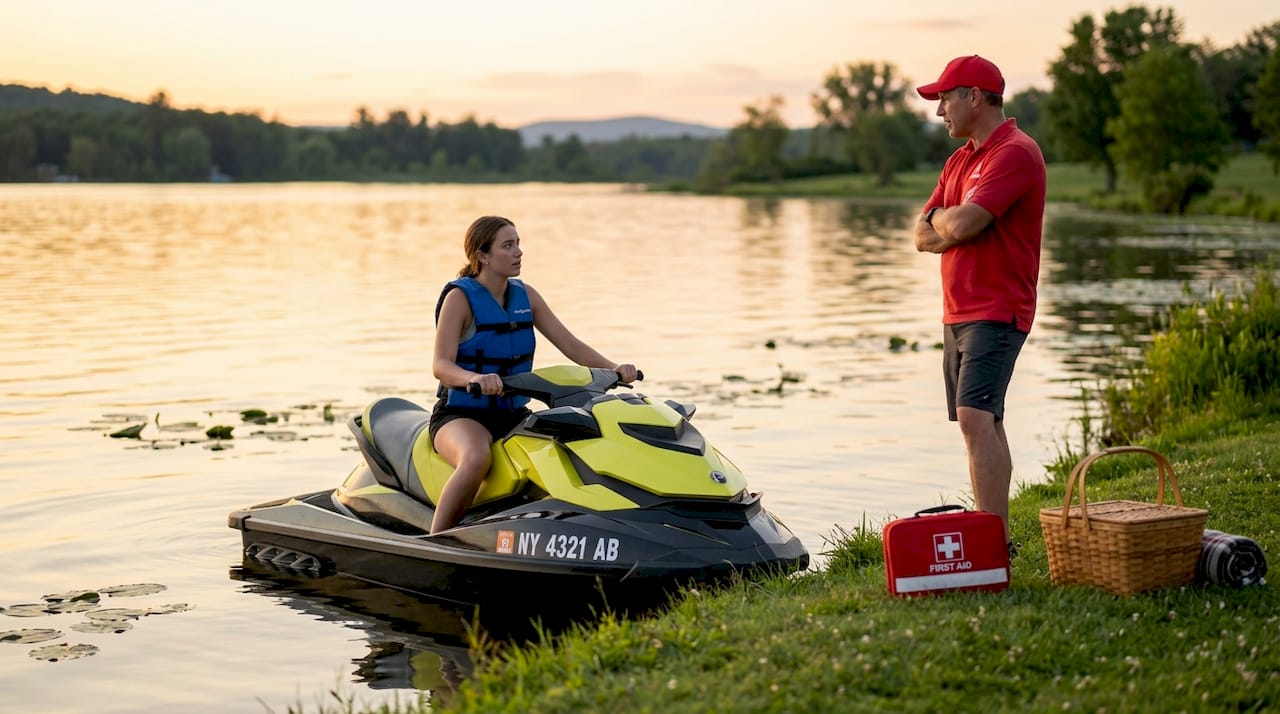
Hands-on courses typically take a full day and cost more than theory-only options, often $100 to $300. They are the right choice for new operators who want actual operating experience, not just a certificate.
One important note: passing a practical skills assessment does not automatically satisfy your state’s written exam requirement. Most states still require the completion of an approved educational component and a written test regardless of demonstrated on-water proficiency.
6. Same-day temporary certificate courses
Jet ski certification same day explained simply: you complete an approved online course, pass the exam, print or download a temporary certificate, and you are legally cleared to operate the same day. Temporary certificates allow immediate operation while your permanent card processes, which typically takes 2 to 4 weeks.
This format is ideal for rental situations, last-minute vacation needs, or operators who learned too close to their planned launch date. Florida’s 90-day temporary certificate structure is one of the most well-documented examples of this approach.
The key limitation is that temporary certificates are not accepted everywhere for every purpose. Some states require the permanent card for documented vessels or formal charter situations. Confirm what your specific use case requires before relying solely on a temporary certificate.
7. Courses for minors and age-specific requirements
Age-specific certification rules apply in most states. Jet ski licenses for minors involve minimum age thresholds, mandatory adult supervision requirements, and in many cases, completion of a state-approved course regardless of supervision status.
In Florida, for example, operators under 14 cannot legally operate a PWC without an adult on board. Those aged 14 to 17 must have a boating safety education ID. New York’s Brianna’s Law applies to operators of all ages. These rules change frequently as states update their mandatory education requirements.
If you are enrolling a minor, choose a course explicitly approved for that state’s minor operator requirements. Standard adult online courses may not satisfy the documentation requirements for underage operators even if the content is the same.
8. Comparing course types at a glance
| Course type | Format | Duration | Cost | NASBLA approved | Same-day cert | Best for |
|---|---|---|---|---|---|---|
| Online self-paced | Virtual | 3 to 6 hours | $50 to $60 | Yes (most) | Yes | Experienced operators, convenience seekers |
| In-person classroom | Classroom | 4 to 8 hours | $75 to $100 | Yes (most) | Yes | First-timers, interactive learners |
| Hands-on practical | On-water | Full day | $100 to $300 | Varies | No | New operators wanting real skills |
9. Choosing the right course for your situation
The right course depends on four factors: your state’s requirements, how soon you need to operate, your budget, and your current skill level.
- Operating in multiple states. Choose a NASBLA-approved course from a nationally recognized provider. Portability is the priority.
- Need to operate this weekend. An online course with same-day temporary certificate is the fastest legal path. Look for jet ski certification same day options from approved providers.
- First-time operator with no water experience. Start with an in-person classroom course and supplement with a hands-on practical session if available in your area.
- Operating only in one state. A state-specific course, including free state agency options, may satisfy all your requirements at the lowest cost.
- Enrolling a minor. Confirm minor-specific approval with your state boating authority before registering.
- Renting a jet ski on vacation. A temporary online boating certificate from an approved provider is sufficient for most rental operations.
Pro Tip: Complete your certification before boating season starts. Courses fill quickly in spring and early summer, and waiting until the weekend before your first trip creates real risk of missing your window. A certificate obtained in January works just as well in July.
More states are expanding PWC education mandates to include electric boats and high-powered watercraft. The certification you obtain now may cover future vessel types under your state’s evolving rules.
My take on what most people get wrong about jet ski certification
I’ve reviewed hundreds of boating education programs, and the single biggest misconception I see is that experience substitutes for certification. It does not. California removed experience exemptions entirely, and most states are trending the same direction.
The second issue is treating the fastest option as the best option. Temporary certificates are legitimate and useful. But an operator who passed a 10-minute online quiz and heads out into heavy boat traffic on a holiday weekend is not prepared, even if they are technically legal. In my view, anyone new to PWC operation should complete at minimum a full-length in-person course, then supplement with on-water time before going out alone.
I also think NASBLA approval is under-discussed in the context of course selection. Most people pick a course based on price or convenience. NASBLA approval is the one criterion that determines whether your certificate works across state lines and holds up under legal scrutiny. It should be the first filter, not an afterthought.
The distinction between a license and an education certificate is also worth understanding. You are not getting a license in the DMV sense. You are completing a state-mandated education requirement. That framing changes how you approach the process. Take it seriously, choose a real course, and the certificate you earn will serve you for life in most states.
— Richard
Get certified through Safeboatingamerica
Safeboatingamerica offers NASBLA-approved jet ski and PWC certification courses across every U.S. state, including state-specific programs built around local regulations in New York, Connecticut, Florida, New Jersey, and beyond. Courses are taught by State Certified Instructors and USCG-Licensed Captains using materials that satisfy each state’s exact boating education requirements.
Whether you need a same-day temporary certificate for a weekend rental or a permanent boater education card that follows you across state lines, Safeboatingamerica has a format that fits. Online courses issue immediate temporary certificates in qualifying states. In-person and live virtual options provide the depth and interaction first-time operators need. Visit Safeboatingamerica to find your state’s approved course and start the certification process today.
FAQ
What are the main jet ski certification course types?
The main types are NASBLA-approved online self-paced courses, state-specific online courses, in-person classroom courses, hands-on practical on-water courses, and temporary certificate programs. Each varies in duration, cost, and accepted states.
Can I get jet ski certified the same day?
Yes. Most NASBLA-approved online courses issue a printable temporary certificate immediately after you pass the exam. Temporary certificates are valid for legal operation in most states while your permanent card processes over 2 to 4 weeks.
Is a jet ski license the same as a boater education certificate?
No. What you receive is a boater education certificate, not a license in the traditional sense. It documents that you completed a state-approved safety course, which is the legal requirement for PWC operation in most states.
Does experience exempt me from jet ski certification?
No. Experience does not substitute for certification in any U.S. state. States including California have removed all experience exemptions, making completion of an approved boater education course mandatory regardless of operating history.
Which jet ski certification course works in multiple states?
A NASBLA-approved course from a nationally recognized provider gives you the broadest multi-state recognition. NASBLA certification is recognized by the U.S. Coast Guard and the vast majority of state boating agencies, making it the most portable option available.