
NASBLA Boating Safety Standard: What Boaters Must Know

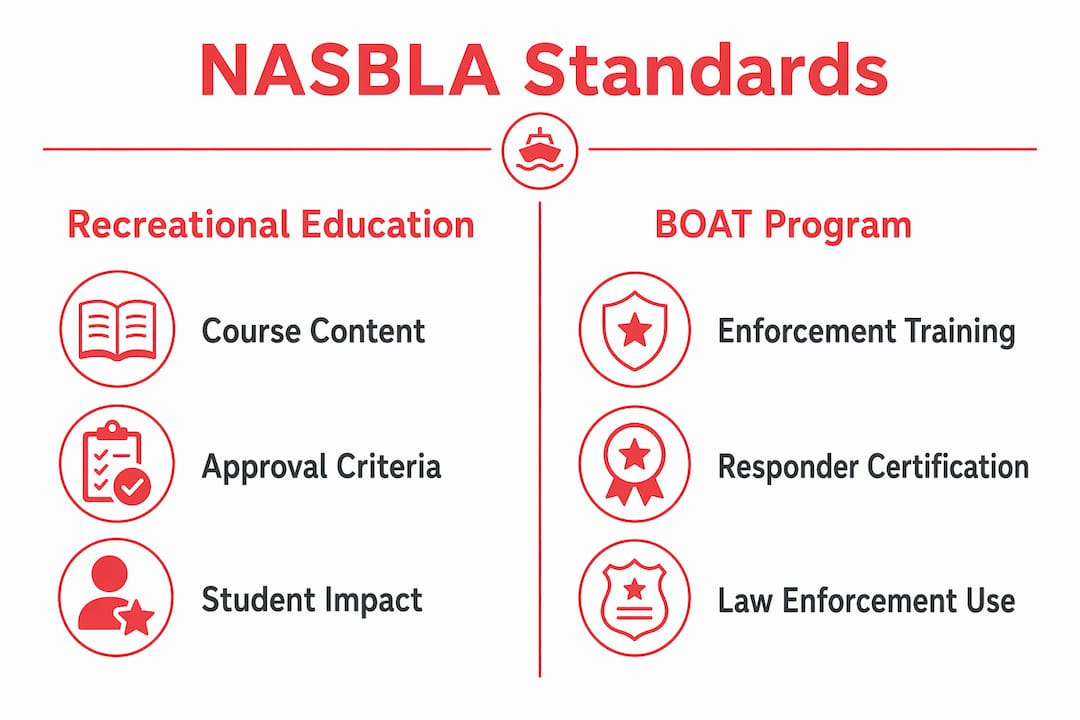
The NASBLA boating safety standard is defined as a set of nationally recognized education and training benchmarks developed by the National Association of State Boating Law Administrators to improve boating safety across the United States. NASBLA operates as a standards-setting body, not a direct certification issuer, which is a distinction most boaters miss entirely. Its standards cover two separate worlds: recreational boater education for the general public, and maritime law enforcement training for emergency responders. Understanding both sides of the NASBLA framework tells you exactly what your state requires, which courses count, and why your boating safety certificate carries legal weight on the water.
What does the NASBLA boating safety standard cover for recreational boaters?
The NASBLA boating safety standard for recreational boaters defines the minimum knowledge areas that any approved boating education course must teach. States adopt these standards and require boaters to complete NASBLA-approved courses before operating motorized vessels, particularly for younger operators. The standard is the backbone of every state boating license program in the country.
NASBLA-approved boating safety courses must cover the following core subject areas:
- Navigation rules: Right-of-way, buoy systems, channel markers, and collision avoidance
- Safety equipment: Life jackets, fire extinguishers, visual distress signals, and sound-producing devices
- Emergency procedures: Man overboard response, capsizing, grounding, and distress signaling
- Boating laws: State-specific regulations, registration requirements, and operator age restrictions
- Environmental awareness: No-discharge zones, fuel spill prevention, and protected waterways
- Vessel operation: Docking, anchoring, trailering, and fueling procedures
These subjects are not optional additions. NASBLA guidelines require course providers to address each area before a student qualifies for a boating safety certificate. This is why boating safety education from a NASBLA-approved provider carries legal recognition across state lines.
States implement these standards through their own boating law programs, which means the course content is consistent even when the issuing agency differs. A boater who completes a NASBLA-approved course in Texas holds credentials that Massachusetts, New York, and Florida will recognize. That cross-state recognition is a direct result of NASBLA’s national standardization work.

Pro Tip: Before enrolling in any boating safety course, confirm it carries explicit NASBLA approval. A course labeled “boating safety” without that approval may not satisfy your state’s legal requirement for certification.
How does NASBLA’s BOAT Program set standards for maritime law enforcement?
The NASBLA BOAT Program is the national standard for maritime law enforcement and emergency response training, formally recognized by the U.S. Coast Guard through a Memorandum of Understanding. This program is entirely separate from recreational boater education. It targets law enforcement officers, search and rescue teams, and emergency responders who operate vessels in professional capacities.
The BOAT Program includes a structured catalog of specialized courses:
- Boat Crew Member: Foundational training for personnel operating as part of a vessel crew in law enforcement or rescue contexts
- Boat Operator Search and Rescue: Specialized training for locating and recovering persons in distress on the water
- Tactical Operator’s Course: Advanced training for law enforcement officers conducting vessel-based tactical operations
- Pursuit and Stop: Procedures for safely pursuing and stopping vessels under law enforcement authority
- Coxswain and Boat Captain courses: Command-level training for vessel operators leading crew operations
The BOAT Program also maintains a centralized certification tracking database to monitor currency requirements for all credentialed responders. This means a law enforcement officer’s qualifications are tracked nationally, not just at the agency level. Responders must maintain active certification status to remain qualified, which prevents credential gaps in emergency response teams.
The practical implication for recreational boaters is straightforward: the officers inspecting your vessel and the rescue teams responding to a distress call are trained under NASBLA BOAT Program standards. The same organization that sets your education requirements also sets the professional standards for the people keeping you safe on the water.
Pro Tip: If you work in maritime law enforcement or emergency response, NASBLA BOAT Program credentials are not interchangeable with recreational boater education certificates. They require separate enrollment, separate courses, and separate currency maintenance.
What are the different types of NASBLA standards?
NASBLA standards fall into two distinct categories, and confusing them leads to real compliance errors. The first category covers recreational boating education and BOAT Program training requirements. The second category covers formal American National Standards, developed through the American National Standards Institute process and published under the ANSI/NASBLA designation.
| Standard Type | Scope | Who It Affects |
|---|---|---|
| Recreational education standards | Course content, approval criteria, and certification recognition for public boaters | Boat owners, operators, and course providers |
| BOAT Program standards | Maritime law enforcement and emergency responder training curricula and currency requirements | Law enforcement officers and rescue personnel |
| ANSI/NASBLA formal standards | Investigative procedures, human factors assessment, and incident analysis protocols | Boating incident investigators and law enforcement |
| Federal/state equipment regulations | Vessel equipment carriage requirements like life jackets and fire extinguishers | All vessel operators, governed by U.S. Coast Guard rules |
The most recent formal standard, ANSI/NASBLA 500-2025, addresses investigative training for boating incidents. It covers scene security, interview procedures, evidence preservation, and human factors analysis in accident investigations. This standard directly shapes how law enforcement agencies train their investigators to handle boating fatalities and serious accidents.
One point that trips up many boaters: NASBLA standards do not set vessel equipment carriage requirements. Life jacket counts, fire extinguisher ratings, and flare requirements come from U.S. Coast Guard rules and state law, not from NASBLA. NASBLA teaches you what equipment you need and how to use it. The legal mandate to carry that equipment comes from a different authority entirely.
How do NASBLA standards affect your boating certification and legal requirements?
NASBLA standards translate into legal requirements through state boating law programs, which adopt the national framework and enforce it through approved course providers and state-issued credentials. The process works in three steps: NASBLA sets the standard, states adopt it, and approved providers deliver the training.
Here is how that process affects you as a boater:
- Complete a NASBLA-approved course. Your state requires completion of a course that meets NASBLA guidelines. This applies to motorboat operators in most states, with age thresholds varying by jurisdiction.
- Receive your state-issued boating safety certificate. The certificate is issued by your state or an approved provider, not by NASBLA directly. NASBLA does not issue certificates to individual boaters.
- Carry your certificate on the vessel. Most states require operators to have their certificate available for inspection while underway. A digital copy may satisfy some states; others require the physical card.
- Recognize out-of-state credentials. If you completed a NASBLA-approved course in another state, most states will accept that credential without requiring you to retake the course. Some states offer a formal conversion process.
- Understand certificate validity. NASBLA-approved certificates carry no expiration date in most states. Once earned, the credential remains valid for life under current standards, though individual states may impose additional requirements.
The Massachusetts Hanson-Milone Boater Safety Act illustrates how states implement NASBLA standards into law. Starting April 1, 2026, Massachusetts requires motorboat operators to carry a boating safety certificate on board. Existing NASBLA-approved certificates from any state satisfy this requirement without additional testing. This is NASBLA’s national standardization working exactly as designed: one approved course, recognized everywhere.
Understanding why boating safety education is mandatory in most states becomes clearer when you see how NASBLA standards create a consistent legal baseline across all 50 states.
What boaters commonly misunderstand about NASBLA standards
The most persistent misconception is that NASBLA itself certifies boaters. NASBLA is a standards body, not a certification authority. It develops model acts, public policies, and standard guidelines that states adopt and enforce. Your certificate comes from your state or an approved provider, not from NASBLA headquarters.
Several other misunderstandings create real problems for boaters:
- “Any boating course counts.” Only courses with explicit NASBLA approval satisfy state legal requirements. A general water safety class or a manufacturer’s orientation does not qualify.
- “NASBLA sets equipment rules.” Equipment carriage requirements come from the U.S. Coast Guard and state law. NASBLA educates boaters about equipment but does not mandate what you carry.
- “My certificate expired.” NASBLA-approved certificates do not expire under the national standard. If you completed an approved course, your credential remains valid in states that follow the NASBLA framework.
- “I need to retake the course in every state.” Most states recognize out-of-state NASBLA-approved credentials. Check your destination state’s specific rules before assuming you need additional training.
Pro Tip: When traveling between states by boat, carry a copy of your boating safety certificate and note which state issued it. Most states accept NASBLA-approved credentials from other jurisdictions, but having documentation of the issuing authority speeds up any inspection.
NASBLA also monitors and influences boating laws to promote consistency across states, which means the standards you follow today reflect an ongoing national effort to reduce boating accidents and fatalities through education.
Key takeaways
NASBLA boating safety standards define the national education and training benchmarks that states use to approve courses, issue credentials, and enforce boating safety requirements for both recreational operators and maritime responders.
| Point | Details |
|---|---|
| NASBLA’s dual standard system | Recreational boater education and BOAT Program responder training operate under separate curricula and credentialing processes. |
| States issue the certificates | NASBLA sets the standard; your state or an approved provider issues your actual boating safety certificate. |
| No expiration on approved credentials | NASBLA-approved boating safety certificates carry no expiration date under the national standard. |
| Equipment rules come from elsewhere | Vessel equipment carriage requirements are set by U.S. Coast Guard and state law, not by NASBLA. |
| Cross-state recognition applies | Most states recognize NASBLA-approved credentials from other states, eliminating the need to retake courses when traveling. |
Why NASBLA standards matter more than most boaters realize
From my perspective, the most underappreciated aspect of NASBLA’s work is the cross-state consistency it creates. Most boaters think of their certification as a local credential. In practice, it is a nationally portable document because NASBLA spent decades building the framework that makes that portability possible.
What I find genuinely useful to communicate is the distinction between the recreational education side and the BOAT Program side. Most boaters will never interact with BOAT Program training directly. But every time a Coast Guard auxiliary vessel responds to a distress call, or a marine patrol officer conducts a safety inspection, those personnel are operating under NASBLA standards. The same framework that trained you also trained the people responsible for your safety on the water.
The practical advice I give to any boat owner is this: choose your course carefully, confirm NASBLA approval before you enroll, and keep your certificate accessible on the vessel. The legal and safety benefits of completing a proper NASBLA-approved course extend well beyond passing an inspection. Boaters who understand navigation rules, emergency procedures, and equipment use make better decisions in the situations where those decisions matter most. That is the real purpose of the standard, and it is worth taking seriously.
— Richard
Get your NASBLA-approved boating certification with Safeboatingamerica
Safeboatingamerica delivers NASBLA-approved boating safety courses across every U.S. state, taught by State Certified Instructors and USCG-Licensed Captains. Whether you need an online course, a live Zoom class, or an in-person session, Safeboatingamerica offers formats that fit your schedule and satisfy your state’s legal requirements.
Courses cover navigation rules, emergency procedures, personal watercraft safety, and all core NASBLA subject areas. Students in New York, Connecticut, Florida, and beyond receive state-recognized certificates upon completion. If you need a Florida boating certification or coverage in any other state, Safeboatingamerica provides accessible, same-day certification options that meet NASBLA boating safety standards and get you legally on the water fast.
FAQ
What is NASBLA and what does it do?
NASBLA stands for the National Association of State Boating Law Administrators. It develops national education and training standards for recreational boating safety and maritime law enforcement, which states adopt to approve courses and issue boating safety credentials.
Does NASBLA issue boating safety certificates directly?
No. NASBLA sets the standards that states use to approve courses and recognize credentials. Your boating safety certificate is issued by your state or an approved course provider, not by NASBLA itself.
Are NASBLA-approved boating certificates valid in all states?
Most states recognize NASBLA-approved credentials from other states without requiring additional testing. Some states offer a formal conversion process, so confirming your destination state’s specific rules before traveling is recommended.
What is the NASBLA BOAT Program?
The BOAT Program is NASBLA’s national standard for maritime law enforcement and emergency responder training, recognized by the U.S. Coast Guard. It includes courses like Boat Crew Member, Boat Operator Search and Rescue, and the Tactical Operator’s Course, and is separate from recreational boater education.
Do NASBLA boating safety certificates expire?
NASBLA-approved boating safety certificates carry no expiration date under the national standard. Once you complete an approved course, your credential remains valid in states that follow the NASBLA framework, though individual state rules may vary.
Recommended
- Why boating safety education is mandatory - Safe Boating America
- How Boating Education Lowers Accident Rates and Saves Lives - Safe Boating America
- Minnesota Boating License: What You Need to Know in 2026 - Safe Boating America
- What is boating safety education: your guide to certification - Safe Boating America