Replace Your Boating License in One Day, NASBLA Approved in the U.S.
That certificate functions as your license in most states. We offer state-specific, NASBLA-aligned courses online, live via Zoom, and in-person, so you can finish the requirement in a single sitting.
TL;DR:
- Many states require specific age and horsepower thresholds, so verifying these rules before enrolling prevents wasting time or enrolling in the wrong course.
- Only NASBLA-approved courses are recognized across most states, making it critical to confirm approval and reciprocity agreements before course completion.
- The course duration averages between 3 to 8 hours, with a standard passing score of 80 percent on the final exam needed for certification.
- Immediate proof includes a printable temporary certificate, while the permanent card typically arrives after several weeks; keeping a photo or physical copy is strongly advised.
- Reissuing a lost certificate requires contacting the original course provider, not the state, as they manage records to avoid unnecessary retakes.
Table of Contents
- Quick Pre-Enrollment Checklist Before You Sign Up
- Step-by-Step: Complete an Approved Course and Get Certified
- State Rules, Reciprocity, and Special Cases to Check First
- Why NASBLA Approval Matters for Compliance
- What Instructors Wish Every Student Knew Before Test Day
- Get Certified Today With Safe Boating America
- Where to Verify State Rules and Course Approval
- Sources
- FAQ
Quick Pre-Enrollment Checklist Before You Sign Up
Before you register for any course, confirm three things. Getting these wrong means wasted hours or a certificate your state won’t accept.
- Check your state’s born-on year and horsepower thresholds on your state boating agency’s website, since rules differ by state and vessel type.
- Have a photo ID, an active email address, and a payment method ready. Some states also charge a small separate fee for a physical card.
- Pick your format: self-paced online, live Zoom class, or in-person session, depending on how much seat time your state requires and how soon you need proof.
Age and horsepower cutoffs trip up more students than the exam itself. A 14-year-old operating a 12-horsepower boat might need a certificate in one state and be exempt in another.
Pro Tip: Screenshot your state’s exact age and horsepower rule before you enroll. Course providers can’t waive a requirement your state sets, and re-taking a course because you picked the wrong track wastes both time and money.
Step-by-Step: Complete an Approved Course and Get Certified
Getting certified breaks down into four steps. Skip none of them, and you’ll walk away with proof you can legally operate a boat or personal watercraft.
- Confirm the provider is approved for your state. Look for NASBLA course approval and cross-check your state agency’s approved-provider list. Not every “certified” course carries both.
- Enroll and work through the modules. Expect 3 to 8 hours of total course material, and follow any minimum seat-time rule your state imposes, which prevents students from clicking through content too fast.
- Pass the final exam. Most exams run 50 to 100 multiple-choice questions, and the standard passing score is 80%.
- Pay any remaining fees and secure your proof. Print your temporary certificate immediately. It counts as legal proof of completion in most states while you wait on a mailed permanent card.
Course fees typically land between $0 and $50, depending on your state and provider. That range covers everything from free nonprofit offerings to full-service paid classes with live instructors.
Here’s the part most students overlook: if you already hold a certificate and lost it, you don’t call your state’s DMV. You contact your original course provider to request a reissue, since providers and state boating offices manage certificate records directly rather than routing them through motor vehicle agencies. Keep your provider’s name and the approximate completion date on hand. That’s usually all it takes to get a duplicate certificate reissued without retaking the course.
Once you pass, your temporary certificate is your immediate proof. Permanent plastic cards, where states issue them, typically arrive after some weeks. Don’t wait on the mail if you’re heading out on the water this weekend.
State Rules, Reciprocity, and Special Cases to Check First
Boating education law is not federal. Every state sets its own age, horsepower, and vessel-type rules, and those rules shift more often than most boaters expect.
- California completed its rollout of universal boater card requirements in 2025, meaning most motorized vessel operators statewide now need a card regardless of age.
- New York enforces Brianna’s Law, which phased in mandatory education for all motorized boat operators; Safe Boating America’s NY-specific certification course walks through exactly what the law requires and how to add the boating endorsement to a New York State driver’s license.
- Massachusetts requires an Out of State Certificate Conversion form for boaters moving in with an out-of-state card, rather than simply accepting the original document at face value.
Most states honor NASBLA-approved certificates under reciprocity agreements, but “most” isn’t “all.” Some states demand a conversion form, a short state-specific quiz, or proof submission before they’ll recognize an out-of-state card. Personal watercraft operators face additional wrinkles too: several states require a separate PWC endorsement, set stricter solo-operation age minimums for jet skis than for boats, and carve out exemptions for active-duty military and U.S. Coast Guard credential holders. Rental customers sometimes get a narrow exemption for supervised, single-day use, but that exemption rarely extends to owning or regularly operating your own vessel.
Why NASBLA Approval Matters for Compliance
NASBLA approval means a course meets ANSI/NASBLA education standards, the benchmark most state agencies and marine enforcement officers reference when checking whether a certificate is legitimate. A course lacking that approval risks rejection at the point you actually need it, on the water, during a stop.
Safe Boating America builds its courses around this standard, with State Certified Instructors and USCG-licensed captains teaching state-specific content across online, Zoom, and in-person formats. That includes Brianna’s Law compliant classes for New York boaters and guidance on adding a boating endorsement directly to a NYS license where the option applies.
- Course approval is checked against both NASBLA’s national list, and each state agency’s own approved-provider registry.
- Instructors cover navigation rules, PWC safety, docking, trailering, and required safety equipment, not just exam trivia.
Pro Tip: If you’re boating in more than one state this season, confirm your certificate’s NASBLA status before you leave home. It’s the single fastest way to know whether reciprocity will actually apply.
What Instructors Wish Every Student Knew Before Test Day
Chapter quizzes aren’t busywork. Exam questions are frequently pulled straight from those same question pools, so treating each module quiz as your actual study guide, and re-taking any quiz you didn’t ace, does more for your pass rate than cramming a textbook the night before.
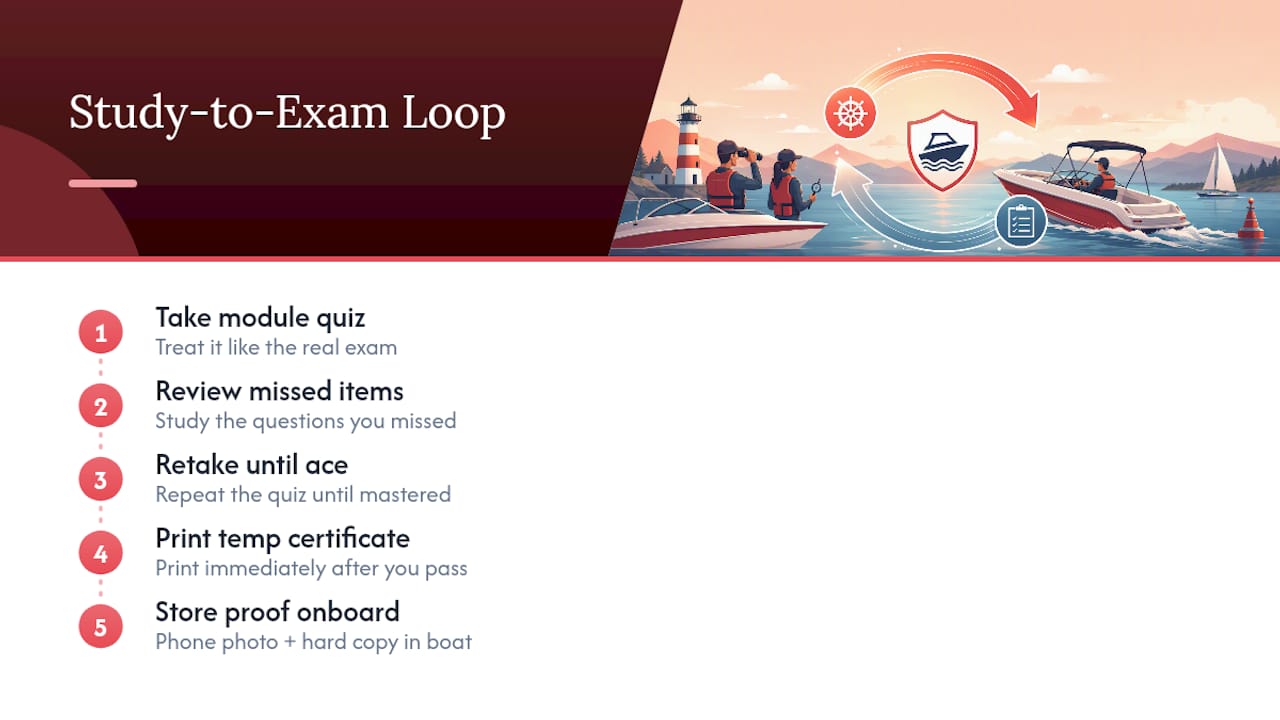
Print your temporary certificate the moment you pass. Don’t assume the mailed card will beat you to the dock. If you’re heading out within days of finishing your course, the printable proof is what you’ll actually need in hand.
One habit separates prepared boaters from the rest: keep a photo of your certificate saved on your phone and a physical copy stored on the boat. Marine enforcement officers can and do ask for a hard copy, and a phone screenshot doesn’t always satisfy that request. A soaked, sun-faded printout stuffed in a dry bag still beats scrambling for a signal offshore.
— Richard
Get Certified Today With Safe Boating America
We run state-specific, NASBLA-aligned courses in every format that fits a real schedule: fully online, live via Zoom, or in-person, with active course availability in New York, Connecticut, California, Florida, Massachusetts, Rhode Island, Texas, and other states nationwide.
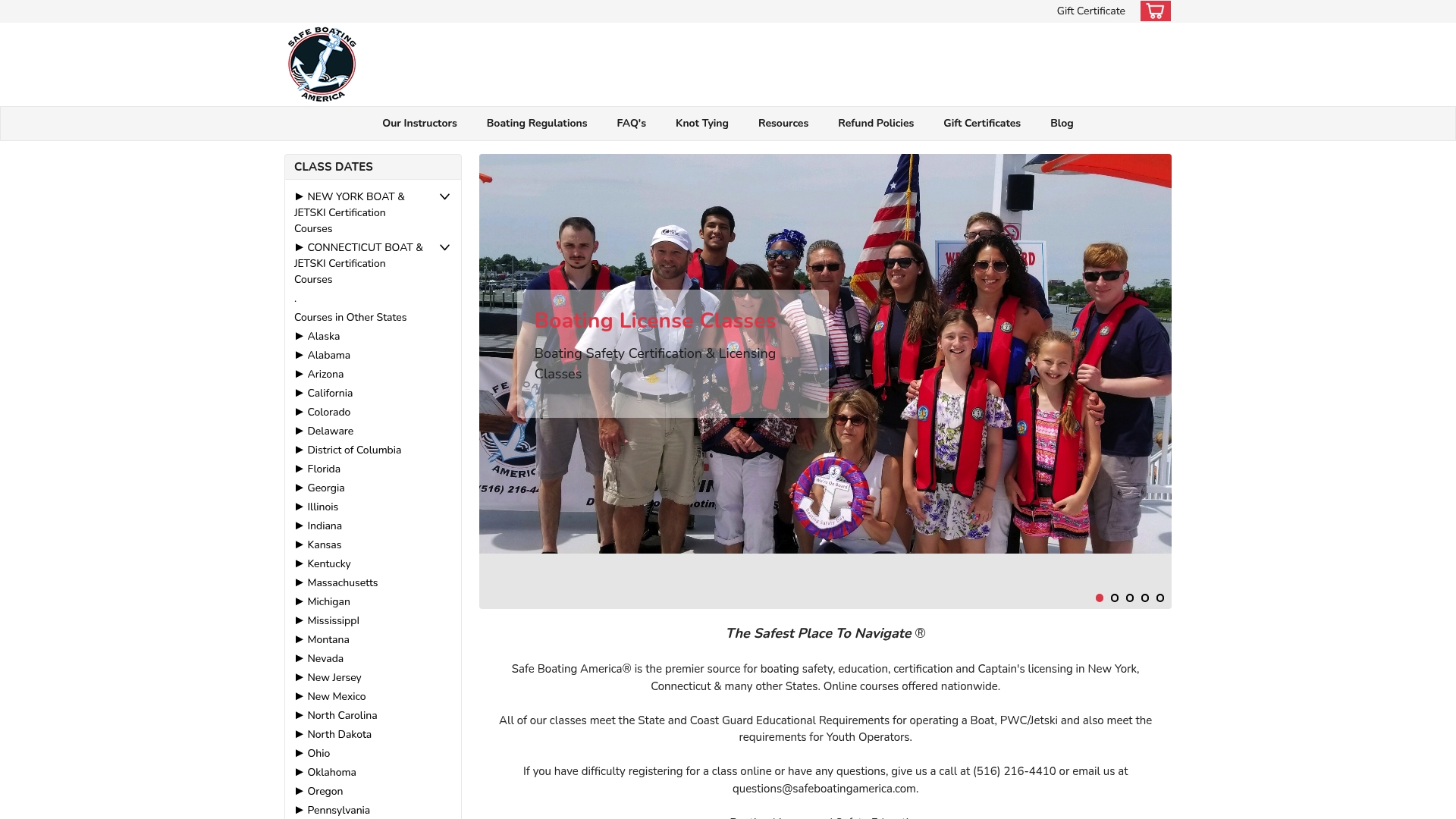
Registration takes a few minutes: pick your state, choose your format, and enroll. Many students finish the same day they start, print a temporary certificate the moment they pass, and receive a mailed permanent card afterward where their state issues one. If you already hold a certificate but lost it, your course provider (not a government office) is who reissues it. Whether you need a first-time certificate, a Jet Ski endorsement, or a Brianna’s Law compliant New York class, find your state’s course and register now to get on the water with valid proof in hand.
Where to Verify State Rules and Course Approval
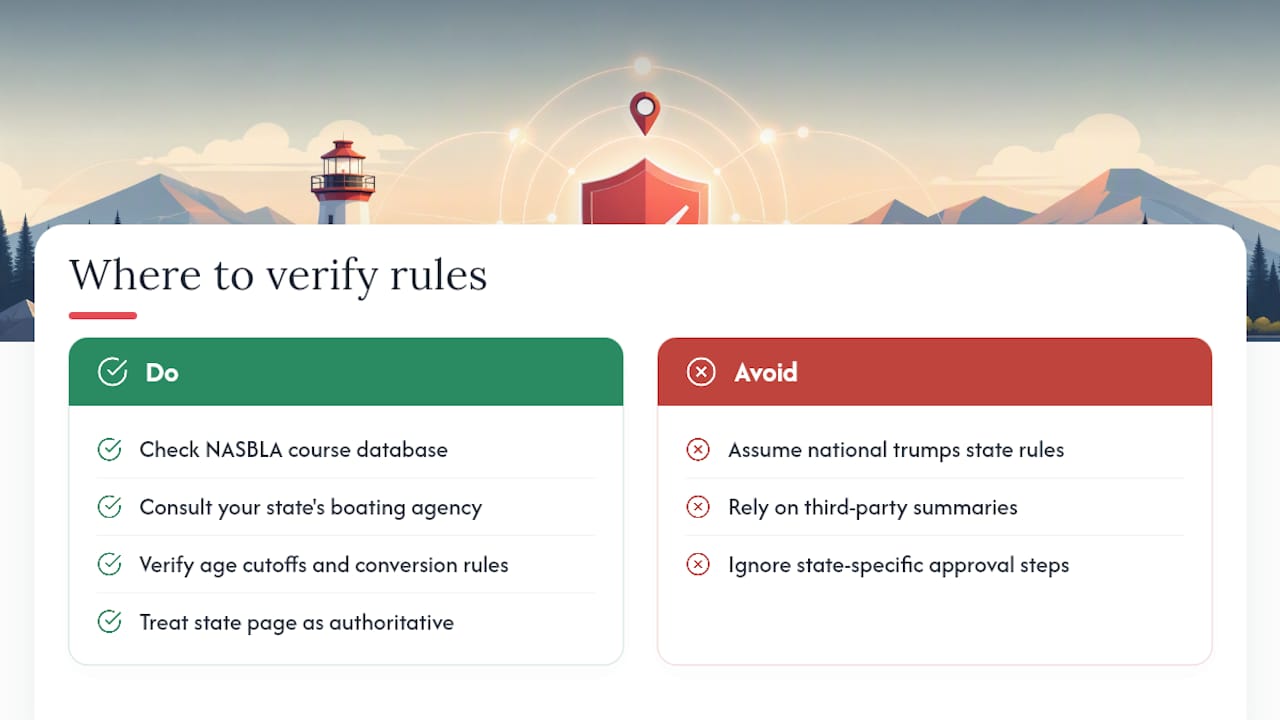
Confirm any course’s national standing through NASBLA’s course approval database. For state-specific rules, age cutoffs, and conversion procedures, check your own state’s boating agency directly, such as the California Division of Boating and Waterways or Massachusetts’s boater safety guidance. State pages carry the final word whenever they conflict with anything else you read.
Sources
- NASBLA — Course approval overview
- California Division of Boating and Waterways — Boating education information
- Mass
- Missouri State Highway Patrol — Boating education FAQ
FAQ
How Do I Replace a Lost Boating Certificate?
Contact the course provider that issued your original certificate, not a DMV or state boating office, since providers manage reissue requests directly.
How Long Does an Approved Boating Course Take?
Most NASBLA-approved courses run 3 to 8 hours of total material, depending on your state’s seat-time requirements and the format you choose.
What Score Do I Need to Pass the Final Exam?
Most states set the passing threshold at 80% on a multiple-choice final exam covering the course modules.
Will My Certificate Work in Another State?
Usually yes, since most states honor NASBLA-approved certificates under reciprocity, though some, like Massachusetts, require an out-of-state conversion form first.
Does Safe Boating America Offer Courses in My State?
We run NASBLA-aligned, state-specific courses in New York, Connecticut, California, Florida, Massachusetts, Rhode Island, Texas, and other states, in online, Zoom, and in-person formats.