
Illinois Boating License: Requirements and How to Get Certified

A boating license in Illinois is a state-approved safety certification required for anyone born on or after january 1, 1998, who operates a motorboat with an engine over 10 horsepower. The Illinois Department of Natural Resources (IDNR) administers the program and mandates that operators carry proof of completion at all times on the water. Illinois boating laws treat certification as a legal requirement, not a suggestion. Failing to comply puts you at risk of fines, citations, and restricted access to Illinois waterways. Safeboatingamerica offers IDNR-approved courses that satisfy this requirement fully.
Who needs a boating license in Illinois?
Illinois boating certification requirements are more specific than most boaters realize. The law targets a defined group based on birthdate, engine size, and vessel type. Knowing exactly where you fall prevents costly mistakes.
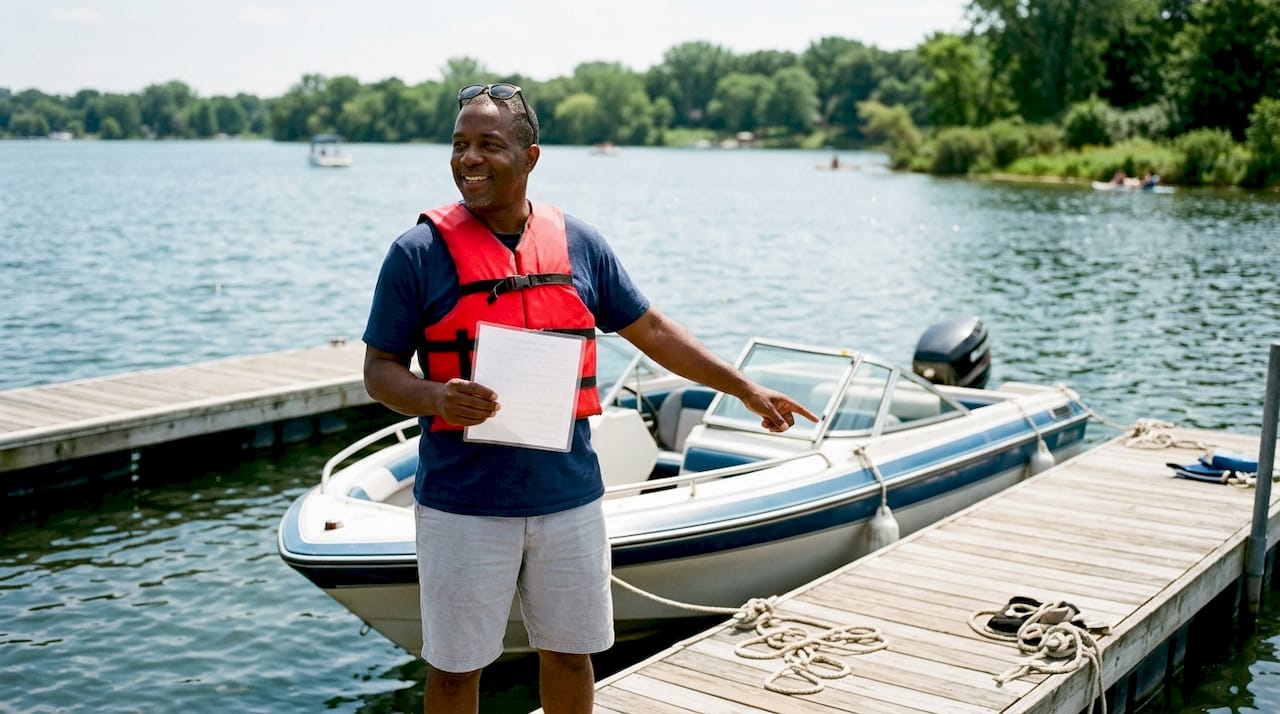
The core rule is straightforward: boaters born on or after january 1, 1998, must complete an approved boating safety course before operating any motorboat with an engine exceeding 10 horsepower. That certificate must be on your person every time you operate the vessel.
Several exemptions apply:
- Non-motorized vessels: Canoes, kayaks, paddleboards, and sailboats without motors are exempt from the education requirement.
- Low-horsepower engines: Operating a motorboat under 10 horsepower does not trigger the certification requirement, regardless of the operator’s birthdate.
- Rental exemptions: Boaters who rent a vessel and receive a safety orientation from the rental provider are exempt for that specific rental period.
- Minors under 12: Children under 12 may not operate a motorboat over 10 horsepower without direct adult supervision, even if they hold a certificate.
- Supervised operation: Minors aged 12 and older may operate qualifying vessels if a certified adult is physically present on board.
The exemptions are narrow. If you were born after january 1, 1998, and you plan to operate any motorboat above 10 horsepower on Illinois waters, you need the certificate. There is no workaround.
How to get your Illinois boating license: approved courses and certification
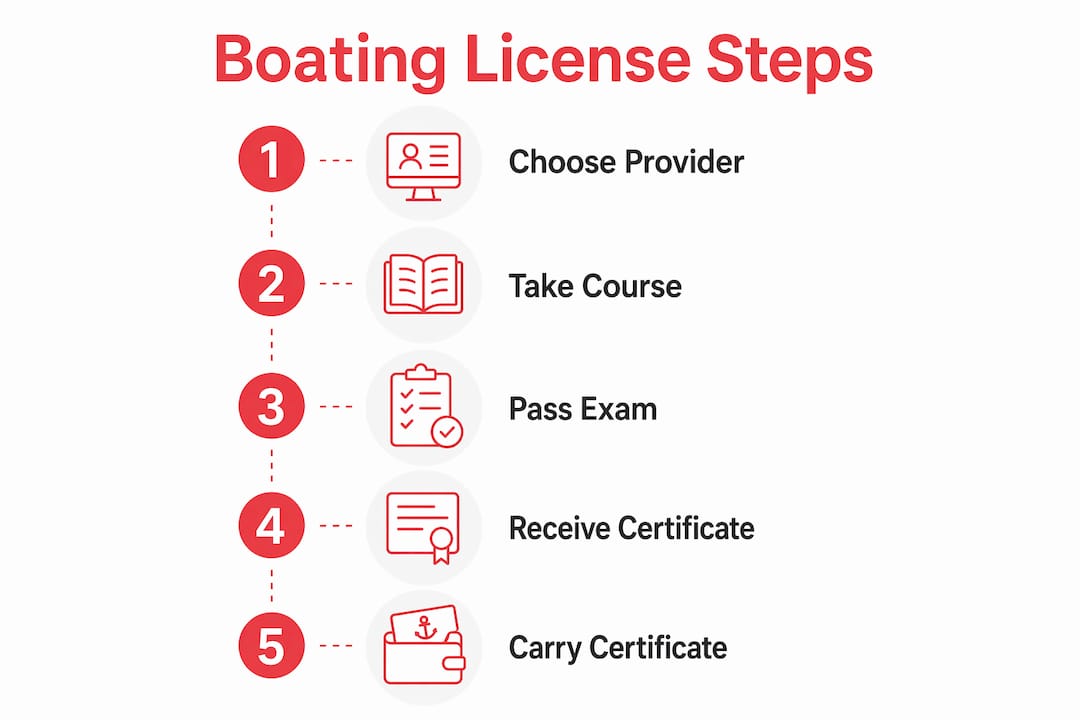
The certification process follows a clear sequence. Illinois requires a minimum of eight hours of boating safety education covering safety basics, equipment rules, and operating procedures. That education is available online, making it accessible from anywhere in the state.
- Choose an IDNR-approved course provider. The Illinois Department of Natural Resources maintains a list of approved providers. Safeboatingamerica offers an Illinois boating course that meets state requirements fully.
- Register and complete the coursework. Online courses let you work at your own pace. The curriculum covers navigation rules, emergency procedures, required safety equipment, and Illinois-specific boating laws.
- Pass the final exam. You must score a passing grade on the state-required exam to receive your certificate. Most providers allow retakes if you do not pass on the first attempt.
- Receive your boating safety certificate. After passing, you receive an official certificate of completion. This document serves as your Illinois boating license.
- Carry the certificate on the water. Illinois law requires you to have the certificate with you every time you operate a qualifying vessel. A digital copy on your phone may be accepted, but a physical copy is the safest option.
| Step | Action | Notes |
|---|---|---|
| 1 | Select IDNR-approved provider | Confirm approval before registering |
| 2 | Complete 8-hour curriculum | Online or instructor-led options available |
| 3 | Pass the final exam | Retakes typically permitted |
| 4 | Receive certificate | Issued immediately after passing |
| 5 | Carry certificate while boating | Required by Illinois law at all times |
Course fees vary by provider. Most online courses are priced accessibly, and the certificate does not expire once issued. That makes the one-time investment straightforward.
Pro Tip: Verify that your chosen provider is listed on the IDNR’s official approved provider page before you pay. Completing an unapproved course means starting over.
What are the key Illinois boating safety regulations?
Illinois boating regulations cover equipment, registration, and conduct on the water. Conservation officers actively patrol Illinois waterways, and failure to carry required safety gear results in citations regardless of how experienced the operator is.
Life jacket rules are the most strictly enforced:
- Children under 13 must wear a U.S. Coast Guard-approved personal flotation device (PFD) at all times while on deck or in an open boat.
- Personal watercraft (PWC) operators and passengers must wear a USCG-approved PFD at all times, with no exceptions, regardless of age.
- All other boaters must have a wearable PFD on board for every person, plus one throwable Type IV device on vessels 16 feet and longer.
Understanding life jacket regulations before you launch is the single most effective way to avoid a citation on the water.
Additional equipment requirements include:
- Fire extinguishers: Required on motorized vessels with enclosed compartments. The class and quantity depend on vessel size.
- Sound-producing devices: A horn or whistle is required on all vessels. Vessels 39.4 feet and longer must carry an electric horn and a bell.
- Navigation lights: Required for operation between sunset and sunrise, and during periods of restricted visibility.
- Visual distress signals: Required on Lake Michigan and other federally regulated waters. Flares or electronic signaling devices satisfy this requirement.
Illinois boat registration fees range from $28 for vessels under 16 feet to $210 for vessels 40 feet and longer. Registration certificates must be carried on board during every outing, and current decals must be displayed on the vessel.
Illinois boat registration is a separate obligation from the safety certificate. Both are required simultaneously.
What are the Illinois boating under the influence (BUI) laws?
Illinois treats boating under the influence as seriously as driving under the influence on public roads. The legal BAC limit is 0.08%, identical to the motor vehicle standard. That alignment is deliberate. Illinois law treats impaired operation of a vessel as a criminal matter, not a minor infraction.
Illinois legal experts note that the state treats boating violations as serious criminal offenses equivalent to road DUI, with penalties escalating sharply when children are present on the vessel during a violation.
The penalties for a first BUI offense are significant. A first offense is a Class A misdemeanor carrying up to 364 days in jail and a fine of up to $2,500. If a child under 16 is on board during the offense, the charge escalates automatically and community service becomes mandatory.
Repeat offenses and incidents involving serious injury or death carry felony charges. Conservation officers use field sobriety tests and chemical testing on the water, and they have full authority to board and inspect vessels. The enforcement presence on Illinois waterways is consistent, particularly on busy summer weekends.
The practical takeaway is simple. Alcohol on the water impairs judgment and reaction time faster than on land because sun, wind, and wave motion amplify its effects. Illinois law reflects that reality with penalties designed to deter.
Common mistakes when getting your Illinois boating license
Most certification errors are avoidable. The mistakes boaters make most often fall into predictable categories, and knowing them in advance saves time and money.
- Assuming age exempts you. Many boaters born before january 1, 1998, assume they are permanently exempt. That is currently true under Illinois law, but regulations can change. Completing a course voluntarily is always a sound decision.
- Forgetting to carry the certificate. The certificate must be physically present on the vessel. Leaving it at home is treated the same as not having one. Keep a waterproof copy on board.
- Choosing an unapproved provider. Not every online boating course is approved by the IDNR. Always verify approval status before enrolling.
- Ignoring equipment requirements. Certification does not replace the obligation to carry required safety gear. Officers check both.
- Underestimating the exam. The Illinois boating safety exam covers specific state laws and USCG regulations. Rushing through the coursework leads to exam failures and delays.
Pro Tip: Review the IDNR’s official equipment checklist before every outing. Conservation officers cite equipment violations as frequently as certification violations, and a missing fire extinguisher or expired flare costs the same as an uncertified operator.
For a faster path to certification, Safeboatingamerica’s online boating courses are structured to cover all required material efficiently without cutting corners on content.
Key Takeaways
Illinois boating certification is a legal requirement for operators born on or after january 1, 1998, who operate motorboats over 10 horsepower, and compliance covers both education and equipment.
| Point | Details |
|---|---|
| Who must certify | Operators born on or after January 1, 1998, running motorboats over 10 horsepower must hold a certificate. |
| Course requirement | Illinois mandates at least 8 hours of IDNR-approved boating safety education before certification. |
| Certificate never expires | The boating safety certificate is a lifetime document, but registration and equipment must be renewed separately. |
| BUI carries criminal penalties | A first BUI offense is a Class A misdemeanor with up to 364 days in jail and a $2,500 fine. |
| Equipment compliance is mandatory | Life jackets, fire extinguishers, and navigation lights are required regardless of certification status. |
Illinois waterways deserve more than a checkbox
I have spent enough time around Illinois boating enforcement to say this plainly: most boating accidents on Illinois lakes and rivers are not caused by ignorance of the rules. They are caused by boaters who knew the rules and chose to cut corners anyway.
The certification requirement for operators born after january 1, 1998, is a reasonable baseline. But the eight hours of coursework is genuinely useful, not just bureaucratic box-checking. The section on emergency procedures alone covers scenarios that experienced boaters handle badly because they never practiced them mentally.
What strikes me most about Illinois boating enforcement is how consistent it is. Conservation officers do not wait for accidents to happen. They board vessels, check equipment, and test for impairment on routine patrols. The BUI enforcement culture in Illinois is among the most active in the Midwest. That is a good thing, even if it surprises boaters who treat the water as a regulation-free zone.
My honest view is that the equipment requirements are where most boaters underinvest. A valid certificate and an expired fire extinguisher is still a citation. The gear requirements exist because they save lives in situations where the certificate is irrelevant. Treat both as equally non-negotiable.
— Richard
Safeboatingamerica’s Illinois boating certification courses
Safeboatingamerica offers IDNR-approved boating safety certification courses designed to meet Illinois requirements fully. Courses are available online, letting you complete the required eight hours of instruction at your own pace from any device.
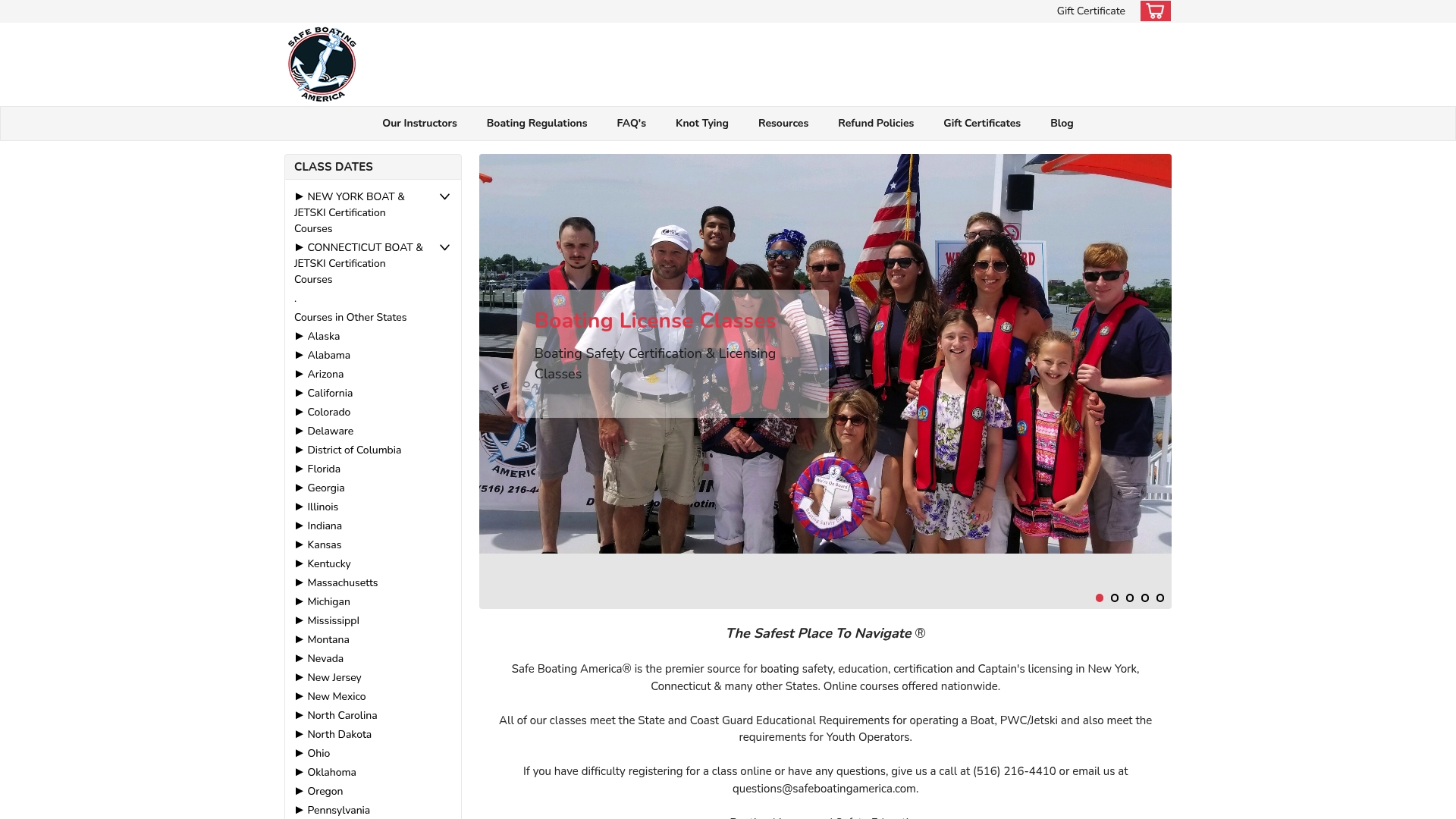
The curriculum covers Illinois boating laws, USCG equipment standards, navigation rules, emergency procedures, and personal watercraft safety. Instructors hold state certifications and USCG credentials. After passing the final exam, you receive your official certificate immediately. Safeboatingamerica’s courses are built for first-time boaters and returning operators who need to meet the state’s education mandate before getting on the water.
FAQ
Who needs a boating license in Illinois?
Anyone born on or after january 1, 1998, who operates a motorboat with an engine over 10 horsepower must hold a valid Illinois boating safety certificate. Operators of non-motorized vessels and motorboats under 10 horsepower are exempt.
Does an Illinois boating license expire?
The Illinois boating safety certificate does not expire. It is a lifetime document, though you must still carry it on board every time you operate a qualifying vessel.
Can I take the Illinois boat safety course online?
Yes. The IDNR approves online boating safety courses that satisfy the eight-hour education requirement. Safeboatingamerica offers a fully online Illinois course that meets state standards.
What is the BUI limit in Illinois?
Illinois sets the legal blood alcohol concentration limit for boating at 0.08%, the same threshold as motor vehicle law. A first offense is a Class A misdemeanor with penalties up to 364 days in jail and a $2,500 fine.
Do children need to wear life jackets in Illinois?
Children under 13 must wear a USCG-approved PFD at all times while on deck or in an open boat. All personal watercraft operators and passengers must wear a PFD regardless of age.
Recommended
- Illinois Boating Course
- License for a Jet Ski: State Requirements and How to Get Certified - Safe Boating America
- 50-State Boating License & Jet Ski Certification Guide (2026) - Safe Boating America
- Illinois Boating License & Jet Ski License: How to Get Your Illinois Boat Safety Certificate Fast - Safe Boating America