
Life Jacket Regulations: What Every Boater Must Know

Life jacket regulations require every person on a recreational vessel to have a U.S. Coast Guard-approved Personal Flotation Device (PFD) that fits properly and is immediately accessible. Federal law sets the baseline, and 75% of all boating deaths involve drowning. Of those drowning victims, 87% were not wearing a life jacket. That single statistic defines why these rules exist. Knowing the federal requirements, understanding how state laws add stricter rules, and choosing the right PFD for your passengers are the three pillars of legal and safe boating. Safeboatingamerica covers all three in the boating safety courses it offers nationwide.
What are the federal life jacket regulations for recreational boating?
Federal life vest laws set a clear minimum standard for every recreational boat operating on U.S. waters. The U.S. Coast Guard requires one USCG-approved wearable PFD for every person on board. That device must be the correct size for the intended wearer, in serviceable condition, and immediately accessible. Stuffed under a seat cushion or locked in a storage compartment does not meet the legal definition of “accessible.”
Boats over 16 feet carry an additional requirement. Vessels over 16 feet must carry a Type IV throwable device, such as a ring buoy or a seat cushion designed for throwing, in addition to one wearable PFD per person. That throwable device must be on deck and ready for immediate deployment, not stored below.
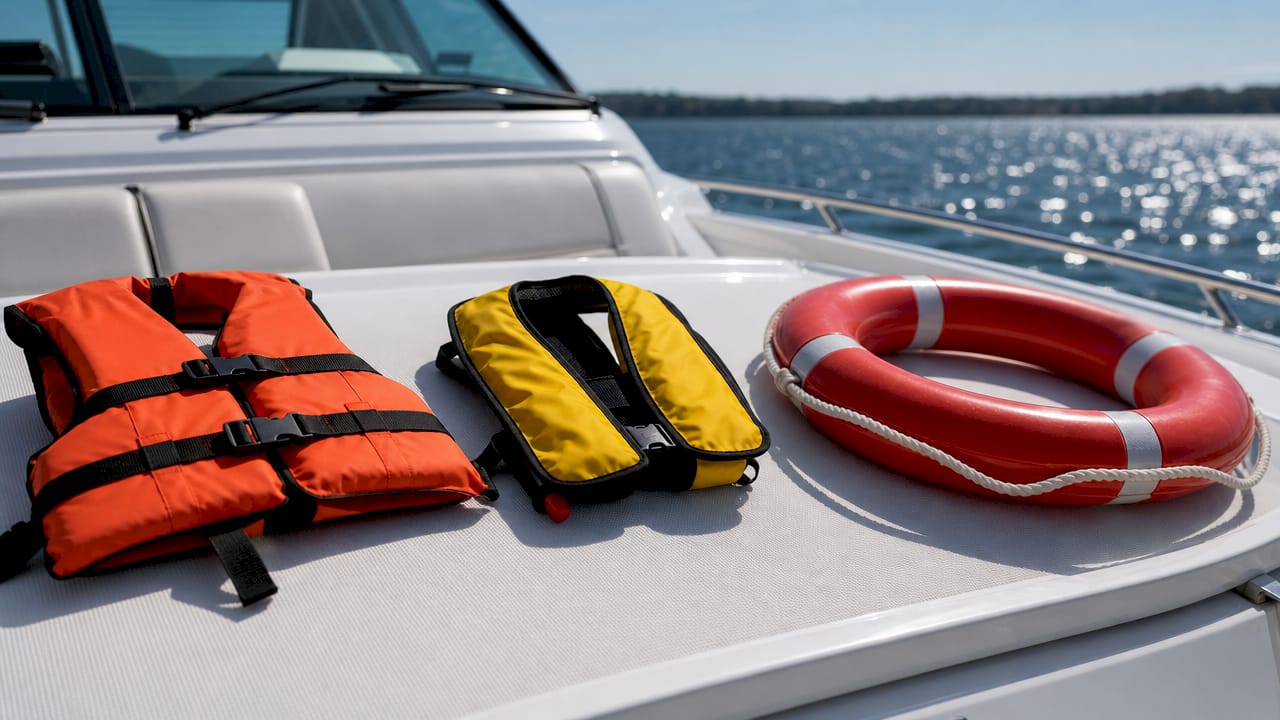
Federal personal flotation device rules also address children specifically. Children under 13 must wear a USCG-approved life jacket whenever the vessel is underway, unless they are below deck or in an enclosed cabin. This is a mandatory wear rule, not just a carry requirement.
Key federal requirements at a glance:
- One USCG-approved wearable PFD per person on board, sized correctly for each wearer
- One Type IV throwable device on all vessels over 16 feet, stored on deck and accessible
- Mandatory wear for all children under 13 while the vessel is moving
- All PFDs must be in serviceable condition, with no tears, missing buckles, or waterlogged foam
- Life jackets must be readily accessible, not buried in storage
Pro Tip: Clip your throwable Type IV device to a cleat or rail with a short line. It stays accessible and will not blow overboard in rough conditions.
Federal boat safety requirements also include the Engine Cut-Off Switch (ECOS). The ECOS connects to the operator and shuts the engine off automatically if the operator is thrown overboard. This prevents propeller strikes, which are among the most severe injuries in boating accidents. Wearing the ECOS lanyard is federally required on most motorized vessels under 26 feet.
How do life jacket regulations vary by age and activity?
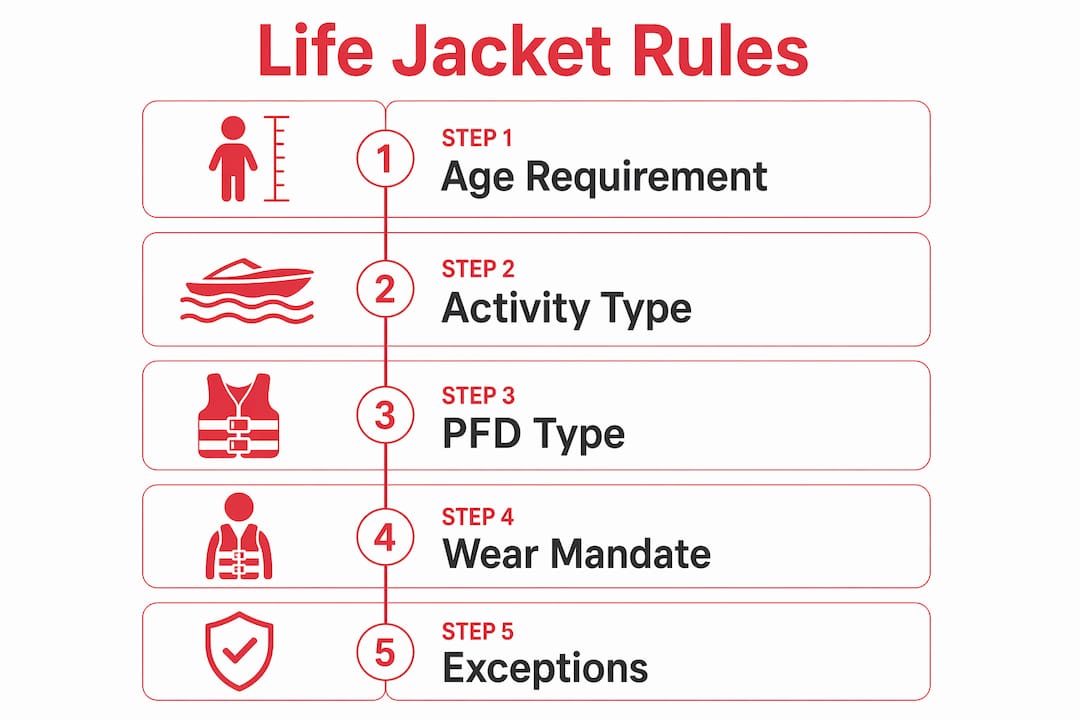
Age and activity type change what the law requires, and this is where many boaters get into trouble. The federal baseline covers children under 13, but several states set the mandatory wear age higher. Some states require all passengers under 16 to wear a PFD while underway. Checking the rules for every state where you plan to boat is not optional.
Inflatable PFDs: not for everyone
Inflatable life jackets are approved only for individuals 16 years and older. They are not legal for children, and they are not approved for high-impact activities like personal watercraft (PWC) operation or waterskiing. An inflatable PFD worn by a child or a waterskier does not count toward legal compliance. That distinction matters because inflatable PFDs must be supplemented by foam PFDs for children and towed watersport participants to satisfy the law.
Activity-specific rules
- Personal watercraft (PWC) operation: All riders on a Jet Ski, WaveRunner, or similar PWC must wear a USCG-approved life jacket. Inflatable PFDs are not permitted for this activity.
- Waterskiing and towed watersports: The person being towed must wear a USCG-approved PFD. Again, inflatables are not approved for this use.
- Kayaking and paddleboarding: Federal law requires a wearable PFD on board for each person. Many states require active wear during certain seasons or at night.
- Children under 13: Mandatory wear applies whenever the vessel is underway, regardless of activity type.
Fit matters as much as type
A life jacket that does not fit correctly is a legal and safety failure. Children’s life jackets must fit snugly and include crotch straps to prevent the device from riding up over the chin or ears during immersion. Test the fit by lifting the child by the shoulders of the PFD. If the jacket rises above the chin, it is too large. Adult PFDs must also match the wearer’s chest size and weight range as printed on the label.
What are the state-level variations and seasonal wear laws you need to know?
State laws build on federal minimums, and they frequently go further. The most significant state-level additions involve mandatory wear seasons and higher age thresholds for children.
Many states enforce cold water mandatory wear laws typically covering the months from november through april or may. Cold water immersion causes rapid loss of muscle control and can incapacitate a swimmer within minutes, even in relatively mild air temperatures. These seasonal rules exist because a boater who falls overboard in 50-degree water has very little time to self-rescue without a PFD already on their body.
Here are the most common state-level additions to federal life jacket laws:
- Higher mandatory wear age: Several states require children under 16 to wear a PFD while underway, compared to the federal threshold of under 13.
- Cold water seasonal requirements: States including Connecticut, New York, and others mandate PFD wear during defined cold water months for all passengers or specific vessel types.
- Nighttime paddling rules: Some states require kayakers and canoeists to wear a PFD after sunset, regardless of season.
- Whitewater boating: Many states mandate active PFD wear on rivers with Class II or higher rapids.
- Operator liability: The boat operator bears legal responsibility for ensuring children under 13 wear compliant PFDs. Failure to comply can result in fines and civil liability.
Pro Tip: Before boating in a new state, check that state’s boating authority website for current PFD wear requirements. Florida life jacket laws, for example, include specific rules for children under 6 on vessels under 26 feet. Rules change, and a quick search before you launch takes two minutes.
Enforcement of life vest laws varies by state, but Coast Guard boarding officers and state marine patrol officers can issue citations on the water. Fines for non-compliance are real, and in the event of an accident, non-compliance with PFD rules can affect insurance claims and legal outcomes.
How to choose, maintain, and comply with life jacket safety standards
Selecting the right PFD starts with understanding the current classification system. Since january 2025, the USCG shifted to a performance level labeling system based on buoyancy, replacing the older Type I through Type V designations. The new labels read Level 50, Level 70, Level 100, and Level 150, where the number represents Newtons of buoyancy. Higher numbers indicate greater buoyancy and better face-up turning ability in the water.
| Performance Level | Buoyancy | Best Use |
|---|---|---|
| Level 50 | Minimal | Calm inland waters, strong swimmers |
| Level 70 | Moderate | Inland and coastal waters, supervised activity |
| Level 100 | High | Open water, offshore boating |
| Level 150 | Maximum | Offshore, rough seas, unconscious wearer support |
Mixing PFD types on board is not just smart practice. It is often legally necessary. A vessel carrying children, adults, and a waterskier needs foam PFDs for the children and the skier, and may carry inflatables for adult non-participants who are 16 or older. Keeping a mix of foam and inflatable PFDs aboard covers all passengers and activities under one roof.
Maintenance checks before every outing protect both safety and compliance:
- Inspect foam PFDs for waterlogged material, tears, or missing hardware
- Check inflatable PFDs for armed CO2 cylinders and functioning oral inflation tubes
- Verify all buckles, zippers, and straps function correctly
- Confirm each PFD’s label is legible and shows USCG approval
- Store PFDs in a dry, ventilated location away from direct sunlight when not in use
The USCG compliance steps for life jackets are straightforward when you build a pre-departure checklist. Count your passengers, match each person to a correctly sized PFD, confirm the throwable device is on deck, and verify children are wearing their jackets before the engine starts.
Key Takeaways
Federal and state life jacket regulations require every boater to carry a USCG-approved PFD for each person on board, with mandatory wear rules for children under 13, cold water seasons, and high-impact water activities.
| Point | Details |
|---|---|
| Federal carry requirement | Every person on board needs a USCG-approved, properly sized, accessible PFD. |
| Children under 13 | Must wear a life jacket whenever the vessel is underway, by federal law. |
| Inflatable PFD limits | Inflatables are not legal for children under 16 or for PWC and towed watersports. |
| State seasonal laws | Many states mandate PFD wear from november through april or may due to cold water risk. |
| New USCG labeling | Since january 2025, PFDs use Level 50–150 buoyancy ratings instead of Type I–V. |
The rule that actually saves lives is the one you follow before you need it
Most boaters I talk to understand that life jackets are required. The gap is in the details. I have seen experienced boaters carry inflatable PFDs for every adult on board, including a 14-year-old, without realizing that inflatable does not count for that passenger. That is not carelessness. That is a knowledge gap that a regulation alone cannot fix.
The cold water seasonal laws are another area where boaters get caught off guard. A 55-degree day in october feels fine on the dock. The water temperature is a different story. Cold water immersion can cause involuntary gasping and muscle failure within the first minute. A PFD already on your body is the only reliable protection in that scenario.
What I have found consistently is that boaters who take a formal safety course understand these distinctions. They know why the rules exist, not just what the rules say. That understanding changes behavior. They check fit before departure. They know which PFDs work for which passengers. They wear the ECOS lanyard. The boat safety equipment rules are not complicated once you see the reasoning behind them.
Regulations set the floor. Education raises the ceiling.
— Richard
Boating safety certification that covers the rules you need to know
Knowing life jacket laws is one part of being a legal, prepared boater. Safeboatingamerica offers state-approved boating safety courses that cover PFD requirements, USCG regulations, personal watercraft rules, and every other boat safety requirement you are expected to know on the water.
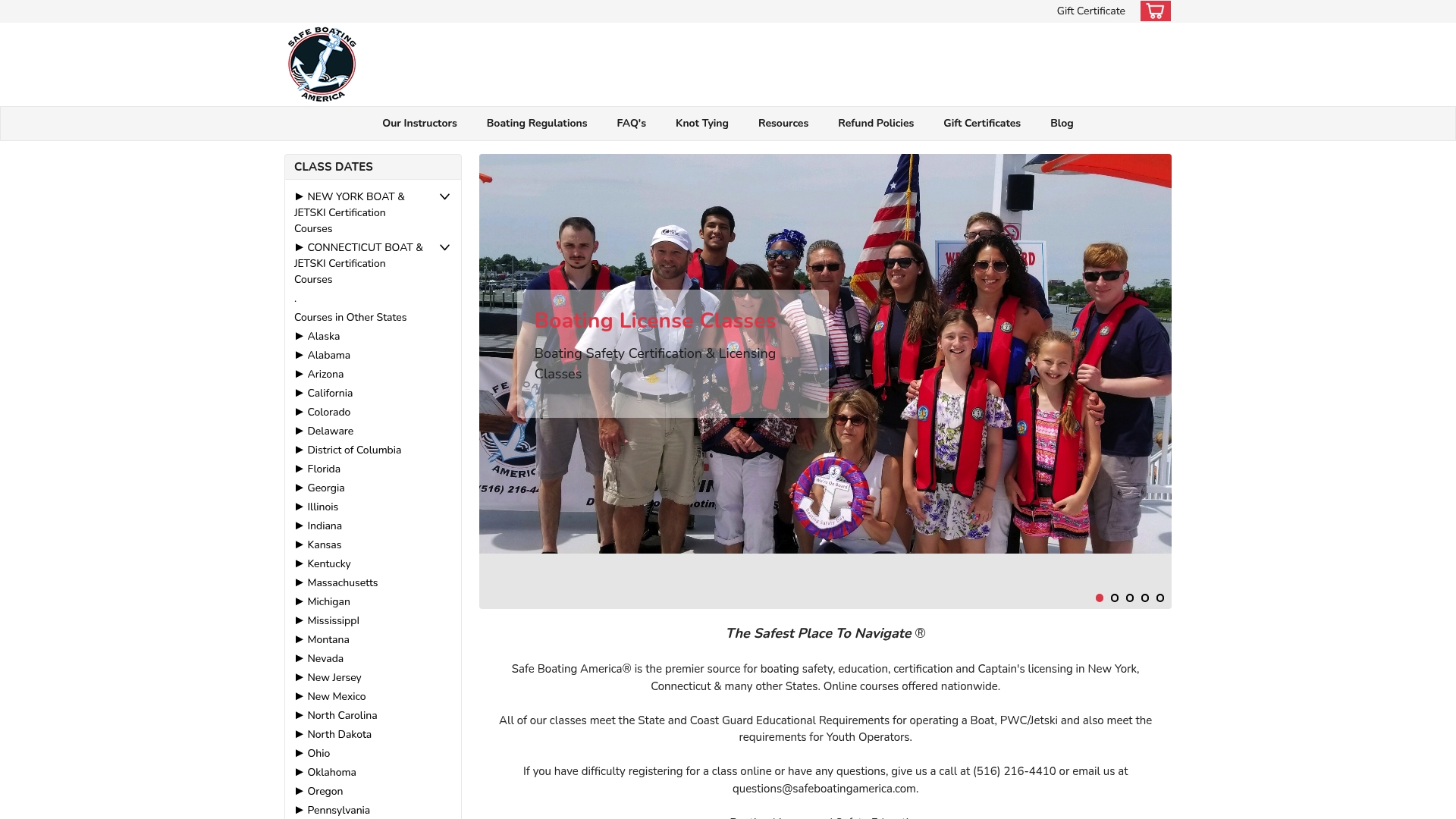
Courses are taught by USCG-Licensed Captains and State Certified Instructors using NASBLA-approved materials. Options include online courses, live Zoom classes, and in-person sessions available in New York, Connecticut, Florida, and every other U.S. state. Whether you need a boating safety certificate for the first time or want to refresh your knowledge before the season starts, Safeboatingamerica delivers the training that meets your state’s legal requirements and makes you a safer operator on the water.
FAQ
What life jackets are required on a boat by federal law?
Federal law requires one USCG-approved wearable PFD per person on board, sized for each wearer and immediately accessible. Vessels over 16 feet must also carry a Type IV throwable device on deck.
At what age must a child wear a life jacket on a boat?
Federal law requires children under 13 to wear a USCG-approved life jacket whenever the vessel is underway. Some states set the mandatory wear age higher, up to 16 in certain jurisdictions.
Are inflatable life jackets legal for children?
Inflatable life jackets are not approved for anyone under 16 years old. Children must wear foam-filled, USCG-approved PFDs that fit correctly, including crotch straps to prevent riding up.
What are Florida life jacket laws for children?
Florida life jacket laws require children under 6 years old to wear a USCG-approved PFD at all times on vessels under 26 feet. All other passengers must have an accessible, approved PFD on board.
What is the new USCG life jacket classification system?
Since january 2025, the USCG replaced the Type I through V system with performance level labels: Level 50, 70, 100, and 150. The number represents buoyancy in Newtons, with higher levels providing greater support and face-up turning ability.
Recommended
- Boat Safety Equipment: What Every Boater Must Carry - Safe Boating America
- Boat Requirements: What Every U.S. Boater Must Know - Safe Boating America
- Coast Guard Boat Requirements: What Boaters Must Know - Safe Boating America
- NASBLA Boating Safety Standard: What Boaters Must Know - Safe Boating America