
License for a Jet Ski: State Requirements and How to Get Certified

A license for a jet ski is a state-approved boater safety certificate required to legally operate personal watercraft on public waterways in most U.S. states. The formal industry term is a boater safety certificate or boating education certificate, though most people search for it as a jet ski license. Both terms refer to the same credential. 38 states require completion of a boater safety course to legally operate personal watercraft, regardless of prior experience or age. Failing to hold this certificate can result in fines up to $500 and vessel impoundment. The rules vary by state, but the process is consistent: complete an approved course, pass a written exam, and carry your certificate on the water.
What is a jet ski license and why is it required?
A jet ski license is a boater safety certificate issued after completing a state-approved education course covering navigation, safety equipment, and waterway laws. It is not a license in the same sense as a driver’s license. No state issues a separate “jet ski license” as a standalone document. Instead, the boater safety certificate serves as proof that you have met your state’s education requirement for operating a personal watercraft (PWC).

States require this certification because jet skis are classified as motorized vessels under federal and state law. The U.S. Coast Guard classifies PWCs as Class A inboard motorboats, placing them under the same regulatory framework as other powered boats. That classification triggers registration requirements, safety equipment mandates, and operator education rules. Providers like Safeboatingamerica and Boat Ed offer state-approved courses that satisfy these requirements.
Is a jet ski considered a boat for licensing purposes?
Yes. Jet skis are legally classified as motorized vessels under both federal and state law, which means every regulation that applies to a motorboat also applies to a PWC. This is the single most important fact for new operators to understand. Many people assume jet skis occupy a separate, less regulated category. They do not.
The USCG’s Class A inboard motorboat designation means your jet ski must be registered, must carry required safety equipment (including a life jacket for every rider), and must be operated by someone who meets the state’s education requirements. The classification also means that operating a jet ski under the influence of alcohol carries the same legal penalties as operating any other vessel while impaired.
Pro Tip: Separating vessel classification from operator licensing helps clarify your obligations. Federal law defines what a jet ski is. State law determines who can legally operate it and what education they need.
This distinction matters practically. If you rent a WaveRunner in Florida, the rental operator is required to verify you meet Florida’s education requirements before handing over the keys. The same applies in New York, California, and most other states. The boat classification is the legal foundation for all of those requirements.
What states require a jet ski license and what age restrictions apply?
Most states require a boater safety certificate to operate a jet ski, but the specific rules differ by state, age, and sometimes by the type of waterway. The trend since 2020 has moved toward stricter enforcement and broader age coverage, with several states expanding requirements to all operators regardless of age.
Massachusetts is one of the clearest examples of age-gated requirements. The Hanson-Milone Boater Safety Act requires PWC operators to be at least 16 years old and hold a state-approved boater safety certificate. Operators under 16 cannot legally operate a jet ski in Massachusetts under any circumstances. For minors navigating these rules, Safeboatingamerica provides a detailed breakdown of age-related licensing requirements across states.
The table below shows how requirements vary across a sample of states:
| State | Minimum age | Certificate required | Notes |
|---|---|---|---|
| Massachusetts | 16 | Yes, all operators | Hanson-Milone Act; exemptions for merchant mariners |
| New York | 10 (supervised) | Yes | Brianna’s Law expands requirements annually |
| Florida | 14 | Yes, born after 1/1/1988 | All operators born after cutoff date |
| California | 16 | Yes, all operators | Card must be carried on board |
| Texas | 13 | Yes, under 18 | Adults born before 9/1/1993 may be exempt |
Age restrictions exist because PWC operation requires specific skills that differ from general boating. Jet skis have no brakes in the traditional sense, respond differently to throttle release, and require active steering input to change direction. States recognize that younger operators need formal instruction before handling that kind of vessel.
How does the jet ski licensing process work?
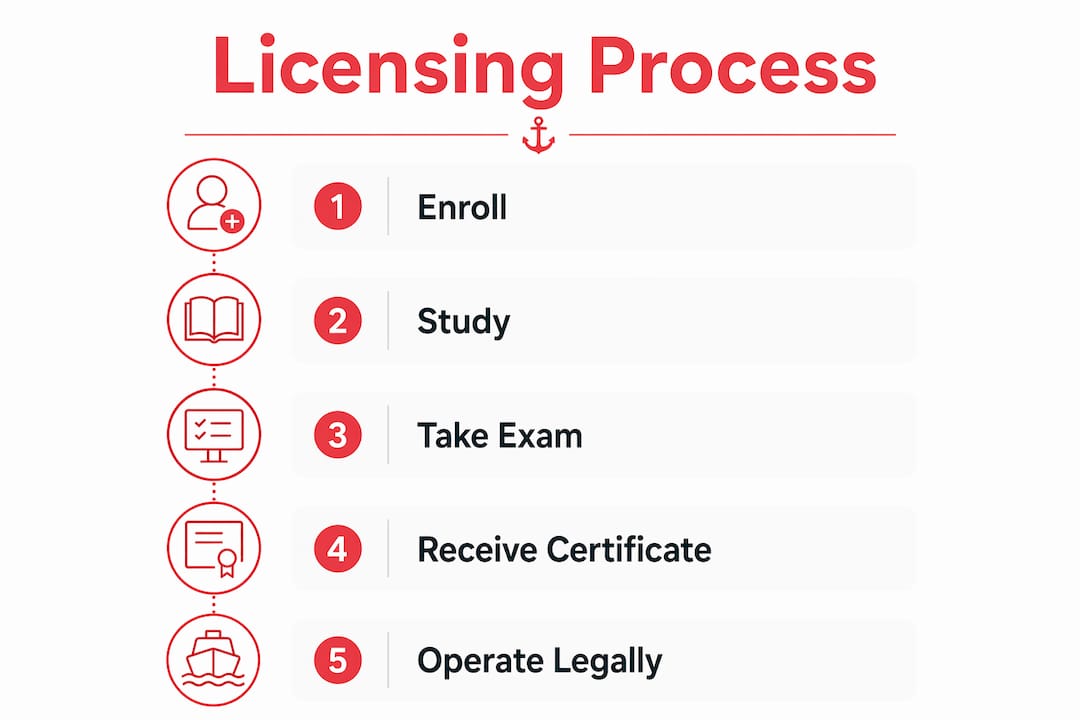
The process for obtaining a boater safety certificate follows the same general structure in every state, though the specific course provider must be state-approved. Here is the standard sequence:
- Confirm your state’s requirements. Check whether your state requires a certificate, what age rules apply, and whether online courses are accepted. Safeboatingamerica’s nationwide course catalog lists state-specific options.
- Enroll in a state-approved course. Courses are available online, via live Zoom sessions, or in person. Online courses are the most common choice for flexibility.
- Complete the coursework. Boating safety courses cover navigation rules, required safety equipment, environmental regulations, and safe operating practices specific to personal watercraft.
- Pass the written exam. Most state exams require a score of 70% or higher to pass. The exam is typically multiple choice and administered at the end of the course.
- Receive your certificate. Online courses issue a printable temporary card immediately after passing. Your permanent card arrives by mail within a few weeks.
- Carry your certificate on board. Most states require you to have physical proof of certification while operating. A digital copy on your phone does not satisfy this requirement in every state.
The topics covered in a standard boater safety course include:
- Navigation rules and right-of-way on the water
- Required safety equipment (life jackets, fire extinguishers, flares)
- PWC-specific operation: throttle behavior, stopping distances, and wake rules
- Environmental regulations including no-wake zones and protected areas
- Alcohol and boating laws
- Emergency procedures and distress signals
Pro Tip: Choose an online course if your schedule is unpredictable. Safeboatingamerica offers courses you can pause and resume, and the exam is available 24 hours a day. You can complete the entire process in a single afternoon.
The exam itself is not difficult if you complete the coursework. Most providers allow multiple attempts. The goal of the exam is to confirm you absorbed the material, not to create a barrier to certification.
Can you use an out-of-state jet ski certificate in another state?
Reciprocity between states is real but not automatic. Not all states honor out-of-state certificates without verification, and some require conversion before you can legally operate. NASBLA (National Association of State Boating Law Administrators) approval is the key factor in mutual recognition. If your certificate comes from a NASBLA-approved course, most states will accept it.
Massachusetts provides a clear model for how reciprocity works in practice. Nonresidents with valid certificates from other U.S. states or Canada are exempt from the Massachusetts boater safety certificate requirement, provided their certificate came from a NASBLA-approved course. Massachusetts also offers a certificate conversion process for residents who completed an out-of-state course and want a Massachusetts-issued credential.
Key points for travelers and seasonal operators:
- Always verify the destination state’s reciprocity policy before you launch.
- Carry your original certificate, not just a photo. Some states require the physical card.
- NASBLA-approved courses are the safest choice for interstate recognition. Safeboatingamerica courses meet NASBLA standards.
- Commercial PWC operation (rentals, tours) requires a U.S. Coast Guard Merchant Mariner Credential, which is a separate federal credential entirely distinct from a recreational boater safety certificate.
- If you operate in multiple states regularly, check whether any of those states require a state-specific certificate rather than accepting out-of-state credentials.
The practical takeaway: a NASBLA-approved certificate earned in one state will satisfy requirements in most other states. Confirm before you ride, especially in states with strict enforcement like Massachusetts, California, and New York.
Common mistakes that delay or complicate getting your jet ski license
The most expensive mistake new operators make is assuming their driver’s license qualifies them to operate a jet ski. Nearly all states require a separate boater safety education certificate for PWC operation. A driver’s license proves you can operate a motor vehicle on public roads. It says nothing about navigation rules, right-of-way on water, or PWC-specific handling. States treat these as entirely different skill sets, and the law reflects that.
Other common mistakes include:
- Skipping the state-approval check. Not every online boating course is approved in every state. Completing a non-approved course means starting over.
- Leaving the certificate at home. Failing to carry proof of certification while on the water can result in a ticket even if you are fully certified. Keep a laminated copy in your PWC storage compartment.
- Waiting until the day before the season starts. Permanent cards take time to arrive by mail. Complete your course at least two weeks before you plan to ride so your card arrives in time.
- Assuming last year’s rental exemption still applies. Many states that previously exempted rental operators have tightened rules. Verify current requirements each season.
Operating without a certificate can result in fines up to $500 and impoundment in many states. That is a steep price for skipping a course that takes a few hours and costs far less. Understanding jet ski etiquette rules on top of your certification also reduces the risk of conflicts and accidents on busy waterways.
Key takeaways
A boater safety certificate is the legal credential required to operate a jet ski in most U.S. states, earned by completing a state-approved course and passing a written exam.
| Point | Details |
|---|---|
| Jet skis are legally boats | The USCG classifies PWCs as Class A inboard motorboats, triggering full vessel regulations. |
| 38 states require certification | Most states mandate a boater safety certificate regardless of age or prior experience. |
| NASBLA approval enables reciprocity | Certificates from NASBLA-approved courses are recognized in most states for out-of-state operators. |
| Driver’s license is not enough | Nearly all states require a separate boater safety certificate; a driver’s license does not qualify. |
| Carry your certificate on board | Physical proof of certification is required on the water in most states to avoid fines. |
Why I take jet ski licensing more seriously than most people expect
I have seen the same pattern repeat itself every summer. Someone rents or buys a jet ski, assumes the process is informal, and gets stopped by a marine patrol officer within the first hour on the water. The fine is real. The impoundment is real. And the frustration is entirely avoidable.
What strikes me most is how often people treat the boater safety certificate as a bureaucratic checkbox rather than genuinely useful training. That view changes fast after you learn that a jet ski at full throttle cannot stop the way a car can. Releasing the throttle on most PWCs removes your ability to steer. That is not intuitive. It is the kind of fact that prevents accidents, and it is covered in every approved course.
State requirements are also tightening, not loosening. New York’s Brianna’s Law has expanded year by year since 2020. Massachusetts enforces the Hanson-Milone Act with real penalties. California marine patrols check certificates routinely during peak season. The direction of regulation is clear: more states, more operators, more enforcement.
My honest view is that the licensing process is one of the few government requirements that actually delivers practical value proportional to the time it takes. A few hours of coursework covers everything you need to ride safely and legally. The certificate lasts a lifetime in most states. There is no renewal, no annual fee, no retest. Complete it once and you are done.
— Richard
Get your jet ski certification online with Safeboatingamerica
Safeboatingamerica offers state-approved boating safety courses for operators across the country, including state-specific programs for Massachusetts, Michigan, Ohio, and dozens of other states. Courses are fully online, self-paced, and taught using NASBLA-approved materials by State Certified Instructors and USCG-Licensed Captains.
After passing the exam, you receive a printable temporary card immediately. Your permanent boater safety certificate arrives by mail and is valid for life with no renewal required. Whether you need a Massachusetts PWC certification or a course for another state, Safeboatingamerica provides a direct path to legal certification without leaving your home.
FAQ
What is a jet ski license exactly?
A jet ski license is a state-issued boater safety certificate earned by completing an approved boating education course and passing a written exam. It is not a separate license document but proof of completed safety education required to legally operate a PWC.
Do all states require a license to operate a jet ski?
38 states require a boater safety certificate to operate a jet ski, with age cutoffs and exemptions varying by state. Check your specific state’s requirements before operating, as rules differ significantly.
Can I get my jet ski license online?
Yes. Online boating safety courses from providers like Safeboatingamerica allow you to complete coursework and testing remotely, with a printable temporary certificate issued immediately after passing the exam.
Does my driver’s license count as a jet ski license?
No. Nearly all states require a separate boater safety education certificate for PWC operation. A driver’s license does not satisfy boating education requirements in any U.S. state.
Is a jet ski certificate from one state valid in another?
In most cases, yes, provided the certificate came from a NASBLA-approved course. Massachusetts and most other states recognize out-of-state certificates from NASBLA-approved programs, though you should verify reciprocity rules before operating in an unfamiliar state.
Recommended
- Jet Ski licenses for minors: safety rules explained - Safe Boating America
- Do You Need a License to Drive a Jet Ski? Your Complete Guide to Jet Ski Laws and Safety - Safe Boating America
- New York Jetski License: How to Get Your NY PWC Certificate - Safe Boating America
- Connecticut Jetski License: How to Get Your CT PWC Certificate - Safe Boating America