39.4 ft and Up: Navigation Rules for Boaters on U.S. Waters
The Navigation Rules are legally binding regulations, not suggestions, and every operator on U.S. waters answers to them. Your primary duty under these rules is simple to state and hard to master: keep a proper lookout, run at a safe speed, and take early, substantial action to avoid collisions. When you’re uncertain whether risk exists, the rules tell you to assume it does and act accordingly.
TL;DR:
- Correctly identifying whether you are the give-way or stand-on vessel depends on vessel type and situation, with rules allowing deviation when immediate danger arises.
- In head-on encounters, both vessels must alter course to starboard immediately, while crossing situations require the vessel on the other’s starboard to give way.
- Overtaking vessels must signal and maneuver to pass on the specified side, regardless of other rules, to avoid collisions caused by misjudged situations.
- Proper use of navigation lights, shapes, sound signals, and maintaining a proper lookout are critical to safe navigation and collision avoidance at all times.
- Formal, scenario-based training enhances decision-making skills and judgment, which is vital for applying rules effectively in real water situations.
Table of Contents
- What Are the Navigation Rules for Boaters?
- Who Has to Give Way, and Who Has to Stand On?
- How Do You Handle Head-On, Crossing, and Overtaking Situations?
- What Lights, Shapes, and Sound Signals Must You Use?
- What Counts as Safe Speed and a Proper Lookout?
- How Do Narrow Channels and Traffic Lanes Change the Rules?
- What Documents Must You Carry, and What Happens if You Don’t?
- How Does Formal Training Prepare You to Apply These Rules?
- What Penalties Apply When You Violate Navigation Rules?
- What Exceptions Exist for Special Vessel Types?
- How Do State Boating Laws Work With Federal Navigation Rules?
- What Should You Do in a Collision or Emergency on the Water?
- The Rules Are the Floor, Not the Ceiling
- Get Certified and Build the Skills Behind the Rules
- Where to Read the Official Navigation Rules
- Sources
- FAQ
What Are the Navigation Rules for Boaters?
Two overlapping bodies of law govern how vessels behave around each other on U.S. waters. The International Regulations for Preventing Collisions at Sea, known as COLREGS, apply on the high seas and international waters connected to them. The U.S. Inland Navigation Rules apply on most rivers, lakes, and harbors inside the demarcation lines set by the Coast Guard. The two sets are similar in structure but differ in specific details, especially around sound signals, and knowing which one governs your stretch of water changes what actions are legally correct.
Both are consolidated in one working document: the Navigation Rules (Navcen / USCG PDF), which lays out look-out duties, safe speed, collision-avoidance action, narrow-channel conduct, lights and shapes, and sound signals in full legal language. This amalgamated version places the international and inland rules side by side, so you can see exactly where they diverge. The 33 CFR Subchapter E citations back the inland side of that same text with the actual federal regulation numbers, which matters if you ever need to reference the rule by its formal code section rather than its plain-language rule number.
Here’s where the practical differences show up on the water:
- Sound signal meaning: Under Inland Rules, a signal announces intent (“I am about to turn”). Under COLREGS, the same signal often confirms an action already underway.
- Narrow channel language: Inland Rules add specific language about not impeding vessels that can only navigate within a channel, a nuance international waters phrase slightly differently.
- Demarcation lines: The boundary between inland and international waters is drawn on charts, not by common sense, so a bay that looks “open ocean” can still be legally inland.
- State overlays: State boating guides restate the federal rules for local waters, and they’re worth reading because they translate the CFR language into plain English for the specific rivers and lakes you’ll actually run.
If you boat across a demarcation line regularly, say, running from an inland river out past a harbor entrance into open water, you’re crossing from one rule set into another mid-trip. That’s not trivial. A passing signal that means one thing on the river can mean something subtly different once you clear the line.
Who Has to Give Way, and Who Has to Stand On?
Every close encounter between two vessels puts one boat in the give-way role and the other in the stand-on role, and knowing which one you are is the first decision you have to make correctly, before you decide anything else. The give-way vessel must take early and substantial action to keep clear. The stand-on vessel must hold its course and speed so the give-way vessel can predict where it will be.
That sounds clean in theory. In practice, a hierarchy of vessel types complicates it. Rule 18 sets a pecking order that power-driven vessels must respect:
- A vessel not under command (lost steering, disabled engine) outranks everyone.
- A vessel restricted in its ability to maneuver (dredging, laying cable, towing operations) comes next.
- Vessels engaged in fishing with gear deployed, such as nets or trawls, rank above sailing vessels and ordinary power-driven boats.
- Sailing vessels under sail alone generally stand on over power-driven vessels of similar size.
- A seaplane and a power-driven vessel fall near the bottom, giving way to nearly everyone else on this list.
Here’s the part recreational boaters miss most often: standing on doesn’t mean sitting still and hoping. Rule 17 gives the stand-on vessel the right, and eventually the obligation, to maneuver on its own if the give-way vessel clearly isn’t taking action in time to avoid collision. Waiting too long to break that standoff has caused more accidents than any misread signal. And underneath every one of these categories sits Rule 2, which states plainly that nothing in the rules excuses an operator from the consequences of neglect, and that any vessel may need to depart from the rules entirely if immediate danger demands it.
A common misconception among newer boaters is that sailboats and paddlecraft always have right of way over everything with an engine. They often do, but not universally. Non-motorized vessels still have to follow overtaking rules, and none of them are exempt from the duty to avoid impeding a large ship that’s constrained by draft in a narrow channel. Size and maneuverability, not just propulsion type, shape the real-world hierarchy.
Pro Tip: If you’re ever unsure whether you’re the give-way or stand-on vessel, treat the encounter as if you’re give-way. Slowing down and altering course costs you a few minutes. Guessing wrong costs a lot more.
For a deeper look at how these responsibilities play out in real collision-avoidance situations, see what to do to avoid colliding with another boat.
How Do You Handle Head-On, Crossing, and Overtaking Situations?
Nearly every close encounter on the water falls into one of three patterns, and each one has its own rule number and its own required response. Knowing the pattern the instant you spot another vessel is what separates a calm course correction from a last-second scramble.
1. Head-on situations (Rule 14)
Two power-driven vessels approaching roughly bow to bow both alter course to starboard, passing each other port side to port side. This is one of the few situations where both vessels take the same action rather than one giving way and one standing on. At night, if you can see both the other vessel’s red and green sidelights, or during the day you’re seeing it dead ahead with a closing masthead line, treat it as head-on and act immediately. Waiting to confirm the angle wastes the exact seconds you need.
2. Crossing situations (Rule 15 and Rule 17)
When two power-driven vessels are on courses that cross, the vessel that has the other on its own starboard side is the give-way vessel and must keep clear, according to the rule governing crossing situations. The other vessel, the stand-on vessel, holds course and speed. Picture a clock face with your boat at the center: if the other vessel is anywhere between your 12 and roughly your 4 o’clock position, you’re almost certainly the one who has to give way.
“Early and substantial” action means altering course enough that the other operator can see the change on radar or by eye well before the vessels get close, not a subtle five-degree nudge at the last moment.
3. Overtaking situations (Rule 13)
Overtaking overrides the crossing and head-on rules entirely. Whichever vessel is coming up from behind, regardless of which side it’s on, is the give-way vessel and must keep clear until it’s fully past and clear of the vessel it passed. On inland waters, the overtaking vessel signals intent with one short blast to pass on the vessel’s starboard side, or two short blasts to pass on the port side, and the vessel being passed answers with the same signal to agree, or five short blasts to signal danger or disagreement. A ship horn built for these exact signals removes any doubt about whether the other operator heard you.
The National Safety Council has tracked hundreds of reportable boating collisions annually for years, and a consistent share trace back to one of these three scenarios being misjudged, usually because someone assumed the other operator saw them, or assumed right of way meant they could hold course no matter what. Rule 17 exists precisely because “I was technically correct” is not a defense against a preventable crash.
What Lights, Shapes, and Sound Signals Must You Use?
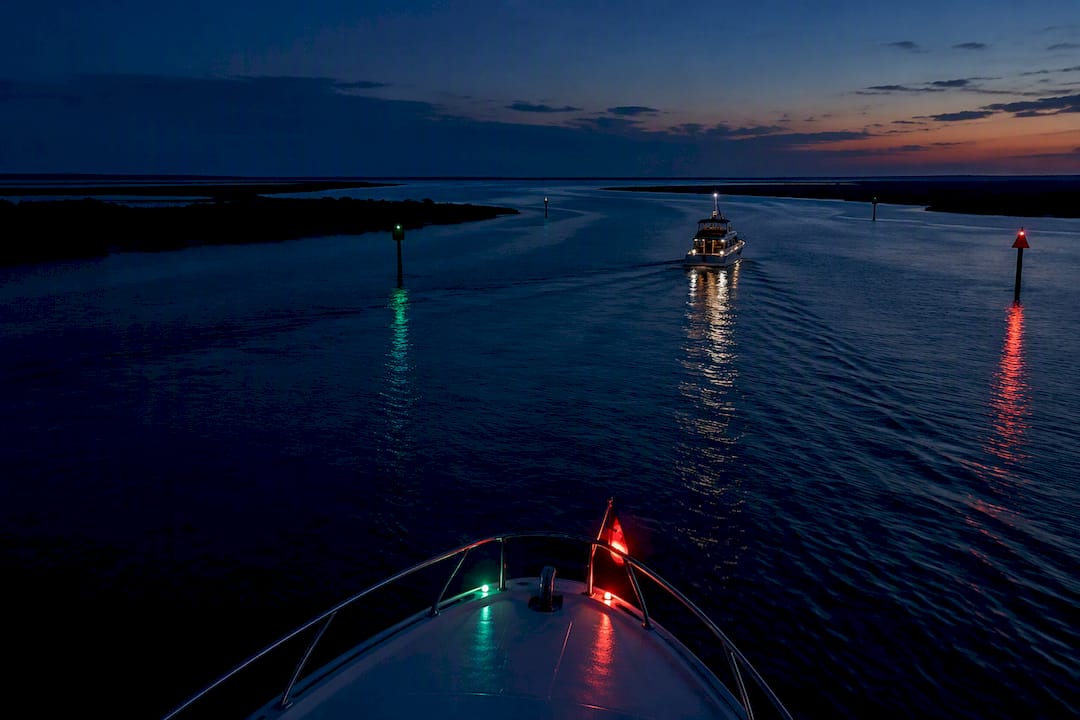
Every vessel underway between sunset and sunrise, and during any period of restricted visibility, must display the correct navigation lights. Recreational vessels are required to show them without exception in those conditions, according to the federal requirements for recreational boats. Which specific lights depend on your vessel’s length and type, but the basic pattern holds across most recreational craft:
- Sidelights: Red on the port side, green on the starboard side, visible from dead ahead to slightly behind the beam on each side.
- Sternlight: White, visible from directly astern.
- All-round white light: Used by smaller power-driven vessels, often combined with the masthead light on boats under 12 meters.
- Anchor light: A single all-round white light shown when anchored outside a designated anchorage area.
Shapes work the same way lights do, but for daytime use, and they signal status that another operator can’t otherwise guess. A vessel not under command shows two black balls in a vertical line. A vessel restricted in its ability to maneuver shows a ball, diamond, ball pattern. A vessel engaged in towing with a long tow shows a diamond shape. These aren’t decorative. A tug with a half-mile of cable behind it looks, from a distance, like any other slow-moving boat until you spot the shape telling you it cannot turn quickly or stop at all.
Sound signals fill the gap lights and shapes can’t cover: intent and warning in the moment. The core set, consistent across most state handbooks, breaks down like this:
- One short blast: I intend to leave you on my port side (or, on inland waters, I’m altering course to starboard).
- Two short blasts: I intend to leave you on my starboard side (or altering course to port).
- Three short blasts: I am operating astern propulsion.
- Five or more short blasts: Danger signal, or disagreement with a proposed passing maneuver.
- One prolonged blast (four to six seconds): Sounded in restricted visibility, repeated at intervals not exceeding two minutes.
That inland vs. international sound-signal distinction matters more than it looks. On inland waters, a signal states what you’re about to do. Internationally, the same signal often confirms what you’re already doing. Getting that backward near a demarcation line can lead you to expect an action the other operator has already taken, or hasn’t started yet. For equipment that meets the audibility range required for your vessel size, see this guide to ship horn types and signals.
What Counts as Safe Speed and a Proper Lookout?
Rule 5 requires every vessel to maintain a lookout by sight, hearing, and every other means available, at all times. Rule 6 then requires proceeding at a speed that lets you take proper and effective action to avoid collision, stopped within a distance appropriate to the circumstances. Neither rule gives you a number. Both require judgment based on conditions.
Determining safe speed means weighing several factors together, not checking one box: visibility conditions, traffic density, your vessel’s maneuverability, background lighting that might mask other vessels’ lights, and current wind, sea, and current state all factor in, along with radar range and setting if your vessel carries it. A speed that’s perfectly safe on a clear afternoon on open water can be reckless in the same spot at dusk with three other boats converging on a channel entrance.
A proper lookout on a small crew, often just one or two people on a recreational boat, means more than glancing forward occasionally. It means:
- Scanning a full circle around the vessel at regular intervals, not just the direction of travel.
- Checking behind you before altering course, since overtaking vessels approach from angles you won’t see facing forward.
- Listening for engines, horns, and radio traffic even when your eyes are occupied with navigation.
- Assigning a passenger as a second set of eyes whenever conditions or traffic warrant it.
In restricted visibility, whether fog, heavy rain, or smoke, the rules narrow further. Reduce to the minimum speed that keeps you under command, have engines ready for immediate maneuvering, use radar if it’s fitted, and sound the appropriate prolonged blast at intervals not exceeding two minutes. If in doubt about whether risk of collision exists, Rule 7 tells you to assume it does.
Pro Tip: Fog doesn’t just reduce visibility, it distorts sound direction too. Don’t trust your ear alone to tell you where another vessel’s horn is coming from; slow down and use every available cue together.
How Do Narrow Channels and Traffic Lanes Change the Rules?
Rule 9 sets special conduct for narrow channels and fairways, and it exists because the normal give-way hierarchy doesn’t work when maneuvering room disappears. A vessel proceeding along a narrow channel must keep as near to the outer limit of the channel that lies on its starboard side as is safe and practicable. That’s the marine equivalent of staying in your lane, and it’s the default assumption other operators will make about your position.
The bigger obligation in narrow channels: smaller, more maneuverable vessels must not impede the passage of a vessel that can only navigate safely within that channel. A recreational boat that can operate almost anywhere on the water has far more room to maneuver than a container ship or deep-draft tanker confined to the dredged channel. That size and maneuverability gap is exactly why the rule exists, regardless of who would technically be give-way or stand-on in open water.
Signaling changes here too. At a bend or obstruction where you can’t see a vessel approaching from the other direction, sound one prolonged blast; a vessel on the other side answers with the same signal. Overtaking inside a narrow channel requires the overtaking vessel to signal intent, and the vessel being overtaken must respond to confirm before the maneuver proceeds:
- One prolonged blast at a bend where visibility is blocked.
- Two prolonged followed by one short blast to propose overtaking on the vessel’s starboard side within a narrow channel.
- Two prolonged followed by two short blasts to propose overtaking on the port side.
Traffic separation schemes, common near major ports, work on the same logic, keeping vessels flowing in predictable lanes so large commercial traffic and recreational boats aren’t guessing about each other’s paths. If you regularly run a channel that mixes small craft and commercial traffic, the rules governing small powerboats in tight quarters are worth reviewing before you go, not after a near-miss teaches you the hard way.
What Documents Must You Carry, and What Happens if You Don’t?
Federal regulation requires operators of self-propelled vessels 39.4 feet (12 meters) or longer to carry a copy of the Inland Navigation Rules on board. That copy doesn’t have to be a printed booklet gathering mildew in a drawer. Electronic copies qualify, provided the system meets the standards laid out in USCG Navigation and Vessel Inspection Circular 01-16, which means a phone with a saved PDF isn’t automatically sufficient if it can’t reliably display the current rules on demand.
Smaller recreational boats under that length threshold aren’t legally required to carry a physical or electronic copy, but that’s not the same as being exempt from following the rules themselves. Every operator, regardless of vessel length, answers to the full set of Navigation Rules the moment they’re underway.
Where to find the current, authoritative version matters as much as the carriage requirement itself:
- The Navcen amalgamated Navigation Rules for the complete legal text, side by side international and inland.
- The 33 CFR Subchapter E citations when you need the formal federal code reference rather than the plain rule number.
- Your state’s boating handbook for local waterway specifics, buoy systems, and any state-added restrictions layered on top of federal rules.
Enforcement in practice usually comes down to Rule 2’s responsibility clause. If an accident investigation finds an operator neglected an available precaution, ordinary practice of seamanship, or the special circumstances of the moment, that neglect carries legal weight independent of whether the operator technically followed the letter of another rule. Good judgment in the moment protects you far more than a memorized rule number ever will.
How Does Formal Training Prepare You to Apply These Rules?
Reading the rule text is the easy part. Recognizing a crossing situation forming at dusk, with three other boats in the picture and a current pushing you sideways, is the hard part, and that’s the gap state-approved boating courses are built to close.
Courses that meet NASBLA-approved standards, the kind Safe Boating America teaches nationwide, walk through lookout technique, lights and sound signal identification, and the head-on, crossing, and overtaking scenarios covered earlier, but they add something a printed rule book can’t: instructor feedback in real time. On-water drills let a certified instructor watch how you actually react when a scenario develops, then correct the habits that would otherwise only get corrected by a near-miss on open water.
That practice matters most for the judgment calls that Rule 2 explicitly protects. Knowing when strict rule-following would create more danger, not less, and choosing to depart from the rules to avoid an immediate hazard, isn’t something you learn from a definition. It’s something scenario practice and instructor feedback build over repeated exposure.
Certification through a course also satisfies state law requirements directly, giving you documented proof of competence that:
- Meets your state’s mandatory boating education requirement for operators.
- Demonstrates a working knowledge of the same rules covered throughout this article.
- Often qualifies for insurance discounts, depending on your carrier and state.
What Penalties Apply When You Violate Navigation Rules?
Violating the Navigation Rules carries consequences that scale with the severity of the outcome, from a citation for an equipment or lighting violation up to serious civil and criminal liability when a violation causes injury, death, or significant property damage. A Coast Guard boarding that finds missing required lights, no sound-signaling device, or an operator disregarding a stand-on vessel’s right of way can result in a federal civil penalty on the spot, independent of whether a collision actually occurred.
When an accident does happen, the rules become the baseline against which fault gets measured. Investigators and courts look at who was give-way, who was stand-on, whether the give-way vessel took early and substantial action, and whether the stand-on vessel held course as required or maneuvered appropriately once collision became unavoidable. An operator found to have violated a specific rule, say, failing to sound a required signal or misjudging an overtaking maneuver, faces civil liability for damages and, in cases involving reckless operation or a fatality, criminal charges under federal boating law.
Rule 2’s responsibility clause cuts both ways here. It doesn’t just allow departure from the rules in emergencies. It also means “I followed the letter of the rule” isn’t a complete defense if an operator ignored ordinary seamanship, failed to account for a special circumstance, or simply wasn’t paying attention. State agencies layer their own penalty schedules on top of federal law, so the exact fine or license consequence for a given violation varies depending on where the incident occurred.
What Exceptions Exist for Special Vessel Types?
The Navigation Rules aren’t a single flat standard applied identically to every boat. Rule 18’s hierarchy exists precisely because some vessels physically cannot maneuver the way an ordinary power-driven boat can, and the rules account for that reality rather than pretending every vessel has equal flexibility.
A vessel not under command, one that’s lost steering or propulsion through an exceptional circumstance, outranks every other vessel type on the water. Everyone else must give way to it, regardless of what a crossing or head-on situation would otherwise dictate. A vessel restricted in its ability to maneuver, dredging, laying underwater cable, or conducting underway replenishment, gets similar priority because stopping or turning quickly isn’t physically possible for it mid-task.
Fishing vessels with gear actually deployed, nets, trawls, or lines that restrict maneuverability, also rank above ordinary sailing and power-driven vessels. That protection covers gear in the water, not a fishing boat simply idling with rods stowed. A recreational angler trolling a single line doesn’t automatically outrank a passing powerboat the way a commercial trawler with a net out does.
Seaplanes fall near the bottom of the same hierarchy, giving way to nearly every other vessel type when operating on the water. And vessels under sail, while often standing on over power-driven boats, still lose that priority against a vessel not under command or one restricted in its maneuverability. None of these exceptions suspend Rule 2’s underlying responsibility clause. Special status raises your priority in the hierarchy; it never excuses inattention to what’s actually happening around you.
How Do State Boating Laws Work With Federal Navigation Rules?
Federal Navigation Rules set the floor everywhere on U.S. waters, and states build on top of that floor rather than replacing it. A state cannot legally weaken a federal rule, but it can add requirements, restrict certain activities on specific bodies of water, or set stricter equipment standards than federal law demands.
Age minimums for personal watercraft operation, mandatory boating education certificates for certain birth years, speed zones near shorelines, and no-wake zones near marinas are almost all state or local additions layered on top of the federal Navigation Rules rather than part of the rules themselves. This is exactly why the state handbook for wherever you boat matters as much as the federal text. A Minnesota lake, a Long Island harbor, and a Florida intracoastal waterway all follow the same core give-way, stand-on, and signaling rules, but each state guide adds local buoy systems, restricted zones, and certification requirements you won’t find in the federal Navigation Rules document itself.
Practically, that means two boaters can both be technically correct on the federal rules and still have one of them violate a state-specific restriction the other never encountered on their home waters. If you trailer your boat across state lines regularly, checking the destination state’s boating guide before you launch isn’t optional caution. It’s the only way to know which local rules stack on top of the ones you already know.
What Should You Do in a Collision or Emergency on the Water?
Every emergency response on the water starts with the same instinct the Navigation Rules already trained into you: assess risk, act early, and communicate your intentions clearly. That overlap isn’t a coincidence. The same lookout discipline and early-action habit that prevents a collision is what gets you through one when prevention fails.
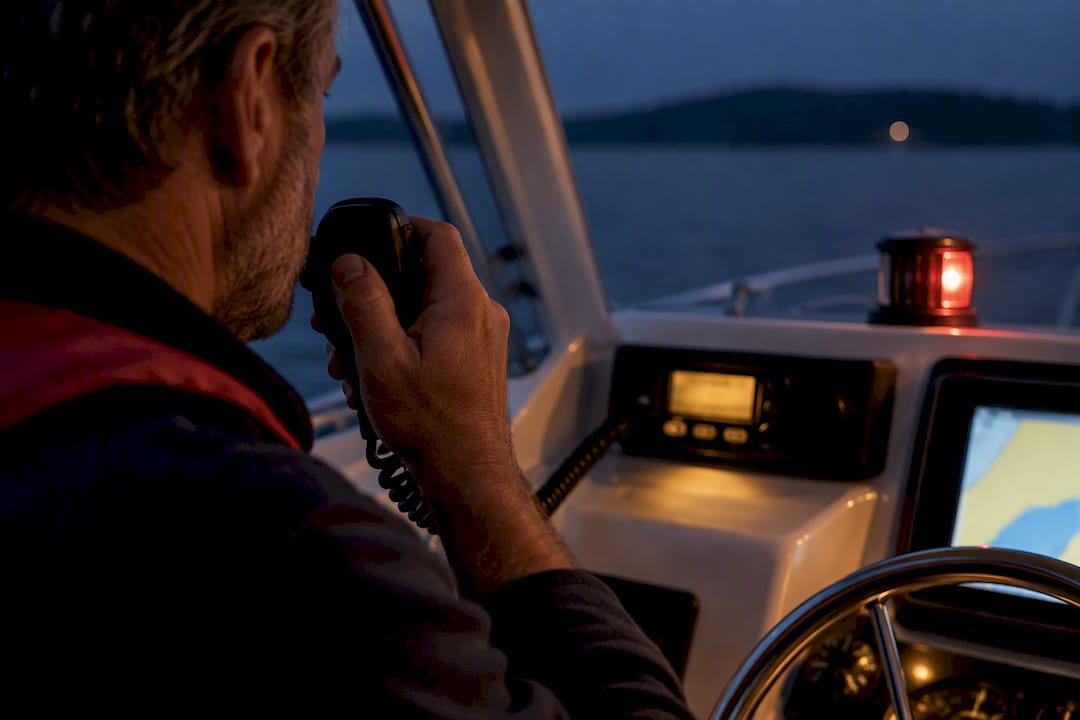
If a collision or near-miss happens, the immediate priorities are checking for injuries, assessing hull damage and flooding, and determining whether the vessel remains safely operable. Marine VHF Channel 16 is the universal distress and calling channel monitored by the Coast Guard and nearby vessels; a “Mayday” call on that channel, stating vessel name, position, nature of the emergency, and number of people aboard, is the fastest way to summon help when the situation is serious. For less urgent assistance, a “Pan Pan” call signals urgency without immediate danger to life.
Sound signals still matter in an emergency. Five or more short blasts remain the universal danger signal, useful for warning a vessel that hasn’t noticed you’re in distress or hasn’t understood your intended maneuver. If visibility is poor, continue prolonged blasts at the required interval even while managing the emergency, since other vessels navigating nearby are relying on that signal to locate you.
Federal law requires reporting any boating accident involving death, disappearance, injury requiring medical treatment beyond first aid, or property damage above a set threshold to state or federal authorities, typically within 48 hours for serious incidents. Keeping a basic account of what happened, positions, times, and actions taken, protects you if the incident is later investigated under Rule 2’s responsibility standard.
The Rules Are the Floor, Not the Ceiling
Most collision reports I’ve read share a common thread: neither operator was ignorant of the rules. They knew give-way from stand-on. They knew the sound signals. What they lacked was the habit of acting on that knowledge early enough to matter.
That’s the real gap between reading the Navigation Rules and applying them. The rules tell you what’s legally correct. They don’t build the reflex to scan the horizon every thirty seconds, or the instinct to slow down the moment a situation feels ambiguous rather than waiting for certainty. Anticipation and clear, early communication, sounding a signal before you need to, altering course before it’s your only option, prevent far more accidents than perfect rule recall ever will.
Review the official sources periodically, not just once before a license test. Rules you haven’t touched in three years fade, and the water doesn’t wait for you to remember Rule 15 correctly. Practical drills, whether through a course or deliberate practice with an experienced boater aboard, are what turn a rule you can recite into a decision you make correctly under pressure.
— Richard
Get Certified and Build the Skills Behind the Rules
Reading the Navigation Rules is one thing. Practicing them until they’re automatic is another, and that’s the gap Safe Boating America’s courses are built to close. Rather than a textbook that ends at the legal definitions, Safe Boating America pairs state-approved certification with instructor feedback drawn from real on-water scenarios, so the give-way, crossing, and overtaking situations covered above become muscle memory, not just rule numbers you memorized for a test.
Course formats fit however you learn best. The NYS Safe Boating Class covers lookout duties, lights and sound signals, and collision scenarios in a state-approved in-person format. Prefer live instruction without the drive? The Zoom Online 1-Day Class delivers the same instructor-led content, including practical navigation and chart reading. Boaters who want fully self-paced study can work through the online computer-based courses available nationwide, and Connecticut boaters can register for the private Connecticut boating course built specifically around the state’s certification requirements.
Every format ends in a state-recognized certificate that satisfies your legal boating education requirement. Check current schedules and pick the format that fits your calendar at Safe Boating America.
Where to Read the Official Navigation Rules
The rules discussed throughout this article all trace back to a small set of primary sources, and it’s worth bookmarking them rather than relying on secondhand summaries.
- The Navcen amalgamated Navigation Rules PDF, the full legal text covering COLREGS and Inland Rules side by side.
- The Navigation Rules Frequently Asked Questions page, which clarifies Rule 2 responsibility and common misconceptions directly from the Coast Guard.
- The Boater’s Guide to Federal Requirements for Recreational Boats, covering lights, shapes, and equipment carriage in plain language.
- Your state’s official boating handbook for local buoy systems, restricted zones, and any state-added requirements.
Boaters seeking additional practical navigation grounding can also consult resources like Náutica Martins da Cruz, which offers supplemental education context for small-craft operators outside the U.S. regulatory framework.
Sources
- Navigation Rules (Navcen / USCG PDF)
- Navigation Rules Frequently Asked Questions | Navigation Center
- 33 U.S.C. / Navigation rules references (Crossing situation / Rule citations)
- A Boater’s Guide to the Federal Requirements for Recreational Boats (USCG Boating Guide PDF)
FAQ
How Do I Remember Port or Starboard?
Port and left both have four letters, which is the simplest memory trick boaters use. Port is always the left side of the vessel when facing forward toward the bow, and starboard is always the right, regardless of which direction the boat is actually pointed at the moment.
What Is the 1/3 Rule in Boating?
The 1/3 rule is a fuel management guideline, not a Navigation Rule: use one third of your fuel to travel out, one third to return, and keep one third in reserve for emergencies, wind, or current changes. It doesn’t appear in the COLREGS or Inland Rules text, but state boating courses commonly teach it alongside safe speed and trip planning.
What Are the Three R’s in Boating?
Boating safety courses use several mnemonic devices, and “the three R’s” isn’t a standardized term within the federal Navigation Rules themselves. Definitions vary by course and instructor, so check your specific state handbook or course materials for the exact version taught in your certification class.
What Is Rule 34 in the Navigation Rules?
Rule 34 covers maneuvering and warning signals, the specific sound signals vessels use to indicate turns, overtaking intentions, and danger. It includes the one, two, and three short-blast signals for course changes and astern propulsion, the five-or-more blast danger signal, and the prolonged blast used in restricted visibility, as detailed in the Colorado Boating Handbook.
Do I Need a Certification Course if I Already Know the Rules?
Most states require a boating safety certificate regardless of how well you know the rules informally, and the certificate itself is what satisfies the legal requirement, not self-taught knowledge. Courses through Safe Boating America provide state-approved certification along with scenario practice that reinforces the rules covered in this article.