Ship Horns: Types, Signals, and Top Models for 2026
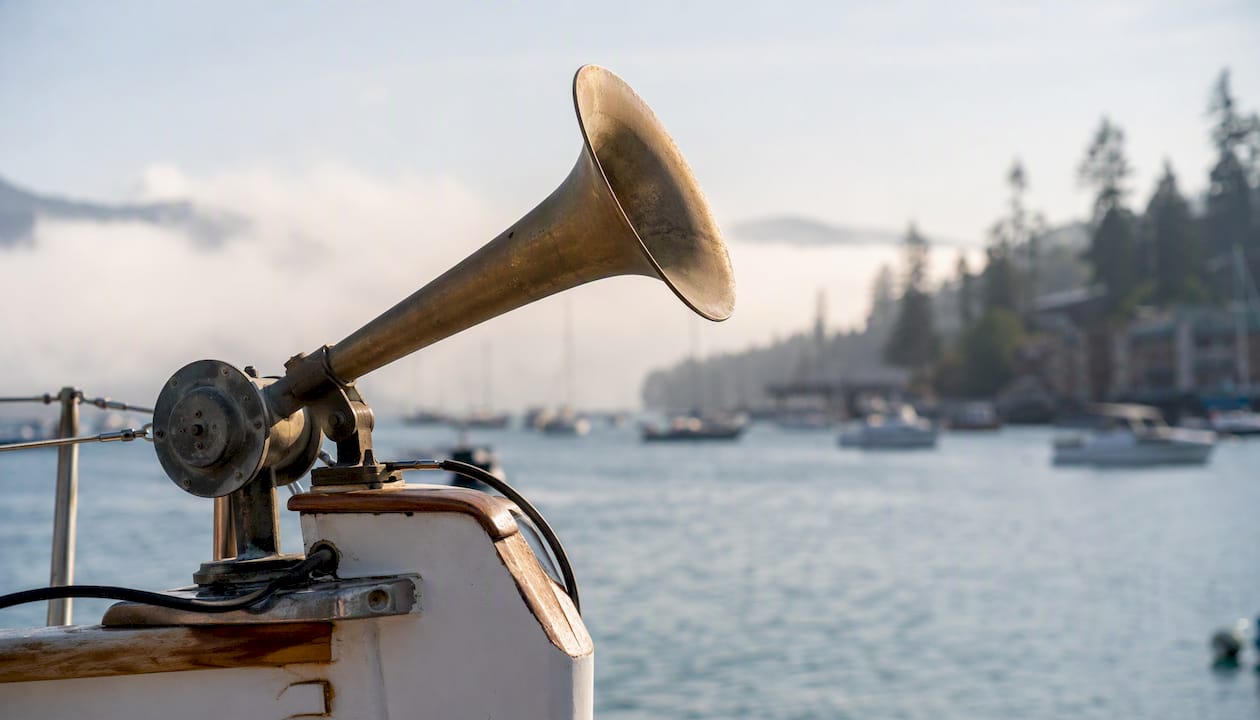
A ship horn, formally called a sound-signaling appliance, is a required safety device on U.S. vessels used to communicate maneuvers, warn of restricted visibility, and signal danger. For most recreational boats under 39 feet, a 12V electric diaphragm horn or a compact compressed-air canister meets USCG requirements. For larger vessels or long-range signaling, a full pneumatic system is the correct choice.
Quick verdict:
- Best ship-scale pneumatic horn: HornBlasters Battleship KM-135 or Dreadnought KM-165 for large recreational boats needing maximum range
- Best mid-range air horn: HornBlasters Warship KM-110 or Destroyer KM-85 for mid-size vessels
- Best compact electric horn: Five Oceans FO600 (120 dB, 12V) for boats under 39 feet
- Best budget canister horn: Better Boat Air Horn 3.5 oz for day-use compliance on small boats
- Best training resource: Safeboatingamerica boating safety certification courses, which cover required signals and USCG navigation rules
Regulatory note: U.S. waters operate under COLREGs and USCG navigation rules. Every power-driven vessel must carry a sound-signaling device capable of producing the required blast patterns. Verify your vessel’s specific requirements before purchase.
Key Takeaways
Matching horn type to vessel size, confirming COLREGs compliance, and completing formal signal training are the three actions that determine whether a marine horn actually improves safety.
| Point | Details |
|---|---|
| Match horn class to vessel size | Boats under 39 ft need a 120 dB electric or canister horn; larger vessels require fixed pneumatic systems. |
| Know the five core signal patterns | One, two, three, five blasts and prolonged blasts each have specific COLREGs meanings operators must know. |
| SPL at 1 m is not range | A 120 dB rating at 1 meter drops roughly 6 dB with each doubling of distance; real-world range depends on frequency and conditions. |
| Install for drainage and corrosion resistance | Mount trumpets angled slightly downward; use stainless or marine-grade ABS in saltwater environments. |
| Safeboatingamerica covers required signals | State-approved certification courses teach COLREGs blast patterns, navigation rules, and compliance requirements for U.S. boaters. |
Table of Contents
- Which ship horn models should you compare?
- How does a ship horn actually produce sound?
- What do ship horn blasts actually mean?
- What are the U.S. regulations for sound-signaling devices?
- How do you choose the right horn for your boat?
- How do you install and maintain a marine horn?
- How are horn loudness and range actually measured?
- How were these horns selected for this guide?
- Why reliable signaling and proper training belong together
- Safeboatingamerica covers horn signals, navigation rules, and on-water compliance
- Sources
- FAQ
Which ship horn models should you compare?
The HornBlasters ship horn collection covers the widest range of pneumatic marine horns available to U.S. recreational boaters, from compact single-trumpet kits to full multi-trumpet ship-scale systems. The table below covers the seven featured models plus two widely sold alternatives across the key spec dimensions.
Per-model notes:
The HornBlasters Battleship KM-135 and Dreadnought KM-165 are the go-to choices when you need genuine ship-scale sound output and multi-trumpet projection. Both require a dedicated air compressor and substantial mounting space, which makes them best suited to larger recreational vessels or trailered show boats.
The KM-250 (Super Tooter) sits at the top of the KM line for raw output. It demands a high-capacity compressor and is overkill for most recreational applications, but it is the correct choice when maximum audible range is the primary requirement.
The Warship KM-110 and Destroyer KM-85 step down in trumpet count and overall size while keeping the pneumatic character of the larger KM series. The KM-110 fits mid-size boats where a full Battleship-class system is too large; the KM-85 suits smaller vessels that still want compressor-driven sound over an electric horn.
The Shocker XL brings a distinct multi-tone, train-style chord to marine applications. It appears in HornBlasters’ marine horn catalog as a loud, attention-getting option for recreational builders who want something audibly different from a standard single-tone horn.
The Battleship Horn is positioned for ship-authentic ceremonial sound and multi-trumpet output, sharing the pneumatic architecture of the KM series.
For straightforward compliance on a boat under 39 feet, the Five Oceans FO600 at 120 dB and 12V is a practical, no-compressor solution. The Better Boat canister horn covers the same dB claim in a disposable format, useful as a backup or for day-use on small boats.
How does a ship horn actually produce sound?
Two principal technologies drive marine horns: compressed-air (pneumatic) systems and electric diaphragm horns. Understanding the difference tells you what installation your boat can support and what real-world range to expect.
Pneumatic (compressed-air) horns
Air from a compressor or pressurized canister forces through a reed or diaphragm inside the trumpet, producing the characteristic loud, low-frequency blast. Ship-scale systems like the KM series use dedicated 12V electric compressors that build pressure in a tank before triggering the horn. More trumpets tuned to different frequencies produce a chord rather than a single tone, which carries farther and is more distinctive.
Key specs to read:
- SPL (dB at 1 m): Sound pressure level measured one meter from the horn. Higher numbers mean more output, but perceived range also depends on frequency and conditions.
- Frequency (Hz): Lower frequencies travel farther over water. Ship-scale horns typically operate in the 100–400 Hz range.
- Compressor PSI and CFM: Determines how quickly the tank refills and how long you can signal continuously.
- Trumpet count: More trumpets generally mean a fuller chord and broader directional coverage.
Electric diaphragm horns
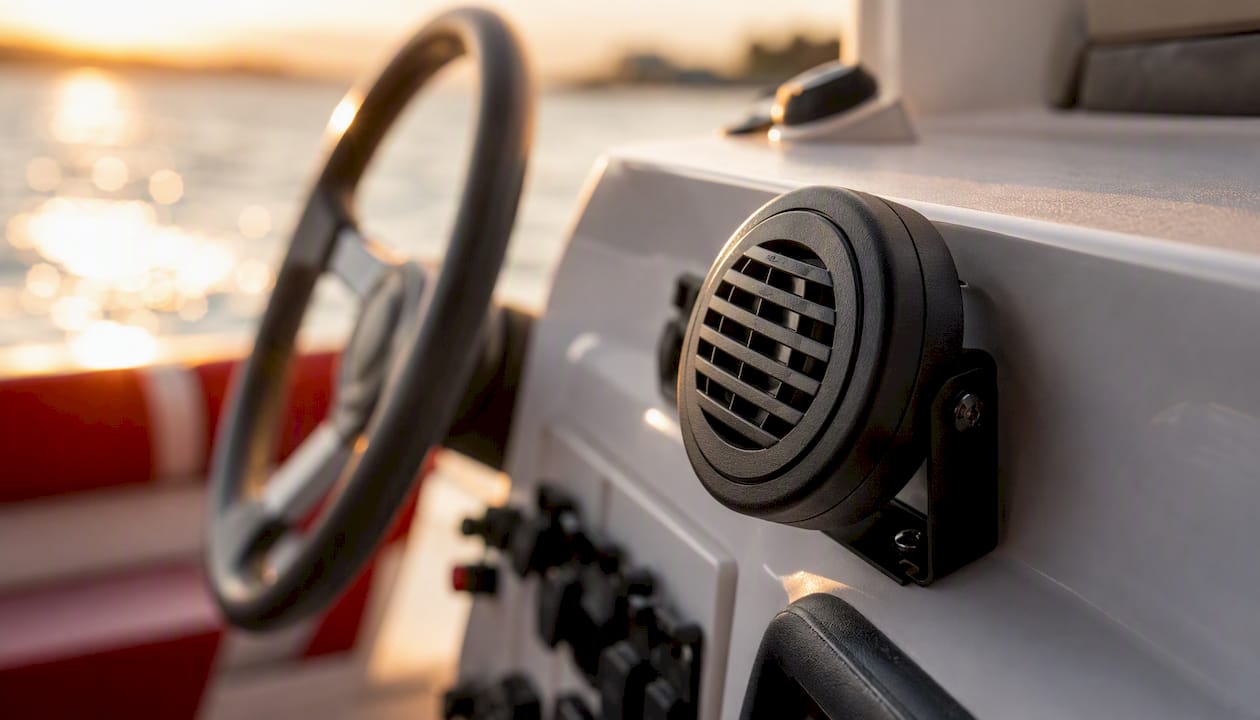
A 12V current vibrates a metal diaphragm at a fixed frequency, producing a single-tone blast. No compressor is needed. The Five Oceans FO600 draws 3 amps at 12V and produces 120 dB at 1 meter, which meets USCG signaling requirements for vessels under 39 feet. Installation is straightforward: mount the horn, run two wires to a 12V source, and connect a momentary switch.
Electric horns are lighter, cheaper, and simpler to install than pneumatic systems. Their limitation is output ceiling: most top out around 120–130 dB, and a single-tone signal carries less distance than a multi-trumpet pneumatic chord at equivalent SPL.
Reading the specs
- Voltage: Most marine horns run on 12V DC. Confirm your vessel’s electrical system matches.
- Material: Stainless steel or UV-stabilized ABS resists salt corrosion. Avoid uncoated steel in saltwater environments.
- Mounting dimensions: Ship-scale pneumatic horns require significant deck or bulkhead space. Measure before ordering.
Pro Tip: Mount any horn with the trumpet opening angled slightly downward so water drains out rather than pooling inside the bell, which causes corrosion and muffled output over time.
What do ship horn blasts actually mean?
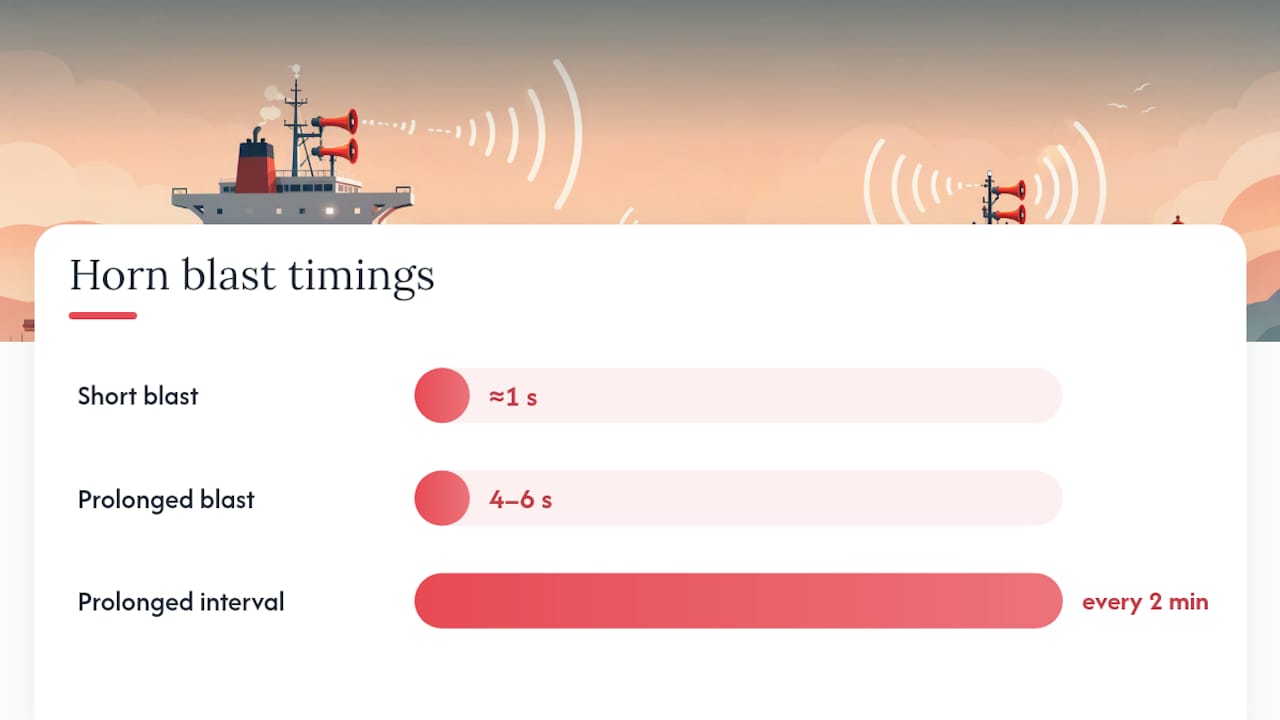
Signal patterns are standardized under COLREGs and the USCG navigation rules. A “short blast” is approximately one second; a “prolonged blast” is four to six seconds. Every boater operating in U.S. waters needs to know these patterns.
- One short blast: “I am altering my course to starboard.” Used when two vessels meet and the give-way vessel intends to pass port-to-port.
- Two short blasts: “I am altering my course to port.” Signals a port-side course change in a meeting or crossing situation.
- Three short blasts: “I am operating astern propulsion.” The vessel is moving backward or slowing with reverse thrust. You will hear this from ferries and large ships maneuvering in tight harbors.
- Five or more short blasts: Danger signal. This is the universal “I do not understand your intentions” or “I believe a collision is imminent” signal. If you hear five rapid blasts, take immediate evasive action and assess the situation.
- One prolonged blast (every two minutes): A power-driven vessel underway in restricted visibility, such as fog or heavy rain. This is the signal most recreational boaters encounter on foggy mornings.
- Two prolonged blasts (every two minutes): A power-driven vessel underway but stopped and making no way through the water in restricted visibility.
- One prolonged blast + two short blasts (every two minutes): A sailing vessel, vessel not under command, vessel restricted in ability to maneuver, or vessel engaged in fishing, in restricted visibility.
For a practical cross-reference of common signal meanings, the Solarglide signal guide offers a readable summary, though always verify against the primary COLREGs text for authoritative definitions.
Understanding these signals is not optional. Misreading a five-blast danger signal or failing to respond to a prolonged blast in fog is a collision risk. Formal boating safety training covers these patterns in detail and puts them in the context of real maneuvering scenarios.
What are the U.S. regulations for sound-signaling devices?
Under USCG navigation rules aligned with COLREGs, every power-driven vessel operating in U.S. waters must carry a sound-signaling device. The specific requirement scales with vessel length.
Minimum requirements by vessel size:
- Vessels under 39.4 feet (12 m): Must carry a device capable of producing an efficient sound signal. A compressed-air canister horn or a 12V electric horn meeting the ~120 dB threshold satisfies this requirement for most practical purposes.
- Vessels 39.4–65.6 feet (12–20 m): Must carry a whistle (horn) meeting the audibility requirements of COLREGs Annex III.
- Vessels over 65.6 feet (20 m): Must carry both a whistle and a bell; vessels over 328 feet (100 m) must also carry a gong.
Compliance checklist:
- Confirm your horn produces a sound audible at the minimum required range for your vessel class
- Test the horn before each trip, not just at the start of the season
- Mount the horn where it can be operated quickly from the helm
- Carry a backup signaling device (a compressed canister) as a redundancy measure
- Know the required blast patterns before you leave the dock
The SEIMI PW3-BC chrome signal horn is an example of a ship-scale device built with explicit COLREG 1972 compliance documentation, including classification society approvals from Lloyd’s Register, Bureau Veritas, and RINA. That level of certification is relevant for commercial and larger recreational vessels; most recreational boaters under 39 feet need only confirm their horn meets the audibility standard.
COLREGs do not specify a single dB number for recreational craft. National product standards and USCG guidance define what devices are acceptable in practice. For a full breakdown of required onboard safety equipment beyond sound signals, the USCG equipment requirements guide from Safeboatingamerica covers the complete list.
How do you choose the right horn for your boat?
Match the horn class to your vessel’s size, power system, and intended use. A compact canister horn and a ship-scale pneumatic system are not interchangeable, and buying the wrong class wastes money and may leave you non-compliant.
Step-by-step selection framework:
- Determine your vessel length. Under 39 feet: a 12V electric horn or canister horn is sufficient. 39–65 feet: a fixed electric or compressor-driven horn is appropriate. Over 65 feet: a full pneumatic system with adequate SPL and range is required.
- Assess your power source. Electric horns need a reliable 12V DC circuit. Pneumatic systems need a compressor, tank, and wiring. If your boat lacks a compressor, factor that cost into the total budget.
- Set your dB and range target. Open-water cruising in fog demands more audible range than marina maneuvering. Ship-scale horns in the KM series deliver substantially more output than a 120 dB electric horn.
- Count your mounting space. Multi-trumpet pneumatic systems need deck or bulkhead real estate. Measure the available space before selecting a KM-series model.
- Choose material for your environment. Saltwater use demands stainless steel or marine-grade ABS. Freshwater boaters have more flexibility, but corrosion-resistant materials are still the better long-term choice.
- Set a realistic budget. Entry-level compressed canisters run under $20. Mid-range 12V electric horns like the Five Oceans FO600 fall in the $30–$80 range. Full pneumatic KM-series systems with compressor kits range from several hundred to over a thousand dollars depending on trumpet count and compressor capacity.
Buying checklist:
- Vessel length and applicable COLREGs class
- Available power (12V DC circuit, compressor capacity)
- Required minimum SPL for your vessel class
- Mounting space dimensions and orientation
- Material (stainless, ABS, chrome)
- Warranty terms and manufacturer support availability
- Backup/secondary horn for redundancy
Red flags to avoid:
- Horns with no stated SPL or frequency spec
- Uncoated steel housings sold for saltwater use
- Canister horns marketed as permanent installations (they are backup devices, not primary systems)
- Any product claiming COLREGs compliance without documentation
How do you install and maintain a marine horn?
Installation varies by horn type, but the core sequence is consistent: mount securely, connect power, route any hoses or wiring away from heat and moving parts, and test before leaving the dock.
Electric horn installation steps
- Mount the horn on a bulkhead or bracket with the trumpet facing forward or to the side, angled slightly downward for drainage
- Run 12V positive and negative leads from a fused circuit at the helm; use marine-grade tinned copper wire
- Connect a momentary push-button switch at the helm position
- Seal all wire connections with heat-shrink tubing rated for marine use
- Test at low volume near the dock before the first trip
Pneumatic system installation steps
- Mount the compressor in a protected, ventilated location away from bilge water
- Run air hose from the compressor tank to the horn trumpet(s) using the manufacturer’s specified hose diameter
- Install a solenoid valve in the air line, wired to a helm-mounted switch
- Secure all hose runs with marine clamps; avoid sharp bends that restrict airflow
- Charge the tank to the manufacturer’s specified PSI before testing
Maintenance schedule:
- Before each trip: Trigger the horn briefly to confirm function; inspect the trumpet opening for debris or water
- Monthly: Check all wire connections and hose fittings for corrosion or loosening; wipe down the horn exterior with a fresh-water rinse
- Seasonally: Drain and inspect the compressor tank; lubricate solenoid valve per manufacturer instructions; check mounting hardware for corrosion
- Winterization: Drain all moisture from the air system; disconnect the battery lead if storing for extended periods; cover the trumpet opening to prevent nesting insects or debris
Pro Tip: Always wear hearing protection when testing a high-SPL pneumatic horn at close range. Ship-scale horns in the KM series can exceed safe exposure levels at distances under 10 feet. Test at the dock with crew standing clear, and never trigger the horn pointed toward people or enclosed spaces.
How are horn loudness and range actually measured?
Manufacturer SPL figures are measured at 1 meter from the horn in controlled conditions. That number does not translate directly to audible range on open water, and understanding the gap between the two is critical for setting realistic expectations.
Why 1 m SPL and real-world range differ
Sound attenuates with distance following the inverse square law: doubling the distance reduces SPL by approximately 6 dB. A horn rated at 120 dB at 1 meter produces roughly 114 dB at 2 meters and approximately 96 dB at 16 meters under ideal conditions. Wind, wave noise, background vessel traffic, and atmospheric absorption all reduce effective range further.
Frequency matters as much as raw SPL. Lower-frequency horns (100–200 Hz) propagate farther over water than high-frequency signals at the same measured SPL. Multi-trumpet pneumatic horns produce a chord spanning multiple frequencies, which improves perceived range and distinctiveness compared to a single-tone electric horn at the same dB rating.
Simple field test protocol
- Position a second person at a measured distance (100 m, 200 m) with a clear line of sight
- Trigger the horn and confirm audibility under ambient conditions
- Note wind direction: test both upwind and downwind to understand the directional range difference
- A smartphone sound-level meter app gives a rough SPL reading but is not calibrated to ANSI standards; use it for relative comparison only, not for compliance verification
Reliable audio sources
- Manufacturer sample pages on the HornBlasters website include audio recordings of KM-series horns
How were these horns selected for this guide?
Selection criteria for the product shortlist and comparison:
- SERP presence: Models appearing consistently across top-ranking marine horn search results were prioritized, reflecting real buyer demand and available public information
- Manufacturer spec availability: Only models with published trumpet counts, SPL claims, or power specifications were included in the comparison table
- Regulatory fit: Products were evaluated against COLREGs and USCG requirements to confirm they address the compliance needs of U.S. recreational boaters
- Real-world use cases: Models were matched to vessel size categories and use cases based on manufacturer positioning and published product descriptions
Sources used:
- HornBlasters manufacturer product pages (ship horns collection and marine horns collection)
- USCG Navigation Center navigation rules (navcen.uscg.gov)
- IMO COLREGs official text
- Five Oceans and Better Boat product specification pages
- SEIMI Marine Equipment compliance documentation
Limitations to note: Manufacturer SPL figures are reported under idealized test conditions. Real-world range depends on frequency, weather, vessel noise, and installation quality. No independent laboratory testing was conducted for this guide. Verify current specs directly with the manufacturer before purchase, as product specifications are subject to change.
Why reliable signaling and proper training belong together
Choosing the right horn is a mechanical decision. Knowing when and how to use it correctly is a training decision, and the two are not interchangeable.
Most collision incidents in restricted visibility involve vessels that had functioning sound-signaling equipment but whose operators either did not know the required signal patterns or did not respond correctly to signals from other vessels. A 140 dB pneumatic horn on a boat whose operator does not know the difference between a one-blast and a five-blast signal is not a safety upgrade. It is a loud liability.
The COLREGs signal patterns covered in this article are not difficult to learn, but they need to be practiced in context, not memorized from a list the night before a trip. Formal boating safety certification teaches these patterns alongside maneuvering rules, restricted-visibility procedures, and collision-avoidance protocols, so the responses become automatic rather than something you have to recall under pressure.
Equipment and training are both required. Neither substitutes for the other.
Safeboatingamerica covers horn signals, navigation rules, and on-water compliance
Knowing which horn to buy is one part of the equation. Knowing the required blast patterns, when COLREGs apply, and how to respond to signals from other vessels is what keeps you legal and safe on the water.
Safeboatingamerica offers state-approved boating safety certification courses taught by USCG-Licensed Captains and State Certified Instructors using NASBLA-approved materials. Every course covers required sound signals, navigation rules, and the COLREGs provisions that apply to recreational boaters in U.S. waters. Courses are available online, via live Zoom, and in person across all 50 states, with same-day certification options for students who need to get on the water quickly.
If you are purchasing a horn to meet state or federal requirements, completing a boating safety certification course through Safeboatingamerica ensures you know exactly how to use it correctly. Visit Safeboatingamerica to find a course that fits your schedule and state requirements.
Sources
- Navigation Rules (International-Inland) — U.S. Coast Guard Navigation Center
- COLREG — International Maritime Organization
- Ship Horns & Horn Kits — HornBlasters
FAQ
What is a ship’s horn called?
A ship’s horn is formally called a sound-signaling appliance or whistle under COLREGs. In common usage, the terms “ship horn,” “marine horn,” and “boat horn” are interchangeable.
What is the loudest ship horn available?
The HornBlasters KM-250 (Super Tooter) sits at the top of the KM pneumatic line for raw output. Ship-scale pneumatic systems with multiple trumpets consistently outperform single-tone electric horns, which typically top out around 120–130 dB at 1 meter.
What does three blasts of a ship horn mean?
Three short blasts signal that the vessel is operating astern propulsion, meaning it is moving backward or slowing with reverse thrust. You will commonly hear this from ferries and large ships maneuvering in harbors.
What do five horn blasts mean on a ship?
Five or more short rapid blasts are the danger or doubt signal under COLREGs Rule 34. It means the signaling vessel does not understand the other vessel’s intentions or believes a collision risk exists. Respond immediately by assessing your position and taking evasive action.
Do recreational boats in the U.S. need a horn?
Yes. Under USCG navigation rules, every power-driven vessel operating in U.S. waters must carry a sound-signaling device. Vessels under 39.4 feet need a device capable of producing an efficient sound signal; a 120 dB electric or canister horn satisfies this requirement for most small recreational boats.
Recommended
- Ship Hull Design, Types, and Structure: A Technical Guide - Safe Boating America
- Maritime Flags for Recreational Boaters: What to Know - Safe Boating America
- Helm of a Boat: What It Is and How It Works - Safe Boating America
- Top Boat Manufacturers: 2026 Buyer’s Guide by Category - Safe Boating America