Top Boat Manufacturers: 2026 Buyer’s Guide by Category
Boat manufacturers are companies that design and build vessels ranging from small recreational craft to luxury mega yachts, each specializing in distinct market segments with unique engineering and production capabilities. Choosing the right builder requires understanding who leads in volume, who excels in fishing performance, and who dominates the superyacht space. The National Marine Manufacturers Association (NMMA) tracks this industry closely, and the distinctions between volume producers and boutique builders matter enormously for buyers. Whether you are buying your first runabout or commissioning a custom offshore fishing boat, knowing the major players gives you a real advantage.
1. Who leads the global recreational boat production market?
Brunswick Boat Group leads globally in recreational boat production volume across dozens of brands. That scale translates into wide dealer coverage, consistent parts availability, and competitive pricing across entry-level and mid-range segments.
Group Beneteau, headquartered in France, holds a dominant position in European powerboat and sailboat production. The company builds under multiple brands and ships to markets worldwide, making it one of the most geographically distributed boat production companies in the industry.
Tracker Marine Group contributes significantly to U.S. freshwater fishing boat output. Its focus on aluminum fishing boats and bass boats keeps prices accessible while maintaining production quality that satisfies serious anglers.
Key differentiators among volume producers:
- Dealer network depth: Brunswick’s multi-brand structure supports thousands of authorized dealers across North America.
- Product diversity: Volume producers cover everything from pontoon boats to sport cruisers under one corporate umbrella.
- Warranty infrastructure: Large manufacturers maintain dedicated service programs that boutique yards cannot match at scale.
Pro Tip: When evaluating volume producers, ask your dealer how many certified service technicians are within 50 miles of your home port. Proximity to support matters more than brand prestige once you own the boat.
2. Which manufacturers dominate the center console fishing boat market?
Top center console fishing brands favored by charter captains and offshore experts include Valhalla Boatworks, Contender, Freeman Boatworks, and Yellowfin. Each brand targets serious anglers who prioritize performance and fishability over comfort amenities.
Freeman Boatworks builds catamaran-style center consoles that exceed speeds of 80 mph. That speed advantage matters for captains running long offshore legs to reach productive fishing grounds before competing boats arrive.
Hull technology separates the best builders in this segment. Hull designs like SeaV2 and Z-Plane improve ride quality in offshore conditions, reducing pounding in chop and improving fuel efficiency at cruise speed. Buyers should ask manufacturers to explain exactly how a patented hull technology performs in their specific intended conditions, not just in marketing materials.
Contender builds its reputation on offshore durability and a loyal following among tournament anglers. Yellowfin emphasizes a balance of speed, fishability, and livability for longer offshore runs. Valhalla Boatworks, backed by Viking Yachts’ engineering heritage, targets buyers who want premium construction at the center console price point.
Pro Tip: Request a sea trial in conditions similar to your typical fishing environment. A boat that rides beautifully in calm water may behave very differently in 3-foot offshore chop.
Understanding hull design relative to use is more important than brand popularity when selecting a fishing boat. That principle applies whether you fish inshore flats or run 60 miles offshore.
3. Top builders of luxury yachts and superyachts
Fincantieri is the world’s largest yacht manufacturer by annual revenue, specializing in bespoke luxury and mega yachts. Revenue leadership in this segment reflects the extraordinary cost of each individual build rather than production volume.
Lürssen, Feadship, Ferretti Group, and Azimut Benetti lead in bespoke design, craftsmanship, and marine engineering. These builders specialize in vessels over 100 feet with high-end finishes and engineering systems that rival commercial ship complexity.
Italian manufacturers including Ferretti Group, Azimut Benetti, and Sanlorenzo dominate the luxury yacht market through a combination of design heritage, performance engineering, and extensive brand portfolios. Their ability to offer multiple price tiers under one corporate group gives buyers a path from mid-size luxury yachts to full superyacht commissions.
| Builder | Country | Specialization |
|---|---|---|
| Fincantieri | Italy | Mega yachts, revenue leader |
| Lürssen | Germany | Custom superyachts over 100 ft |
| Feadship | Netherlands | Bespoke engineering, Dutch craftsmanship |
| Ferretti Group | Italy | Multi-brand luxury portfolio |
| Azimut Benetti | Italy | Volume luxury and full custom |
Choosing among top yacht manufacturers at this level involves evaluating the yard’s project management capability as much as its design portfolio. A superyacht build can span two to four years, and the builder’s communication process matters as much as the finished product.
4. Custom boat manufacturers and boutique yards
Boutique boatyards provide semi-custom or fully custom builds with longer lead times and higher investment than mass-market producers. That trade-off delivers personalized expression unavailable from any volume manufacturer.
Custom boat manufacturers work directly with buyers to specify hull dimensions, interior layouts, propulsion systems, and finish materials. The process resembles architectural design more than retail shopping. Buyers who engage early in the design phase get better results than those who arrive with a fixed budget and a short timeline.
Choosing a builder in the custom market is increasingly about building a long-term relationship. Owners often return to the same yard for refit work, upgrades, and future builds because the yard already understands their preferences and operational requirements.
Semi-custom options from mid-tier builders offer a middle path. These yards allow buyers to select from a defined range of hull platforms and then customize interiors, electronics packages, and deck layouts within those parameters. Lead times run shorter than full custom, and pricing stays more predictable.
5. How the boat manufacturing process shapes what you buy
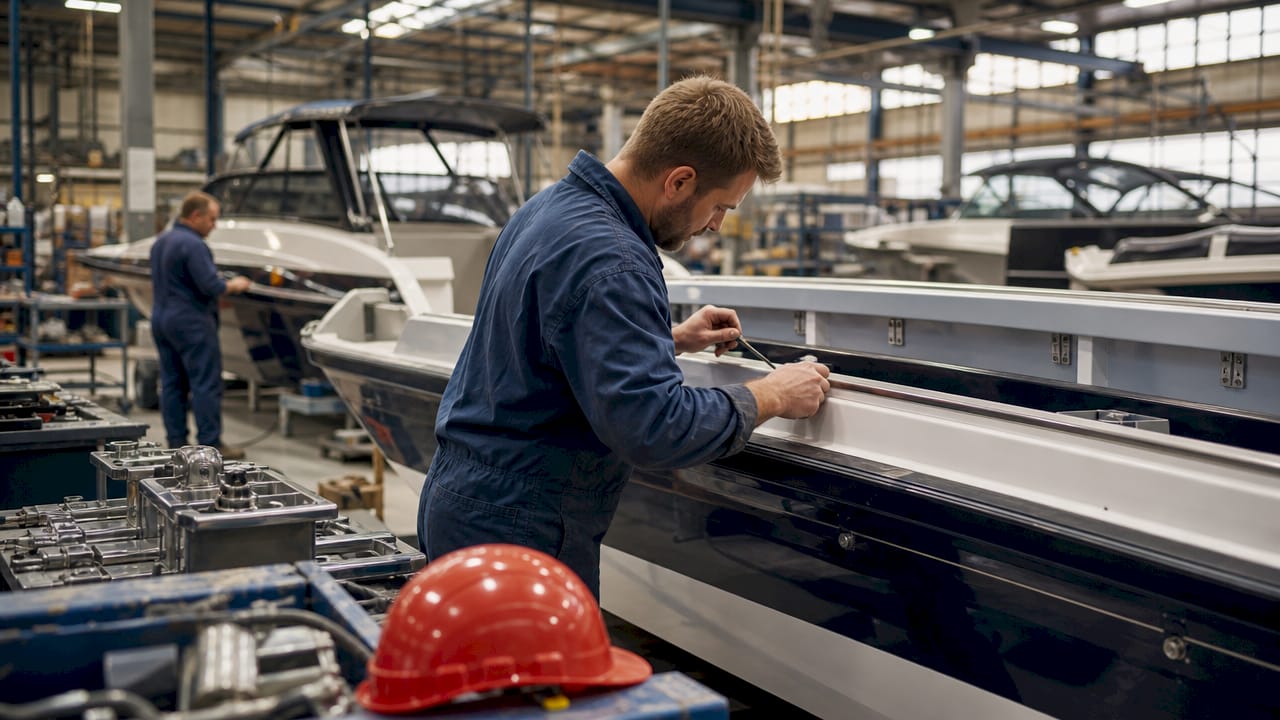
The boat manufacturing process at volume producers relies on CAD-precision robotic assembly and specialized hull technology to improve efficiency and product consistency. Buyers should verify whether a manufacturer’s technology claims reflect genuine performance gains or marketing terminology.
Modern fiberglass layup processes, vacuum infusion techniques, and CNC-cut structural components have raised the baseline quality across the industry. A mid-priced production boat today is structurally superior to a comparable boat built 20 years ago. That improvement benefits buyers at every price point.
Sustainability and electric propulsion are now major drivers of value, with shipyards pivoting toward aluminum high-efficiency builds and battery-electric vessel programs. Electric propulsion is most practical today in day boats, tenders, and short-range recreational craft. Longer-range electric vessels remain in development across multiple yards.
Pro Tip: Ask any manufacturer about their warranty on the hull laminate separately from the mechanical warranty. Hull structural warranties of 10 years or more signal genuine confidence in the build process.
6. What to look for in a boat manufacturer’s dealer network
A strong dealer and service network is the single most practical factor buyers overlook when selecting a manufacturer. Buyers encounter significant delays when the manufacturer lacks local support, even when the product itself is high quality.
Dealer network strength affects warranty fulfillment, parts sourcing, and scheduled maintenance. A manufacturer with 500 dealers nationwide delivers a fundamentally different ownership experience than one with 50. That gap shows up most clearly when something breaks at the start of a holiday weekend.
For buyers researching family-friendly boat options, dealer proximity and service responsiveness rank above brand prestige in practical importance. A well-supported mid-tier brand outperforms a prestigious brand with poor local service every time.
Evaluate dealer quality, not just dealer count. Visit the service department, ask about average repair turnaround times, and check owner forums for real-world service experiences with the brands you are considering.
7. How to match a manufacturer to your boating needs
Matching a manufacturer to your needs starts with defining your primary use case. Freshwater fishing, offshore sport fishing, coastal cruising, and luxury chartering each point toward different builders with different engineering priorities.
Buyers who understand boat types before approaching a manufacturer make better decisions. Knowing whether you need a center console, a walkaround cabin, a pontoon, or a sport cruiser narrows the field from hundreds of builders to a manageable shortlist.
Budget shapes the decision at every level, but the total cost of ownership matters more than the purchase price. Factor in insurance, storage, fuel, maintenance, and the cost of dealer service when comparing manufacturers at similar price points. A boat with lower upfront cost but poor parts availability can cost more over five years than a higher-priced alternative with strong dealer support.
Boat dealer marketing platforms increasingly help buyers research inventory and connect with local dealers before visiting a showroom. Using these tools to compare available models in your region saves significant time during the selection process.
Key takeaways
The best boat manufacturer for any buyer is the one whose product, dealer network, and build quality align with their specific use case and long-term ownership expectations.
| Point | Details |
|---|---|
| Volume leaders by production | Brunswick Boat Group leads globally in recreational boat output across multiple brands. |
| Fishing boat specialists | Valhalla Boatworks, Contender, Freeman, and Yellowfin lead the center console fishing segment. |
| Luxury and superyacht leaders | Fincantieri leads by revenue; Lürssen, Feadship, and Azimut Benetti lead in bespoke builds. |
| Custom vs. production trade-off | Boutique yards offer full personalization but require longer lead times and higher budgets. |
| Dealer network is critical | Local service availability determines real-world ownership quality more than brand reputation alone. |
What I have learned from watching buyers choose manufacturers
Most buyers spend 80% of their research time comparing horsepower and hull dimensions, and almost no time evaluating the dealer network they will depend on for the next decade. That is the single most common mistake I see.
The buyers who end up happiest are the ones who visited the service department before they visited the showroom. They asked the service manager how long a typical warranty repair takes. They checked whether parts for their target model are stocked locally or have to be shipped from overseas. Those questions reveal more about the ownership experience than any spec sheet.
The shift toward electric propulsion and sustainable builds is real, but it is not yet mature enough to drive a purchasing decision for most recreational buyers in 2026. Watch it closely. The yards investing seriously in battery-electric programs today will have a meaningful advantage in three to five years. If you are buying a boat you plan to keep long-term, ask your shortlisted manufacturers directly about their electrification roadmap.
Custom and semi-custom options are worth considering at a lower price point than most buyers assume. Several mid-tier yards now offer semi-custom programs starting well below the superyacht threshold. If your budget allows any flexibility, the ability to specify your own layout and finish materials produces a boat you will keep longer and enjoy more.
— Richard
Safeboatingamerica: get certified before you get underway
Selecting the right manufacturer is only part of becoming a responsible boat owner. Operating any vessel legally and safely requires proper certification, and Safeboatingamerica makes that process straightforward for boaters in every U.S. state.
Safeboatingamerica offers state-approved boating certification through online courses, live Zoom classes, and in-person programs taught by USCG-Licensed Captains and NASBLA-approved instructors. Whether you need a New York boating safety certificate under Brianna’s Law, a Connecticut Safe Boating Certificate, or a license for any other state, Safeboatingamerica provides same-day certification options with convenient scheduling. Get certified before your first trip on the water.
FAQ
What is the largest boat manufacturer in the world by volume?
Brunswick Boat Group is recognized as the global leader in recreational boat production volume, operating across dozens of brands. Its scale gives it the widest dealer network and broadest product range in the industry.
Which center console fishing boat brands do experts recommend?
Valhalla Boatworks, Contender, Freeman Boatworks, and Yellowfin are consistently favored by charter captains and fishing experts for offshore performance. Freeman’s catamaran hulls exceed 80 mph, making them among the fastest center consoles available.
What separates custom boat manufacturers from production builders?
Custom and semi-custom yards allow buyers to specify hull dimensions, interiors, and systems in ways that volume producers cannot match. The trade-off is longer lead times and higher cost per vessel.
How important is a dealer network when choosing a manufacturer?
A strong local dealer and service network is critical to the ownership experience, affecting warranty fulfillment, parts availability, and maintenance turnaround. A manufacturer with poor regional support creates real operational problems regardless of product quality.
Do I need a boating license to operate a boat from any manufacturer?
Most U.S. states require a boating safety certificate to legally operate a motorized vessel, regardless of the brand or type. Safeboatingamerica provides state-approved certification courses that satisfy requirements in every state.