Man Overboard Procedure: Steps for Boaters

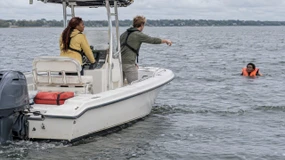
The man overboard procedure has one order: shout, point, throw flotation, slow the boat and turn back, shut off the engine near the person, recover, then treat for cold and injury. The National Park Service puts the first action as alerting everyone aboard and judging whether a safe rescue is possible. Jumping in comes last. This guide covers each step for powerboats, personal watercraft and sailboats, plus the equipment and drills that make the steps work.
TL;DR
- Shout “man overboard,” assign one person to point at the swimmer continuously, and throw a life ring or throwable PFD, ideally on a line.
- Stop, turn slowly, and keep the person in sight. Never reverse the boat to pick someone up.
- Shut off the engine when you approach the person, and keep them on the operator’s side.
- Make contact with a line or boat hook, secure the person alongside, then bring them aboard by a ladder or swim platform.
- Treat for cold-water exposure, call for help on VHF-FM Channel 16 or 911, and know when an accident report is required.
Table of Contents
- The first 30 seconds: alert, point, throw
- The three phases of recovery
- Turning the boat around
- Quick Stop and other return methods
- Final approach and contact
- Getting the person aboard
- After recovery: cold, injury and calling for help
- Personal watercraft and small powerboats
- Equipment to have ready
- Reporting an accident
- Prevention and drills
- Perspective
- Build the skill with a boating safety course
- FAQ
- Sources
The first 30 seconds: alert, point, throw
The first seconds decide whether you can still see the person. Three jobs happen at once, and each needs an owner.
- Shout. The first person to see the fall shouts “Man overboard!” and states the side. The University of Washington Boating Safety Manual lists the alert and the side as the opening step.
- Point. Assign a spotter whose only job is to keep eyes and arm on the person. US Sailing lists a continuous spotter in the initial reaction. The U.S. Naval Academy sailing guide calls for a permanent spotter too.
- Throw. Toss a life ring, a cushion-type Type IV PFD or other flotation. The National Park Service advises throwing a life jacket or throwable device to the person. Flotation also marks the spot if the person drifts out of sight.
Also save the position. US Sailing includes saving the GPS or MOB waypoint in the initial reaction, and calling for help when appropriate. One crew member presses the MOB button or marks the plotter while the operator handles the boat.
Who does what on a small boat
On a two-person boat there is no spare hand. If you are the operator and your passenger is the one in the water, you throw flotation, slow the boat, and keep looking at the person yourself. If your passenger is untrained, give one short instruction: “Point at him and do not stop pointing.” That one sentence is the most useful thing a first-time guest can learn before leaving the dock.
The three phases of recovery
US Sailing splits the procedure into three parts. Thinking in phases keeps the crew from skipping ahead.
| Phase | Goal | Key actions |
|---|---|---|
| 1. Initial reaction | Keep contact, get flotation to the person | Shout, point, throw flotation, mark position, call for help if needed |
| 2. Return | Turn the boat around safely | Slow down, turn, keep the person in sight, plan the approach |
| 3. Approach and rescue | Reach the person without hurting them | Shut off the engine, make contact, secure alongside, bring aboard |
US Sailing also notes that no single maneuver fits every incident. The return method depends on the boat’s handling, crew and conditions. That is why practice on your own boat matters more than memorizing a diagram.
Turning the boat around
The U.S. Coast Guard propeller-injury brochure gives the core sequence for a powerboat: stop, turn around slowly, keep the person in sight, assign a passenger to watch them, turn the engine off, then bring the person to safety. It also says never to reverse to pick someone up. If you overshoot, go around again.

The Coast Guard’s engine cut-off device guidance says the same: stop, keep the person visible, and circle forward rather than using reverse.
Reduce speed before you turn
On a planing boat, come off plane and slow down before a sharp turn. Hard turns at speed throw other passengers around and can put a second person in the water. After the turn, plan the final approach into the wind or current where you can, so the boat slows itself and drifts less toward the person.
Keep the person on the operator’s side
The Coast Guard’s Boater’s Guide to Federal Requirements says to keep the person on the operator’s side and always in view. On most boats the helm is where your sight lines are weakest on the passenger side, so approach so the swimmer stays where you can see them until you shut down.
Quick Stop and other return methods
Quick Stop
The Quick Stop is the method most search results lead with. US Sailing describes it as turning into the wind when appropriate, tacking, and stopping or slowing the boat while the person stays in sight, then making a controlled approach. The aim is to stay as near to the swimmer as possible. US Sailing also says the method has a time and place, depending on the boat and conditions.
Other sailboat turns
Sailing crews also use the figure 8 and the Lifesling. The Anderson, Williamson and Scharnow turns come from larger vessels and are common in textbooks. For a recreational powerboat, the practical rule is simpler: stop, turn, come back in a gentle arc, and arrive at the slowest controllable speed.
Choosing between them
- Small powerboat or PWC: stop, circle forward, approach at idle.
- Sailboat under sail: use the method your crew has practiced, usually Quick Stop or figure 8.
- Large vessel with limited maneuverability: a longer return turn, with a spotter on the highest vantage point.
Final approach and contact
The approach is where propeller injuries happen. The Coast Guard’s guidance makes engine shutdown critical when approaching anyone in the water. The University of Washington manual lists motors off or out of gear during the final approach, then contact with a throw rope, boat hook or dock line.
A practical sequence:
- Approach slowly, into the wind or current if possible.
- Take the engine out of gear as you near the person.
- Shut the engine off when contact is imminent. In calm to moderate seas, DAN Boater advises turning it off after contact.
- Pass a line, boat hook or flotation device, ideally with a line attached.
- Bring the person alongside and secure them to the boat.
The Coast Guard Auxiliary’s MOB recovery sheet distinguishes direct and indirect recovery. It tells crews to choose a leeward or windward approach based on weather, place engines in neutral once alongside, and establish positive control. Positive control means the person cannot drift away or slip under the hull while you work on getting them aboard.
Getting the person aboard
Being alongside is not the same as being aboard. A cold, tired or injured person often cannot climb. DAN Boater describes recovery as four stages: make contact, attach the person to the boat, get the person aboard, and provide after-care.
- Use a ladder or swim platform. A boarding ladder that reaches below the waterline is the simplest tool. Our guide to boat boarding ladders covers types and installation.
- Use two people when possible. The Auxiliary sheet prioritizes two-person lifting where possible.
- Unconscious person: DAN Boater says to bring the person aboard only if it is safe. Otherwise secure them alongside and call for help.
- Do not jump in unprepared. The National Park Service warns that a rescuer who enters the water without flotation can become a second victim. If you must enter, put on a life jacket first.
After recovery: cold, injury and calling for help
Call early. The Coast Guard Navigation Center says boaters in a real emergency should use VHF-FM Channel 16 or 911. If the person is unconscious, the National Park Service says to call 911 and start CPR.
For a conscious person who is cold:
- Move them to a warm, dry place on board.
- Remove wet clothing and apply dry blankets.
- Seek medical attention right away, even if they say they feel fine.
- Do not give hot liquids after prolonged cold-water exposure, per the National Park Service.
Children lose heat faster than adults, and the signs of chilling can be easy to miss. If young passengers are aboard, read why children chill in the water and keep dry towels and clothing within reach.
Inspect for injuries, especially head, neck, and propeller or hull strikes. Anyone who inhaled water or lost consciousness needs a medical evaluation.
Personal watercraft and small powerboats
The principles are the same on a Jet Ski or WaveRunner: keep the rider in sight, approach slowly, and shut off the engine before contact. Differences come from size. A PWC has little room, so recover one person at a time, approach from downwind or down-current where practical, and stop the engine so the rider is not near the jet intake. Riders who fall off together should stay with the craft and signal.
On small open boats, a person hauled over the side can swamp the boat. Bring them in over the stern or transom where freeboard is lowest and keep weight centered. Our guide to avoiding capsizing or swamping explains how loading and boarding affect stability.

Equipment to have ready
The Coast Guard’s federal requirements guide lists the baseline:
- A U.S. Coast Guard-approved wearable PFD for every person aboard.
- An immediately available throwable PFD on vessels 16 feet or longer, except canoes and kayaks.
- Ideally, a whistle and an emergency light attached to wearable PFDs.
Add a throw line, boat hook and boarding ladder, and keep them where one person can reach them in seconds. A throwable device stowed under a locked seat does not count as immediately available in practice. For a full list, see what every boater must carry and run a step-by-step boat safety inspection before the season.
Reporting an accident
A fall overboard can trigger reporting duties. Under the Coast Guard’s 2023 incident reporting policy, a person falling overboard from a vessel underway or anchored is generally among the occurrences that must be reported when federal reporting thresholds apply. The Coast Guard’s accident reporting page says the owner must file a report with the state reporting authority when an accident causes a death or an injury requiring medical treatment. Check your state agency for its deadlines and forms.
Prevention and drills
Most recoveries go better when the fall is avoided or when the crew has rehearsed.
- Wear the PFD. A person who falls in wearing one stays afloat and is easier to find.
- Use the engine cut-off switch. The lanyard stops the engine if the operator is thrown from the helm.
- Brief every guest. Show where flotation, the ladder and the radio are, and who points.
- Stay seated while underway and avoid standing on bows, gunwales and transoms.
- Practice with a cushion or fender. Throw it overboard unannounced, and time how long it takes to turn back and make contact.
The U.S. Naval Academy guide stresses a practiced recovery. Run the drill each season in calm water with new crew, and again after any change in boat or crew. Pair it with the six launch checks before leaving the ramp. If you are new to the water, our beginner’s safety guide covers the basics.
Docking and wind
Wind and current change how the boat drifts toward a swimmer, and the same skills apply at the dock. Our guides on docking a boat in wind and recommended docking techniques build the slow-speed handling that a recovery approach needs.
Perspective
We teach man overboard recovery as a skill, not a checklist to memorize. In our classes the same pattern repeats: operators who know the steps on paper still hesitate when it happens, because they have never turned a boat back toward a person in the water.
That is why our state-approved courses, taught by State Certified Instructors and USCG-licensed captains, put emergency response next to rules of the road and equipment. A certificate shows you have covered the material. Practice on your own boat makes it usable.
We also ask every student to assign a spotter and a throw-line handler on day one. Those two habits cost nothing, and they are what we see work.
Richard
Build the skill with a boating safety course
If you want the procedure taught by an instructor, we offer state-approved boating safety education for powerboat and PWC operators. Options include the NYS Safe Boating Class at $85, the Zoom Online 1-Day Class at $75, and online courses for every state. Connecticut boaters can ask about the private Connecticut boating course.
On-water training and advanced education are also listed on our class page. Want to give a friend or family member the course? Gift certificates are available.
FAQ
What is the first action in a man overboard situation?
Alert everyone aboard by shouting “Man overboard!” and the side the person fell. Then assign someone to point at the person continuously and throw flotation. The National Park Service lists alerting the vessel and judging whether a safe rescue is possible as the first response.
What are the three man overboard recovery procedures?
US Sailing describes three: the initial reaction on board, turning the boat around and returning to the person, and approaching and rescuing the person. Each needs a clear owner, and the return method depends on boat type, crew and conditions.
What is the Quick Stop procedure?
The Quick Stop is a sailboat method. You turn into the wind when appropriate, tack, and stop or slow the boat so you stay close to the person, then approach under control. US Sailing says it has a time and place depending on the boat and conditions.
Should I reverse the boat to pick someone up?
No. The U.S. Coast Guard says never to reverse to pick someone up. Stop, keep the person in sight, circle forward, shut off the engine on approach, and go around again if you overshoot.
Should I jump in to help?
It is the last option. The National Park Service says a rescuer without flotation can become a second victim. Throw flotation first, and if you must enter the water, wear a life jacket.
Sources
- Man Overboard! (U.S. National Park Service)
- Man Overboard Rescue Procedure (US Sailing)
- Man Overboard! (U.S. Naval Academy)
- UW Boating Safety Manual
- Beware: propeller injuries (U.S. Coast Guard)
- Engine/Propulsion Cut-Off Devices (U.S. Coast Guard)
- A Boater’s Guide to the Federal Requirements (U.S. Coast Guard)
- Man Overboard! (Now what?!) (DAN Boater)
- MAN OVERBOARD (MOB) RECOVERY (Coast Guard Auxiliary)
- News and Notices (USCG Navigation Center)
- CG-BSX Policy 23-01 Recreational Boating Incident Reporting
- Accident Reporting (U.S. Coast Guard)
- Why children chill in the water