Florida Boating License Requirements: Who Needs a Card

Florida does not issue a general boating license. It requires proof of boating safety education instead. If you were born on or after January 1, 1988 and operate a vessel with a motor of 10 horsepower or greater, you must carry that proof, plus photo ID, whenever you operate. The permanent proof is the Boating Safety Education Identification Card issued by the Florida Fish and Wildlife Conservation Commission (FWC). Most people call it a Florida boating license, and that is the search term this guide answers.
TL;DR
- Florida has no boating license. It has a boater education requirement, shown by an FWC identification card.
- The rule applies to anyone born on or after January 1, 1988 who operates a vessel powered by a motor of 10 horsepower or greater.
- Pass a commission-approved course. The card is valid for life. A course certificate or temporary certificate covers you for 90 days.
- Personal watercraft operators must be at least 14. Renting a personal watercraft requires being at least 18.
- Exemptions exist, including Coast Guard-licensed masters, private lakes and ponds, accompanied operation, and qualifying nonresidents.
Table of Contents
- Does Florida require a boating license?
- Who needs a Florida boating safety certificate
- What proof you must carry while operating
- How to get a Florida boating license (the card)
- Age limits for boats and personal watercraft
- Exemptions to the education requirement
- Out-of-state boaters and Canadians
- Rules that still apply after you have the card
- Our perspective
- Take a course with Safe Boating America
- Checklist before you launch
- FAQ
- Sources
Does Florida require a boating license?
No. FWC states that Florida has no general boating license. The state regulates by education, not by licensing. The document that counts is the Boating Safety Education Identification Card, carried with a photo ID.
The rule sits in Section 327.395 of the 2026 Florida Statutes. It prohibits a person born on or after January 1, 1988 from operating a vessel powered by a motor of 10 horsepower or greater unless the required proof is aboard.
Three conditions decide whether the rule applies to you:
| Condition | Applies when |
|---|---|
| Birth date | Born on or after January 1, 1988 |
| Vessel power | Motor of 10 horsepower or greater |
| Role | You are the person operating the vessel |
All three must be true. Someone born in 1985 does not need the card. A 1995-born boater running a 5 horsepower outboard does not need it either. A passenger never needs it, because the rule covers operators.
Who needs a Florida boating safety certificate
The rule is tied to age cohort, not to experience. A boater with twenty years on the water who was born in 1990 still needs the card. A boater born in 1980 who has never driven a boat does not.
Common situations:
- Owners of powerboats. Any operator born on or after the cutoff date who runs a motor of 10 horsepower or greater.
- Jet Ski and WaveRunner operators. Personal watercraft fall under the same education rule. Age limits apply on top of it (see below).
- Boaters who borrow a boat. The rule follows the operator, not the owner. If you take the helm of a friend’s boat, you need your own proof.
- New Florida residents. Moving to the state does not remove the requirement. Residents born on or after the cutoff need proof on board.
- Visitors. Florida visitors must comply with the boating safety education requirements, unless a nonresident exemption applies.
Our guide to what boating safety education covers explains how the course content maps to the rules you will meet on the water.
What proof you must carry while operating
Florida accepts three forms of proof. Which one you hold depends on how far along you are.

Permanent card
The normal proof is the FWC-issued Boating Safety Education Identification Card together with photographic identification. The card is valid for life. It does not need renewal.
The statute also allows a Florida driver license or state ID that bears the boating safety card indicator, as specified by law. If yours carries that indicator, it can serve as the proof.
Course completion certificate
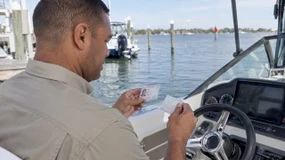
After you pass an approved course, the completion certificate works as temporary proof for up to 90 days. You must also carry photo ID. The certificate has to show:
- Your first and last name
- Your date of birth
- The date you passed the course
A certificate missing any of these items may not satisfy an officer. Check the printed document before you leave the dock.
Temporary certificate
A temporary certificate comes from passing a commission-approved temporary-certificate examination. The 2026 statute makes it valid for 90 days after issuance. Carry it with photo ID while operating.
This route suits renters and visitors who need to be on the water soon. It is not a lifetime credential. After 90 days, you need the permanent card. Our posts on the Florida boater education temporary certificate and on renting a boat in Florida with the 90-day certificate cover the practical details.
How to get a Florida boating license (the card)
The process is short. Most of the time goes to the course itself.
- Confirm you need it. Check your birth date and the horsepower of the motor you will operate.
- Choose a commission-approved course. FWC requires that the course be approved. A course that is not approved does not qualify you for the card.
- Complete the course and pass the exam. Keep your completion certificate. It is your proof for the first 90 days.
- Get the card issued. A provider may submit your information to FWC automatically. When that happens, the card generally arrives within two to three weeks.
- Request it yourself if the provider does not submit. Send FWC your course-completion proof, name, date of birth, return address and phone number. The address is Bobbercard@MYFWC.com, or you can mail the FWC Boating Safety Unit. Details are on the FWC identification card page.
If you manage your record online, our walkthrough of the My FWC account shows how setup and certification fit together.
What the course covers
Approved courses teach the rules and practices an operator needs: navigation rules, right-of-way, safety equipment, required lights, emergency procedures, and the laws that apply to recreational vessels. Topics for personal watercraft operators include lanyard use, life jackets, and operating limits.
How long it takes
Online courses are self-paced, so the time depends on how quickly you work through the material. Live formats compress the content into a single session. Plan for the card to arrive by mail after the course, since issuance takes weeks even when the course takes a day.
Age limits for boats and personal watercraft
The education requirement is separate from age limits. Florida sets its own ages for personal watercraft.
- Operating a personal watercraft: the minimum age is 14.
- Renting a personal watercraft: you must be at least 18.
- Allowing a child to operate: knowingly allowing someone under 14 to operate a personal watercraft is unlawful.
A 15-year-old who was born after 1988 therefore needs two things: to meet the age limit and to hold proof of education. Parents who own a Jet Ski should check both. Our Florida PWC laws guide covers age, the education card, rules and penalties in one place. For a broader view, see our article on Jet Ski licenses for minors.
Exemptions to the education requirement
Florida exempts several groups. FWC lists these exemptions:
- A person licensed by the U.S. Coast Guard as a vessel master
- A person operating only on a private lake or pond
- An operator accompanied by an eligible person at least 18 years old who is attending to the operation and is responsible for safe operation
- A qualifying nonresident
- A person within 90 days after buying a vessel, with the required bill of sale
- A person within 90 days after completing an approved course, with the required identification and certificate
The accompanied-operator exemption has conditions. The supervising person must be eligible, meaning they are exempt or hold the proper proof themselves, and they must be actively responsible for safe operation. Sitting in the boat is not enough.
The 90-day purchase window helps new owners. Keep the bill of sale on board. Without it, the exemption is hard to show.
Out-of-state boaters and Canadians
Florida recognizes credentials from elsewhere in several cases. The statute recognizes qualifying credentials from another state, a U.S. territory or Canada when the course or equivalency exam meets or exceeds NASBLA minimum standards. It also recognizes a valid International Certificate of Competency and a Canadian Pleasure Craft Operator Card.
For visitors, a nonresident who shows proof of a boater safety course or equivalent exam that meets Florida’s requirements does not need a Florida card. Bring the physical card or certificate and photo ID.
Residents should not rely on this. If you live in Florida, get the Florida card. A visiting boater from another state is in a different position from a permanent resident.
Other states set their own ages and dates. Examples from our library: Georgia boating age rules, Texas Jet Ski age rules and California Jet Ski rules. Do not assume Florida’s birth-date cutoff applies elsewhere.
Rules that still apply after you have the card
The card proves education. It does not replace the operating rules. For personal watercraft, FWC requires:
- Each operator, rider or person being towed wears an approved non-inflatable wearable life jacket
- The operator attaches the engine-cutoff lanyard when the manufacturer provides one
- No operation from one-half hour after sunset until one-half hour before sunrise, even with navigation lights
Penalties for violations are covered in our Florida PWC laws article. Treat the list above as the minimum and read the FWC regulations page for the full set.
Our perspective
We teach boating safety courses across the country, and Florida generates the same confusion every season. Boaters search for a license, find that none exists, and conclude they need nothing. Then they are stopped on the water without the card.
Three points from our classes:
- The name does not matter. The proof does. Call it a license, a card or a certificate. Officers look for the documents the statute names.
- Check the certificate before you leave class. Name, date of birth and passing date must all appear. Errors are easier to fix on the day than weeks later.
- Do not stack risk on the 90-day window. Temporary proof is for bridging the gap. Make sure the card request has gone to FWC, either through the provider or by you.
Our instructors are state certified instructors and USCG-licensed captains. Courses use NASBLA-approved material. We want a student to leave knowing the rules, not only holding paper.
— Richard
Take a course with Safe Boating America
We offer online computer-based boating safety courses for boaters across the U.S., plus live Zoom classes. The Zoom Online 1-Day Class costs $75. Our online boating courses page covers the self-paced option. Before you pay for any course, confirm it is approved for the state where you will operate, and for Florida confirm it is commission-approved.
Gift certificates are available at $75 to $85 for a family member or friend who needs the course. See our gift certificate page.
Checklist before you launch
- Check your birth date against January 1, 1988.
- Check the horsepower of the motor you will run.
- Carry photo ID.
- Carry the card, or the course certificate or temporary certificate if inside 90 days.
- Confirm the certificate shows your name, date of birth and passing date.
- For a personal watercraft, confirm the operator is at least 14 and, if renting, at least 18.
- Bring approved life jackets and attach the lanyard.
FAQ
Do you need a boating license in Florida?
No. Florida has no general boating license. If you were born on or after January 1, 1988 and operate a vessel with a motor of 10 horsepower or greater, you need proof of boating safety education. That proof is usually the FWC card plus photo ID.
How long is the Florida boater card valid?
The permanent card is valid for life and does not need renewal. A temporary certificate is valid for 90 days after issuance. A course completion certificate can serve as proof for up to 90 days after you pass.
Can you operate a boat in Florida without the card if you are exempt?
Yes, if an exemption applies. Examples are a Coast Guard-licensed master, operation only on a private lake or pond, or operation while accompanied by an eligible person at least 18. Keep any documents that support the exemption, such as a bill of sale within 90 days of purchase.
Is an out-of-state boater card accepted in Florida?
Often, yes. Florida recognizes qualifying credentials from other states, U.S. territories and Canada when the course or exam meets or exceeds NASBLA minimum standards. Residents should still get the Florida card.
What is the youngest age to operate a Jet Ski in Florida?
The minimum age to operate a personal watercraft is 14. You must be at least 18 to rent one. Operators born on or after January 1, 1988 also need proof of boating safety education.
Sources
- FAQs About Boating Safety Education Requirements, FWC
- Boating Safety Education Identification Card, FWC
- Boating Regulations, FWC
- Chapter 327, Section 395, 2026 Florida Statutes
- Frequently Asked Questions, Florida Department of Highway Safety and Motor Vehicles
- Boating Safety and Education, Florida Department of Highway Safety and Motor Vehicles