No Federal Boating License. Get Certified With a $75 1 Day Class

No federal recreational boating license exists. The federal government issues commercial mariner licenses and certificates under Title 46, but recreational boater education and certification fall to the states. Most states now require a state-approved boater education certificate, often called a boater card, for at least some operators. Check the U.S. Coast Guard (USCG) and NASBLA for the rules that actually apply to you.
TL;DR:
- Most states require a state-approved boater education certificate, often called a boater card, with requirements varying by age, vessel type, and horsepower.
- Federal rules govern vessel equipment, registration, and accident reporting, but do not issue a nationwide recreational boating license.
- Certification courses can be online, live, or on-water, but some states mandate in-person or hands-on skills training for certain operators or vessels.
- Most states recognize a NASBLA-approved certificate from another state, but exceptions exist, so verification before boating in a new state is essential.
- Operating vessels without the proper certification, safety gear, or registration can lead to legal issues or increased risk, especially since 69% of boating fatalities involve untrained operators.
Table of Contents
- Federal vs. State: What Federal Law Actually Covers
- Who Actually Has to Complete Boating Education?
- How Do You Get Certified for Boating?
- What Federal Equipment and Registration Rules Apply to You?
- Does Your Boating Certificate Work in Other States?
- Your Boating Certification Checklist
- Why Boating Education Matters More Than the Paperwork Suggests
- Get Certified Nationwide With Safe Boating America
- Sources
- FAQ
Federal vs. State: What Federal Law Actually Covers
Federal authority over boating splits cleanly into two lanes, and confusing them is where most boaters get tripped up. 46 U.S. Code § 7101 gives the Secretary authority to issue licenses and certificates of registry for masters, mates, engineers, and pilots. That’s professional mariner territory. It has nothing to do with a family running a center console on the weekend or a teenager riding a personal watercraft.
Recreational operator education lives with the states. What the federal government does regulate, regardless of where you boat, is the equipment, registration, and reporting side of vessel ownership. The Boater’s Guide to Federal Requirements lays out those obligations in detail. A quick way to keep the two straight:
- Federal: vessel equipment carriage, registration/documentation standards, accident reporting thresholds, engine cutoff switch rules.
- State: who must complete boating education, minimum operator age, course approval, certificate issuance.
- Neither: a nationwide recreational “license” that works the same way in all 50 states.
If you’re searching for USCG license requirements and expecting something like a driver’s license, that mismatch is exactly why the term “federal boating license” causes so much confusion.
Who Actually Has to Complete Boating Education?
States use a handful of common triggers to decide who needs certification, and none of them are identical from state to state. The usual variables:
- Birth-year cutoffs — many states require education only for operators born after a certain date, phasing in the requirement generation by generation.
- PWC operators — Jet Ski and WaveRunner riders frequently face stricter age minimums and mandatory education even where other boaters don’t.
- Horsepower and vessel age thresholds — some states exempt older or lower-powered boats from the requirement entirely.
- Youth operator rules — supervised-operation windows for young teens before they’re allowed to run a boat solo.
Alabama illustrates the variation well. Operators must be at least 12 to qualify for certification, with supervised-operation rules for 12 and 13-year-olds, and the state added distinct nonresident certification requirements effective October 1, 2024. A boater certified in one state can’t assume Alabama’s rules mirror their home state’s.
Pro Tip: Never assume your home state’s age cutoff applies elsewhere. Check NASBLA’s State Law Dashboard or call the destination state’s boating agency before you launch, especially if you’re trailering to a new lake for the first time.
How Do You Get Certified for Boating?
“NASBLA-approved” and “ANSI/NASBLA standard” get used almost interchangeably, but they mean slightly different things. NASBLA approves individual courses against a set of content requirements. The ANSI/NASBLA national education standards define what those content requirements actually are, covering navigation rules, PWC safety, and emergency procedures. A course can be NASBLA-approved in one state and still not satisfy another state’s specific statute, which is why verifying acceptance in your own state matters more than the approval label alone.
Course formats generally fall into three buckets:
- Online, knowledge-only — self-paced modules covering navigation rules, safety equipment, and boating law. Accepted by most states for a standard certificate.
- Live Zoom or in-person classroom — instructor-led sessions covering the same material, often finished in a single day.
- On-water skills training — hands-on instruction that some states, and NASBLA’s advanced credential, treat as a stronger reciprocity signal than a knowledge-only course.
Exams typically require a passing score above the minimum threshold set by the course provider, and once you pass, the provider issues a certificate, usually a permanent one rather than something that expires like a driver’s license.
Can you finish certification fully online? In many states, yes. But it’s state-dependent: some jurisdictions still require an in-person or on-water component for certain age groups or PWC operators, so confirm before you enroll. The safety case for finishing the course at all is hard to argue with. USCG data shows 69% of boating fatalities occurred on vessels where the operator had no safety instruction, compared with just 19% where the operator held a nationally approved certificate.

What Federal Equipment and Registration Rules Apply to You?
Regardless of what your state requires for education, federal rules govern the gear on board and how your vessel is documented. The Boater’s Guide to Federal Requirements spells out the baseline:
- One wearable personal flotation device (PFD) per person aboard, sized correctly for each occupant.
- A throwable flotation device on boats 16 feet and longer.
- Visual distress signals where federal waters or vessel size require them.
- Registration through your state (a Certificate of Number) for most recreational boats, versus federal documentation through the Coast Guard for larger vessels or specific ownership situations.
Two more federal rules trip up first-time owners regularly. Accidents above certain injury, death, or property-damage thresholds must be reported, and any vessel under 26 feet with an engine cutoff switch capability must have the operator wear the engine cutoff switch lanyard while underway on plane or above displacement speed. Neither rule depends on which state you’re in.
Does Your Boating Certificate Work in Other States?
Most states recognize a NASBLA-approved certificate issued by another state, which is the entire point of national standards. But “most” isn’t “all,” and reciprocity rules carry exceptions worth checking before you trailer a boat across state lines.
- Confirm the destination state’s stance through the NASBLA State Law Dashboard before you launch, not after.
- Carry your physical or digital certificate on board. A verbal claim that you’re certified doesn’t satisfy an officer doing a safety check.
- Watch for temporary nonresident operation windows some states grant visitors before requiring local certification.
For boaters who want a stronger credential, NASBLA’s Enhanced Recreational Boating Certificate (ERBC) combines a knowledge-based course with verified on-water skills training. It’s a pilot program in select states rather than a universal requirement, but it signals a level of hands-on competency that a knowledge-only certificate doesn’t capture.
Your Boating Certification Checklist
Getting compliant doesn’t require guesswork if you follow the sequence in order:
- Look up your state’s boating education requirement and any age or vessel-type exemptions.
- Cross-check reciprocity and nonresident rules on the NASBLA State Law Dashboard if you boat across state lines.
- Choose an approved course format, whether that’s boating safety education delivered online, live, or on the water.
- Pass the exam and keep your certificate accessible on board, physically or digitally.
- Confirm your vessel’s registration status and required safety gear, and know your state’s accident-reporting thresholds.
Pro Tip: Take a photo of your certificate and store it in your phone the day you receive it. Officers checking compliance during a routine stop rarely have patience for “it’s at home in a drawer.”
Why Boating Education Matters More Than the Paperwork Suggests
The certification requirement gets treated as a bureaucratic hurdle, but the numbers argue otherwise. Nearly seven in ten boating fatalities involve operators with zero safety instruction. That’s not a rounding error. Safe Boating America has spent years watching first-time owners treat the course as a formality, then come back afterward and admit the navigation rules or capsizing drills changed how they actually operate on the water. The certificate is the byproduct. The judgment it builds is the point.
— Richard
Get Certified Nationwide With Safe Boating America
Safe Boating America offers boating certification courses designed to meet state boating education requirements. Courses run online, live over Zoom, or in person, with certification available upon completion depending on the format.
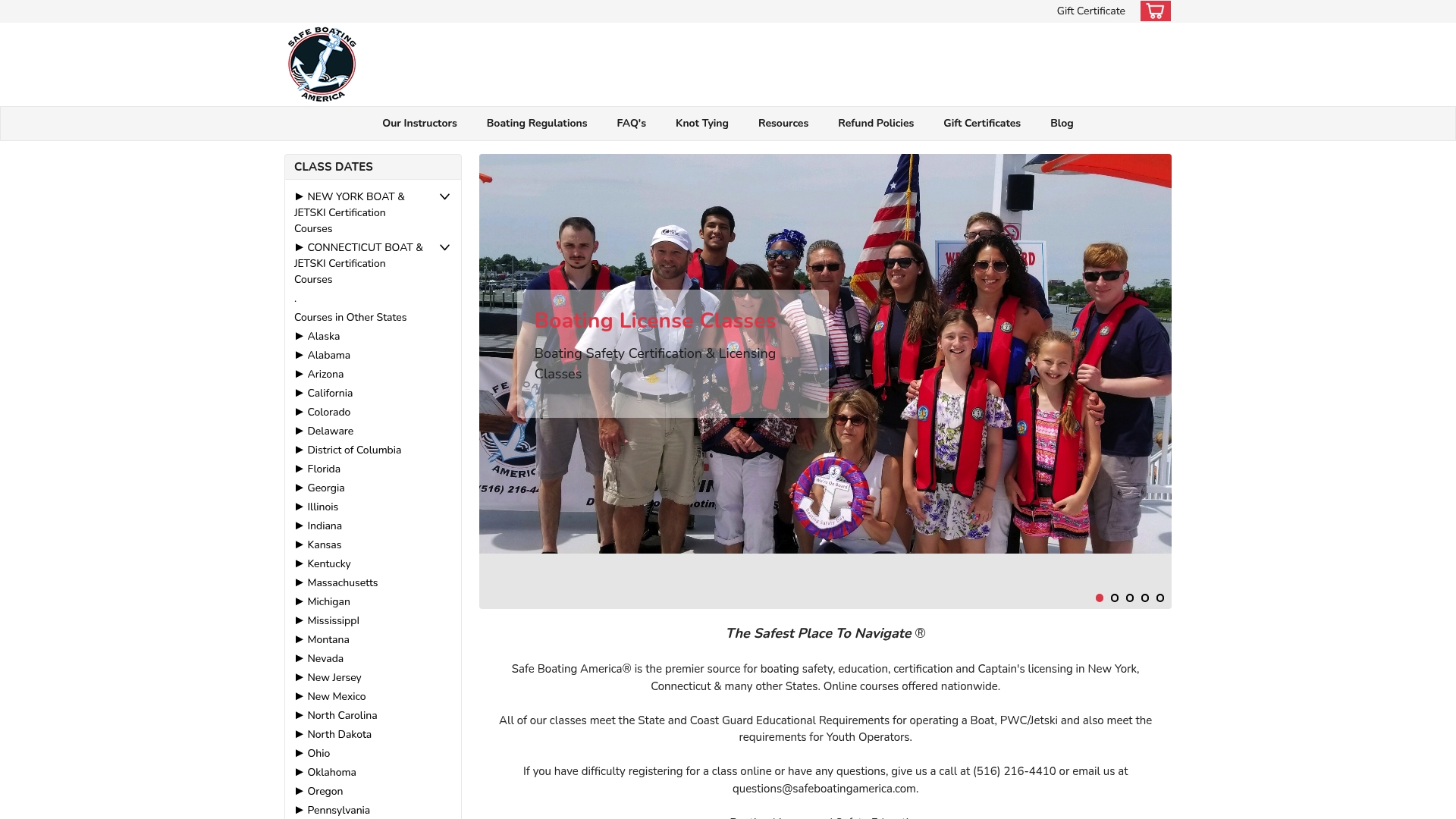
Courses are taught using NASBLA-approved materials by qualified instructors. If you want the fastest path, the Zoom Online 1-Day Class runs $75 and gets you certified in one sitting. Prefer to work through material on your own schedule? The nationwide online courses cover most states’ knowledge-only requirements. New York boaters can start directly with the NYS Safe Boating Class for $85, which also satisfies Brianna’s Law. Pick your format, check your state’s requirement against the course description, and register today.
Sources
- A Boater’s Guide to the Federal Requirements for Recreational Boats
- 46 U.S. Code § 7101 - Issuing and classifying licenses and certificates of registry
- NASBLA State Law Dashboard
FAQ
Is a Boater’s License Valid in All States?
Not automatically. Most states recognize NASBLA-approved certificates issued elsewhere, but exceptions and nonresident rules exist, so check the NASBLA State Law Dashboard before boating in a new state. Carrying your certificate on board and confirming reciprocity in advance avoids problems during a safety check.
What Is the 1/3 Rule in Boating?
The 1/3 rule refers to fuel management: use one-third of your fuel to travel out, one-third to return, and keep one-third in reserve for emergencies or unexpected conditions. It’s a boating safety best practice rather than a certification or legal requirement.
What Changed in Boating Laws Heading Into 2026?
States continue updating age cutoffs, nonresident certification rules, and PWC-specific requirements on a rolling basis rather than all at once. Alabama, for example, added nonresident certification requirements effective October 2024. Check your specific state’s boating agency for the current year’s updates rather than relying on last year’s rules.
Can You Get Your Boating License Fully Online?
In many states, yes, a knowledge-based online course satisfies the education requirement completely. Some states still require an in-person or on-water component for certain ages or PWC operators, so confirm your state’s rule before enrolling. Safe Boating America offers both fully online courses and live Zoom classes depending on what your state accepts.