Avoid Surprise Fees: Boating License Costs by State ($20–$100 Typical)
Most U.S. boaters pay between $20 and $100 total to get a boater education card, and the exact number comes down to three variables: the course provider’s fee, whether your state tacks on a separate card issuance fee, and any optional extras like a physical card or proctoring session. Always confirm the current figure on your state’s DNR, Fish & Wildlife, or parks agency page and check that the course carries NASBLA approval before you pay.
TL;DR:
- Most states charge between $20 and $100 for a boater education card, with costs influenced by provider fees, state charges, and optional extras like shipping or proctoring.
- Fees often include course access, digital certificates, and sometimes the physical card, but additional costs may appear at checkout if extras or separate state fees are not clarified upfront
- The total price can vary widely depending on whether the state bundles fees or charges them separately, making price transparency at checkout essential before enrolling.
- All NASBLA-approved courses provide equivalent certification, but support quality and support options cause cost disparities, not certification strength.
Table of Contents
- How Much Is a Boating License by State?
- What Does the Boating License Cost Actually Include?
- Is There a Free Way to Get a Boating License?
- How Long Does It Take and How Long Is the Card Valid?
- How Do You Choose the Right Course Without Overpaying?
- What Safe Boating America Brings to the Comparison
- Why the “Cheapest Course” Question Misses the Point
- Get Certified Without the Guesswork on Pricing
- Sources
- FAQ
How Much Is a Boating License by State?
State totals vary more than most first-time buyers expect, and the differences usually come down to whether the state folds its card fee into the provider’s price or bills you separately.
Florida requires a Boating Safety Education Identification Card for anyone born on or after January 1, 1988, operating a vessel with 10 horsepower or more. Many providers bundle the course, exam, and ID card into one payment, with typical all-in totals landing in the mid-range. The card never expires once issued.
California splits the cost into a course fee plus a possible card fee, and the state has been phasing in its education requirement by age group over several years, so younger boaters have needed the card longer than older ones. Check your birth-year cutoff before assuming you’re exempt.
Texas follows a straightforward “provider fee plus state fee” model. The Texas Parks and Wildlife Department lists approved online providers with course prices that typically run $20 to $35, plus a standard $10 state card fee added at checkout.
New York courses generally run in a similar range, plus a flat $10 state fee. New York also offers something unusual: an optional anchor icon added to your driver’s license marking you as boating certified. Requesting it right away carries an immediate DMV fee of $12.50, while waiting for your license to renew naturally can let you skip that add-on cost.
A few more examples worth knowing:
- Pennsylvania charges a separate card fee on top of the course price, payable to the Fish and Boat Commission.
- Oregon keeps its card issuance fee notably low, around $11.
- North Carolina offers a free course option through approved providers, though you should still confirm any card fee.
- Several states, mostly in the interior with limited large-water recreation, don’t require a boater card at all for certain vessel types or age groups.
Bottom line: total costs by state commonly range from a free course plus a small card fee to a moderate all-in package. The PracticeTestGeeks state breakdown tracks many of these figures, but state agency pages remain the authoritative source since fees do change.
What Does the Boating License Cost Actually Include?
A course price rarely tells the whole story. Here’s what’s typically bundled versus billed separately:
- Course access: lessons, practice quizzes, and unlimited exam attempts in most cases.
- Digital certificate: issued immediately upon passing, in most states.
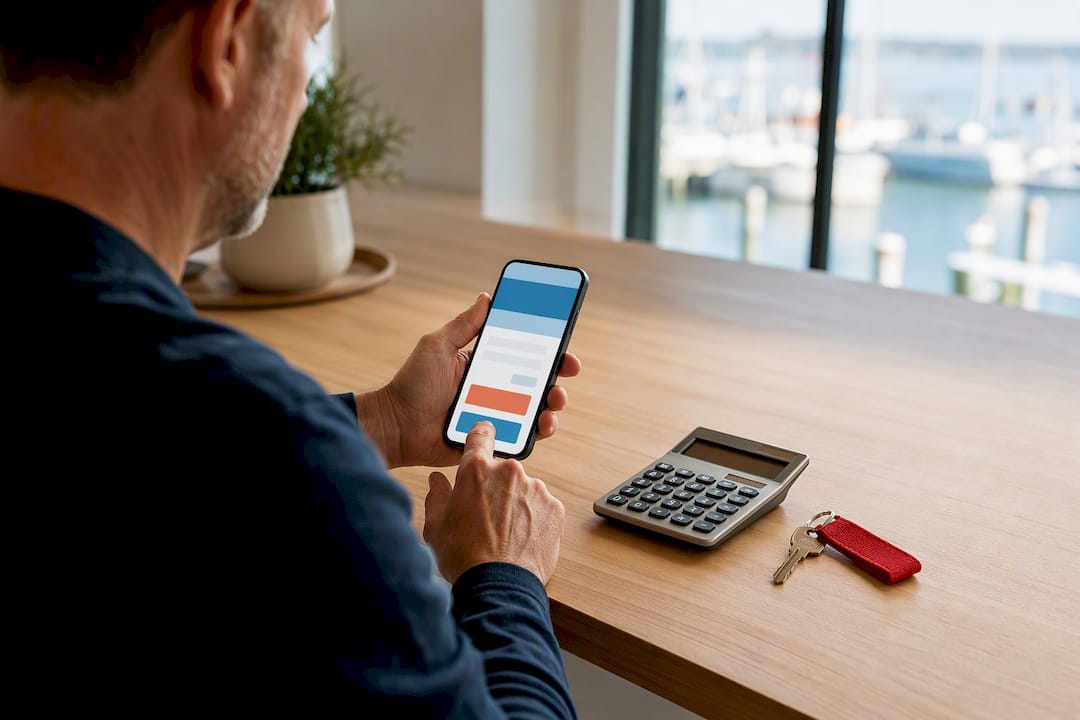
- State card issuance: sometimes bundled into the course price, sometimes charged separately, generally $0 to $15.
- Proctoring: a supervised final exam, required in some states; free through provider-arranged proctors, or up to $25 if you need a paid option.
- Physical card and shipping: some providers include this, others charge $5 to $10 extra to mail a hard copy.
- Replacement fees: commonly $5 to $15 if you lose your card down the road.
The NASBLA standard means the credential itself is equivalent no matter which approved provider you choose. Price differences mostly reflect support quality and optional add-ons, not a better or worse certification.
Pro Tip: Before entering payment info, add up the course fee and every listed add-on separately. If a provider hides the state fee until the final checkout screen, that’s the number that turns a $20 course into a $45 surprise.
How Long Does It Take and How Long Is the Card Valid?
Most online courses take several hours to finish, and many students complete the exam and receive a digital certificate the same day. Physical cards, when ordered, typically arrive by mail within one to three weeks, though digital proof of completion often works in the meantime.
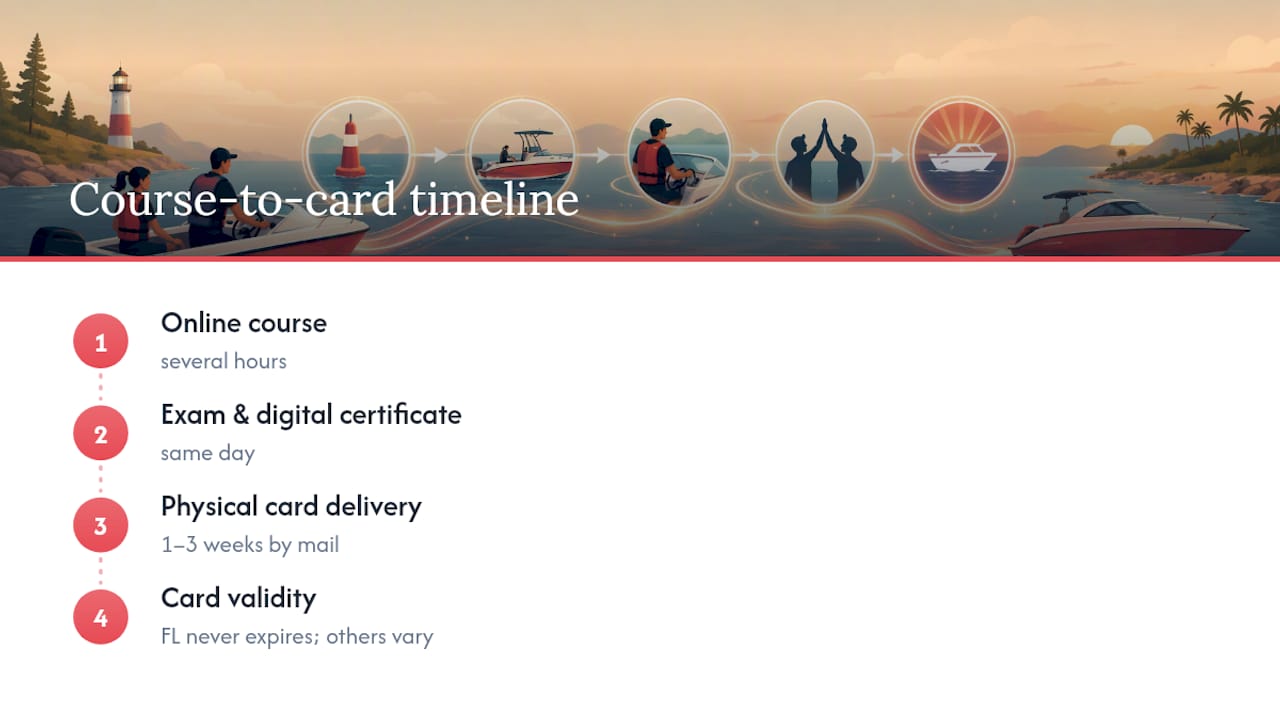
Card permanence depends on the state. Florida’s boating safety ID card is issued once and never expires, while other states may have different renewal rules tied to license cycles. Replacement cards generally cost a small fee, and the fastest path is ordering directly through your state agency portal or your original course provider rather than a third-party reissue site, which can charge inflated convenience fees for the same paperwork.
How Do You Choose the Right Course Without Overpaying?
Run through this checklist before entering a credit card number:
- Confirm the course carries NASBLA approval and check that your state explicitly accepts it.
- Ask whether the state card fee is bundled into the listed price or billed separately at the end.
- Find out if proctoring is required, and whether a free proctor site is available near you.
- Read the replacement and reissue policy in case you lose your card later.
- Check the refund or retake policy if you fail the final exam.
At checkout, ask the provider directly: “Is the state fee included in this price, and is there any additional charge to mail a physical card?” That single question surfaces most hidden fees before you commit.
Watch for red flags: vague language about state acceptance, a listed price that jumps once you reach the final screen, or a replacement fee buried deep in fine print that’s several times higher than the $5 to $15 norm.
Pro Tip: Screenshot the total price before you enter payment details. If the final charge doesn’t match what you saw at the start, that’s your signal to stop and verify with the state agency’s own approved-course page before continuing.
What Safe Boating America Brings to the Comparison
Safe Boating America runs state-approved boating courses in every state, built on NASBLA-based materials and taught by USCG-licensed captains and state-certified instructors. That matters for cost comparisons because pricing structure, not just the sticker price, determines whether you get surprised at checkout.
Here’s what the courses typically include:
- Online, live Zoom, and in-person formats depending on state and schedule
- Course content aligned with each state’s specific boating law requirements
- Support from instructors who can answer proctoring and state-fee questions directly, rather than leaving you to guess
Even with a state-approved provider, verify the current card fee on your state agency’s own page before paying, since agencies occasionally adjust these figures.
Why the “Cheapest Course” Question Misses the Point
The conventional advice tells boaters to hunt for the lowest advertised course price. That’s the wrong first question. The credential itself is standardized under NASBLA, so a $20 course and a $60 course produce the exact same legal certification. What actually separates a good deal from a bad one is whether the total price at checkout matches the price you saw when you started.
Every hidden-fee complaint in this space traces back to the same pattern: a provider advertises a course fee, then adds the state card fee, a proctoring charge, or a shipping cost at the final screen. None of those add-ons are scams. They’re legitimate costs. The problem is sequencing, not legitimacy.
If you take one thing from this guide, make it this: ask about the total price before you start the course, not after you’ve already invested three hours passing the exam. State agency pages and NASBLA’s own provider list exist precisely so you can verify a course before committing time or money to it. Use them first, not as a last resort after something feels off.
— Richard
Get Certified Without the Guesswork on Pricing
There are providers that offer state-approved certification with total pricing that’s clear before you enroll. Rather than piecing together a course fee from one provider and a state card fee from another, Safe Boating America structures its online, live Zoom, and in-person options so you know what’s included from the start.
Courses are often built around state-specific requirements, whether for first PWC certification, New York boating law requirements including Brianna’s Law, or Connecticut-specific safety courses. Pricing typically covers instruction, exam attempts, and the certificate, so the final charge is clear. Visit the Safe Boating America course page to pick your state, compare the available formats, and register for the option that fits your schedule.
Sources
- Internet Courses — Texas Parks & Wildlife Department
- How to Get a Boater Education Identification Card | FWC
- About NASBLA
- Boater Safety Adventure License — NY State Parks shop
- Boating License Cost by State (2026 July Guide) — PracticeTestGeeks
FAQ
Does It Cost Anything to Get a Boating License?
In most states, yes, though the amount varies widely. Expect somewhere between free (through a provider like the BoatU.S. Foundation) and roughly $80 total once course and card fees are combined.
Is There a Cheap Way to Get a Boating License in Texas?
Texas courses commonly run $20 to $35 through TPWD-approved providers, plus a standard $10 state card fee, making it one of the more predictable state fee structures.
Is There a Free Boating License in Florida?
Florida doesn’t offer a fully free option, but many providers bundle the course, exam, and ID card into one payment with typical totals landing in the mid-range, and the card never expires once issued.
What States Don’t Need a Boating License?
A handful of states don’t require a boater education card for certain vessel types, engine sizes, or age groups, mostly in landlocked regions with less large-water traffic. Always check your specific state’s requirement rather than assuming exemption, since rules shift by vessel horsepower and operator age.
Are All NASBLA-Approved Courses the Same Credential?
Yes. NASBLA sets the national standard for course content, so a state accepts any approved provider’s certificate equally. Price differences between providers reflect support and extras, not a stronger or weaker certification.