Boat Keel Basics for U.S. Boating Certification
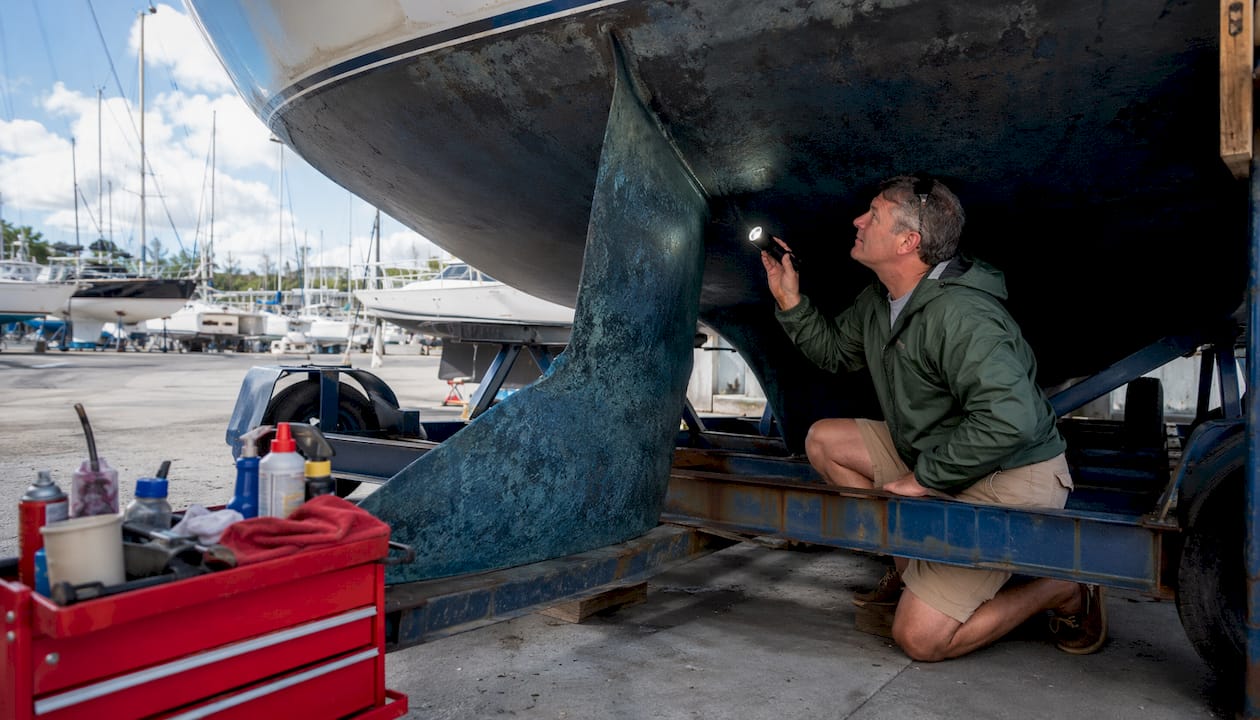
A boat keel is the bottommost longitudinal structural element of a vessel — its underwater backbone — serving three core functions: counterbalancing heel through ballast, resisting sideways drift (leeway), and distributing structural loads across the hull. For students preparing for state-approved certification, understanding these functions is exam-ready knowledge aligned with NASBLA and USCG boating safety standards. Safeboatingamerica incorporates keel fundamentals into its NASBLA-approved curriculum so students can answer confidently on written tests and apply the concepts on the water.
Key facts every certification candidate should know:
- The keel uses a foil shape to generate lift from forward motion, similar to an airplane wing, keeping the vessel on course.
- Ballast concentrated low in or under the keel lowers the center of gravity, limiting capsize risk.
- Keel type and draft determine where you can safely navigate — a critical factor on tidal or shallow-water routes.
Table of Contents
- What does a boat keel actually do?
- Common keel types and where each one fits
- How keel design shapes handling and performance
- Keel inspection checklist every boater must know
- Questions to ask about any boat’s keel
- Keel maintenance schedule
- Legal and regulatory considerations for keel modifications
- Key Takeaways
- Why keel knowledge matters more than most students expect
- State-approved keel and safety training with Safeboatingamerica
- Useful sources
- FAQ
What does a boat keel actually do?
Three distinct jobs, each with direct safety implications.
Stability and counterbalance. Ballast placed in or under the keel lowers the vessel’s center of gravity. As the boat heels under sail or wind pressure, the keel’s weight creates a righting moment that pulls the hull back upright. Without adequate ballast, a vessel becomes dangerously prone to capsizing.
Lateral resistance. The keel acts as an underwater foil. Forward motion generates lift perpendicular to the hull, countering the leeward push of wind on the sails. Sailing without a properly designed keel is like trying to walk straight on ice — there is no underwater grip to control drift. This lift is what allows a sailboat to make progress upwind.
Structural backbone. The keel ties the hull together longitudinally, distributing loads from the rig, ballast, and wave action. Damage to the keel-to-hull joint compromises the entire vessel’s integrity.
Pro Tip: NASBLA and USCG course materials expect students to name all three keel functions. Memorize: stability, lateral resistance, structural support.
Common keel types and where each one fits
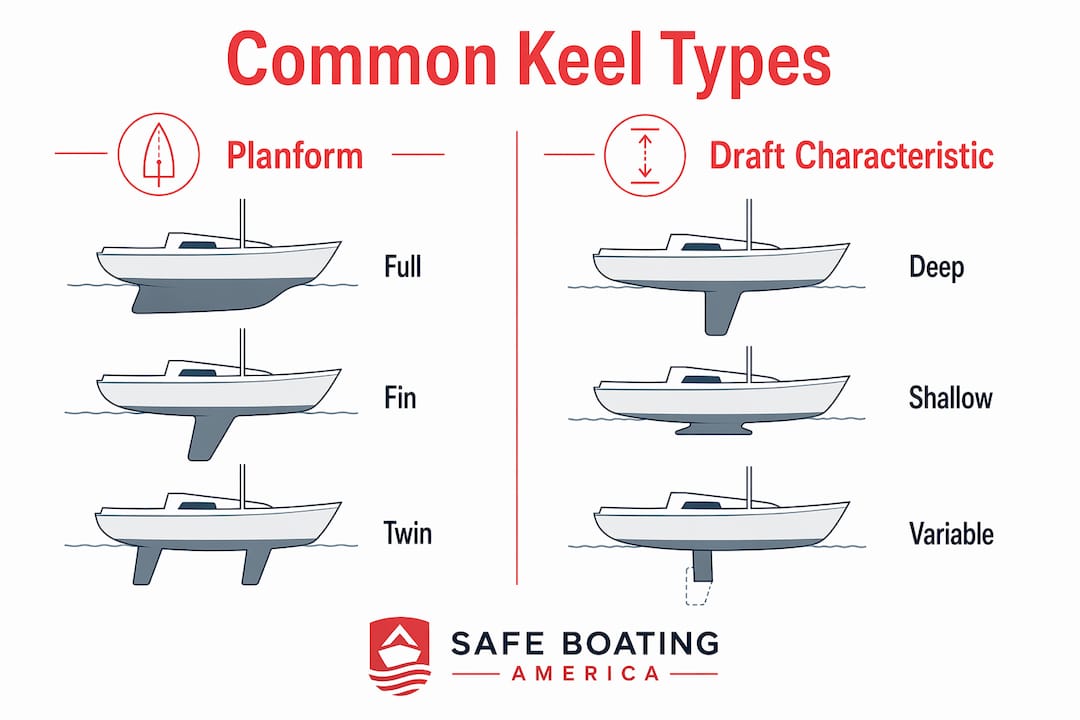
Keel designs vary significantly by intended use. The table below covers the five types most frequently tested in state-approved courses.
| Keel Type | Typical Draft | Best For | Key Trait |
|---|---|---|---|
| Full (long) keel | Shallow–moderate | Offshore cruising, liveaboards | Maximum directional stability; large wetted area |
| Fin keel | Deep | Racing, performance cruising | High lift, low drag; bolted on, requires bolt inspection |
| Bilge (twin) keel | Shallow | Tidal waters, beachable boats | Sits upright when dried out; slower upwind |
| Bulb/wing keel | Moderate | Coastal cruising, cruiser-racers | Low center of gravity; reduces required draft |
| Lifting/centerboard | Variable | Shallow inland and coastal waters | Retractable for shoal access; versatile but complex |
Pros and cons by type:
- Full keel: stable and forgiving in groundings, but slow and hard to maneuver in tight harbors.
- Fin keel: fast and efficient, but bolted attachment demands regular inspection; can break off in a hard grounding.
- Bilge keel: ideal for tidal environments where drying out is routine; antifouling between twin fins adds maintenance cost.
- Bulb/wing keel: lowers center of gravity without deep draft; wing tips can snag lines or nets.
- Lifting keel: maximum versatility for shallow water; internal keel trunk reduces cabin space and adds mechanical complexity.
Exam tip: Describe a keel type in two elements — its planform (full, fin, twin) and its draft characteristic (deep, shoal, variable). That two-part answer covers most written-test questions.
How keel design shapes handling and performance
Keel geometry is the primary driver of a boat’s handling trade-offs. Two rules of thumb cover most exam scenarios.
Rule 1: Aspect ratio vs. draft. Deeper, narrower (high-aspect) keels generate more lift with less drag. Longer, shallower keels increase directional stability but reduce maneuverability. Drag scales with underwater area and the square of speed, so a full keel’s large wetted surface costs measurably more propulsion power.

Rule 2: Draft limits your operating area. Draft is the distance from the waterline to the bottom of the keel. Deep keels restrict access to shoal water; lifting or bilge keels allow operation in tidal or shallow zones. Memorize your boat’s draft before planning any route.
| Keel Category | Typical Ballast Ratio | Draft Impact | Handling Note |
|---|---|---|---|
| Offshore sailboat | 35–40% | Deep | Strong righting ability; limits shoal access |
| Coastal cruiser | 25–35% | Moderate | Balanced stability and maneuverability |
| Shoal/twin keel | Varies | Shallow | Versatile; reduced upwind efficiency |
Ballast ratios sourced from BoatsGeek keel construction data.
For tight-harbor maneuvering, a fin keel with a spade rudder gives the smallest turning circle. For offshore passage-keeping, a full or modified full keel tracks steadily with minimal helm input. In tidal grounding scenarios, bilge and lifting keels are the only designs that allow a vessel to dry out safely upright.
Keel inspection checklist every boater must know
“Treat the keel as a critical structural component. Schedule a professional inspection after any unusual event — grounding, vibration, or visible seam cracking — before returning to service.” — Practical Sailor
Numbered pre-departure and haul-out inspection steps:
- Visual scan — check the keel surface for fresh paint patches, cracked fairing, or new stress marks.
- Keel-to-hull joint — look for cracking, separation, or movement at the seam where the keel meets the hull.
- Keel bolts — inspect bolt heads for corrosion, shear marks, or signs of movement; small rust streaks around bolt heads are a warning sign.
- Antifouling condition — confirm paint coverage is intact; bare metal accelerates corrosion.
- Evidence of leaks — check the bilge for water intrusion near the keel area after being underway.
- Post-grounding check — after any grounding, have a qualified marine surveyor assess structural integrity before the next voyage.
Keel bolt corrosion and shear movement are the leading causes of bolted fin keel failure. Encapsulated keels reduce bolt-related risk but still require inspection of the hull laminate around the keel root.
Pro Tip: Include keel inspection as a line item in your standard boat safety inspection checklist — not just at haul-out, but before any offshore passage.
Questions to ask about any boat’s keel
Use these when talking to a broker, surveyor, or instructor — and when filling out inspection forms during certification training.
- What keel type is it, and is the ballast encapsulated or externally bolted?
- What is the draft, and does it match the intended operating area?
- What is the ballast weight and ratio relative to displacement?
- How old are the keel bolts or fasteners, and when were they last inspected?
- Has the boat grounded hard, and was a professional survey completed afterward?
- Are there any records of keel repairs or modifications?
Red flags: unexplained paint patches over bolt heads, seam cracking at the keel root, an unexplained list at rest, or unusual vibration under power. Any of these warrants a professional underwater survey before purchase or operation. For a broader look at how hull and keel combinations affect boat selection, the boat types guide from Safeboatingamerica covers the key decision points.
Keel maintenance schedule
- Pre-departure (every trip): Visual check of keel surface and keel-to-hull seam. Note any new cracks or paint loss.
- Annual haul-out: Inspect and torque keel bolts; check bonding system and antifouling paint; apply keel guard if trailering regularly.
- After any grounding: Do not return to service until a qualified marine surveyor has assessed the keel attachment and hull structure.
- Every 5 years (bolted fin keels): Consider removing and re-bedding keel bolts as a preventive measure, particularly on boats over 15 years old.
Pro Tip: A keel guard — a rubber or polymer strip bonded to the keel tip — significantly reduces impact damage during docking and trailering. It is inexpensive insurance against costly structural repairs.
Legal and regulatory considerations for keel modifications
Keel modifications and repairs in the United States fall under a combination of federal and state oversight. The USCG does not require a permit for routine keel maintenance, but structural modifications — changing keel type, adding ballast, or altering draft — can affect a vessel’s stability documentation and Coast Guard documentation status.
For documented vessels, any modification that changes the vessel’s dimensions or displacement may require updated documentation with the National Vessel Documentation Center (NVDC). State-registered boats may need updated registration if draft or overall dimensions change materially. Always confirm with your state boating authority before proceeding.
From a liability standpoint, unauthorized structural modifications can void marine insurance coverage and create legal exposure if a keel failure causes injury or property damage. A qualified marine surveyor should assess any planned modification and provide a written stability assessment. Certification students should note that NASBLA-aligned course materials treat the keel as a fixed safety-critical component — any alteration requires professional engineering review, not a DIY approach.
Key Takeaways
A boat keel provides stability, lateral resistance, and structural integrity — three functions that directly determine safe vessel operation and are tested in every NASBLA-aligned state certification exam.
| Point | Details |
|---|---|
| Three core keel functions | Stability via ballast, lateral resistance via foil lift, and structural backbone for hull integrity. |
| Match keel type to operating area | Deep fin keels suit offshore use; bilge and lifting keels are required for tidal or shallow-water navigation. |
| Pre-departure inspection | Check the keel-to-hull seam, bolt heads, and antifouling condition before every offshore passage. |
| Ballast ratio as a stability indicator | Offshore sailboats typically carry ballast ratios of 35–40%; coastal cruisers range 25–35%. |
| Safeboatingamerica course coverage | Safeboatingamerica’s NASBLA-approved curriculum covers keel functions and inspection as part of state-approved certification training. |
Why keel knowledge matters more than most students expect
Most certification candidates memorize the definition and move on. That is a mistake. Keel condition is one of the first things an experienced captain checks before departure — not because it fails often, but because when it does, the consequences are immediate and severe. A bolted fin keel that separates from the hull in open water leaves no margin for error.
What Safeboatingamerica’s instructors emphasize is the connection between classroom knowledge and on-water judgment. Knowing that a high-aspect fin keel concentrates stress at the bolt attachment points is not trivia — it tells you exactly where to look during a pre-departure check and why a hard grounding demands a professional survey before the next voyage. NASBLA and USCG materials frame the keel as a safety-critical system, not a passive structural feature, and that framing is correct.
Every safety briefing should include a keel status line. If the boat has grounded recently, say so. If the bolts have not been inspected in several seasons, schedule it. That discipline is what separates a certified boater from someone who simply passed a test.
State-approved keel and safety training with Safeboatingamerica
Safeboatingamerica offers state-approved boating license and safety certification courses across all U.S. states, taught by USCG-Licensed Captains and State Certified Instructors using NASBLA-approved materials. Courses cover keel functions, vessel inspection procedures, navigation rules, and emergency protocols — everything a certification candidate needs to pass the written exam and operate safely.
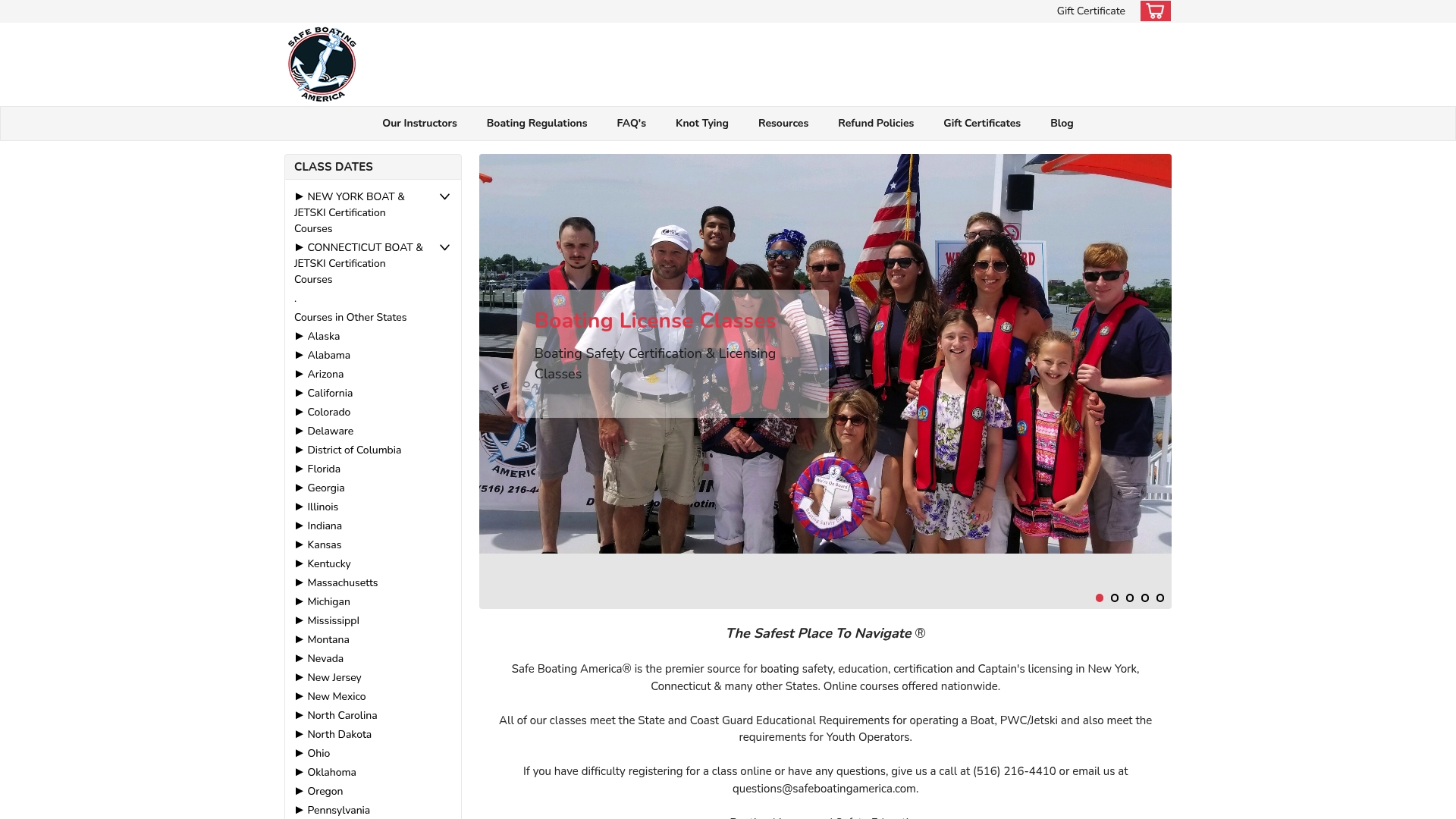
Options include in-person classes, live Zoom sessions, and online courses, with same-day certification available in many states. Whether you need a New York Brian’s Law-compliant course, a Connecticut Safe Boating Certificate, or a state-approved license in California, Florida, Texas, or any other state, Safeboatingamerica has a course that fits your schedule. Register for a boating safety course and get certified with confidence.
Useful sources
- What does the keel do? — Discover Boating: Best starting point for function-based definitions; USCG-aligned framing.
- Keel construction and design explained — BoatsGeek: Technical detail on construction types, ballast ratios, and inspection implications.
- Keel and rudder design basics — Practical Sailor: Authoritative source on drag/lift trade-offs and inspection after design evolution.
- Sailboat keel types and maintenance — Life of Sailing: Practical maintenance intervals and bolt inspection guidance.
- What is a Boat Keel? — Boating Basics Online: Accessible overview including keel guard recommendations for trailering.
- All about keels — Good Old Boat: In-depth design analysis for students who want to go beyond exam basics.
For state-specific certification rules, always refer directly to NASBLA and USCG published guidance, or consult your state boating authority.
FAQ
What are the three main functions of a boat keel?
A keel provides stability through ballast counterbalance, lateral resistance by acting as an underwater foil to reduce leeway, and structural support as the hull’s backbone.
What is the difference between a fin keel and a centerboard?
A fin keel is a fixed, bolted blade that provides ballast and lift; a centerboard is a retractable pivot that adjusts draft but typically carries little or no ballast.
How does keel draft affect where you can safely operate?
Draft is the distance from the waterline to the keel’s lowest point. Deep-draft keels restrict access to shallow or tidal areas; lifting and bilge keels allow operation in those zones.
When should a keel be professionally inspected?
Schedule a professional survey after any hard grounding, if keel-to-hull seam cracking appears, or if unusual vibration develops underway — do not return to service until cleared.
Does Safeboatingamerica cover keel inspection in its certification courses?
Yes. Safeboatingamerica’s NASBLA-approved curriculum includes vessel inspection procedures, covering keel functions and safety checks as part of state-approved boating license training.
Recommended
- Boat Requirements: What Every U.S. Boater Must Know - Safe Boating America
- BoatUS Foundation: Your Guide to Boating Safety Certification - Safe Boating America
- Learn How to Boat: A Beginner’s Safety Guide - Safe Boating America
- Boat Captains: Certifications, Skills, and Duties - Safe Boating America