
Safe Water Markers: Colors, Meaning & Quick ID Guide
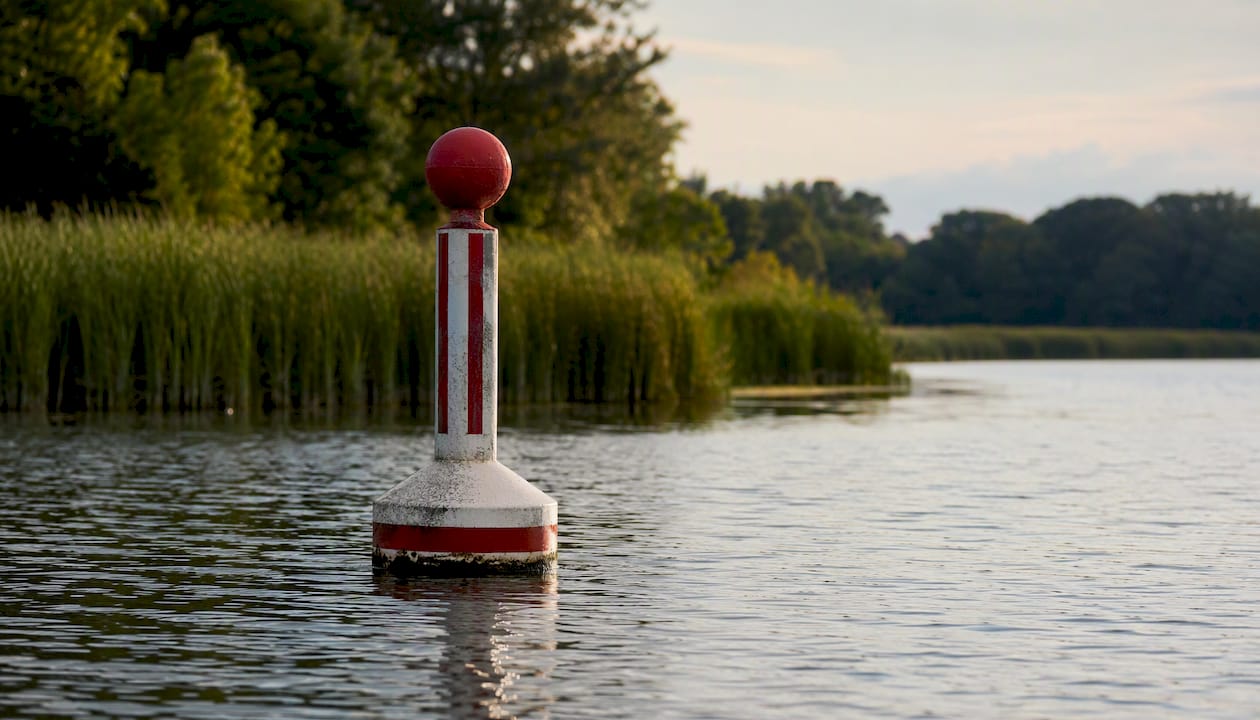
Safe water markers are white with red stripes running vertically, top to bottom. That stripe orientation tells you the water is navigable on all sides, and you can legally pass the mark on any side.
For anyone piloting a boat, PWC, or Jet Ski through unfamiliar waterways, this is the single fact worth memorizing before every other detail about buoys and beacons. Get the stripe direction wrong and you risk confusing a safe water mark with a lateral marker that actually restricts which side you should pass on.
Here’s what to look for at a glance:
- Color/pattern: White background, red vertical stripes (not horizontal bands)
- Topmark: A single red sphere on top of buoys
- Light color: White, when the mark carries a light at all
Key Takeaways
Safe water markers use vertical red and white stripes with a red spherical topmark to signal navigable water on every side of the mark.
| Point | Details |
|---|---|
| Color and pattern | Vertical red and white stripes distinguish safe water marks from every other buoy type. |
| Meaning | Navigable water surrounds the mark, so you can pass on any side. |
| Topmark and light | A single red sphere on top and a white light, if lit, confirm identification. |
| Common placement | Look for these marks in fairways, mid-channels, and at the seaward end of channels. |
| Structured training | Safeboatingamerica’s certification courses teach marker ID as part of state-approved boating safety instruction. |
Table of Contents
- What Do Safe Water Markers Mean and Where Do You Find Them?
- How Do You Identify a Safe Water Marker on the Water?
- Why Are Safe Water Marker Colors Standardized by Regulation?
- What Mistakes Do New Boaters Make With Safe Water Markers?
- Why Recognizing Safe Water Markers Matters More Than Boaters Expect
- Ready to Master Marker ID Beyond This Guide?
- Sources
- FAQ
What Do Safe Water Markers Mean and Where Do You Find Them?
“Safe water” means exactly what it sounds like: navigable water surrounds the mark in every direction. There’s no lateral restriction, no hidden hazard tucked behind it, and no requirement to keep it on a specific side of your hull.
You’ll typically spot these markers in a handful of predictable spots:
- Fairways and mid-channel areas where boats need a clear centerline reference
- The seaward end of a channel, marking the transition from open water to a marked route
- Charted mid-channel marks that confirm you’re still in the deepest, safest part of a waterway
Picture approaching an unfamiliar inlet from open ocean. A safe water marker sitting at the channel’s outer edge tells you where to line up before you start following the lateral buoys that guide you the rest of the way in. It’s the “start here” signal, not a warning.
How Do You Identify a Safe Water Marker on the Water?

The vertical red-and-white stripe pattern is the detail that separates safe water markers from almost every other aid to navigation you’ll encounter. Vertical stripes signal “safe water, pass any side.” Horizontal red bands, by contrast, typically show up on markers with very different instructions, which is exactly why the orientation matters more than the color combination alone.
Beyond the stripes, a few consistent features help confirm identification:
- Topmark: A single red sphere mounted on top of the buoy
- Shapes: Buoys are typically spherical or have a rounded profile; fixed beacons display an octagonal daymark
- Light: White, if the mark is lighted at all, distinguishing it from marks that flash red or green
Comparing it against other common marks makes the pattern click faster:
- Mooring buoys: White with a blue horizontal band, marking a spot to tie up, not a navigation channel
- Obstruction/danger marks: Often white with orange bands or symbols, warning of a hazard to avoid entirely
- Lateral marks: Solid red or solid green, telling you which side to keep the mark on as you travel
Pro Tip: At night or in fog, don’t rely on shape alone; distant silhouettes blur together fast. Watch the light instead. A steady or slow-flashing white light on a mark in open channel water is your fastest confirmation that you’re looking at a safe water marker rather than a lateral or hazard mark. For a deeper breakdown of what different boat lighting requirements mean after dark, it’s worth reviewing before any nighttime run.
Why Are Safe Water Marker Colors Standardized by Regulation?
This isn’t a design choice made by a buoy manufacturer. The color and stripe pattern come straight from federal regulation, and that consistency is what makes the system trustworthy across every U.S. waterway.
Under 33 CFR §62.27, safe water marks are defined as having red and white vertical stripes, marking fairways, mid-channels, or the seaward end of channels. Beacons carry an octagonal daymark, and buoys showing this pattern can carry a red spherical topmark. The Govinfo, confirming the standard isn’t open to local interpretation.
That standard doesn’t stop at U.S. borders, either. The International Association of Marine Aids to Navigation and Lighthouse Authorities sets the broader international framework for topmarks and visual conventions, which is why a red sphere on a striped buoy means the same thing whether you’re boating off Long Island or navigating waters governed by a different country’s charts.
Maritime safety experts generally agree the vertical stripe choice wasn’t arbitrary. High contrast against open water improves recognition at distance, and the pattern avoids overlapping visually with lateral marks or danger marks, which reduces split-second misidentification when visibility is poor or a boater is scanning multiple marks at once.
What Mistakes Do New Boaters Make With Safe Water Markers?
The most common error is assuming any white buoy automatically means “safe.” It doesn’t. A common novice mistake is treating white as the whole story when the stripe orientation and topmark are the actual identifiers; other white-hulled buoys, like mooring marks, use horizontal bands or entirely different symbols that carry a completely different meaning.
A few other mix-ups show up repeatedly on boating safety exams and real waterways alike:
- Confusing a red spherical topmark with a can or nun buoy shape used on lateral marks
- Assuming a lighted white mark must be a hazard, when steady or slow-flashing white is actually the safe water light color
- Mistaking horizontal red bands (often signaling a different category of mark) for the vertical stripe pattern that defines safe water
Here’s a sample question in the style you’ll see on a certification exam: “You spot a buoy with vertical red and white stripes and a single red sphere on top. What does it indicate?” The correct answer: navigable water on all sides of the mark, meaning you can pass it on any side without a lateral restriction.
A quick mnemonic that sticks: “Stripes up, safe all around.” Vertical stripes point up and down like the safety they represent, reminding you the water around the mark is clear in every direction.
Why Recognizing Safe Water Markers Matters More Than Boaters Expect
Instructors see the same pattern year after year: boaters who misjudge a mark rarely do it out of carelessness. They do it because they never built a reliable visual habit for scanning stripe direction and topmark shape before making a turn.
The consequence isn’t usually catastrophic, but it is avoidable. A boater who mistakes a safe water mark for a lateral mark might unnecessarily hug one side of a fairway, cutting closer to shallow water or other traffic than the chart actually requires. In tighter inlets, that extra margin matters.
The fix is simple and worth building into every trip: check your chart before entering an unfamiliar channel, and confirm any mark’s identity using both its topmark and its light characteristics, not just its color from a distance. Pairing that habit with a working understanding of boat navigation methods and tools turns marker recognition from a memorized fact into an instinct you can rely on when conditions get busy.
Ready to Master Marker ID Beyond This Guide?
Reading about stripe patterns is one thing. Being tested on them, drilled on real chart scenarios, and certified to prove you know the difference between a safe water mark and a lateral buoy is another. That’s where a structured course closes the gap that a single article can’t.
Safeboatingamerica builds navigation marker identification, including safe water marks, lateral marks, and regulatory marks, directly into its state-approved boating safety courses. You get instruction from State Certified Instructors and USCG-Licensed Captains using NASBLA-approved materials, whether you take the class online, live via Zoom, or in person. Students walk away with an official boating safety certificate and the kind of on-water confidence that comes from actually being tested on this material, not just reading about it. If you’re ready to turn this guide into certified knowledge, find your state’s boating safety course and get scheduled today.
Sources
FAQ
What colors are safe water markers?
Safe water markers are white with vertical red stripes, topped with a single red spherical topmark on buoys and an octagonal daymark on fixed beacons.
What color are safe watermarks?
The correct term is “safe water marks,” and they’re always red and white with vertical stripes; there’s no horizontal-band version used for this category.
What color are safe water mark buoys?
Safe water mark buoys are white-hulled with vertical red stripes and typically carry a red spherical topmark, with a white light if they’re lighted.
What do the different colors of buoy markers mean?
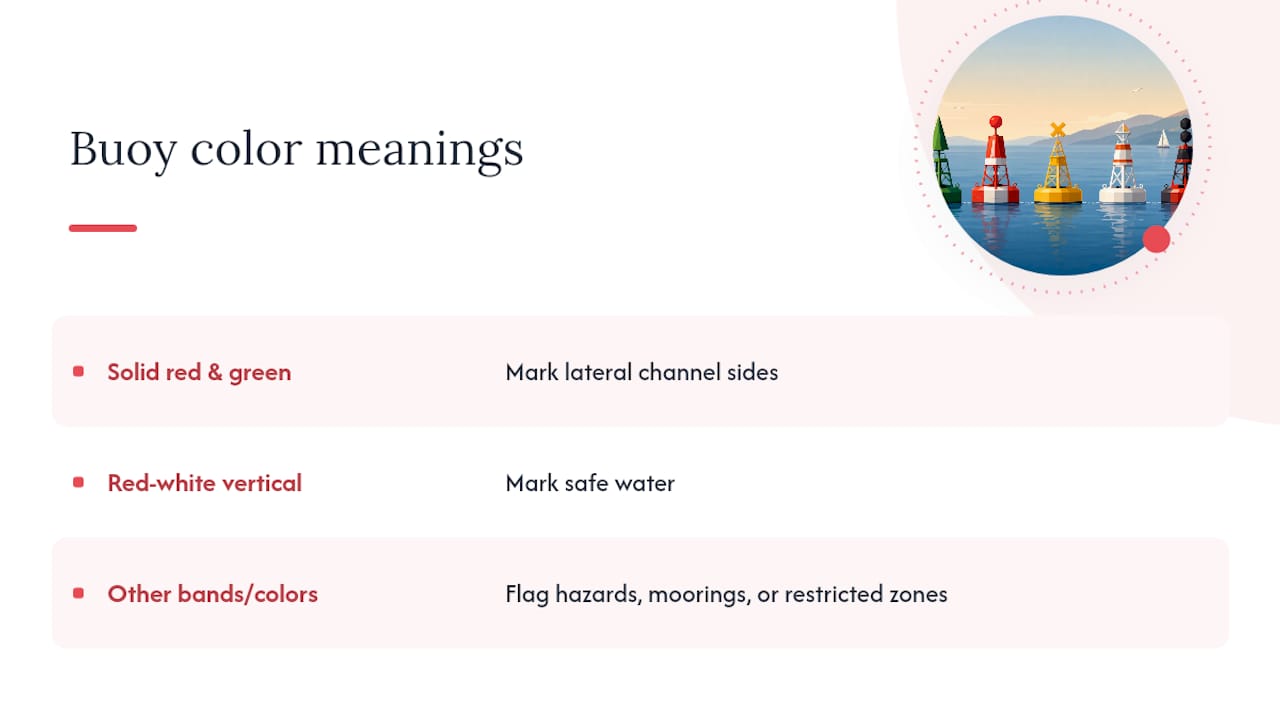
Buoy colors indicate different rules: red and green solid colors mark lateral channel sides, red and white vertical stripes mark safe water, and other bands or colors flag hazards, moorings, or restricted zones.
Can you pass a safe water marker on any side?
Yes, safe water marks indicate navigable water in every direction, so there’s no required side to keep them on as you pass.
How can Safeboatingamerica help me learn to identify these markers?
Safeboatingamerica’s state-approved boating safety courses cover navigation marker identification, including safe water marks, as part of certified instruction taught online, via Zoom, or in person.
Recommended
- Safe Water Markers: Visual ID and Navigation Guide - Safe Boating America
- Maritime Flags for Recreational Boaters: What to Know - Safe Boating America
- Water Chart for Boaters: How to Read Nautical Charts - Safe Boating America
- Parts of a Canoe: Names, Functions, and How to Identify Them - Safe Boating America