Visual Distress Signals: What Boaters Must Carry and How to Use Them

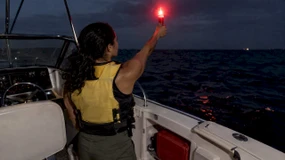
Visual distress signals (VDS) are devices that show other people your vessel is in trouble and help rescuers find you: flares, orange smoke, an orange flag or an electric distress light. Federal rules decide how many your boat must carry, which ones count by day or night, and how long they stay valid. Knowing the rules is half the job. Knowing how to deploy a signal under stress is the other half, and that is what a certified boating course puts in your hands before you need it.
TL;DR
- Boats 16 feet or longer on U.S. coastal waters must carry day and night signals. Boats under 16 feet need night signals between sunset and sunrise.
- Most approved sets total three signals of each kind. Three hand-held red flares cover both day and night.
- Pyrotechnic signals expire 42 months after manufacture. Expired ones cannot count toward the requirement.
- Use signals only when you need help. Displaying them without immediate or potential danger to people aboard is prohibited.
- Store them dry, accessible and out of children’s reach.
Table of Contents
- What counts as a visual distress signal
- Who must carry them
- Which signals work by day, by night, or both
- Choosing between aerial and hand-held
- Using the orange distress flag
- Storing, checking and replacing signals
- When and how to fire a signal
- Our perspective
- Get certified and carry the right gear
- FAQ
- Sources
What counts as a visual distress signal
A visual distress signal is any device designed to show that your vessel is in distress and help others locate you. The New Jersey Boating Safety Manual states they may only be used in emergencies, and 33 CFR 175.140 prohibits display except where assistance is needed because of immediate or potential danger to people on board.
That covers three families:
- Pyrotechnic: red hand-held flares, aerial flares, parachute flares, orange smoke.
- Non-pyrotechnic: the orange distress flag and the electric distress light.
- Alternatives: the electronic visual distress signal device, covered below.
Sound signals, VHF calls and beacons are separate topics. This page covers what you can see.
Who must carry them
The rule is in 33 CFR 175.110. No one may use a boat 16 feet or longer, or any uninspected passenger vessel, on U.S. coastal waters without approved signals suitable for day and night use, in the required numbers. Boats under 16 feet must carry night signals between sunset and sunrise. That includes Jet Skis, WaveRunners and other personal watercraft, which are boats under federal law.
Where the rule applies
The USCG’s Boater’s Guide to federal requirements says the rule covers U.S. coastal waters, the Great Lakes and territorial seas, plus connected waters up to the point where the waterway is less than two nautical miles wide. Inland lakes and rivers beyond that are governed by state rules, which vary. Some states add their own requirements: the Minnesota DNR notes that boats over 16 feet on Lake Superior need both day and night signals, even if used only in daylight.
Exceptions
Under 33 CFR 175.115, these boats need only night signals, and only between sunset and sunrise:
- Boats in organized parades, regattas or races
- Manually propelled boats, such as kayaks and canoes
- Open sailboats under 26 feet with no motor
On a state-regulated lake, check the state’s own rule too. Our guide to Coast Guard boat requirements lists the rest of the federal equipment you carry alongside signals.
Which signals work by day, by night, or both
33 CFR 175.130 lists every accepted device. Here it is in one table.
| Signal | Day | Night | Number required |
|---|---|---|---|
| Orange flag | Yes | No | 1 |
| Hand-held or floating orange smoke | Yes | No | 3 |
| Electric distress light | No | Yes | 1 |
| Hand-held red flare | Yes | Yes | 3 |
| Parachute red flare (needs approved launcher) | Yes | Yes | 3 |
| Rocket-propelled parachute red flare | Yes | Yes | 3 |
| Red aerial flare | Yes | Yes | 3 |
Combinations count. Three hand-held orange smoke signals plus one electric distress light satisfy both day and night. So does a single set of three red flares.
The daylight answer
For daylight, one orange flag, three orange smoke signals or three day/night red flares are acceptable. Many boaters carry a flag and an electric light because neither expires the way pyrotechnics do, though the flag must be marked as meeting 46 CFR 160.072.

Electronic signals
The Boater’s Guide describes the electronic visual distress signal device (eVDSD) as acceptable for night use only. It automatically flashes the international SOS signal and must be marked as meeting 46 CFR 161.013 or RTCM Std. 13200.0.
Choosing between aerial and hand-held
No single device is ideal in every condition. The New Jersey State Police manual notes that aerial flares are visible over long distances on clear nights, while hand-held flares suit closer work. A practical pattern is two steps: first get attention with an aerial flare, then pinpoint your position with a hand-held flare, smoke or the flag once help is close.
Match the signal to the setting:
- Offshore or open bay: aerial flares reach farthest.
- Bright daylight: orange smoke and the flag are easier to see than a flare.
- Small PWC with little storage: a compact electric light and a hand-held flare set in a waterproof pouch.
Using the orange distress flag
The orange flag is a day signal only. It must be at least 3 by 3 feet, with a black square and ball on an orange background. The Boater’s Guide says it is most visible when attached to a paddle or boat hook and waved, or flown from a mast. To attract aircraft, lay it flat on deck. For other flags you may see on the water, read our maritime flags guide.

Storing, checking and replacing signals
Signals only help if they work and you can reach them.
- Check the date. Pyrotechnics expire 42 months after manufacture. Expired ones can be carried as extras but do not count toward the requirement.
- Store them properly. Keep them in a cool, dry place in a watertight container, painted red or orange and marked “DISTRESS SIGNALS” or “FLARES.”
- Keep them accessible and safe. Orion Safety Products notes that 33 CFR 175.120 requires an accessible location, and that signals must also stay out of children’s reach. Launchers should never be stored loaded.
- Inspect at least once a year. Look for damaged casings and moisture.
- Dispose correctly. Never throw expired flares overboard or in household trash. The Boater’s Guide says they may be ignited on land in a safe area or handled on local law enforcement or fire agency advice. Orion’s guidance adds that expired flares can be donated to the Coast Guard Auxiliary or Power Squadron for training.
When and how to fire a signal
Use signals when there is a real emergency such as a collision, medical emergency or fire, and when you can reasonably expect someone to see them. Discover Boating advises not firing one-time signals until you have sighted or heard a ship or aircraft. If rescuers appear, the Coast Guard advises shooting two overhead flares quickly to confirm the sighting and show your direction.
Basics worth rehearsing before you leave the dock:
- Wear gloves and eye protection if you have them aboard, and hold hand-held flares downwind and away from the boat.
- Aim aerial flares up and downwind, never at people or other vessels.
- Make sure everyone aboard knows where the signals are and how to use them.
If someone has gone into the water, signals are only one part of the response. Our man overboard procedure walks through the rest, and the fire extinguisher guide covers the other onboard emergency equipment.
Our perspective
We teach distress signals as a skill, not a checklist item. A boater who has bought the right flares but has never handled one in class will hesitate on the water, and hesitation is when minutes are lost.
That is why signals sit inside our state-approved courses alongside the rules for your vessel, your waters and your state. Our instructors are State Certified Instructors and USCG-licensed captains, and our classes are built on NASBLA-approved material, so the equipment questions you have get answered by people who work on the water.
Check the date on your flares this week, make sure every passenger knows where they are, and add a certified course to your season plan.
Richard
Get certified and carry the right gear
Safe Boating America offers state-approved boating safety courses for boaters and Jet Ski and PWC operators. Choose an online boating course available nationwide, or the Zoom online one-day class at $75. New York students can take the NYS Safe Boating Class at $85, and gift certificates are available for $75 to $85 via the gift certificate page.
If you also run navigation lights at night, our boat lighting requirements guide pairs well with this one.
FAQ
What is a distress signal?
It is a device or action that tells others your vessel or someone aboard is in grave danger. Visual types include flares, orange smoke, the orange flag and electric distress lights. Federal rules allow displaying them only when assistance is needed because of immediate or potential danger to people aboard.
Which visual distress signal is acceptable for daylight?
One orange distress flag, three orange smoke signals, or three day/night red flares all qualify. An electric distress light is night-only, so it does not count for daytime.
What boating flag is a distress signal?
The orange flag with a black square and ball, at least 3 by 3 feet, is the daytime distress flag. Wave it on a paddle or boat hook, fly it from a mast, or lay it flat on deck for aircraft.
Do Jet Skis need flares?
A personal watercraft is under 16 feet in most cases, so it needs night signals between sunset and sunrise on federally regulated waters. Check your state rules as well, because some add requirements.
Sources
- New Jersey Boating Safety Manual (April 2024)
- New Jersey Boating Safety Manual (June 2025)
- eCFR 33 CFR Part 175 Subpart C
- eCFR 33 CFR Part 175 (Sept. 25, 2025)
- eCFR 33 CFR 175.130
- USCG Boater’s Guide to Federal Requirements
- Minnesota DNR Lake Superior Boating Guide
- Discover Boating: marine flares
- Orion Safety Products Marine FAQ
- Orion Safety Products flare expiration guidance