
South Carolina Boating Laws: 2026 Complete Guide

South Carolina boating laws require every motorized vessel on public waters to be registered, operators born after july 1, 2007 to complete a state-approved safety course, and all boaters to carry specific safety equipment at all times. These rules are enforced by the South Carolina Department of Natural Resources (SCDNR) and align with U.S. Coast Guard standards. Whether you are a lifelong resident or a first-time visitor to Lake Murray or the Intracoastal Waterway, knowing these requirements keeps you legal and safe on the water.
What are the South Carolina boating education requirements?
South Carolina boating laws mandate that operators born after July 1, 2007 must complete an SCDNR-approved boating safety course and carry a Boater Education Card while on the water. This requirement applies to anyone operating a vessel with 10 or more horsepower, a personal watercraft (PWC) such as a Jet Ski or WaveRunner, or a specialty propcraft. The law targets younger operators statistically most likely to be involved in accidents caused by inexperience.
Accepted course providers include SCDNR-approved programs and any NASBLA-approved course from another state. NASBLA stands for the National Association of State Boating Law Administrators, the body that sets national education standards. Completing a course through a NASBLA-approved provider satisfies South Carolina’s requirement regardless of where the course was taken.
Failing to carry your Boater Education Card while operating a qualifying vessel can result in fines up to $300. That fine applies even if you completed the course. The card is your proof of compliance, so treat it like a driver’s license.
Key exemptions and conditions under the education law:
- Operators born on or before July 1, 2007 are not required to hold a Boater Education Card.
- Licensed commercial vessel operators are exempt from the recreational education requirement.
- Operators under direct supervision of a qualifying adult may operate without a card in some circumstances.
- Out-of-state visitors with a valid NASBLA-approved certificate from their home state satisfy the SC requirement.
Pro Tip: Complete your boating safety course before your first trip of the season. SCDNR can issue your Boater Education Card quickly, but processing delays happen during peak spring months.
How does boat registration and titling work in South Carolina?
All motorized watercraft and sailboats operated on South Carolina public waters must be titled and registered with SCDNR. The new registration fee is $20, and annual renewal costs $10. These fees are low compared to most states, but the renewal process catches many new residents off guard.
South Carolina ties boat registration renewal to county property tax notices, not to a DMV-style mailing. This means your renewal reminder arrives with your annual property tax bill, not as a separate boating document. Unpaid property taxes can cause your vessel registration to lapse without any direct warning from SCDNR. New residents moving from states with centralized DMV renewals frequently miss this and end up operating with an expired registration.
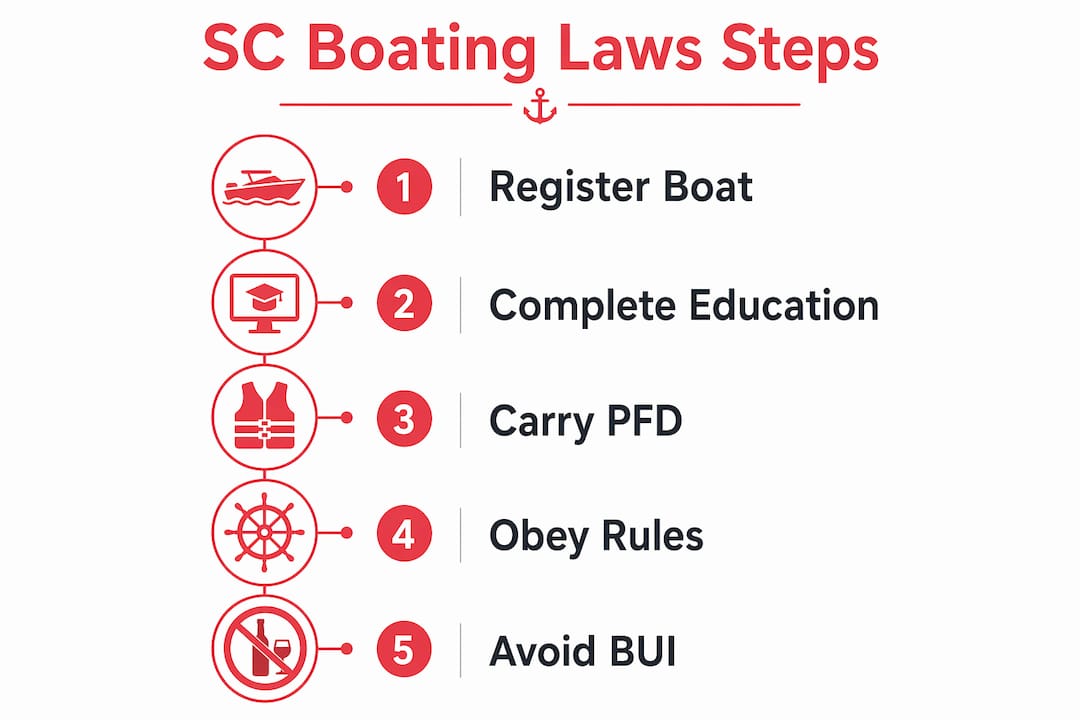
A 5% casual excise tax applies to all vessel purchases in South Carolina, capped at $500. That cap makes the tax manageable even on high-value boats. Outboard motors are titled separately from the vessel hull, which surprises buyers who assume the motor and boat are registered together as one unit.
| Registration Item | Fee or Rule |
|---|---|
| New registration | $20 |
| Annual renewal | $10 |
| Casual excise tax | 5%, capped at $500 |
| Outboard motor | Titled separately |
| Renewal billing method | County property tax notice |
Pro Tip: Set a calendar reminder tied to your county tax bill due date, not a boating anniversary date. Missing the property tax payment is the most common reason SC boaters unknowingly operate with a lapsed registration.
What safety equipment and operational rules must boaters follow?
South Carolina boat safety laws require every vessel to carry a U.S. Coast Guard-approved personal flotation device (PFD) for each person on board. Children under 12 must wear a Coast Guard-approved PFD at all times on vessels under 16 feet when the motor is running. Vessels 16 feet or longer must also carry a throwable Type IV device in addition to wearable PFDs.
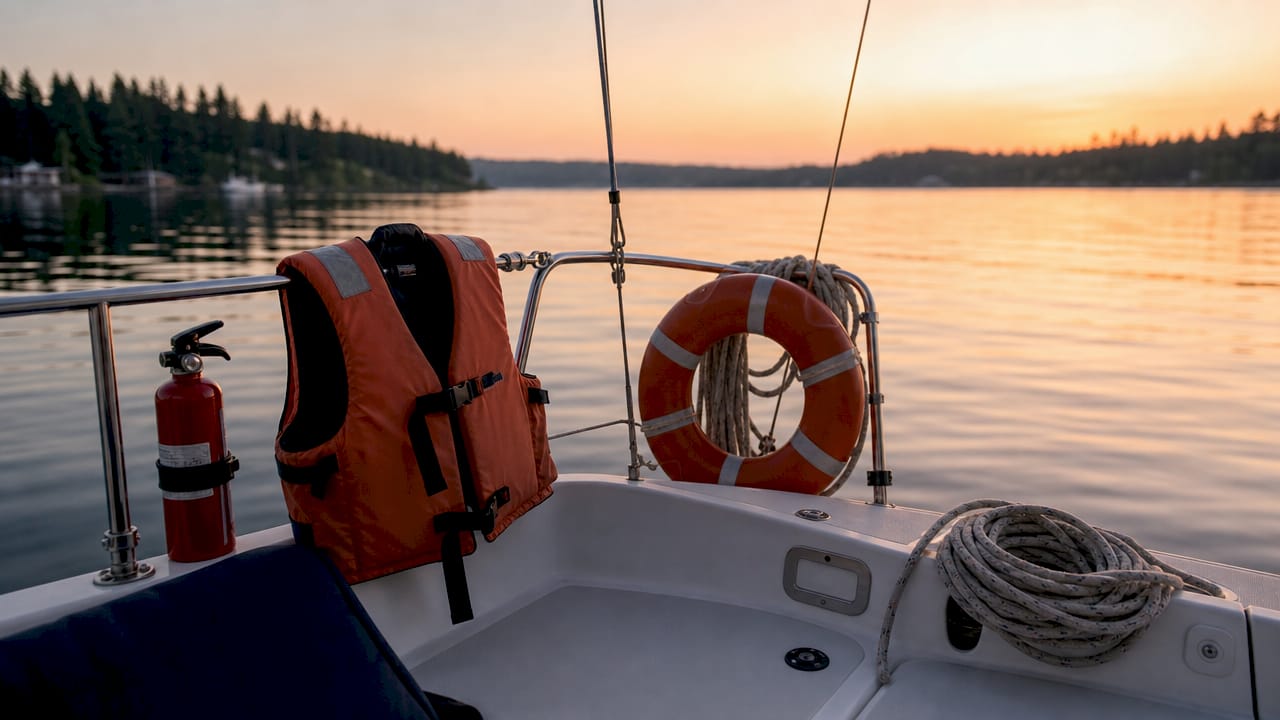
Experienced boaters keep all PFDs readily accessible rather than stored in a locked compartment. In an emergency, reaching a stored device is often not possible. The law requires PFDs to be accessible, but practical safety demands they be within arm’s reach.
Required safety equipment under South Carolina boating safety requirements includes:
- A U.S. Coast Guard-approved PFD for every person on board
- A Type IV throwable device on vessels 16 feet or longer
- A fire extinguisher on all motorized enclosed vessels
- A sound-producing device (horn or whistle) for vessels under 39.4 feet
- Navigation lights for operation between sunset and sunrise
- Visual distress signals (flares) for vessels on coastal waters
No wake zones require idle speed within 50 feet of anchored boats, docks, and swimmers, and within 100 yards of the Atlantic coast. Idle speed means the slowest speed at which you can maintain steerage. Slowing down but still creating a wake does not satisfy the legal requirement.
“No Wake Zones are strictly enforced and require legal idle speed, not just slowing down, to prevent accidents and protect shoreline and swimmers.” — South Carolina waterway enforcement guidance
Boating rules in SC also require operators to yield to vessels being overtaken and to maintain safe passing distances from other boats, swimmers, and fixed structures. Violating these operational rules is among the most frequently cited infractions on South Carolina waterways.
What are the penalties for violating South Carolina boating laws?
Boating under the influence (BUI) carries escalating penalties starting at a $200 fine and a 6-month suspension of boating privileges for a first offense. A third offense carries a fine of $3,500 to $6,000, up to 3 years in jail, and a boating privileges suspension of up to 2 years. South Carolina treats BUI with the same legal seriousness as driving under the influence on public roads.
SCDNR conservation officers have full authority to conduct vessel stops and safety inspections at any time on public waters. Officers check registration, safety equipment, sobriety, and operator credentials during these stops. They can issue on-the-spot citations for missing or expired equipment, including fire extinguishers and flares.
Common violations and their consequences:
- Missing Boater Education Card: Fine up to $300, even if the course was completed.
- Expired registration: Citation and potential vessel impoundment until resolved.
- Missing fire extinguisher or expired flares: Immediate citation during a safety inspection.
- BUI first offense: $200 fine, 6-month boating privileges suspension.
- BUI third offense: $3,500–$6,000 fine, up to 3 years jail, up to 2-year suspension.
- No wake zone violation: One of the most common citations issued on SC waters.
Understanding why boating safety education is mandatory becomes clearer when you see these penalties. Most boating collisions result from operator error. Education directly reduces the behaviors that lead to citations and accidents.
How do South Carolina boating laws apply to out-of-state visitors?
Out-of-state visitors with a home-state NASBLA-approved certificate can operate on South Carolina waters without obtaining a separate SC Boater Education Card. South Carolina honors reciprocity for any certificate issued by a NASBLA-approved program. This covers boaters from most U.S. states who completed a recognized course at home.
For vessel registration, non-residents may operate their home-state-registered boat on SC public waters for up to 60 days before SC registration is required. That 60-day window covers most vacation and seasonal visits. Boaters staying longer or establishing residency must register their vessel with SCDNR.
Key rules for visiting boaters:
- Carry your home-state NASBLA-approved Boater Education Card at all times while operating.
- Your home-state registration is valid for up to 60 days on SC waters.
- After 60 days, SC registration is required regardless of home-state status.
- All SC safety equipment rules apply to visiting boaters from day one.
Pro Tip: Visiting boaters should review required onboard safety equipment before launching. SC officers inspect all vessels equally, regardless of where they are registered.
Key Takeaways
South Carolina boating regulations require education cards, registered vessels, proper safety equipment, and sober operation to legally use public waters in 2026.
| Point | Details |
|---|---|
| Education card requirement | Operators born after July 1, 2007 must carry an SCDNR-approved Boater Education Card. |
| Registration fees | New registration costs $20; annual renewal is $10, billed through county property taxes. |
| PFD rules | Children under 12 must wear a PFD at all times; all others must have one accessible per person. |
| BUI penalties | First offense carries a $200 fine and 6-month suspension; third offense reaches up to 3 years jail. |
| Visitor reciprocity | Out-of-state NASBLA-approved certificates are valid in SC for up to 60 days of operation. |
What I’ve learned from watching boaters get cited on SC waters
The most common mistake I see is boaters who completed their education course years ago but never bothered to keep the card on the vessel. SCDNR officers do not accept verbal confirmation. They need the physical card or a digital version you can display immediately. That $300 fine for a missing card is entirely avoidable.
The second pattern I notice is new residents who moved from states with DMV-style registration renewals. They wait for a renewal notice that never comes in the format they expect. The county property tax bill is the renewal notice. Miss that bill, and your registration lapses quietly.
My strongest advice for new boaters and visitors is to go beyond the legal minimum. The boating education and accident prevention connection is well established. A course does not just keep you legal. It builds the judgment that keeps you and your passengers safe when conditions change fast on open water.
— Richard
Safeboatingamerica’s South Carolina boating certification courses
Safeboatingamerica offers a state-approved South Carolina Boating and PWC Certification Course online, designed to meet SCDNR education requirements for operators born after July 1, 2007. The course covers navigation rules, required safety equipment, South Carolina waterway laws, emergency procedures, and responsible vessel operation.
Courses are taught by USCG-Licensed Captains and State Certified Instructors using NASBLA-approved materials. Students can complete the course online at their own pace and receive their Boater Education Card upon passing. Safeboatingamerica also offers boating safety certification for every U.S. state, making it a reliable option for out-of-state visitors who need to meet their home-state requirements before arriving in South Carolina.
FAQ
Who needs a boating license in South Carolina?
Operators born after July 1, 2007 must complete an SCDNR-approved boating safety course and carry a Boater Education Card to operate vessels with 10 or more horsepower or any personal watercraft.
How much does it cost to register a boat in South Carolina?
New boat registration with SCDNR costs $20, with annual renewal at $10. A 5% casual excise tax applies to vessel purchases, capped at $500.
What is the penalty for boating under the influence in SC?
A first BUI offense carries a $200 fine and a 6-month boating privileges suspension. A third offense can result in a $3,500 to $6,000 fine, up to 3 years in jail, and a 2-year suspension.
Do children need to wear life jackets on SC boats?
Children under 12 must wear a Coast Guard-approved PFD at all times on vessels under 16 feet when the motor is running. All other passengers must have an accessible PFD on board.
Can out-of-state boaters use their home certification in South Carolina?
Yes. South Carolina accepts any NASBLA-approved boater education certificate from another state. Visiting boaters may also operate their home-registered vessel on SC waters for up to 60 days before local registration is required.
Recommended
- 50-State Boating License & Jet Ski Certification Guide (2026) - Safe Boating America
- Minnesota Boating Regulations: 2026 Compliance Guide - Safe Boating America
- NY Boating Safety Course: 2026 Certification Guide - Safe Boating America
- Boat Requirements: What Every U.S. Boater Must Know - Safe Boating America