PWC Safety Gear: What U.S. Riders Must Wear, Carry, and 6 Checks
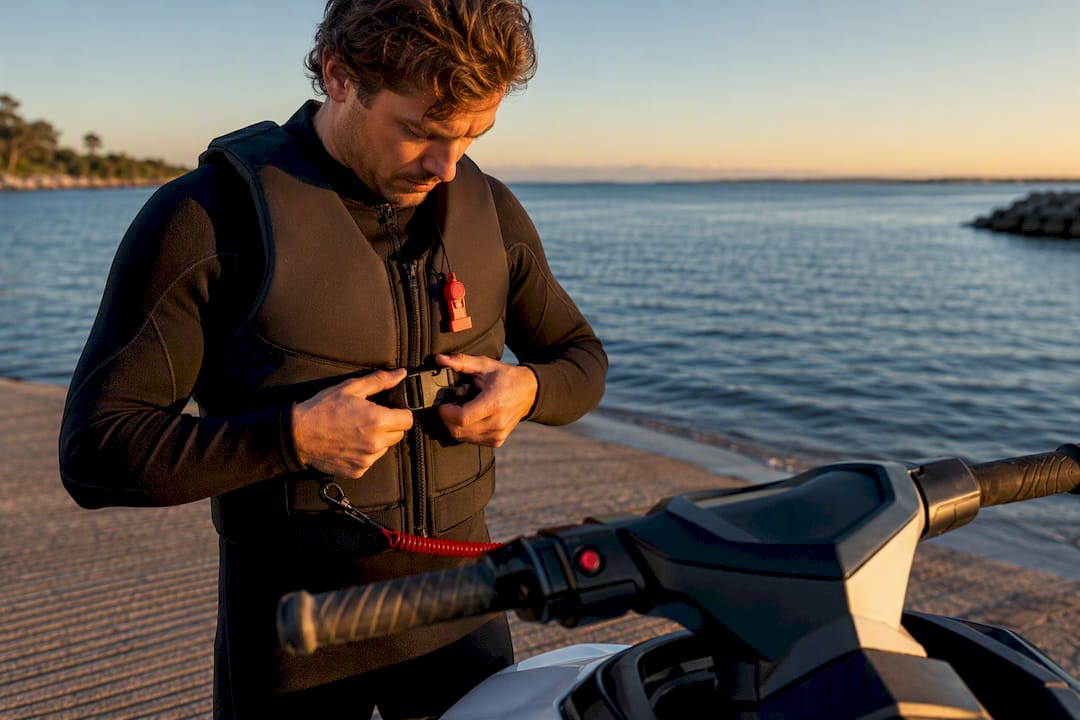
Every person aboard a personal watercraft must wear a U.S. Coast Guard-approved life jacket while the craft is underway, no exceptions. Beyond that, riders need a functioning engine cut-off switch (lanyard or wireless), a marine-rated fire extinguisher, a sound-signaling device, and valid registration onboard. Some states layer on age minimums or education requirements, so check local rules before you launch.
- Wearing a USCG-approved life jacket is mandatory for all riders, and inflatable PFDs are generally prohibited for PWC use due to inflation delays.
- The engine cut-off switch (lanyard or wireless) must be tested regularly to ensure it stops the engine immediately when pulled, preventing fall-related accidents.
- Extra safety gear like impact vests, gloves, water shoes, and waterproof radios can significantly reduce injury and improve safety in remote or open water conditions.
- State-specific rules often add age limits, safety certifications, and towing restrictions beyond federal requirements, requiring riders to verify local regulations.
- Proper PFD fit, especially the shoulder and chin/ear checks, is crucial, as loose or ill-fitting vests can slip off during a fall, nullifying their safety function.
Table of Contents
- Required PWC Safety Gear: The Legal Minimums
- Recommended Gear That Goes Beyond the Legal Minimum
- Pre-Ride Checklist and ECOS Testing
- Choosing and Fitting a PFD for PWC Use
- State Rules Vary: Age, Education, and Towing Add-Ons
- Why Training Still Beats a Gear Checklist Alone
- What Actually Matters on a PWC (and What Doesn’t)
- Sources
- FAQ
Required PWC Safety Gear: The Legal Minimums
The rider disproportionately at fault or at risk in on-water accidents is often the operator without the right gear on. Personal watercraft operators are involved in a significant number of boating accidents compared to other vessel types, which highlights the importance of the legal minimum safety equipment.
- Life jacket: A USCG-approved wearable PFD (Type I, II, III, or a Type V explicitly labeled “approved for personal watercraft use”) must stay on every rider from the moment the engine starts. Check the sewn-in label for the approval type; many states specifically ban inflatable PFDs on PWCs because inflation can lag during a high-speed ejection.
- Engine cut-off switch (ECOS): The lanyard clips to the operator’s wrist, vest, or body, or a wireless ECOS fob rides in a pocket. Either way, the switch must be attached and functioning before you leave the dock, since it’s what kills the engine the instant you’re thrown clear.
- Fire extinguisher: A marine-rated extinguisher needs to be mounted where you can reach it without digging through storage.
- Sound-signaling device and registration: A whistle or horn satisfies the sound requirement, and your registration numbers need to be visible and current.
- Towing: Pulling a skier or tuber usually requires either an observer facing backward or a rearview mirror of a minimum size, along with a seating capacity that accounts for the extra rider you’re about to bring aboard.
Pro Tip: Towing rules trip up more riders than any other item on this list. If you’re pulling anyone behind your PWC, confirm your state’s mirror-size or observer requirement before you throw the tow-rope in the water, not after.
Recommended Gear That Goes Beyond the Legal Minimum
Passing a gear check doesn’t mean you’re actually dressed for a fall at 40 miles per hour. Discover Boating’s safety guidance recommends several items that aren’t legally mandated but meaningfully cut your injury risk.
- Neoprene wetsuit or rash guard: Reduces cold shock in cooler water and protects skin from abrasion during a slide-off or reboarding.
- Impact vest or competition vest: Offers extra padding but is not a substitute for a USCG-approved PFD. Wear one over your life jacket, never instead of it.
- Eye protection, gloves, and water shoes: Improve grip on the handlebars and protect your feet climbing back aboard over a rocky or barnacle-covered bottom.
- Handheld VHF radio or waterproof phone case: Worth carrying if you’re riding offshore or in open water where cell coverage disappears fast.
Basic boat safety equipment guidance applies the same logic to any vessel: legal minimums keep you compliant, but the extra layer of gear is what keeps you unhurt.
Pre-Ride Checklist and ECOS Testing
Run this sequence every time, not just on the first trip of the season.
- Put your PFD on before you step onto the PWC, not after you’re already underway.
- Test the ECOS. Idle the engine, pull the lanyard sharply, and confirm the engine cuts off immediately and the switch snaps back into place.
- Check fuel level and confirm the throttle and steering respond without sticking.
- Verify the fire extinguisher is mounted, charged, and reachable.
- Confirm registration is displayed and current.
- Charge your radio or phone if you’re heading anywhere remote.
A cracked lanyard casing or a switch that snaps back slowly is a failure sign, not a minor cosmetic issue. If the ECOS doesn’t reset cleanly, pull the craft from service until it’s fixed. Simulating an operator fall by yanking the lanyard while idling, then inspecting for flex cracks and fraying before the season starts, catches most failures before they become an actual emergency. A full step-by-step safety inspection walks through this in more detail if you want a printable version to keep at the dock.
Choosing and Fitting a PFD for PWC Use
Read the label before you buy. Anything marked Type V needs the specific phrase “approved for personal watercraft use,” and inflatable PFDs, however comfortable, generally don’t meet that bar.
- Shoulder pull test: Have someone pull up on the shoulder straps. If the jacket rides up past your ears or chin, it’s too loose.
- Chin and ear check: A properly fitted vest stays below your ears when the straps are pulled snug.
- Weight range: Confirm your body weight falls within the label’s stated range, not just your general size category.
- Youth sizing: Kids need PFDs sized to their weight, not their age, and a snug fit matters even more since a loose jacket can slip off entirely in a fall.
Pro Tip: Competition-style vests marketed for wakeboarding or freestyle riding often lack full USCG approval. If the label doesn’t say “Coast Guard approved,” don’t wear it as your only PFD on a PWC.
State Rules Vary: Age, Education, and Towing Add-Ons
Federal minimums set the floor, but states build on top of it. Expect to see additional rules covering:
- Minimum operator age (commonly 14 to 16, depending on the state)
- Mandatory boating safety certificates for anyone born after a certain year
- Night operation restrictions, since most states prohibit PWC use after sunset
- Towing-specific observer or mirror requirements that go beyond the federal baseline
Your state’s boating agency page is the authoritative source, not a forum post or a rental shop’s laminated handout. Search for your state’s fish, wildlife, or natural resources department, then look for the boating or PWC section specifically. If you’re unsure whether you need a certificate before you can legally operate, a quick look at PWC license requirements by state will point you in the right direction faster than digging through a state statute.
Why Training Still Beats a Gear Checklist Alone
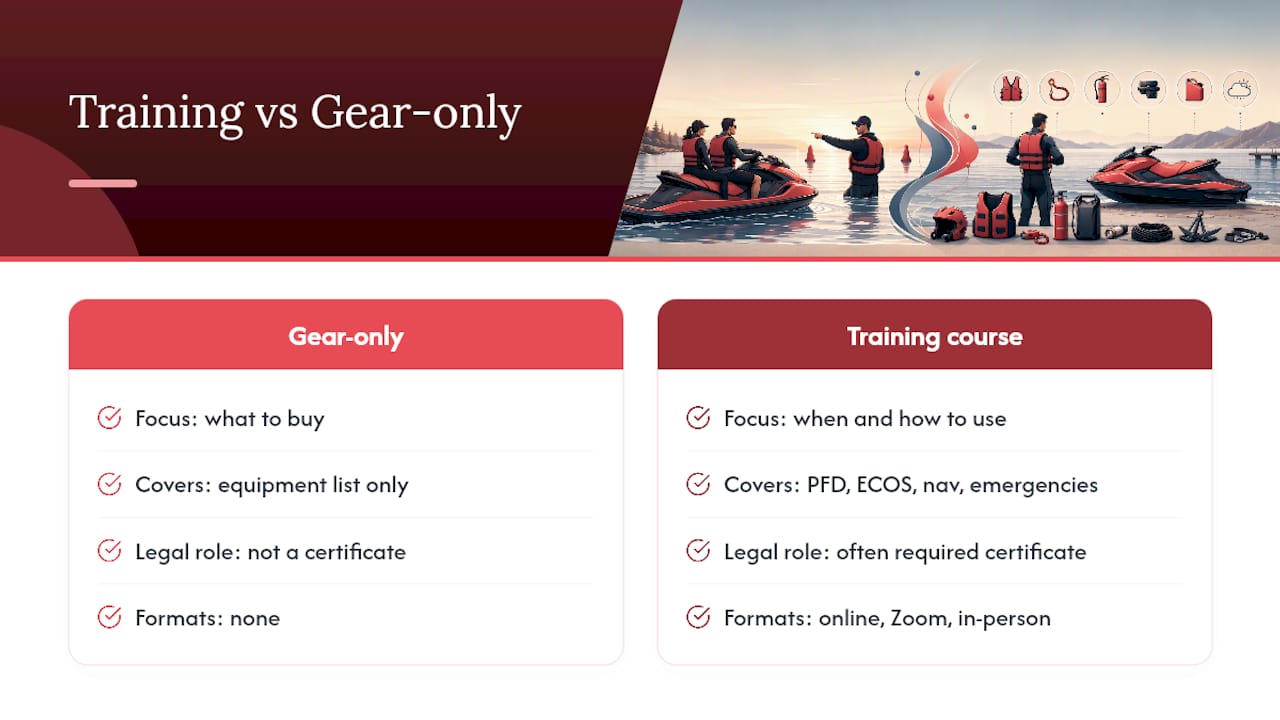
Owning the right equipment doesn’t teach you when to use it. A state-approved PWC course covers required safety equipment, proper PFD wear, ECOS operation, navigation rules, and emergency procedures in a format built around real on-water decisions, not just a list of what to buy.
Safeboatingamerica builds its courses on NASBLA-aligned curriculum and teaches through state-certified instructors, with flexible online, live Zoom, and in-person formats. Many states require a certificate before you can legally operate a PWC, which makes the certification class a legal checkbox and a practical skill upgrade at the same time. Riders who’ve completed formal training tend to catch ECOS failures faster and handle close calls with less panic, simply because they’ve walked through the scenario before it happened for real.
If you’re ready to meet your state’s education requirement while sharpening the habits that actually keep you upright, Safeboatingamerica’s certification courses are built specifically for that gap between owning the gear and knowing how to use it.
What Actually Matters on a PWC (and What Doesn’t)
Most PWC safety content buries the life jacket rule under paragraphs of gear marketing. That’s backwards. The PFD and the ECOS are doing almost all the protective work here, and everything else is refinement.
Here’s what conventional advice gets wrong: it treats a wetsuit or an impact vest as safety gear on equal footing with a Coast Guard-approved PFD. It isn’t. A wetsuit prevents cold shock and skin abrasion, both real problems, but neither one keeps an unconscious rider’s head above water. Only a properly fitted, approved life jacket does that job, and no amount of neoprene changes that hierarchy.
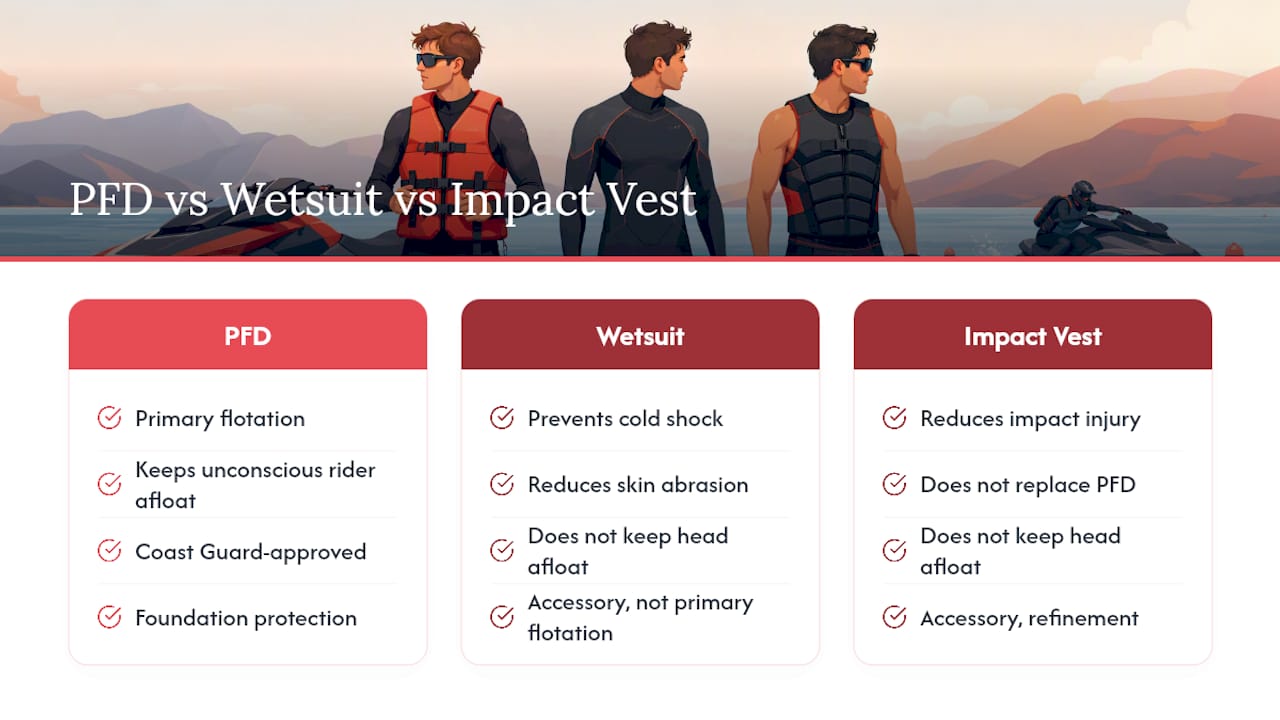
The second miss is treating the ECOS as a formality instead of a mechanical component that ages. A lanyard that’s been baking in the sun for three seasons doesn’t look broken until it’s tested under load, which is exactly the wrong moment to find out.
If you take one thing from this article, prioritize the PFD label and the lanyard snap test over any amount of accessory shopping. Everything else is genuinely useful, but it’s optimization on top of a foundation that either holds or doesn’t.
— Richard
Sources
- Personal Watercraft: Required Safety Equipment — Texas Parks & Wildlife Department
- Personal Watercraft Safety Guide: Rules, Equipment & Tips — Discover Boating
- Personal Watercraft | Fish and Boat Commission | Commonwealth of Pennsylvania
- USCG Boating Safety — Boating under the influence
FAQ
What safety equipment is required on a Sea-Doo or other PWC?
Every rider needs a USCG-approved life jacket worn while underway, a working engine cut-off switch (lanyard or wireless), a marine-rated fire extinguisher, a sound-signaling device, and current registration displayed on the craft.
What do I need to carry on my jet ski?
At minimum, carry a fire extinguisher, a whistle or horn, and your registration paperwork, along with wearing your PFD and ECOS at all times. Riders headed offshore or into remote water should also bring a handheld VHF radio or a waterproof phone.
What is a PWC on a boat?
PWC stands for personal watercraft, referring to vessels like Jet Skis, WaveRunners, and Sea-Doos that a rider operates while sitting, standing, or kneeling rather than sitting inside a hull.
What does the USCG consider a PWC to be?
The Coast Guard defines a personal watercraft as a jet-drive vessel under 16 feet designed to be operated by a person sitting, standing, or kneeling on it rather than within the confines of a conventional hull, and it falls under the same recreational boating safety enforcement rules as other powered vessels.