Best Marine Insurance Companies for U.S. Boat Owners
For most U.S. recreational boat owners, a focused set of national carriers covers the majority of needs: Progressive, BoatUS, GEICO, USAA, Chubb, Foremost, and Markel are the names that appear most consistently across consumer market roundups and independent comparisons. Each serves a distinct segment. The right pick depends on your vessel type, navigation area, and whether you need basic liability or high-limit agreed-value coverage.
| Carrier | Best For | Boats Covered | Quick Pros |
|---|---|---|---|
| Progressive Boat Insurance | Affordability, wide agent network | Runabouts, fishing boats, pontoons, PWCs | Easy online quotes; bundles with auto/home |
| BoatUS Boat Insurance | Membership benefits, on-water towing | Most recreational craft | Integrated towing; membership discounts |
| GEICO Boat Insurance | Budget-conscious multi-policy owners | Standard recreational boats | Strong multi-policy discounts |
| USAA Boat Insurance | Military families (eligibility required) | Recreational vessels | Member-focused service; competitive rates |
| Chubb Boat Insurance | High-value yachts, tailored underwriting | Larger yachts, luxury craft | High limits; specialist underwriting |
| Foremost Boat Insurance | PWCs and specialty small craft | PWCs, fishing boats, small craft | Tailored PWC and fishing-boat options |
| Markel Boat Insurance | Flexible endorsements, unusual exposures | Varied recreational uses | Custom endorsements for niche risks |
Next steps for immediate action:
- Gather your vessel’s make, model, year, hull material, and engine specs before requesting quotes.
- Confirm your primary navigation area (inland lakes, coastal, offshore) since navigation limits affect both eligibility and premium.
- Check each carrier’s AM Best financial strength rating and any available J.D. Power claims satisfaction data.
- Ask specifically about agreed value vs. actual cash value (ACV) terms before binding coverage.
- Verify whether towing and on-water assistance are included or billed as a separate add-on.
Safeboatingamerica publishes this guide as part of its broader commitment to boating safety education and certification across all U.S. states.
Key Takeaways
For most U.S. recreational boat owners, the right marine insurance policy comes down to matching coverage type and claims service to your vessel’s value, navigation area, and use case — not selecting the lowest annual premium.
| Point | Details |
|---|---|
| Match carrier to vessel type | Progressive and GEICO suit standard recreational boats; Chubb and Markel suit high-value or non-standard craft. |
| Agreed value vs. ACV matters | Agreed value pays the stated amount at total loss; ACV deducts depreciation — a meaningful gap on older vessels. |
| Check AM Best and complaints | Verify AM Best financial strength (A or better) and NAIC complaint ratios before binding any policy. |
| Document safety training | A state-approved certificate can qualify you for underwriting discounts and signals active risk management to insurers. |
| Safeboatingamerica certification | Safeboatingamerica’s NASBLA-approved courses provide the documented credential insurers recognize at the point of underwriting. |
Table of Contents
- Which marine insurance companies best match your boat and needs?
- How to choose a marine insurance policy and company
- What are the main types of marine insurance?
- How were these picks chosen?
- How boating safety training affects your premiums and coverage
- The real trade-off between cost and specialist marine coverage
- Certification reduces risk before you ever call an insurer
- Sources
- FAQ
Which marine insurance companies best match your boat and needs?
The profiles below cover the seven carriers most commonly encountered by U.S. recreational boat owners. Each entry focuses on what the carrier actually covers, where it excels, and where it falls short.
Progressive Boat Insurance
Progressive is the largest personal lines insurer in the U.S. and brings that distribution reach to recreational boat coverage. It writes policies for runabouts, fishing boats, pontoons, bass boats, and PWCs, with online quoting available in most states. Agreed value and actual cash value options are both available. Bundling with an existing Progressive auto or home policy typically yields a multi-policy discount, and the carrier accepts safety course completion as a discount qualifier.
Pros: Broad availability; fast online quotes; multi-policy bundling. Cons: Less specialized underwriting for high-value or offshore vessels; claims handling is generalist rather than marine-specific.
Foremost Boat Insurance
Foremost, a Farmers Insurance subsidiary, focuses on personal watercraft and specialty small craft. It writes coverage for PWCs, fishing boats, and a range of recreational vessels through independent agents, with product options specifically tailored to the exposures those craft carry. If your primary vessel is a Jet Ski, WaveRunner, or small fishing boat, Foremost’s product structure fits more precisely than a mass-market policy.
Pros: PWC-specific coverage options; fishing-boat endorsements; independent agent distribution. Cons: Not the strongest option for larger sailboats or offshore yachts; availability varies by state.
BoatUS Boat Insurance
BoatUS bundles insurance with its membership program, which includes on-water towing, fuel delivery, and soft-ungrounding assistance. That integration is the carrier’s primary differentiator. Policies cover most recreational craft, and the membership layer means towing is not a separate line item to negotiate. The BoatUS Foundation’s safety certification resources are also widely recognized by insurers as credible training credentials.
Pros: Integrated towing and on-water assistance; membership discounts; strong brand recognition among recreational boaters. Cons: Membership fee adds to total cost; coverage limits may not satisfy high-value vessel owners.
GEICO Boat Insurance
GEICO writes boat insurance for standard recreational vessels and markets it primarily to existing GEICO customers who want to consolidate policies. Multi-policy discounts are the headline benefit. The carrier is well-suited to owners with straightforward needs: a mid-size runabout, inland or coastal navigation, and no unusual hull configuration. Claims handling follows GEICO’s general personal lines process rather than a dedicated marine unit.
Pros: Competitive multi-policy discounts; easy to add alongside auto/home; widely available. Cons: Generalist claims process; limited options for specialty craft or extended offshore navigation.
USAA Boat Insurance
USAA restricts eligibility to active military, veterans, and their immediate families. Within that group, it consistently earns high marks for member service and claims satisfaction. Policies cover recreational vessels, and the carrier’s underwriting tends to be favorable for members with clean records. If you qualify, USAA is worth a quote alongside any other carrier on this list.
Pros: Strong claims satisfaction among eligible members; competitive pricing for qualifying households. Cons: Eligibility is restricted; not available to the general public.
Chubb Boat Insurance
Chubb operates at the high end of the market. Its marine insurance division provides tailored programs for higher-value yachts, extended navigation areas, and owners who need limits that standard retail carriers do not offer. Underwriting is individualized rather than algorithmic, which means the quoting process takes longer but produces a policy that actually fits the vessel. Specialist marine adjusters handle claims.
Pros: High limits; tailored underwriting; dedicated marine claims unit. Cons: Premium reflects the specialization; not cost-efficient for basic recreational craft.
Markel Boat Insurance
Markel is a niche carrier that writes flexible endorsements for recreational uses that fall outside standard product templates. Owners with unusual exposures — charter use, extended coastal cruising, or a vessel with a non-standard hull — often find Markel’s endorsement options more accommodating than mass-market alternatives.
Pros: Custom endorsements; flexible underwriting for non-standard risks. Cons: Less name recognition; not always the most competitive for routine recreational boats.
The table below consolidates the key comparison dimensions across all seven carriers.
Pro Tip: When you request quotes, ask each carrier whether claims are handled by a dedicated marine adjuster or routed through a general personal lines unit. That single question reveals more about real-world claims experience than any star rating.
How to choose a marine insurance policy and company
Prioritize coverage fit and claims service over the lowest premium. A policy that costs $200 less per year but excludes your navigation area or settles on ACV rather than agreed value can cost thousands more after a loss.
Policy features to compare
- Hull & Machinery (H&M): Physical damage to the vessel, engine, and permanently attached equipment.
- Liability / P&I-style coverage: Third-party bodily injury and property damage arising from vessel operation.
- Uninsured boaters: Covers your injuries when the at-fault operator carries no insurance.
- Towing and on-water assistance: Confirm whether this is included, add-on, or requires a separate membership.
- Personal effects: Gear, electronics, and clothing aboard.
- Agreed value vs. ACV: Agreed value pays the stated amount at total loss; ACV deducts depreciation. For boats over a few years old, the difference is significant.
- Navigation limits: Most policies define a geographic boundary. Operating outside it can void coverage.
Questions to ask your agent or broker
- How is the agreed value established, and is it reviewed at renewal?
- What are the exact navigation area limits, and what happens if I temporarily exceed them?
- Is towing included in the base premium, or does it require a separate membership or rider?
- Does the policy cover the trailer as well as the vessel?
- How are claims assigned — to a marine specialist or a general adjuster?
- What discounts apply for documented safety course completion?
Five red flags to watch for
- Vague or missing navigation limit language in the policy wording.
- Liability limits below $300,000 for a vessel used in coastal or offshore waters.
- No mention of a dedicated marine adjuster in the claims process.
- ACV settlement terms presented as equivalent to agreed value.
- Exclusions for “racing” or “commercial use” that are defined so broadly they could apply to routine fishing charters or club events.
What drives your premium
Boat value and engine size are the two largest factors. Typical cost drivers also include navigation area (offshore costs more than inland), storage method (in-water vs. dry storage), operator age and experience, claims history, and whether the owner holds a state-approved boating safety certificate. Most carriers can bind a standard recreational boat policy within one to three business days of a completed application; high-value or unusual vessels placed through a broker may take longer depending on underwriting review.
Pro Tip: Completing a state-approved boating safety course before you request quotes gives you a documented credential to present at the time of application — many carriers apply the discount at binding rather than at renewal.
What are the main types of marine insurance?
Recreational boat owners primarily need hull and machinery coverage plus liability protection. Cargo, Freight Demurrage and Defence (FD&D), and war risk products serve commercial operators and are not relevant to standard pleasure craft.
Marine insurance broadly covers the transportation of goods and vessels, extending to third-party liability, cargo, and physical damage. The product categories below map to distinct operational exposures.
Primary coverage types
- Hull & Machinery (H&M): Covers physical damage to the vessel, engine, and installed equipment. A recreational owner whose boat is damaged in a collision or storm makes a claim here. H&M and Protection & Indemnity are the two foundational marine insurance products for vessel owners.
- Protection & Indemnity (P&I): Covers third-party liabilities from vessel operation — bodily injury to passengers or other boaters, damage to docks or other vessels, and pollution liability. On a personal boat policy, this appears as liability coverage.
- Marine cargo insurance: Covers goods in transit by sea. Relevant to commercial shippers and freight operators, not recreational boaters.
- Freight Demurrage and Defence (FD&D): A commercial product covering legal defence costs and contractual disputes for shipowners and charterers.
- War and political risk: Covers losses from war, piracy, or political instability. Commercial shipping product; not applicable to standard U.S. recreational boating.
Commercial vs. recreational: a critical distinction
AIG notes a strict distinction between commercial marine coverage and personal boat insurance. Applying a commercial product to a pleasure craft is a common consumer error that can result in coverage gaps or outright denial. Recreational owners need personal lines policies tailored to pleasure craft.
P&I clubs and large mutuals — organizations like London P&I and Skuld — provide high-limit liability and defence covers for commercial shipowners. They are not the right channel for a recreational boat owner in the U.S.
Common claims scenarios by coverage type:
- Collision damage to hull: H&M responds. The adjuster assesses repair cost against the agreed or ACV value.
- Passenger injured aboard: P&I-style liability responds. Limits matter here — low liability limits expose the owner personally.
- Towing after engine failure: Towing rider or membership benefit responds. Without it, the owner pays out of pocket.
How were these picks chosen?
The shortlist reflects coverage fit, claims service quality, financial strength, consumer-facing policy features, and niche expertise. No carrier was ranked on premium alone.
Trust signals to verify before you buy
- AM Best financial strength rating: A or better indicates the carrier can pay claims. Chubb holds an A++ (Superior) rating.
- J.D. Power claims satisfaction: Where published, J.D. Power scores reflect real policyholder experience after a loss — more useful than aggregate star ratings.
- Published policy wording: Read the declarations page and the exclusions section, not just the marketing summary.
- Consumer complaint trends: The NAIC Consumer Information Source tracks complaint ratios by carrier. A high complaint index relative to market share is a concrete warning sign.
- Dedicated marine adjusters: Ask directly. A carrier that routes boat claims through a general auto or home unit often produces slower, less accurate settlements.
- Regional underwriting considerations: Alliant’s marine team notes emerging exposures such as saltwater intrusion and climate-related coastal flooding that affect underwriting in some U.S. coastal regions. If you operate in a high-risk coastal zone, confirm your carrier underwrites that area actively.
Methodology note: Carrier profiles were compiled from insurer product pages, marine brokerage resources, and consumer comparison outlets. Ratings signals referenced are from AM Best and J.D. Power where publicly available. Policy availability and underwriting criteria vary by state and vessel type; verify current terms directly with each carrier or a licensed agent.
How boating safety training affects your premiums and coverage
Documented safety training and state-approved boating certification commonly reduce perceived risk in underwriting and can qualify owners for direct premium discounts. Formal boating education has a measurable connection to lower accident rates, and insurers increasingly recognize that credential at the point of underwriting.
Specialist marine brokers emphasize proactive risk management as a core part of their value to clients. A documented safety program and maintenance log are practical underwriting items: a short history of professional training and preventative maintenance can influence both premium and the terms an underwriter is willing to offer. Alliant’s marine practice similarly notes that bespoke underwriting solutions are shaped by the owner’s documented risk profile, not just the vessel’s specs.
Three practical steps to document your credentials for insurers
- Submit your course completion certificate at quote time. A NASBLA-approved or state-approved certificate from a program like Safeboatingamerica carries weight with underwriters who recognize accredited training.
- List instructor credentials and course provider. Noting that instruction was delivered by a USCG-Licensed Captain or State Certified Instructor adds specificity that a generic “safety course” claim does not.
- Log supervised operation hours. For newer operators or those moving to a larger vessel class, a brief log of supervised hours demonstrates practical competence beyond classroom training.
Pro Tip: Present a short safety plan and recent boat safety equipment checklist alongside your maintenance records when requesting a quote. Underwriters respond to documented evidence of loss prevention — it signals an owner who manages risk actively, not reactively.
The real trade-off between cost and specialist marine coverage
For a standard recreational boat — a 20-foot runabout used on inland lakes or near-coastal waters — a mainstream carrier like Progressive or GEICO will cover the core exposures at a competitive price. The policy wording is standardized, the quoting process is fast, and the premium reflects a well-understood risk class.
The calculation shifts when the vessel is high-value, the navigation profile extends offshore, or the use case includes charter, racing, or commercial activity. At that point, a mass-market policy’s standardized exclusions and generalist claims process become genuine liabilities. Specialist underwriters and brokers add value through deep industry knowledge, loss control, and claims advocacy that a retail carrier’s general lines unit cannot replicate.
The trade-off is not simply price vs. coverage breadth. It is also about claims advocacy: a dedicated marine adjuster who understands salvage, agreed value disputes, and navigation limit nuance will produce a materially different outcome than a generalist adjuster working from a checklist. For owners of vessels worth $100,000 or more, or anyone operating beyond standard coastal limits, the premium difference between a retail carrier and a specialist placement is usually small relative to the claims exposure.
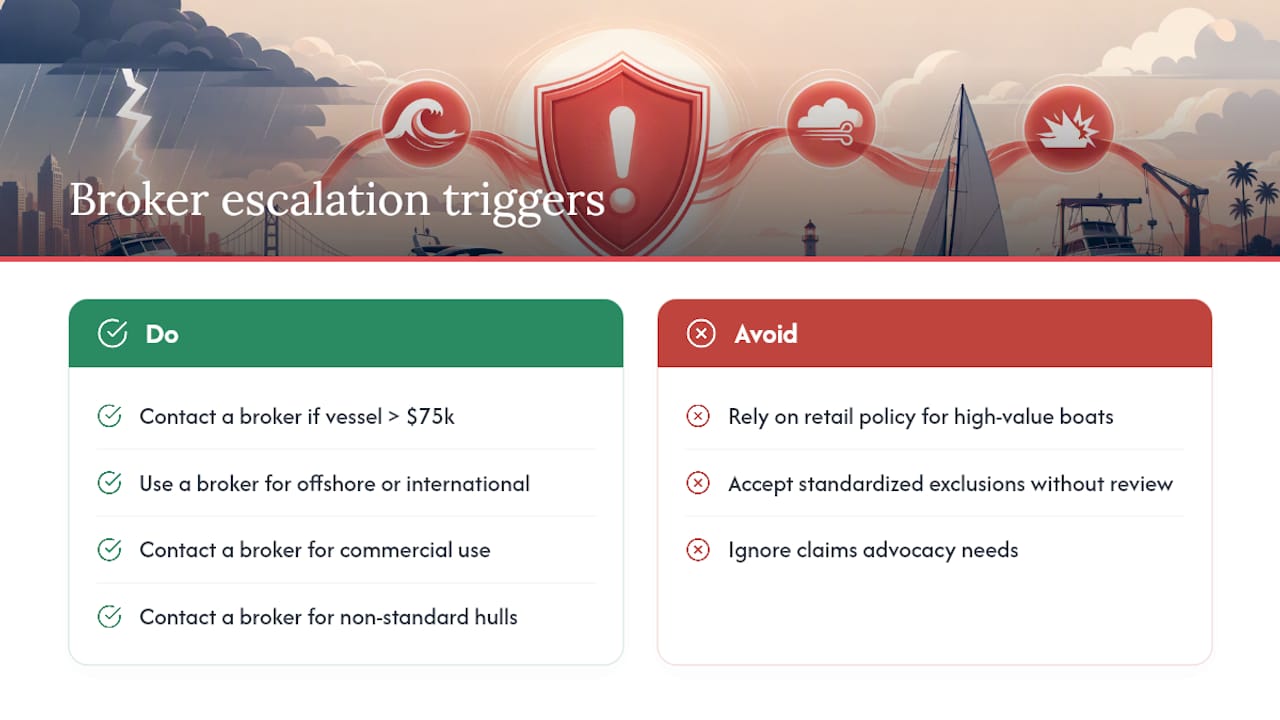
When to escalate to a broker: if your vessel exceeds $75,000 in value, operates offshore or in international waters, is used for any commercial purpose, or carries a non-standard hull configuration, contact a specialist marine broker rather than quoting direct. Brokers represent you to multiple markets and can negotiate terms that a direct retail carrier will not offer.
Certification reduces risk before you ever call an insurer
Choosing the right carrier matters. So does what you bring to the conversation. A state-approved boating safety certificate from Safeboatingamerica gives you a documented credential that many carriers recognize at the point of underwriting — and it satisfies state law requirements before you leave the dock.
Safeboatingamerica offers NASBLA-approved courses taught by USCG-Licensed Captains and State Certified Instructors, available online, in-person, and via live Zoom sessions across all U.S. states. Key benefits for boat owners preparing to shop for insurance:
- Same-day certification options available in many states.
- PWC and Jet Ski endorsements recognized by carriers that write personal watercraft coverage.
- Brianna’s Law-compliant New York courses and Connecticut Safe Boating Certificate programs for state-specific requirements.
Get your boating safety certification through Safeboatingamerica and present your completed credential when requesting marine insurance quotes.
Sources
The following sources informed the carrier profiles, coverage definitions, and buying guidance in this article.
- Marine Insurance | AIG US
- Shipowners - Skuld
- Marine Risk Insurance: Hull, Liability & P&I Coverage | Howden U.S.
- Comprehensive Marine Insurance Coverage | Alliant
- Chubb - Marine Insurance
- Best Boat Insurance Companies of 2026
- Marine Insurance for Shipowners & Charterers | London P&I
FAQ
Who has the best marine insurance for recreational boat owners?
No single carrier is best for every owner. Progressive and BoatUS consistently rank well for standard recreational boats; USAA leads for eligible military families; Chubb is the strongest option for high-value yachts requiring specialist underwriting.
What are the four main types of marine insurance?
The four primary types are Hull & Machinery (physical vessel damage), Protection & Indemnity (third-party liability), marine cargo (goods in transit), and war/political risk coverage. Recreational boat owners typically need only H&M and liability protection.
Who are the largest marine insurers in the U.S.?
Progressive is the largest personal lines carrier writing recreational boat insurance in the U.S. by distribution reach. For commercial and high-value marine risks, Chubb and specialist underwriters accessed through brokers like Howden and Alliant represent the market’s depth.
Which marine insurance is best for PWCs and Jet Skis?
Foremost is specifically structured for personal watercraft, with product options tailored to PWC exposures. Progressive also writes PWC coverage broadly. Confirming that the policy covers PWC-specific risks — including liability for wake damage — is more important than carrier name alone.
How long does it take to get a boat insurance policy?
Most standard recreational boat policies can be bound within one to three business days of a completed application. High-value vessels or unusual risks placed through a specialist broker may require additional underwriting review, extending the timeline by several days.