
DLNR Boating in Hawaii: Regulations and Safety Guide

DLNR boating is defined as the full set of vessel registration, safety education, and operation rules administered by Hawaii’s Department of Land and Natural Resources through its Division of Boating and Ocean Recreation, known as DOBOR. Every boater operating a motorized vessel in Hawaii waters must comply with these rules to stay legal and safe. DOBOR manages everything from watercraft registration and titling to mandatory certification courses and thrill craft permits. Understanding these requirements before you launch protects you from fines, keeps Hawaii’s reefs intact, and makes every trip on the water safer for everyone.
What are the vessel registration and titling requirements under DLNR boating?
Vessel registration and titling in Hawaii are managed exclusively by DOBOR, not by county offices. This distinction matters because many boaters assume the process mirrors car registration. It does not.
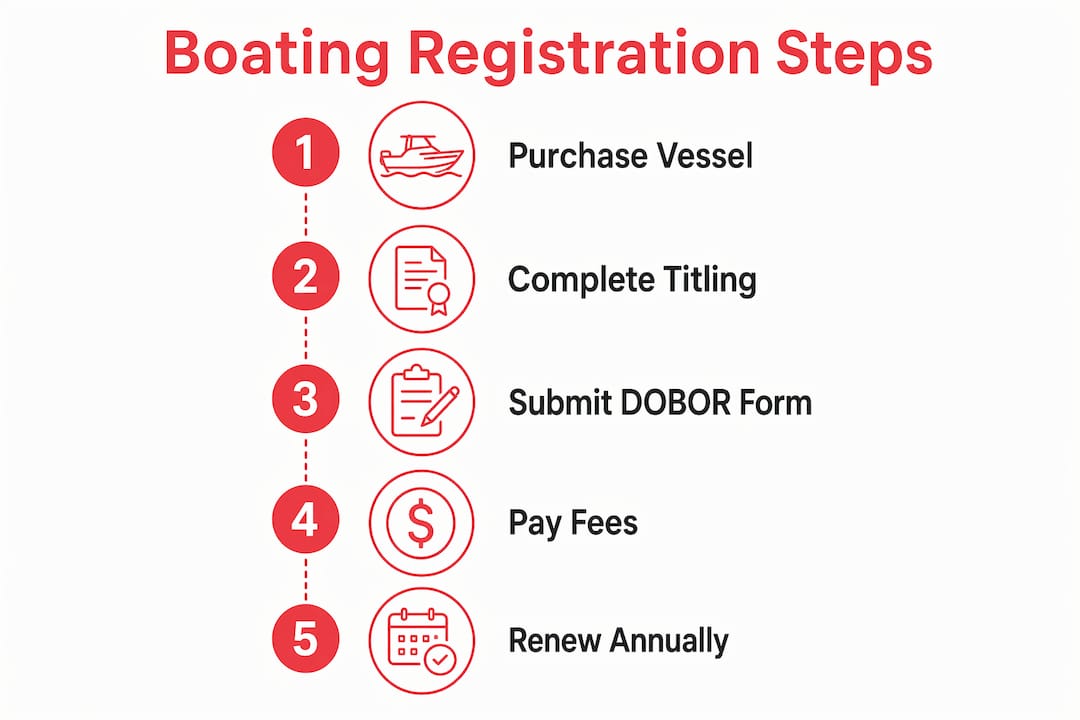
DOBOR implemented vessel titling on july 1, 2021. Titling is now mandatory for most motorized vessels in Hawaii. The title fee is $20, and boaters who missed the original deadline face a late fee of $40, bringing the total to $60 for late titling. Titles remain valid for the life of the vessel or until ownership transfers to a new buyer.
Registration renewals must also go through DOBOR, and compliance with titling is required before a renewal is processed. New purchases, transfers, and renewals can be handled at DOBOR offices or through the agency’s online portal.
One critical point that trips up many boaters: trailers are registered separately at County DMV offices, not at DOBOR. Trailer safety inspections are also handled at the county level. Mixing up these two processes can delay your launch date significantly.
Key registration steps at a glance
- Complete vessel titling through DOBOR before or at the time of registration
- Pay the $20 title fee, or $60 if titling is late
- Renew registration annually through DOBOR offices or the online portal
- Register trailers separately at your County DMV office
- Carry proof of registration on board at all times
Pro Tip: If you recently purchased a used vessel in Hawaii, check whether the previous owner completed titling. Untitled vessels require you to pay the title fee plus any applicable late fees before DOBOR will process your registration.
| Requirement | Details |
|---|---|
| Vessel titling | Mandatory; $20 fee; managed by DOBOR |
| Late titling fee | $40 additional fee; total $60 if past deadline |
| Title validity | Lifetime of vessel or until ownership transfer |
| Trailer registration | Handled at County DMV offices, not DOBOR |
| Registration renewal | Annual; requires titling compliance |
What are the mandatory boating safety education and certification requirements?
Hawaii requires all motorized vessel operators to complete a NASBLA-approved boating safety course before operating on state waters. This requirement took effect in november 2014 and applies to anyone operating a motorized vessel, regardless of vessel size or engine power.
The certification process is straightforward, but the rules around carrying proof are strict. Boaters must carry a physical copy of their certification card whenever they are on the water. Law enforcement can request proof at any time, and failure to produce it can result in fines or termination of the voyage.
Online courses are the primary approved method for completing Hawaii’s mandatory boating education. All DLNR and NASBLA-approved providers deliver identical curriculum content, so the choice of provider does not affect what you learn. Selection should be based solely on whether the provider appears on the official DLNR approval list.
Steps to get certified for motorized boating in Hawaii
- Confirm the course provider is both NASBLA and DLNR-approved before enrolling
- Complete the full online course, including all required modules and the final exam
- Receive your certification card upon passing
- Carry the physical card on board every time you operate a motorized vessel
- Optionally, register your credentials with the Hawaii Certified Boater Registry for digital backup
DOBOR also offers the Hawaii Certified Boater Registry, an optional digital system where certified boaters can upload their credentials. The registry does not replace the hardcopy requirement, but it serves as a secure backup if a card is lost or damaged. Registering takes only a few minutes and is worth doing immediately after certification.
Pro Tip: Complete your boating safety course before you purchase or rent a vessel in Hawaii. Certification is a prerequisite for legal operation, and some rental operators will ask for proof before handing over the keys.
Understanding why boating safety education is mandatory helps boaters treat certification as more than a checkbox. The curriculum covers navigation rules, emergency procedures, and environmental awareness, all of which directly reduce accident risk in Hawaii’s busy coastal waters.
What specific regulations govern thrill craft (jet skis and PWCs) in Hawaii?
Thrill craft regulations in Hawaii are stricter than general motorized boating rules. DOBOR applies the term “thrill craft” to personal watercraft including Jet Skis, WaveRunners, and similar vessels. Operating one requires meeting two separate certification requirements, not just one.
Operators must be at least 15 years old and must hold both a NASBLA-approved basic boating safety certificate and a specialized Thrill Craft Operator Certification. Completing only the general boating course is not sufficient. Both credentials must be carried on the water.
“All thrill craft must operate in designated zones or maintain a 500-foot distance from shore or reef when outside designated corridors.” — DOBOR, Division of Boating and Ocean Recreation
This 500-foot rule exists to protect Hawaii’s coral reef systems and shoreline environments. Reefs damaged by watercraft take decades to recover. The rule also reduces collision risk between thrill craft and swimmers or paddlers near shore.
Thrill craft operational rules
- Minimum operator age: 15 years
- Required credentials: basic boating safety certificate plus Thrill Craft Operator Certification
- Distance rule: 500 feet from shore or reef when outside designated zones
- Launch points: designated harbors or private beachfront property only
- Both certifications must be physically carried during operation
The Thrill Craft Operator Certification is available through DLNR-approved online providers. Like the general boating course, all approved providers deliver the same content. Boaters planning to operate a Jet Ski or PWC in Hawaii should complete both courses before arriving, since certification cannot be completed on the beach the morning of a rental.
How do Hawaii’s boating regulations affect safety and ocean resource protection?
DOBOR’s mission is to preserve Hawaii’s natural and cultural ocean resources while maintaining public access to state waters. The boating regulations Hawaii enforces are not arbitrary. Each rule ties directly to a documented safety or environmental outcome.
Enforcement is active and consistent. DOBOR officers can stop any vessel and request proof of registration, boating education certification, and required safety equipment. Non-compliance results in fines or an immediate end to the voyage. Repeat violations carry escalating penalties.
Required safety equipment for vessels operating in Hawaii waters includes:
- U.S. Coast Guard-approved life jackets for every person on board
- Visual distress signals appropriate for the vessel type and operating area
- A functioning fire extinguisher on motorized vessels
- Sound-producing devices such as a horn or whistle
- Navigation lights for vessels operating at night or in reduced visibility
Beyond equipment, boaters must follow federal Navigation Rules, which govern right-of-way, speed in congested areas, and safe passing procedures. Hawaii’s waters include heavy recreational and commercial traffic near Honolulu Harbor, Kaneohe Bay, and the Kona Coast. Knowing the rules of the road is not optional in these areas.
The NASBLA boating safety standard that underpins Hawaii’s required curriculum was designed specifically to address these real-world scenarios. Boaters who complete an approved course are measurably better prepared to handle traffic, weather changes, and emergencies in Hawaii’s open ocean conditions.
Key Takeaways
DLNR boating compliance in Hawaii requires vessel titling through DOBOR, a NASBLA-approved safety certificate, and for thrill craft operators, a second specialized certification plus adherence to the 500-foot distance rule.
| Point | Details |
|---|---|
| Vessel titling is mandatory | Complete titling through DOBOR; the fee is $20, or $60 if filed late. |
| Carry physical certification | Hawaii law requires a hardcopy boating certificate on board at all times. |
| Thrill craft needs dual credentials | Jet Ski and PWC operators must hold both a general and a thrill craft certificate. |
| Trailers register at the county | Trailer registration and inspections go through County DMV offices, not DOBOR. |
| 500-foot rule protects reefs | Thrill craft must stay 500 feet from shore or reef outside designated zones. |
Richard’s take on navigating Hawaii’s boating rules
Most boaters who get into trouble with DLNR regulations make the same mistake: they treat Hawaii like any other state. It is not. The dual certification requirement for thrill craft, the vessel titling system that launched in 2021, and the strict 500-foot reef rule are all Hawaii-specific. Boaters who arrive assuming their out-of-state certification covers everything often find out otherwise at the dock.
The titling system catches people off guard most often. If you buy a used vessel in Hawaii and the previous owner never completed titling, that becomes your problem. You inherit the late fee and the paperwork delay. Always verify titling status before any purchase closes.
On the certification side, I have seen boaters skip the Hawaii Certified Boater Registry because it is optional. That is a mistake. Losing a physical certification card while traveling means you cannot legally operate until you get a replacement. Uploading your credentials to the registry takes five minutes and eliminates that risk entirely.
The 500-foot reef rule is the one I feel most strongly about. Hawaii’s reefs are irreplaceable. A Jet Ski running too close to a reef does not just risk a fine. It causes real, lasting damage to an ecosystem that supports the entire ocean recreation economy. Respecting that boundary is not just legal compliance. It is the right call.
— Richard
Safeboatingamerica: your path to DLNR-approved certification
Safeboatingamerica offers NASBLA-approved online boating courses that meet Hawaii’s DLNR requirements for both general motorized vessel operators and thrill craft certification. Courses are taught by USCG-Licensed Captains and State Certified Instructors, covering navigation rules, emergency procedures, and Hawaii-specific boating laws.
Certification cards are valid for life and accepted by DOBOR enforcement officers as proof of compliance. Whether you need a general boating certificate or a thrill craft credential before your next Hawaii trip, Safeboatingamerica provides online boating courses with same-day completion options. Get certified before you launch and spend your time on the water, not on paperwork.
FAQ
What does DOBOR stand for in Hawaii boating?
DOBOR stands for the Division of Boating and Ocean Recreation, the agency within Hawaii’s Department of Land and Natural Resources that manages vessel registration, boating safety education, and watercraft operation rules.
Do I need a boating license to operate a boat in Hawaii?
Hawaii does not issue a traditional boating license. Instead, all motorized vessel operators must complete a NASBLA-approved safety course and carry their certification card on board at all times.
What is the minimum age to operate a Jet Ski in Hawaii?
The minimum age to operate a thrill craft such as a Jet Ski or PWC in Hawaii is 15 years. Operators must also hold both a basic boating safety certificate and a Thrill Craft Operator Certification.
Where do I register my boat in Hawaii?
Vessel registration and titling are handled by DOBOR, either at a DOBOR office or through the agency’s online portal. Trailer registration is separate and must be completed at your County DMV office.
Can I complete my Hawaii boating certification online?
Yes. Online courses are the primary approved method for Hawaii boating education. All DLNR and NASBLA-approved online providers deliver identical curriculum, so any provider on the official approval list satisfies the state requirement.
Recommended
- Minnesota Boating Regulations: 2026 Compliance Guide - Safe Boating America
- Boat Requirements: What Every U.S. Boater Must Know - Safe Boating America
- How to Perform a Boat Safety Inspection Step by Step - Safe Boating America
- Boat Safety Equipment: What Every Boater Must Carry - Safe Boating America