
Arizona Boating Laws: What Every Boater Must Know

Arizona boating laws define a mandatory framework that governs every motorized vessel on state waters, covering registration, safety equipment, operator age, education, and environmental compliance. The Arizona Game and Fish Department (AZGFD) enforces these rules across popular waterways including Lake Havasu, Lake Powell, and Roosevelt Lake. Whether you operate a powerboat, a personal watercraft, or a Jet Ski, understanding these regulations keeps you legal, safe, and protected from serious liability.
What are Arizona boating laws and who enforces them?
Arizona boating laws are the set of statutes and administrative rules that govern vessel registration, operator conduct, safety equipment, and environmental protection on Arizona waterways. The AZGFD serves as the primary enforcement authority, working alongside local law enforcement agencies and U.S. Coast Guard personnel. These rules apply to residents and out-of-state visitors alike. If you launch a motorized vessel on any Arizona lake or river, you are subject to these requirements from the moment you leave the dock.
What are the Arizona boat registration requirements and process?
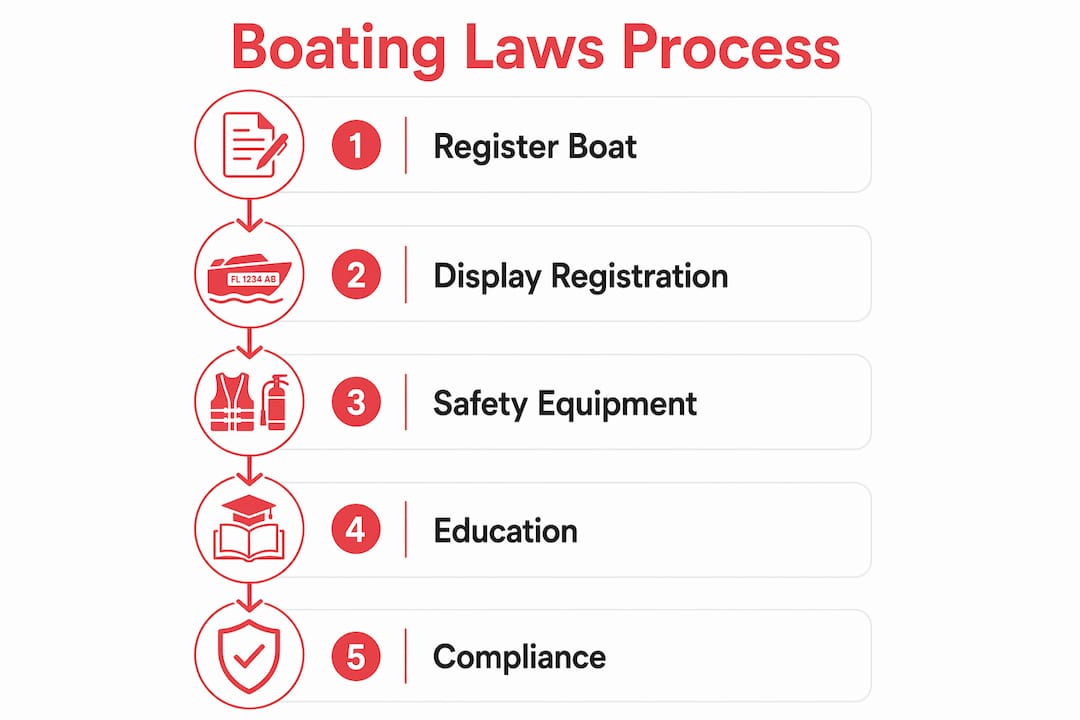
All motorized watercraft must register with the AZGFD before operating on Arizona waters. Registration is annual, and fees range from $20 to $66 depending on vessel size. You can complete registration and renewal online, and the certificate is valid for immediate use upon issuance.

Registration display and documentation rules
Your registration number must be displayed on both sides of the bow in block letters at least three inches high. The registration certificate must be kept aboard the vessel at all times. Arizona is a registration-only state, meaning no boat titles are issued. A bill of sale paired with your registration certificate serves as the primary proof of ownership. If you purchase a used vessel, you must apply for new registration within 15 days of the transfer.
Vessels exempt from registration
- Non-motorized watercraft such as canoes, kayaks, and paddleboards
- Lifeboats used exclusively for emergency purposes
- Federally documented vessels with a valid USCG documentation certificate
- Vessels registered in another state that are used temporarily in Arizona waters
Pro Tip: Keep a digital copy of your registration certificate on your phone as a backup. AZGFD officers accept it during inspections, and it protects you if the paper copy gets wet or lost.
| Registration detail | Specifics |
|---|---|
| Governing authority | Arizona Game and Fish Department (AZGFD) |
| Annual fee range | $20–$66 based on vessel size |
| Renewal method | Online; valid for immediate use |
| Ownership documentation | Bill of sale plus registration certificate |
| Transfer deadline | New registration required within 15 days of sale |
What safety equipment and behavioral rules must boaters follow in Arizona?
Arizona law requires a U.S. Coast Guard-approved life jacket for every person on board. Children 12 and under must wear their life jackets at all times while the vessel is underway. This rule is not optional, and officers issue citations on the spot for violations. Review the full list of required safety gear to make sure your vessel is fully equipped before launch.
Required safety equipment for motorized vessels
- U.S. Coast Guard-approved personal flotation device (PFD) for each person aboard
- At least one Type IV throwable flotation device on vessels 16 feet or longer
- Approved fire extinguisher on all motorboats with enclosed compartments
- Sound-producing device such as a horn or whistle
- Navigation lights for operation between sunset and sunrise
Boating under the influence and conduct rules
Operating a boat while impaired is a criminal offense in Arizona. The legal blood-alcohol concentration (BAC) limit is 0.08, matching the standard for motor vehicles. Officers can cite any operator showing signs of impairment regardless of BAC level. Bow-riding, sitting on gunwales, and reckless operation are also prohibited. Penalties for BUI include criminal charges, jail time, fines, and loss of boating privileges.
“The greatest danger is assuming you can put on a life jacket in an emergency. Consistent wear is the only reliable protection.” — AZGFD
The statistics behind this warning are stark. 87% of drowning victims in recreational boating accidents were not wearing life jackets. That number means a properly worn PFD is the single most effective safety measure available to any boater.
Pro Tip: Inflatable PFDs are comfortable and Coast Guard-approved for adults, but they do not satisfy the requirement for children 12 and under. Children must wear a foam-filled, properly fitted Type I, II, or III life jacket.
What are the age and education requirements for operating motorized watercraft in Arizona?
The minimum age to operate a motorized vessel in Arizona is 12 years old. Persons born on or after January 1, 1986, must carry a boater education card while operating any motorized watercraft. This requirement applies to boats, personal watercraft, and Jet Skis. Arizona does not issue a universal boating license, but the education card functions as the legal credential for operators in that birth-year group.
How to satisfy the education requirement
- Complete a NASBLA-approved boating safety course recognized by AZGFD.
- Pass the final exam and receive your official boater education card.
- Carry the card on your person whenever operating a motorized vessel.
- Present the card to any law enforcement officer upon request.
NASBLA-approved courses cover navigation rules, emergency procedures, required safety equipment, and Arizona-specific waterway rules. Safeboatingamerica offers an Arizona-approved certification course that satisfies the state requirement and can be completed entirely online. Research confirms that boating education reduces accident risk by preparing operators for real-world hazards before they reach the water.
Rental companies on Lake Havasu and other high-traffic lakes often enforce stricter rules than state law requires. Many demand proof of education course completion regardless of birth year. Calling ahead to confirm rental requirements saves time and prevents a wasted trip to the marina.
Pro Tip: If you are under 16, Arizona law requires an adult to be aboard the vessel at all times. Completing a boating safety course before your first trip builds confidence and satisfies any rental company’s documentation requirements in one step.
How does Arizona boating law address ownership proof, insurance, and invasive species?
Arizona registers boats but does not issue titles. This is a meaningful distinction from most other states. The bill of sale and registration certificate together replace the title system and serve as the accepted proof of ownership for financing, insurance, and resale purposes.
Insurance and financial liability
Boat insurance is not legally required in Arizona. That said, operating without coverage exposes you to significant personal financial risk. An accident involving injuries or a fatality can generate liability claims that exceed the value of the vessel many times over. Legal experts consistently advise coverage as a practical necessity even when the law does not mandate it.
Invasive species and the Clean, Drain, Dry protocol
Arizona lakes face a serious threat from aquatic invasive species, particularly quagga and zebra mussels. Boaters must follow Clean, Drain, Dry protocols before moving a vessel between water bodies. Law enforcement actively monitors compliance at boat ramps and inspection stations. Failure to comply results in penalties and contributes to ecological damage that affects fishing, recreation, and water infrastructure statewide.
The protocol requires three steps:
- Clean: Remove all visible aquatic plants, animals, and mud from the vessel, trailer, and equipment.
- Drain: Remove all water from the bilge, live well, motor, and any other compartments before leaving the launch site.
- Dry: Allow the vessel and equipment to dry completely before launching in a different water body.
What are the consequences of violating Arizona boating laws?
Failure to carry required safety equipment or comply with registration rules results in citations and fines. More serious violations carry criminal consequences. The severity of the penalty scales with the nature of the offense.
- Equipment violations: Citations and fines issued on the water; vessel may be required to return to shore.
- Registration lapses: Fines and potential impoundment of the vessel.
- Boating under the influence: Criminal charges, mandatory court appearance, fines, possible jail time, and suspension of boating privileges.
- Reckless operation: Criminal charges and civil liability for any injuries or property damage caused.
- Underage operator violations: Parental and vessel owner liability applies when a minor operates a vessel in violation of age or education requirements.
- Invasive species non-compliance: Fines and mandatory decontamination at an approved inspection station.
A violation that causes injury or death also serves as evidence of negligence in civil litigation. That exposure makes compliance a financial priority, not just a legal one. Review the full scope of U.S. boater legal requirements to understand how Arizona rules fit within the broader federal framework.
Key takeaways
Arizona boating laws require AZGFD registration, mandatory safety equipment, a 0.08 BAC limit, a minimum operator age of 12, and a boater education card for anyone born on or after January 1, 1986.
| Point | Details |
|---|---|
| Registration is mandatory | All motorized vessels must register with AZGFD annually; fees range from $20 to $66. |
| Life jackets save lives | 87% of boating drowning victims were not wearing a PFD; children 12 and under must wear one at all times. |
| Education card required | Operators born on or after January 1, 1986, must carry a NASBLA-approved boater education card. |
| No boat titles in Arizona | A bill of sale plus registration certificate serves as the accepted proof of ownership. |
| Clean, Drain, Dry is law | Boaters must follow invasive species protocols before moving vessels between water bodies. |
What I’ve learned watching boaters get it wrong on Arizona waters
Most violations I see on Arizona lakes are not intentional. They come from boaters who assumed the rules were simpler than they are, or who figured they could handle an emergency if one arose. The life jacket issue is the clearest example. Adults routinely stow their PFDs under a seat and tell themselves they will grab one if needed. Cold water shock and sudden capsize make that plan unrealistic. You have seconds, not minutes, and a jacket you are not wearing does nothing.
The education requirement surprises a lot of people too. Arizona does not issue a boating license in the traditional sense, so many operators assume no formal training is needed. The boater education card requirement for anyone born after January 1, 1986, catches people off guard, especially at rental counters where staff check documentation before handing over keys. Taking a course before you need it is far less stressful than scrambling to find one at the marina.
The invasive species rules are the most underestimated part of Arizona waterway rules. Quagga mussels have already spread to multiple Arizona reservoirs, and the damage to infrastructure and ecosystems is measurable. The Clean, Drain, Dry protocol takes less than 15 minutes. Skipping it risks a fine and contributes to a problem that affects every boater in the state for years.
My honest advice: treat compliance as part of your pre-launch checklist, not as an afterthought. A registered vessel, a properly fitted PFD on every passenger, a sober operator, and a clean trailer represent the baseline. Everything above that is just good seamanship.
— Richard
Get certified and get on the water legally
Arizona boaters who need to satisfy the state’s education card requirement have a direct path through Safeboatingamerica.
Safeboatingamerica offers an Arizona Boating and PWC Certification Course that is fully online, NASBLA-approved, and accepted by AZGFD. The course covers Arizona waterway rules, required safety equipment, navigation, and personal watercraft operation. You can complete it at your own pace and receive your certification the same day. Visit Safeboatingamerica to enroll and get your boater education card before your next trip to Lake Havasu, Lake Powell, or any other Arizona waterway.
FAQ
What is the minimum age to operate a boat in Arizona?
The minimum age to operate a motorized vessel in Arizona is 12 years old. Operators under 16 must have an adult aboard at all times.
Do I need a boating license in Arizona?
Arizona does not issue a traditional boating license. Operators born on or after January 1, 1986, must carry a NASBLA-approved boater education card while operating any motorized watercraft.
What are the life jacket rules for children in Arizona?
Children 12 and under must wear a U.S. Coast Guard-approved life jacket at all times while the vessel is underway. Adults must have an approved PFD available for every person on board.
Is boat insurance required in Arizona?
Boat insurance is not legally required in Arizona. Legal experts strongly advise coverage because an uninsured accident involving injuries or death can result in significant personal financial liability.
How do I prove boat ownership in Arizona if there are no titles?
Arizona does not issue boat titles. A bill of sale combined with the current AZGFD registration certificate serves as the accepted proof of ownership for all legal and financial purposes.
Recommended
- Boat Requirements: What Every U.S. Boater Must Know - Safe Boating America
- Boat Safety Equipment: What Every Boater Must Carry - Safe Boating America
- Coast Guard Boat Requirements: What Boaters Must Know - Safe Boating America
- NASBLA Boating Safety Standard: What Boaters Must Know - Safe Boating America