January 1, 1989 Cutoff: Wisconsin Boating License Age and PWC Rules
Wisconsin sets clear age floors for operating watercraft: no one under 10 can run a motorboat, and no one under 12 can run a personal watercraft. Beyond those floors, the state’s real trigger is a birthdate, not a birthday. Anyone born on or after January 1, 1989 must carry a boating safety certificate once they reach the applicable operating age. The sections below break down exactly which rule applies at each age and how to get certified.
TL;DR:
- Boaters born before January 1, 1989, are grandfathered and do not need a certificate, but the DNR still recommends safety courses due to evolving standards.
- Children under 10 cannot operate any motorboat, while those aged 10 to 11 need adult supervision or a certificate to operate a motorboat.
- Personal watercraft operators must be at least 12 years old and hold a certificate for independent operation, with no exceptions for supervision below that age.
- A boating safety certificate is a one-time, lifelong credential, and taking approved courses online or in person simplifies the certification process.
- Rental boat operators must be at least 16 years old with a valid certificate, and minors aged 10 to 15 are ineligible for temporary rental certificates.
Table of Contents
- Wisconsin Boat License Age Requirements by Vessel and Operator Age
- Personal Watercraft Rules: Stricter Ages, No Gray Area
- Who Actually Needs a Wisconsin Boating Safety Certificate?
- Renting a Boat or PWC: Temporary Certificate Rules
- How to Get a Wisconsin Boating Safety Certificate
- Enforcement: Carrying Your Card and Avoiding Fines
- Why Safeboatingamerica Recommends Getting Certified Early
- Get Your Wisconsin Boating Certificate Without the Hassle
- Sources
- FAQ
Wisconsin Boat License Age Requirements by Vessel and Operator Age
The state splits its rules by age band, and each one carries different obligations for supervision or certification. Wisconsin statute 30.678 spells out the framework in detail, and it’s worth knowing exactly where your child (or you) fall.
- Under 10: No person may operate a motorboat, period. There’s no supervised exception at this age for motorboats.
- Ages 10–11: May operate a motorboat only when accompanied by a qualifying adult, meaning someone at least 18 years old who either holds a valid certificate or was born before January 1, 1989.
- Ages 12–15: May operate with adult supervision (same qualifying adult standard) or with their own valid boating safety certificate. No certificate, no supervision, no operating.
- Age 16 and older, born on or after January 1, 1989: Must hold a certificate or be accompanied by a qualifying adult. There’s no age at which the certificate requirement simply expires.
Picture a 13-year-old on a family pontoon boat on Lake Winnebago. If a parent born in 1975 is aboard and actively supervising, that’s compliant. If the same 13-year-old wants to run the boat solo on a fishing trip, the statute requires a certificate first. The rule follows the operator, not the boat’s size or horsepower.
Personal Watercraft Rules: Stricter Ages, No Gray Area
Jet Skis and other PWCs carry a higher minimum age than motorboats, and Wisconsin enforces it tightly. No person under 12 may operate a PWC under any circumstance, supervised or not.
- Under 12: Flatly prohibited from operating a PWC.
- Ages 12–15: Must hold a valid boating safety certificate to operate without direct adult supervision.
- 16 and older, born on or after January 1, 1989: Certificate required, same as the motorboat standard.
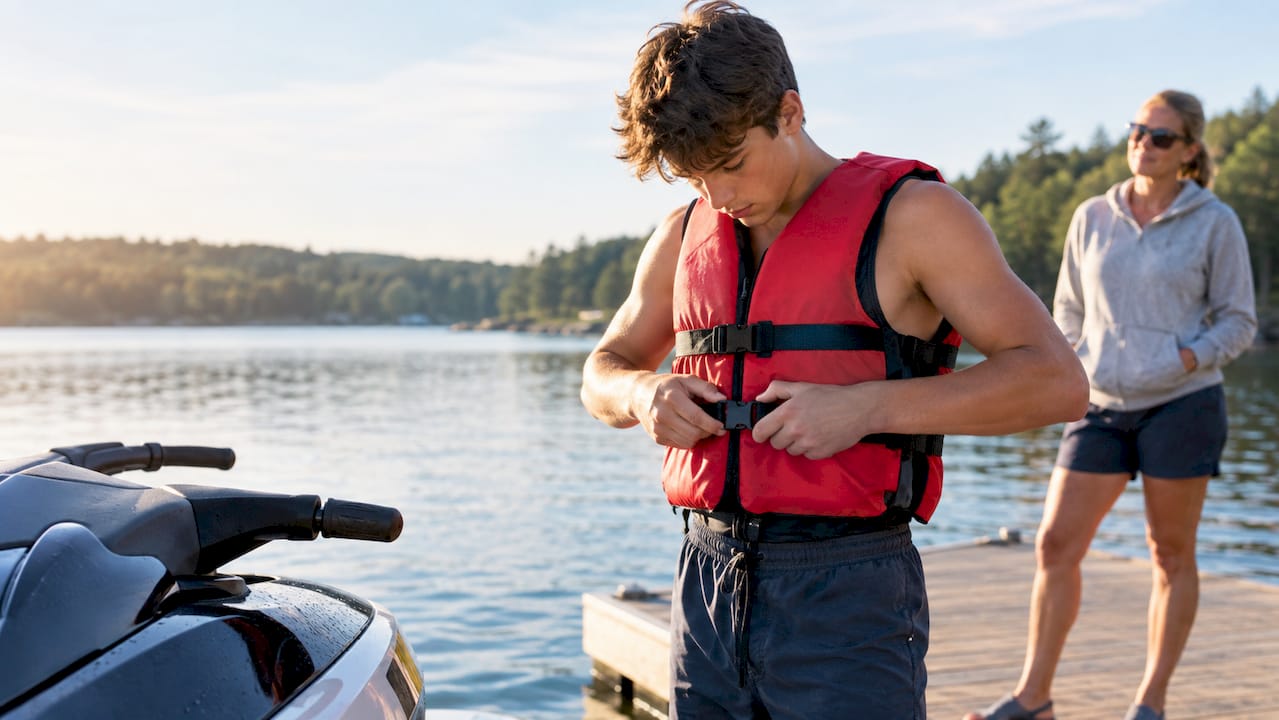
PWCs move faster, turn tighter, and throw riders more often than motorboats, which is part of why the DNR’s safety education standards treat them separately. Every rider should also wear a Coast Guard-approved life jacket rated for PWC use, and the engine cutoff lanyard should stay attached at all times.
Pro Tip: If your teen splits time between a family boat and a rented Jet Ski, get the certificate before summer starts. It covers both vessel types, so you’re not scrambling for a rental-specific workaround later.
Who Actually Needs a Wisconsin Boating Safety Certificate?
The birthdate rule is the piece most parents miss. It’s not tied to when your child starts boating. It’s tied to when they were born.
Anyone born on or after January 1, 1989 must have a valid certificate once they reach the operating age for their vessel type. Boaters born before that date are grandfathered in and don’t need one, though the DNR still recommends the course since equipment rules and navigation standards keep changing.
A few things simplify this once you understand them:
- The certificate is generally a one-time credential. Earn it once, and it’s valid for life, with no annual renewal.
- Wisconsin honors equivalent certificates from other states and from NASBLA-approved courses taken elsewhere, so a family relocating from another state usually doesn’t need to start over.
- Operator certification and vessel registration are two separate obligations. One certifies the person; the other registers the boat itself. You need both, but they’re issued and checked differently, as Safeboatingamerica’s breakdown of boat requirements lays out.
Renting a Boat or PWC: Temporary Certificate Rules
Rental counters can’t just hand the keys to anyone. Wisconsin administrative code caps temporary boating education certificates at renters age 16 and older, full stop.
- Confirm the renter’s age. Only people 16 or older qualify for a temporary certificate at the rental counter.
- Know the age 10–15 gap. Minors in this range are not eligible for temporary certificates, regardless of supervision plans, so they cannot be the primary renter.
- Check validity limits. Temporary certificates typically apply only to that specific rental period and vessel, unlike a full certificate that carries no expiration.
Families renting a pontoon or Jet Ski for a lake weekend should plan around this ahead of time, not at the dock.
How to Get a Wisconsin Boating Safety Certificate
Getting certified follows three straightforward steps, and most people finish in a single sitting.
- Step 1: Check your status. If you were born on or after January 1, 1989, and you’re old enough to operate your intended vessel, you need a certificate before you go out alone.
- Step 2: Pick a DNR-approved course. Wisconsin accepts courses from state-approved providers delivering NASBLA-consistent curriculum, covering navigation rules, required safety equipment, and emergency procedures. Safeboatingamerica offers Wisconsin-approved courses online, live via Zoom, or in-person, so scheduling around work or school isn’t a barrier.
- Step 3: Pass the exam and get your card. Completion issues your certificate along with a DNR customer number, which you can manage through GoWild, the state’s official account system.
Courses are commonly written to a level accessible for younger learners, which is part of why families with a 12- or 15-year-old often knock it out early, well before the child reaches unsupervised operating age.
Enforcement: Carrying Your Card and Avoiding Fines
Wardens most often ask for the operator’s certificate when a minor is at the helm or during rental inspections. Carrying a printed or digital copy with your DNR customer number handy speeds things up considerably.
- Keep your certificate on the boat, not just at home in a drawer.
- Failing to carry proof when required can result in a citation, separate from any registration issue.
- Remember that vessel registration and operator certification are enforced independently. A properly registered boat doesn’t excuse an uncertified operator, and vice versa.
Pro Tip: Take a photo of your certificate and store it in your phone’s photo album offline. Cell service on the water is unreliable, and a saved image beats a cloud file you can’t load.
Why Safeboatingamerica Recommends Getting Certified Early
Rules shift, boats get faster, and waiting until a birthday forces the issue rarely goes well. Courses are available for every U.S. state, including Wisconsin, to provide flexible timing rather than a scramble before a lake trip. Certifying a 12-year-old this spring, well ahead of when unsupervised operation becomes legally relevant, avoids the mid-summer rush entirely. The earlier a young operator understands right-of-way, required equipment, and emergency response, the less that knowledge depends on an adult being physically present in the boat.
— Richard
Get Your Wisconsin Boating Certificate Without the Hassle
Certification can be obtained faster than a single in-person class date allows, because you can choose online, live Zoom, or in-person format on your own schedule instead of waiting for one local session to open up.
Sign up, complete the state-approved coursework, and pass the final exam. You’ll receive your official certificate along with your DNR customer number, and most students finish the entire process in one sitting. That card then works for motorboats and PWCs alike, satisfying Wisconsin’s certificate requirement for life. If your family has a mix of ages, from a 12-year-old itching to run the Jet Ski to a teenager about to take the boat out solo, get everyone squared away before the season fills up. Start your Wisconsin boating safety course today and get it handled before the first weekend on the water.
This article is general information, not a substitute for advice from a qualified lawyer. Consult a qualified legal professional about your own circumstances before acting on anything here.
Sources
- What you should know before you operate your boat | Wisconsin DNR
- Wisconsin statutes 30.678 — Boating safety certificates; requirements; exemptions; operation by minors
FAQ
Can a 14-year-old drive a boat in Wisconsin?
Yes, someone aged 12 to 15 can operate a motorboat if accompanied by a qualifying adult or if they hold a valid boating safety certificate. Without either, they cannot legally operate one alone.
Can a 12-year-old operate a PWC in Wisconsin?
Yes, but only if they hold a valid boating safety certificate; Wisconsin sets 12 as the strict minimum age for PWC operation, with no supervised exception below that. Without a certificate, a 12 to 15 year old still needs a qualifying adult aboard.
Can I drink a beer while driving a boat in Wisconsin?
Wisconsin’s boating-while-intoxicated laws mirror its drunk-driving laws, and operating impaired carries real legal risk regardless of how much was consumed. Anyone operating a boat should treat alcohol limits on the water the same way they would behind the wheel of a car.
Does everyone need a boater’s license in Wisconsin?
No. Only operators born on or after January 1, 1989 are required to hold a boating safety certificate, though the DNR encourages all boaters to take a course regardless of birthdate.
Is the Wisconsin boating certificate a one-time requirement?
Yes, the certificate is generally valid for life once earned, with no annual renewal needed, unlike vessel registration, which is a separate, ongoing obligation.