Born After Jan 1, 1984? Louisiana Boating Age Rules and Who Is Exempt
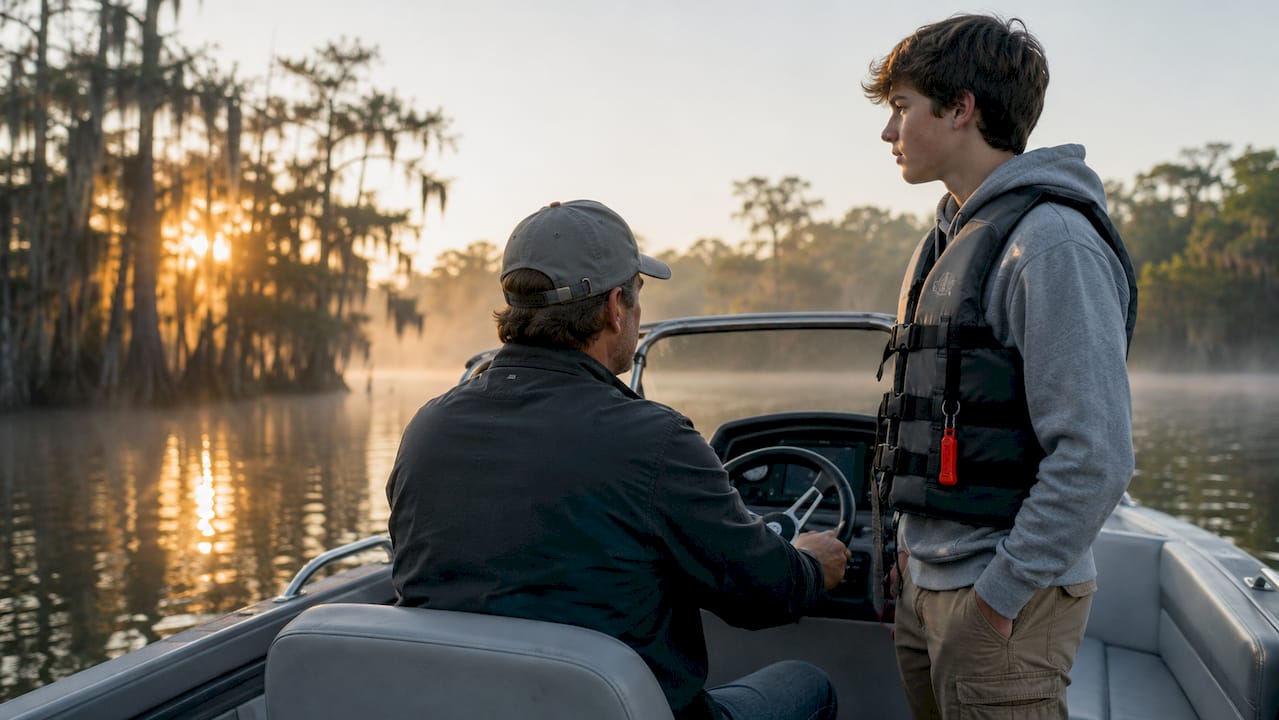
Anyone born after January 1, 1984, must complete an approved boater education course before operating a motorboat over 10 horsepower in Louisiana. Personal watercraft operators face a stricter, absolute rule: you must be at least 16, with no supervision exception. Children under 10 can take the course but cannot be certified until they turn 10.
TL;DR:
- Anyone born after January 1, 1984, must carry proof of boater education to operate a motorboat over 10 horsepower in Louisiana.
- Personal watercraft operators must be at least 16 years old with no supervision exception, and rental companies strictly enforce this rule.
- Children under 10 can take the course but cannot be certified until they turn 10, and retaking the course is necessary at that age for certification.
- Proof of boater education must be carried on the water, with a driver’s license endorsement providing a convenient form of evidence.
- Louisiana’s rules are clear-cut; confusion often arises from assumptions about out-of-state or rental policies rather than the law itself.
Table of Contents
- Louisiana Boating License Age Requirements: The Birth-Date Rule
- Why the PWC Minimum Age of 16 Has No Exceptions
- What Age Can You Take the Boater Safety Course?
- How to Get Your Louisiana Boater Education Certificate
- Who’s Exempt: Coast Guard Captains, Supervision, and Rental Rules
- Carrying Proof and What Happens If You Don’t
- Boat Registration and Titling: A Separate Requirement
- How Safe Boating America Helps You Meet Louisiana’s Requirements
- The Age Rules Are Simple. The Confusion Comes From Elsewhere.
- Sources
- FAQ
Louisiana Boating License Age Requirements: The Birth-Date Rule
Louisiana doesn’t set a flat minimum age for boating the way some states do. Instead, state law ties the requirement to a birth date: anyone born after January 1, 1984, must complete boater education before legally operating a motorboat with more than 10 horsepower. If you were born on or before that date, you’re grandfathered in and don’t need the certificate, even though the boat itself is identical.
This birth-date rule catches a lot of people off guard, especially visitors. It applies to anyone operating a covered vessel in Louisiana waters, resident or not. A 40-year-old from out of state who’s never needed a boating certificate at home might still fall on the wrong side of the cutoff here.
A few practical points worth knowing about how the rule actually works on the water:
- The requirement is tied to engine horsepower over 10, not boat size or type.
- You must have evidence of course completion in your possession while operating a qualifying motorboat.
- Kayaks, canoes, and other non-motorized craft fall outside this requirement entirely.
- The rule follows the operator, not the boat, so anyone driving needs their own proof.
Why the PWC Minimum Age of 16 Has No Exceptions
Personal watercraft operators face the strictest age rule on Louisiana’s books. State regulations require operators to be at least 16, period. There’s no supervised-minor carve-out, no parental sign-off, and no way around it.
That’s a meaningful departure from the motorboat rule, where an adult who’s completed the course can sometimes accompany a younger operator. PWCs get no such flexibility.
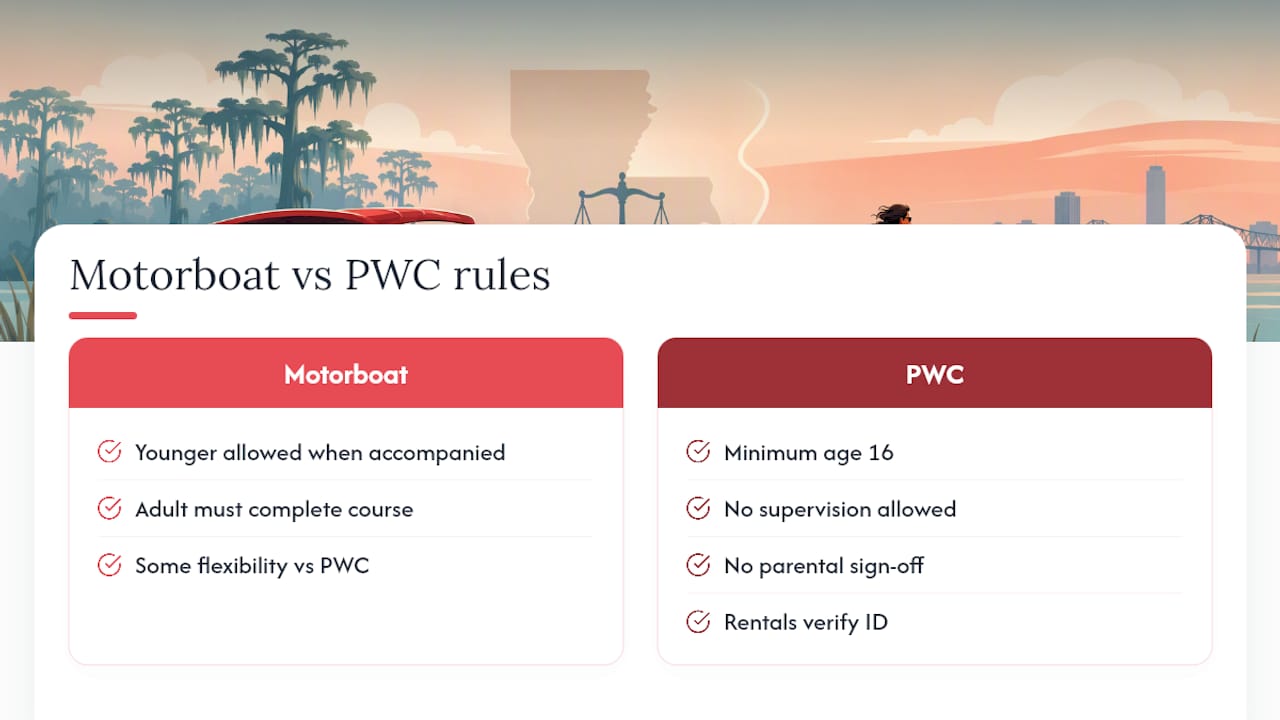
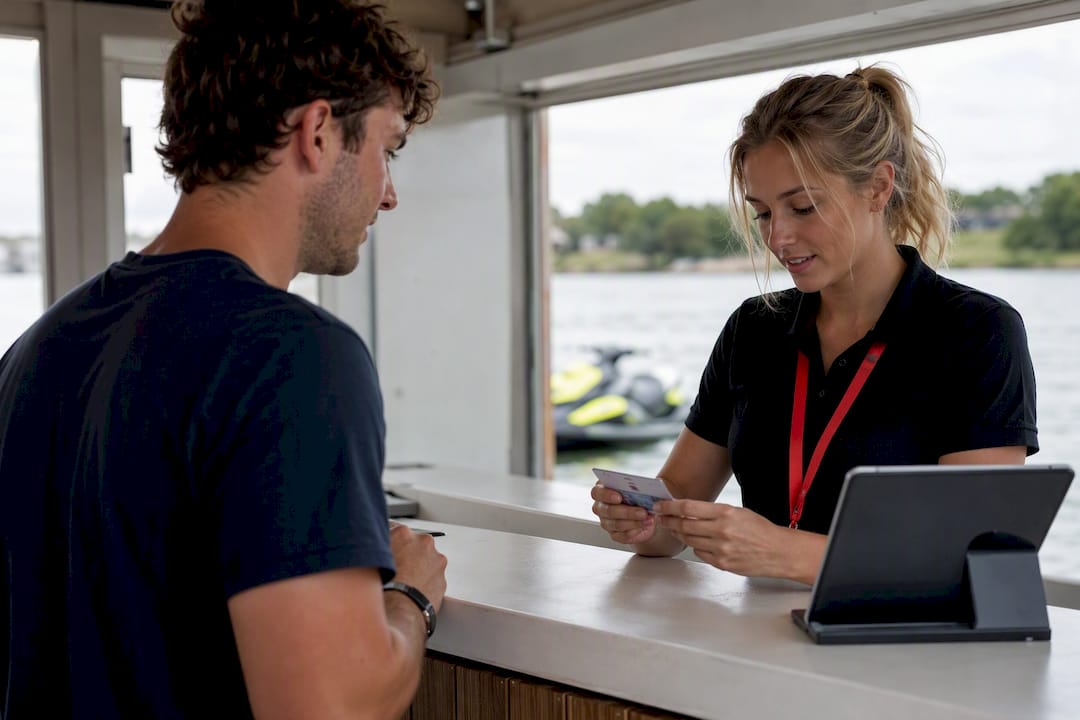
16 is the floor for PWC operation in Louisiana, full stop. Owners and rental companies who knowingly let someone under 16 operate a Jet Ski or WaveRunner are violating state law themselves. That’s why reputable rental counters ask for ID before handing over the keys. If you’re a parent hoping your 14-year-old can run the family PWC solo, Louisiana law says no, regardless of how experienced they are. Our Jet Ski license guide for minors covers this in more detail if you’re planning a family outing.
What Age Can You Take the Boater Safety Course?
Louisiana lets younger kids get a head start on the classroom material, even if they can’t legally operate a boat yet. LDWF guidance allows children younger than 10 to take an approved course, but they aren’t eligible for certification until they actually turn 10.
That distinction trips people up. Completing the course early doesn’t lock in a certificate. Here’s how it plays out:
- Kids under 10 can enroll and finish the coursework, but LDWF won’t issue certification yet.
- Once the child turns 10, they need to retake the course to receive an actual certificate.
- Approved providers commonly set their own enrollment minimum around age 10, though some let younger students preview the material.
- Always confirm a course carries current NASBLA approval before enrolling a child, since not every online course meets that bar.
If you’re planning ahead for a young boater in the family, it’s usually smarter to wait until they hit 10 rather than pay for a course they’ll need to repeat.
How to Get Your Louisiana Boater Education Certificate
Getting certified is straightforward once you know the sequence. Here’s the path most first-time applicants follow:
- Check your birth date and your boat. Confirm whether you were born after January 1, 1984, and whether your vessel’s engine exceeds 10 horsepower. That combination triggers the requirement.
- Pick an approved course. Look for NASBLA-approved programs accepted by LDWF, available online, via live Zoom class, or in person.
- Complete and pass the course. Most online providers issue a printable temporary certificate immediately after you pass, with a permanent card following by mail.
- Carry proof or add the endorsement. You can carry the physical certificate on the water, or add a free boater education endorsement to your driver’s license at the Office of Motor Vehicles.
Pro Tip: Confirm the course provider’s LDWF and NASBLA approval status before you pay. A quick check saves you from finishing a course that doesn’t actually satisfy the state requirement.
Who’s Exempt: Coast Guard Captains, Supervision, and Rental Rules
Not everyone needs to sit through a course. Louisiana’s statute carves out several specific exemptions, and understanding them keeps you from either over-complying or assuming you’re covered when you’re not.
- U.S. Coast Guard licensed captains operating within their license scope are exempt from the boater education requirement.
- A person subject to the requirement can still operate a motorboat if accompanied by someone 18 or older who has completed the course.
- Rental-livery businesses can let qualified adult renters operate a rented motorboat for up to 48 hours after watching a required safety video, without a lifetime card.
- None of these exemptions extend to personal watercraft; the 16-and-over PWC rule has no rental or supervision workaround.
The 48-hour rental exception is convenient for vacationers who want to take out a pontoon boat for a weekend, but it’s not a substitute for certification if you plan to own or regularly operate a motorboat.
Carrying Proof and What Happens If You Don’t
Louisiana expects you to have your boater education proof on you, not just on file somewhere. Operating a qualifying motorboat without evidence of completion can get you cited even if you actually completed a course years ago and just left the card at home.
The driver’s license endorsement solves that problem neatly. Once added at the OMV, it functions as your proof, and most enforcement checks accept it as primary documentation.
Consequences for skipping the rule aren’t limited to a citation:
- Operators cited for lacking required proof face fines under state boating law.
- Rental companies that knowingly rent a PWC to someone under 16, or let an uncertified operator run a motorboat, can face their own liability exposure.
- Repeated or serious violations can affect a renter’s ability to book with that company again.
Boat Registration and Titling: A Separate Requirement
Boater education covers who can legally operate a boat. Registration and titling cover the boat itself, and Louisiana treats them as distinct obligations.
- LDWF handles registration and titling for motorized vessels and certain non-motorized houseboats.
- Registrations run on a three-year cycle before renewal is required.
- Homemade boats, boats with mismatched hull identification numbers, or those coming from out of state sometimes need an inspection before titling.
If you just bought a used boat locally or from another state, check registration status before you check certification status. Our boat requirements overview walks through equipment and paperwork you’ll want in order either way.
How Safe Boating America Helps You Meet Louisiana’s Requirements
Once you know which age rule applies to you, the next step is picking a course that actually counts. There are NASBLA-based, state-approved courses available in online, live Zoom, and in-person formats, built to satisfy Louisiana’s boater education requirement for anyone born after January 1, 1984.
- Students receive an official certificate on completion, which you can carry on the water or use as the basis for a driver’s license endorsement at the OMV.
- Course formats fit different schedules and comfort levels, whether you prefer self-paced online modules or live instruction.
- Verifying a course’s approval status before you register avoids wasted time and money on a program Louisiana won’t accept.
| What you get | Why it matters |
|---|---|
| NASBLA-based curriculum | Meets the standard LDWF references for approved courses |
| Multiple formats (online, Zoom, in-person) | Fits work schedules, family logistics, and different learning styles |
| Official certificate on completion | Serves as your carry-proof or basis for a license endorsement |
Explore Safe Boating America’s course options to find a format that matches your schedule and get certified before your next trip on the water.
The Age Rules Are Simple. The Confusion Comes From Elsewhere.
Louisiana’s boating age framework is actually one of the more straightforward setups among coastal and gulf states. A birth-date cutoff for motorboats, a hard 16-year floor for PWCs, no ambiguity about who’s exempt. The confusion people run into isn’t the law itself. It’s assuming their home state’s rules travel with them, or assuming a rental company’s policy reflects the actual statute rather than the company’s own liability comfort.
The conventional advice, “check if you need a boating license,” undersells the real risk. The bigger exposure is the PWC rule, because it has zero flexibility built in. Parents who’d never let an unlicensed teen drive a car sometimes hand over Jet Ski keys to a 14-year-old on a family trip, assuming supervision covers it. It doesn’t, and the rental company handing over that PWC is breaking the law right alongside the family that asked for it.
If you take one thing from this, prioritize the PWC rule over the motorboat birth-date rule. The horsepower threshold has workarounds and exemptions. The PWC age floor has none.
— Richard
Sources
- Mandatory Boater Education | Louisiana Department of Wildlife and Fisheries
- Louisiana Laws - Boater education statute
FAQ
What Age Do You Need to Get a Louisiana Boating License?
Anyone born after January 1, 1984, must complete a boater education course to operate a motorboat over 10 horsepower, while personal watercraft operators must be at least 16 with no exceptions.
Can a 13-Year-Old Operate a Boat in Louisiana?
Anyone under 16 can operate a motorboat over 10 horsepower only if accompanied by someone 18 or older who has completed boater education, but they cannot legally operate a personal watercraft under any circumstances until age 16.
Is There a Free Way to Get a Boating License in Louisiana?
Adding the boater education endorsement to your driver’s license is free at the Office of Motor Vehicles once you’ve completed an approved course, though the course itself typically carries a fee from the provider.
What Are the Requirements for Getting a Louisiana Boater’s License?
You need to complete a NASBLA-approved, LDWF-accepted boater education course, pass it, and carry proof of completion (or the license endorsement) while operating a qualifying motorboat over 10 horsepower.
Do You Need a Boating License to Operate a Kayak or Canoe in Louisiana?
No. Louisiana’s boater education requirement applies to motorboats over 10 horsepower and personal watercraft; non-motorized craft like kayaks and canoes fall outside the requirement entirely.