VHF Radio Etiquette: Rules, Channels and Call Scripts

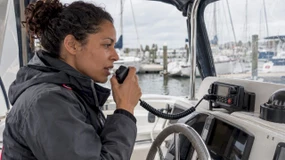
Good VHF etiquette comes down to five habits. Listen before you transmit. Hail on the right channel. Move to a working channel as soon as the other station answers. Keep calls short and in plain English. Keep Channel 16 free for distress, safety and hailing. This guide covers each habit with the scripts and rules behind it, based on FCC and U.S. Coast Guard guidance.
TL;DR
- Listen first, then hail. Channel 16 is for calling and distress only; after contact, switch to a working channel.
- Call a station by name three times, say “this is” and your vessel name, then “over.” Limit each call to 30 seconds.
- Keep the radio on and tuned to Channel 16 while underway, and use low power for nearby stations.
- Mayday means grave and imminent danger. Pan-Pan means urgency without immediate danger to life or vessel.
- VHF is never private. Anyone with a radio in range can hear every transmission.
Table of Contents
- Why VHF etiquette matters
- Keep a watch on Channel 16
- Which channel for what
- How to operate the radio
- How to hail another vessel
- Words and habits that keep a channel clean
- Can you have a private conversation on VHF?
- Mayday, Pan-Pan and Sécurité
- Perspective: what we see in the classroom
- Handheld, fixed-mount, and what about CB?
- Learn it in a boating safety course
- Pre-departure radio checklist
- FAQ
- Sources
Why VHF etiquette matters
A marine VHF radio is a shared party line. Every transmission on a channel reaches every radio in range, and Channel 16 is the channel the Coast Guard and other boaters watch for distress calls. A long chat on that channel can block someone who needs help.
Etiquette on the water is also regulation. The FCC’s ship-radio rules cover the basics: listen first, identify your station in English at the beginning and end of each message, change channels right after contact, and never send false distress messages or obscene, indecent or profane language. General calls on Channel 16 are not allowed except in an emergency or when testing the radio, according to the FCC’s ship radio station operations guidance.

Most of what follows is simple discipline. The rest of this article covers the channels, the call scripts and the situations where boaters most often go wrong.
Keep a watch on Channel 16
The Coast Guard says any vessel with a VHF marine radiotelephone, whether carried voluntarily or required, generally must maintain a Channel 16 watch whenever the radio is not being used to communicate, per its radio watchkeeping regulations. The FCC guidance says the same in practice: a boat underway should keep its VHF on and tuned to Channel 16 except when transmitting.
In practice:
- Turn the radio on before you leave the dock.
- Set it to Channel 16 (or dual watch if your radio has it) and set the volume so you can hear it over engine noise.
- Leave it on while underway, even on a short trip.
Larger and commercial vessels carry an additional Channel 13 watch requirement in U.S. waters. The Coast Guard notes that a scanner alone does not meet it, because two receivers or two radios are required.
Which channel for what
A short channel guide prevents most etiquette mistakes. The Coast Guard Navigation Center’s U.S. VHF channel information sets out the following uses.
| Channel | Use | Etiquette note |
|---|---|---|
| 16 | Calling or distress alerting | Hail, then move. No chatting. |
| 9 | Boater calling (156.450 MHz), commercial and noncommercial | Alternative hailing channel for recreational boaters |
| 13 | Contacting a ship when collision is a danger | Bridge-to-bridge safety; keep it brief |
| 22A | Coast Guard liaison and maritime-safety broadcasts announced on Channel 16 | Not for radio checks or routine calls |
Working channels for routine conversation vary by area, and the exact list is on the Coast Guard page. Our own marine VHF frequencies channel chart lays out the full list for reference.
A 2025 Coast Guard district notice repeats the core rules: Channel 16 is limited to distress, safety and hailing, routine calls must not be made while distress traffic is in progress, and users must shift to a working frequency once contact is established. It also states that radio checks are not authorized on Channel 16 or Channel 22A. The notice is posted as a Special Local Notice to Mariners.
How to operate the radio
Operating a marine VHF takes about a minute to learn. The Connecticut Department of Energy and Environmental Protection’s marine VHF basics give this sequence:
- Turn the radio on and select the channel.
- Listen before you transmit.
- Set the squelch as low as possible without static. Turn it up until the static stops, then no further.
- Press the microphone button to transmit and speak in a normal voice.
- Release the button to listen for the reply.
Keep the language plain. Use English, keep the conversation short and to the point, and use low power for nearby stations. The FCC guidance suggests starting with 1 watt when the station you are calling is within a few miles, increasing power only if necessary. Lower power keeps your transmission from blocking other users far away.
How to hail another vessel
A routine hail has a fixed shape. Using the Connecticut guidance:
- Listen first and make sure the channel is clear.
- Call the station’s name three times.
- Say “this is,” then your vessel name.
- Say “over.”
A hail looks like this:
“Sea Breeze, Sea Breeze, Sea Breeze, this is Blue Heron. Over.”
When the other station answers, agree on a working channel, switch to it, and repeat the hail there before you start the conversation. On the working channel:
“Sea Breeze, this is Blue Heron. Over.”
The FCC says to call another ship on Channel 16, or on a ship-to-ship channel only when you know the other ship is monitoring that channel and Channel 16 at the same time. Channel 9 is the alternative boater calling channel the Coast Guard identifies.
How long and how often to call
The FCC sets timing limits:
- A call to the same station should last no more than 30 seconds.
- If nobody answers, wait at least two minutes before calling again.
- After three calling periods, wait at least 15 minutes.
These limits keep a quiet or busy channel from being tied up by one persistent caller.
Identify yourself
Under the FCC rules, you identify your station in English at the beginning and end of each message. In everyday boating, that means naming your vessel when you hail and again when you sign off.
Words and habits that keep a channel clean
Most etiquette problems are small habits. The list below follows the rules above and the practice you hear on a well-run channel.
- Listen before you key the mic. Two boats talking over each other helps no one.
- Keep it short. State your business, get the answer, sign off.
- Leave Channel 16 after contact. Even a friendly chat belongs on a working channel.
- Skip radio checks on 16 and 22A. They are not authorized there. Ask a nearby boat on a working channel, or use a radio-check service where one exists.
- Do not say “over and out.” The two words contradict each other: “over” means you expect a reply, “out” means you do not. Use “over” when you expect an answer and “out” when the exchange is finished.
- Clean language only. The FCC prohibits obscene, indecent or profane messages.
- Never make a false distress call. It is prohibited, and it pulls rescue assets away from real emergencies.
Passengers should know the ground rules too. If you take guests aboard, brief them before they touch the microphone; a guide to guest conduct during sailing events shows how much smoother a trip runs when everyone knows their role.
Can you have a private conversation on VHF?
No. VHF marine radio transmissions are not private. Connecticut’s boating guide says everything transmitted can be heard by anyone with a VHF radio. A working channel is the right place for routine conversation, but treat it as public. Do not discuss anything you would not want a marina, another boat or the Coast Guard to hear. For truly private conversation, use a phone.
Mayday, Pan-Pan and Sécurité
Three urgency words set the priority of a call.
| Word | Meaning | Use |
|---|---|---|
| Mayday | Grave and imminent danger to life or vessel | Sinking, fire, a person overboard in danger, serious medical emergency |
| Pan-Pan (pronounced “pahn-pahn”) | Urgent situation, not an immediate threat to life or vessel | Disabled engine with no immediate danger, a lost or stranded person, a medical problem that is not life threatening |
| Sécurité | Safety message | Navigation hazard, weather warning |
If you are unsure whether a situation is a Mayday or a Pan-Pan and lives are at risk, call Mayday. A Mayday has priority over every other call.
Making a Mayday call
A distress call should begin on Channel 16 unless you know that shore stations and ships are outside VHF range, according to the Coast Guard’s radio information for boaters. Speak slowly, clearly and calmly. The Coast Guard format is:
- “Mayday, Mayday, Mayday.”
- “This is” and your vessel name three times, plus your call sign or registration number.
- “Mayday,” and your vessel name once more.
- Your position and movement.
- The nature of distress.
- The assistance you need.
- The number of people aboard.
- Other useful rescue details.
- “Over.”
An example:
“Mayday, Mayday, Mayday. This is Blue Heron, Blue Heron, Blue Heron, registration NY 1234 AB. Mayday, Blue Heron. Position: two miles south of the inlet, drifting east. We are taking on water. Need immediate assistance. Four people aboard, all wearing life jackets. White 24-foot center console. Over.”
The registration number in that example is invented, as is the vessel. Use your own.
If nobody answers
The Coast Guard’s emergency radio procedures sheet says to repeat the Mayday if there is no response, then transmit your location twice, the nature of distress, the people and injuries aboard, the vessel’s condition and description, lifesaving equipment, the channel you are listening on and your vessel identification.
The Coast Guard’s boater guide adds these points:
- If no one responds, tune an HF radio to an HF channel guarded by the Coast Guard and repeat the Mayday, if you have one.
- Activate your EPIRB.
- Remain by the radio if possible. Continued transmissions can help rescuers home in on the vessel.
If you hear a distress call
If you hear a distress call that nobody acknowledges, answer it. If you are reasonably sure the vessel is not near you, wait briefly for others to acknowledge first. Stay off the channel for routine traffic while distress traffic is in progress.
The red DSC button
Many fixed-mount radios have a Digital Selective Calling button. According to a Coast Guard article on Digital Selective Calling, pressing it sends a digital distress alert to vessels and coast stations in range, but only if the radio is programmed with a Maritime Mobile Service Identity (MMSI) number and has GPS input. Check both before you rely on it.
Perspective: what we see in the classroom
We teach boating safety certification, and radio questions come up in every class. Students do not usually ask about the rules first. They ask what to say. A script on paper helps more than a reminder to “use the radio properly.”
Three patterns repeat among new boaters:
- They treat Channel 16 like a phone line and stay on it after contact.
- They use “over and out” together, or skip identifying the vessel.
- They never practice a Mayday until the day they need one.
Our advice is to write the Mayday format on a waterproof card and stick it near the helm. Put the vessel name, registration number and a plain description of the boat on it. In an emergency, stress strips out memory, and a card does not forget. Rehearse the hail with your crew once, at the dock, with the radio off.
Radio use is one piece of a wider habit of preparation. Our guides on avoiding a collision with another boat, right-of-way rules and launch checks that prevent accidents cover the rest.
— Richard
Handheld, fixed-mount, and what about CB?
A fixed-mount VHF with a masthead antenna reaches farther than a handheld, because antenna height drives range. A handheld works as a backup and for small boats, with a shorter reach. Whichever you carry, the same etiquette applies.
Some boaters ask about CB instead. CB is not a replacement for marine VHF, because the Coast Guard and other vessels monitor VHF channels. Our guide to marine CB radio options explains where each fits.
Learn it in a boating safety course
Radio procedure is part of what a state-approved boating safety course covers, alongside right-of-way, navigation rules and equipment. If you need a certificate to operate legally in your state, we offer several ways to complete it:
- The NYS Safe Boating Class is $85 one-off.
- The Zoom Online 1-Day Class is $75 one-off.
- Online boating safety courses are available for other states.
- Gift certificates are available for a new boater in your life.
Our instructors are state certified and USCG-licensed, and students who complete an approved course receive their official boating safety certificate. Check your own state’s requirements first, since they differ by state and boat type. Our boat requirements overview is a good place to start.
Pre-departure radio checklist
Before you cast off:
- Radio on, volume up, Channel 16 selected.
- Squelch set just past the static.
- Power on low for nearby calls.
- Vessel name, registration number and position description written near the helm.
- Crew knows where the distress button and microphone are.
- DSC radio has an MMSI programmed and a GPS connection.
- EPIRB registered and accessible, if your boat carries one.
FAQ
How do you hail someone on a VHF radio?
Listen to be sure the channel is clear. Call the other station’s name three times, say “this is” and your vessel name, then “over.” When they answer, agree on a working channel, switch to it and repeat the hail there before you talk.
What is the difference between Mayday and Pan-Pan?
Mayday is for grave and imminent danger to life or vessel, such as a sinking or fire. Pan-Pan is for an urgent situation that is not an immediate threat, such as a disabled engine with no immediate danger. When in doubt and lives are at risk, use Mayday.
Can I do a radio check on Channel 16?
No. A 2025 Coast Guard notice says radio checks are not authorized on Channel 16 or Channel 22A. Use a working channel and ask a nearby boat for a signal report instead.
What do you say on a VHF radio?
Name the station you are calling three times, say “this is” and your vessel name, and say “over.” Use plain English and keep each transmission short. Identify your vessel at the start and end of each message.
Can I have a private conversation on VHF?
No. Anyone with a VHF radio in range can hear what you transmit. Use a working channel for routine conversation and keep private matters off the air.
Sources
- FCC: Ship Radio Stations Operations
- USCG Navigation Center: Radio Watchkeeping Regulations
- USCG Navigation Center: U.S. VHF Channel Information
- USCG Navigation Center: Radio Information for Boaters
- USCG Special Local Notice to Mariners, 2025
- USCG: Emergency Radio Procedures
- USCG: Digital Selective Calling article
- Connecticut DEEP: Marine VHF Radio, The Basics