Best Marine CB Radio Options for Boaters in 2026
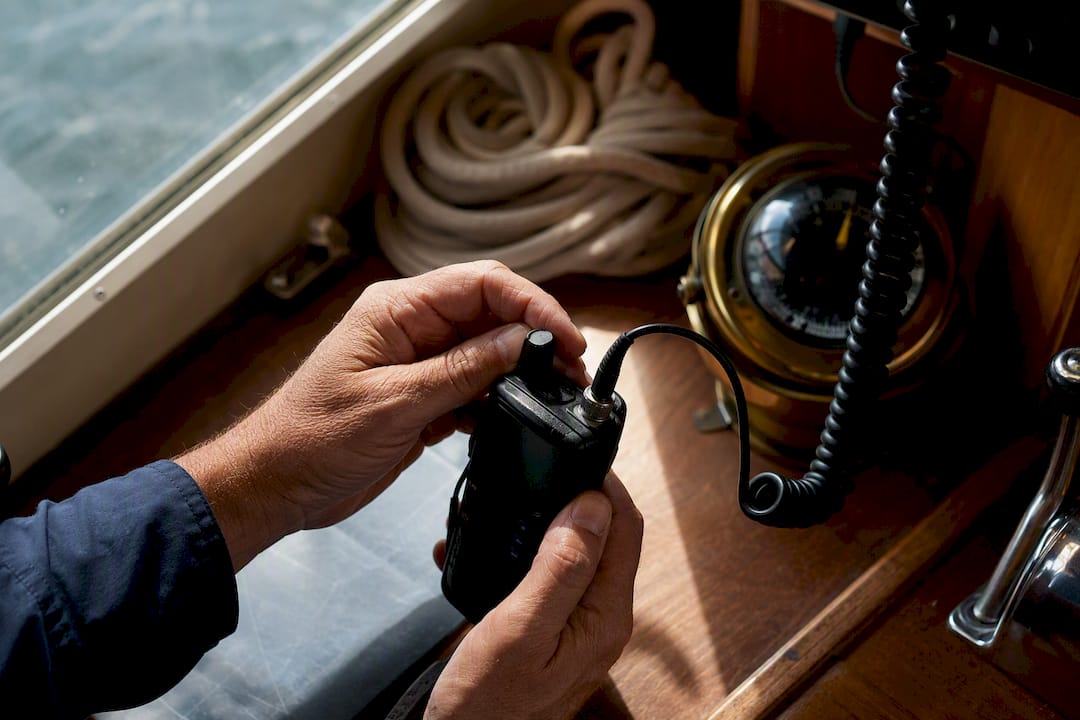
For most recreational boaters, a VHF marine radio beats a CB radio for on-water safety. Handheld VHF units suit dayboats and paddlecraft; fixed-mount 25 W VHF units suit offshore cruisers who want integration with chartplotters. The reason comes down to three features CB radios lack entirely: Digital Selective Calling (DSC), MMSI-linked distress alerts, and NOAA weather channels.
Here’s a shortlist that covers budget to premium, handheld to fixed:
- Icom M94D — built-in GPS plus AIS receive for search-and-rescue-level awareness.
- Icom IC-M510 EVO — 25 W fixed-mount with Class D DSC and NMEA 2000 integration.
- Standard Horizon HX890 — DSC-enabled handheld with strong waterproofing and battery life.
- Standard Horizon HX210 — budget handheld with NOAA weather and a dedicated Channel 16 button.
- Cobra HH350 — compact, buoyant handheld for kayakers on a tight budget.
Once you’ve bought a radio, a short certification course covering MMSI registration and distress calling rounds out the safety picture. Safeboatingamerica’s boating safety courses cover exactly that.
Key Takeaways
Choosing between a handheld and fixed-mount VHF radio comes down to matching output power, DSC/GPS features, and waterproofing to how far offshore you actually go.
| Point | Details |
|---|---|
| Skip CB radios entirely | Marine VHF radios offer DSC, MMSI distress alerts, and NOAA weather that CB radios lack. |
| Match radio type to boat use | Handhelds suit dayboats and paddlecraft; fixed 25 W units suit offshore cruisers needing chartplotter integration. |
| Prioritize DSC and GPS | These features auto-transmit your position during a distress call, cutting emergency response time. |
| Register your MMSI before relying on DSC | DSC only works fully once your boat’s MMSI number is registered through BoatUS or the FCC. |
| Pair your purchase with training | Safeboatingamerica’s certification courses cover MMSI setup, distress procedures, and radio etiquette after you buy. |
Table of Contents
- Marine CB Radio vs. VHF: Comparing the Top Models
- How Do You Choose the Right Marine Radio for Your Boat?
- What Legal Rules Apply to Marine Radios?
- What Accessories Do You Need for Installation?
- Why Training Matters as Much as Equipment
- How Were These Marine Radios Evaluated?
- Get Certified After You Buy Your Radio
- Sources
- FAQ
Marine CB Radio vs. VHF: Comparing the Top Models
The term “marine CB radio” gets searched constantly, but it’s worth clearing up before you shop: standard CB radios operate on a different frequency band than marine VHF and lack DSC, MMSI, and NOAA weather integration entirely. Every radio the U.S. Coast Guard, marine retailers, and safety instructors recommend for boats is a VHF marine radio, not a CB unit. That’s the standard you should be shopping against, whatever term brought you here.
Handhelds transmit at 1 to 6 watts and deliver line-of-sight range of roughly 3 to 5 nautical miles under typical conditions. Fixed-mount units step up to 25 watts and extend range substantially, especially with a taller antenna. Most modern handhelds now ship with DSC built in, and several higher-end models add GPS and AIS receive for tracking nearby vessel traffic.
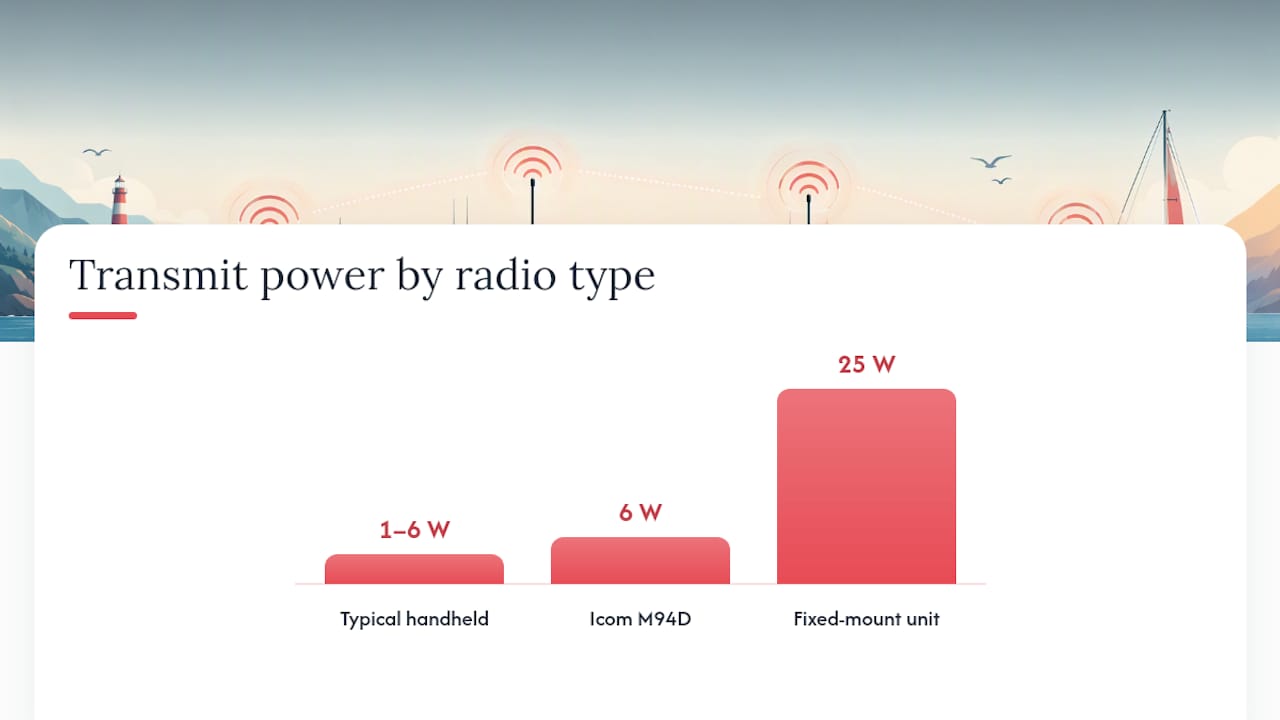
The Icom M94D sits at the premium end for a reason. It pairs AIS reception with built-in GPS and a 6 W output, backed by flash-and-float and AquaQuake speaker-clearing features that reviewers single out as genuinely useful during a man-overboard scenario.
The Icom IC-M510 EVO (also sold as the IC-M510E) is the fixed-mount pick for anyone running a chartplotter. It brings Class D DSC, integrated GNSS, optional AIS, and NMEA 2000 connectivity at 25 W, plus app control from a phone. Note that AIS and some NMEA features depend on which variant and add-on modules you buy.
The Standard Horizon HX890 delivers DSC and a large, easy-read display without the M94D’s price tag, making it the practical choice for charter operators who need reliability over bells and whistles. The HX210 strips things down further, keeping NOAA weather alerts and a dedicated distress button while dropping DSC entirely, which is why it’s priced for casual paddlers rather than offshore runs.
The Uniden Atlantis 2 earns its spot on clear audio and a float-and-strobe safety package, though some models in that line skip DSC, so check the spec sheet before buying. The Cobra HH350 is the cheapest entry here, built for kayakers who want basic buoyancy and NOAA access without paying for features they won’t use. The Cobra MR HH600W splits the difference: GPS, DSC, and Bluetooth phone-pairing at a mid-range price, plus a dedicated MOB key.
Price bands run roughly:
- Budget handheld ($60-$120): Cobra HH350, Standard Horizon HX210
- Mid-range handheld ($150-$250): Uniden Atlantis 2, Cobra MR HH600W
- Premium handheld ($300-$400): Icom M94D, Standard Horizon HX890
- Fixed 25 W units ($250-$500+): Icom IC-M510 EVO
You’ll find all of these at marine retailers like Hodges Marine, big-box marine chains, and online marketplaces. Local dealers are worth a visit if you want to handle the unit and check display readability before buying.
How Do You Choose the Right Marine Radio for Your Boat?
Start with three questions: how far offshore do you go, what kind of boat do you run, and do you want a unit wired into your electronics or one you can grab and go? A kayaker rarely needs a fixed-mount radio. An offshore cruiser running a chartplotter benefits enormously from a fixed 25 W unit with NMEA 2000 integration.
From there, run through this feature checklist before you buy:
- DSC capability with MMSI registration for one-touch distress alerts
- Built-in GPS so a distress call transmits your exact position automatically
- AIS receive if you want to see nearby vessel traffic on the radio’s display
- Output power matched to your typical range from shore or a towing service
- Waterproof rating (look for IPX7 or IPX8 on handhelds)
- Battery options, including whether it takes AA batteries in a pinch
- Display size and button layout you can operate with wet, gloved hands
- NMEA 2000 or Bluetooth connectivity if you want it talking to other electronics
Typical price ranges break down by class: budget handhelds run $60 to $120, mid-range handhelds $150 to $250, premium handhelds $300 to $400, and fixed 25 W units $250 and up depending on features.
Pro Tip: If you don’t want to deal with drilling a mounting hole or running power cable, buy a premium handheld with built-in GPS and DSC instead of a fixed unit. You get nearly the same safety features without any installation.
What Legal Rules Apply to Marine Radios?
Recreational boaters do not need an individual FCC license to operate a standard marine VHF radio, but installed radios must be operated according to FCC rules. That’s a meaningful difference from a business or commercial vessel, which does need licensing.
DSC only works fully once you’ve registered an MMSI number, a nine-digit ID tied to your boat that transmits automatically with a distress call. You can register a free MMSI through BoatUS if you only travel domestically, or through the FCC if you plan to cruise internationally or use SSB.
If you ever need to send a real distress call, follow this sequence on Channel 16:
- Press and hold the DSC distress button if your radio has one (this auto-transmits your MMSI and GPS position).
- Key the mic and say “Mayday, Mayday, Mayday.”
- State your vessel name and MMSI number.
- Give your position (latitude/longitude or a landmark).
- Describe the nature of the emergency and number of people aboard.
- Release the mic and listen for a response.
Basic radio etiquette matters too: monitor Channel 16 whenever you’re underway, identify your vessel before transmitting, keep routine chatter off Channel 16, and never key the mic just to test range. The Oregon State Marine Board and other state agencies publish detailed etiquette guides worth a read before your first season.
What Accessories Do You Need for Installation?
A taller antenna generally beats a “higher gain” one for coastal cruising, since gain trades off vertical coverage for horizontal reach, which backfires when your boat rolls in chop. Handhelds ship with their antenna attached; fixed units need a dedicated whip antenna mounted as high as practical.
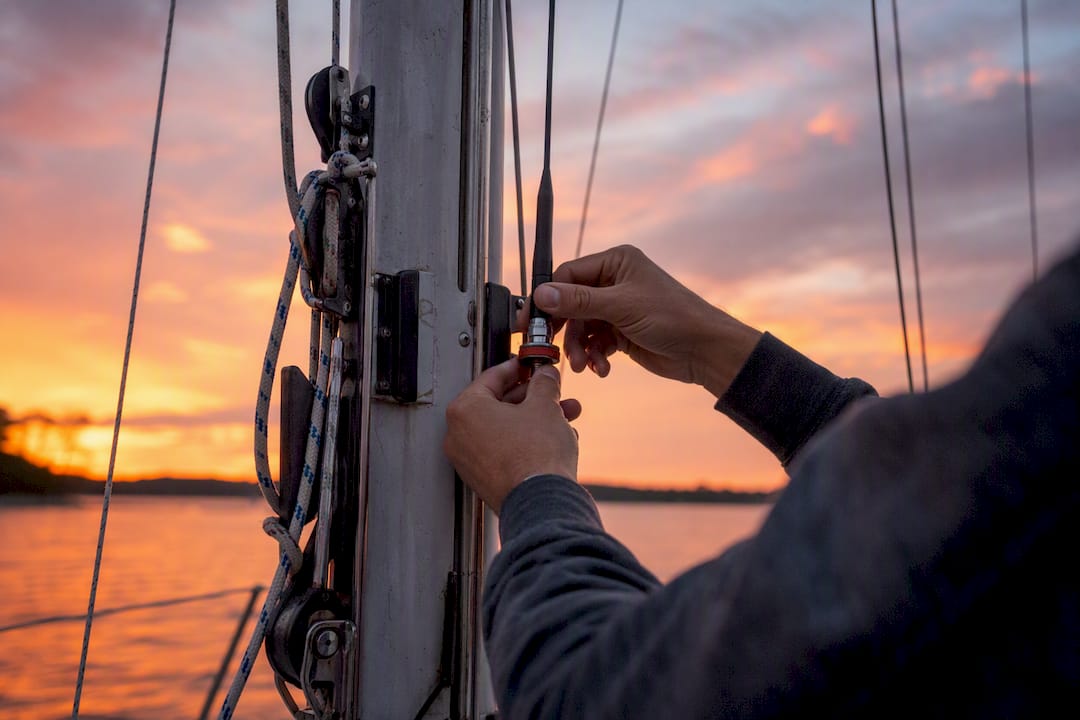
Mounting a fixed unit yourself is doable if you’re comfortable running cable and crimping connectors, but professional installation (often $150-$300) makes sense if you’re integrating with existing NMEA 2000 electronics. Budget for a fused power connection tied directly to your battery, marine-grade tinned wire, and weatherproof cable glands wherever wire passes through the hull. Review essential boating electronics before finalizing your setup.
Round out your kit with a spare handheld battery pack, a floating case if your radio doesn’t already float, and a waterproof power bank for charging on longer trips.
Pro Tip: Test your DSC and MMSI transmission during a sea trial in the harbor before you ever leave the dock. A radio that isn’t sending your position correctly is worse than no radio at all.
Why Training Matters as Much as Equipment
Buying the right radio solves half the problem. State marine boards emphasize that formal training on radio procedures, DSC setup, and distress calling matters just as much as the hardware itself.
Course formats vary by need: online self-paced classes work for boaters who just need certification on their own schedule, live Zoom classes suit people who want instructor access without travel, and in-person classes fit hands-on learners who want to practice with real equipment. A short certification class typically covers radio etiquette, MMSI/DSC setup, and the exact distress sequence outlined above, plus the broader boating safety education your state requires anyway.
How Were These Marine Radios Evaluated?
Recommendations for this guide draw on manufacturer specification sheets, published hands-on reviews from marine publications, and the practical feature checklist that certified boating safety instructors use when advising new boat owners. The evaluation weighs four categories: safety feature set (DSC, GPS, AIS, MMSI compatibility), build quality (waterproof rating, buoyancy, battery life), output power relative to stated use case, and ease of use under real conditions like wet hands or bright sunlight.
Boating Magazine’s handheld VHF review roundup tests units side by side for exactly these criteria, and its findings inform how this guide ranks handhelds against each other. Icom’s own IC-M510 EVO product documentation supplies the fixed-mount specifications cited above. Rather than inventing a proprietary scoring system, this guide cross-references what manufacturers claim against what independent marine reviewers actually found when they put these radios in the water. No single review source gets treated as gospel. The goal is a shortlist that holds up whether you’re comparing spec sheets at home or handling units at a dealer counter.
A Quick Buying Note From the Editor
Buy for your worst day, not your typical one. I’ve seen boaters pick the cheapest handheld and regret it the first time fog rolled in and DSC would have sent their position automatically instead of leaving them shouting into static.
Get Certified After You Buy Your Radio
A new radio only helps if you know how to register your MMSI, run through a distress call without fumbling, and follow basic channel etiquette. That’s exactly the gap a short course closes.
Safeboatingamerica offers state-approved boating safety certification courses in online, live Zoom, and in-person formats, taught by State Certified Instructors and USCG-Licensed Captains using NASBLA-approved materials. Courses cover radio procedures, required safety equipment, and emergency response alongside the navigation rules your state requires for certification. If you just bought a handheld or fixed-mount VHF, pairing it with a boating safety certification course means you’ll actually know how to use the DSC button when it counts. Check course schedules and enroll in the format that fits your calendar.
Sources
- FCC radio licenses — U.S. Coast Guard Navigation Center
- Handheld VHF marine radio reviews — Boating Magazine
- Handheld VHF radios — Cruising World
- Communication devices — Oregon State Marine Board
FAQ
What’s the Difference Between a CB Radio and a Marine Radio?
CB radios operate on a different frequency band with no DSC, MMSI, or NOAA weather integration, while marine VHF radios are built specifically for boat-to-boat and distress communication with those safety features built in.
Can a CB Radio Be Used as a Marine Radio?
Technically some boaters have used CB radios on the water, but they lack DSC, GPS distress transmission, and Coast Guard monitoring on Channel 16, making a marine VHF radio the safer and more practical choice for on-water communication.
Do I Need an FCC License to Use a Marine VHF Radio?
Recreational boaters generally do not need an individual FCC license to operate a standard marine VHF radio, though the radio itself must be operated according to FCC rules.
Can You Listen to Marine Radio Channels on Land?
Yes, marine VHF frequencies can be picked up on land with a marine handheld or a scanner capable of receiving those frequencies, though transmitting from land without a vessel isn’t the intended use.
How Do I Register My MMSI Number?
You can register a free MMSI number through BoatUS for domestic use, or through the FCC if you plan to travel internationally or use SSB equipment, and doing so is what makes your radio’s DSC distress button functional.
Where Can I Get Certified to Use a Marine Radio Properly?
Safeboatingamerica offers state-approved boating safety courses covering radio etiquette, MMSI/DSC setup, and distress procedures in online, live Zoom, and in-person formats.
Recommended
- Marine VHF Frequencies: The Complete Channel Chart - Safe Boating America
- Best Marine Insurance Companies for U.S. Boat Owners - Safe Boating America
- Ship Horns: Types, Signals, and Top Models for 2026 - Safe Boating America
- Top Boat Manufacturers: 2026 Buyer’s Guide by Category - Safe Boating America