USCG License Explained: What Recreational Boaters Need
Most recreational boaters do not need a USCG license. The term “USCG license” almost always refers to the Merchant Mariner Credential (MMC), a professional commercial credential issued by the National Maritime Center (NMC). If you operate a boat for personal use, what you actually need is a state-approved boating safety certificate. The immediate next step: check your state’s requirements, confirm whether a NASBLA-recognized course satisfies them, and enroll. Safeboatingamerica offers state-approved courses nationwide, including PWC and Jet Ski modules, with same-day certification available in many states.
Table of Contents
- USCG license vs. state boating certificate: which one applies to you?
- When do you actually need a USCG Merchant Mariner Credential?
- How to get the state-approved boating certificate most recreational boaters need
- PWC and Jet Ski rules: what varies by state and what to check before you ride
- If you need a USCG MMC: application essentials
- How to pick a state-approved boating safety course before you enroll
- How Safeboatingamerica’s state-approved courses meet these requirements
- Key Takeaways
- What boating instructors see go wrong most often
- Safeboatingamerica: state-approved boating courses, ready when you are
- Useful sources
- FAQ
USCG license vs. state boating certificate: which one applies to you?
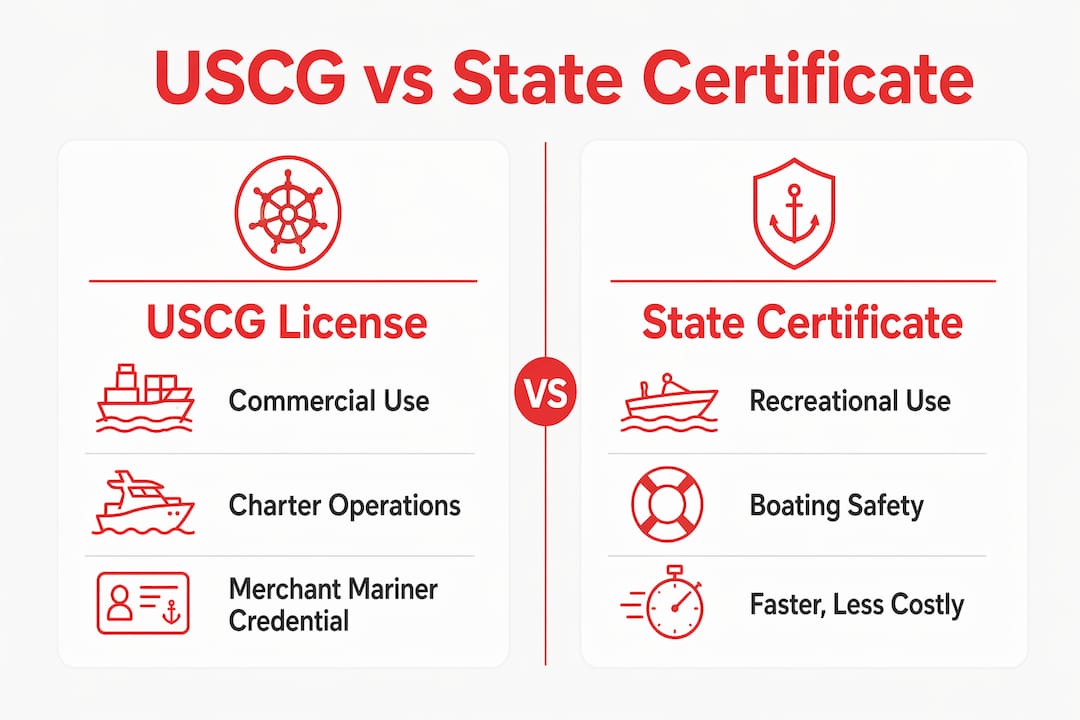
The two credentials serve entirely different purposes.
USCG Merchant Mariner Credential (MMC)
- Issued by the NMC under the Office of Merchant Mariner Credentialing (CG-MMC)
- Required for commercial maritime work: paid passenger transport, cargo operations, inspected vessels
- Requires forms CG-719B, CG-719C/S, CG-719P, CG-719K, and a TWIC (Transportation Worker Identification Credential)
- Governed by 46 U.S. Code and federal maritime regulations
State boating safety certificate (boater card)
- Issued after completing a NASBLA-approved boating safety course
- Required for recreational boat and PWC operation in most states
- Rules on age, ID, and PWC endorsements vary by state
- No federal application forms or TWIC required
Quick decision rule: Personal or recreational use → state certificate. Paid work, charter operations, or credentialed crew service on an inspected vessel → MMC.
When do you actually need a USCG Merchant Mariner Credential?
An MMC is mandatory in specific, well-defined situations. Verify your scenario against this checklist before spending time on documentation.
- Commercial passenger transport: Operating a vessel carrying paying passengers (e.g., charter fishing, water taxi, tour boat)
- Inspected vessel crew: Serving as crew on a USCG-inspected vessel, regardless of route
- Tonnage and route thresholds: Credentials like OUPV (Six-Pack) cover up to six passengers on uninspected vessels; Master 25, 50, or 100 GRT endorsements apply to larger or different route categories
- Cargo operations: Commercial cargo handling on U.S. merchant vessels
- Sea service minimums: Many credentials require documented sea time, for example 360 days total with at least 90 days in the previous three years for certain endorsements, recorded on form CG-719S
The Office of Merchant Mariner Credentialing sets these standards under Title 46 of the U.S. Code. Credential classifications are based on vessel tonnage, propulsion, and operating waters.
Pro Tip: Before documenting any sea time, confirm the exact credential you need (OUPV vs. Master) using the NMC checklist. Choosing the wrong credential wastes months of documentation effort and money.
How to get the state-approved boating certificate most recreational boaters need
For recreational boaters, the process is straightforward. Follow these steps:
- Check your state’s requirements. Age minimums, mandatory course content, and PWC endorsement rules differ by state. Your state boating agency is the authoritative source.
- Choose a NASBLA-recognized course. States accept courses that meet NASBLA’s model curriculum. Safeboatingamerica’s courses are NASBLA-aligned and accepted in every state.
- Complete the course and pass the exam. Online courses typically take a few hours. In-person and live Zoom classes vary by schedule.
- Receive your certificate or boater card. Many states allow same-day digital issuance; others mail a physical card within days.
| Format | Typical Completion Time | Certificate Issuance |
|---|---|---|
| Online (self-paced) | a few hours | Same day (digital) in many states |
| Live Zoom class | Half-day or full-day session | Same day or next business day |
| In-person class | Half-day or full-day session | Same day in most cases |
State boating certificates are significantly less costly and faster to obtain than an MMC. An MMC application involves federal fees paid via pay.gov, medical exams, drug testing, TWIC enrollment, and sea-service documentation that can take months to compile. A state boating course, by contrast, can be completed and certified quickly. Find state-approved courses and verify your state’s accepted formats before enrolling.
PWC and Jet Ski rules: what varies by state and what to check before you ride
Personal watercraft (PWC) rules add a layer of state-specific requirements on top of the general boating certificate.
- Same certificate, different endorsement: Most states require PWC operators to hold the same state-approved boating safety certificate as boat operators, but some add a PWC-specific module or endorsement.
- Minimum operator age: Age minimums for unsupervised PWC operation range from 12 to 16 years old depending on the state; some states require adult supervision below a certain age regardless of certification.
- Mandatory safety equipment: Life jackets, a lanyard kill switch, and a fire extinguisher are commonly required; specifics vary.
- Distance and wake rules: Many states mandate minimum distances from shore, docks, swimmers, and other vessels, plus no-wake zones near congested areas.
- Always verify locally: The state boating agency where you launch or operate is the definitive source. Rules differ between state waters and federal navigable waters, and enforcement reflects those distinctions.
For a detailed breakdown by state, Safeboatingamerica’s PWC license requirements guide covers current rules and endorsement specifics.
If you need a USCG MMC: application essentials
If commercial work is your goal, here is the core application workflow.
- Confirm the correct credential. OUPV (Six-Pack) vs. Master 25/50/100 GRT determines your sea-time and examination requirements. Verify with the NMC checklist.
- Document sea service. Complete form CG-719S for each vessel. Every entry must carry an authorized signature from the vessel owner or operator; unsigned letters are rejected.
- Schedule medical and drug testing. Form CG-719K covers the medical exam; CG-719P covers drug testing. Run these concurrently with TWIC enrollment to avoid serial delays.
- Enroll for TWIC. The Transportation Worker Identification Credential is a separate TSA-managed federal background check. It cannot be substituted by any state boating certificate.
- Submit form CG-719B. This is the primary MMC application. The Coast Guard may refuse to process incomplete submissions; follow the NMC checklist precisely.
- Pay fees via pay.gov. Evaluation, examination, and issuance fees apply at different stages of the process.
Pro Tip: Applicants who request sea-service signatures early and run TWIC, medical, and drug tests simultaneously often cut total processing time by months compared with a sequential approach.
How to pick a state-approved boating safety course before you enroll
Not all courses are equal. Use this checklist before committing.
- NASBLA approval and state acceptance: Confirm the course is recognized by your specific state, not just NASBLA-approved generically.
- PWC module availability: If you plan to operate a Jet Ski or WaveRunner, verify the course includes a PWC-specific module where your state requires it.
- Instructor credentials: Courses taught by state-certified instructors and USCG-licensed captains carry more weight with state agencies and produce better-prepared boaters.
- Certificate format: Check whether your state accepts a digital certificate, requires a mailed card, or allows a printed completion document. This affects how quickly you can legally operate after finishing.
- Format fit: Online self-paced courses suit flexible schedules; live Zoom and in-person classes work better for those who prefer instructor interaction or need same-day proof of completion.
Pro Tip: Call your state boating agency and ask specifically: “What certificate format do you accept as proof of completion?” Getting this wrong means re-enrolling.
How Safeboatingamerica’s state-approved courses meet these requirements
Safeboatingamerica delivers NASBLA-aligned, state-approved boating safety courses in every U.S. state through three formats.
| Format | Time to Complete | Issuance | Best Fit |
|---|---|---|---|
| Online (self-paced) | a few hours | Same day (digital) in many states | Flexible schedules, any location |
| Live Zoom class | Half-day or full-day | Same day or next business day | Instructor interaction, remote access |
| In-person class | Half-day or full-day | Same day in most cases | Hands-on learners, local groups |
Key trust signals:
- Courses taught by state-certified instructors and USCG-licensed captains
- Materials developed using NASBLA-approved boating safety curricula
- PWC and Jet Ski modules available where state rules require them
- Same-day certification options in many states
- New York students can add a boating endorsement to their NYS driver’s license
Use Safeboatingamerica’s state course finder to select your state, add a PWC module if needed, and complete certification on your schedule.
Key Takeaways
Most recreational boaters need a state-approved boating safety certificate, not a USCG Merchant Mariner Credential, and Safeboatingamerica offers NASBLA-aligned courses in every state to satisfy that requirement.
| Point | Details |
|---|---|
| MMC vs. state certificate | Recreational boaters need a state certificate; an MMC is required only for commercial maritime work. |
| MMC sea-time rule | Many credentials require 360 days total sea time, with at least 90 days in the previous three years. |
| Incomplete applications | The Coast Guard may refuse to process incomplete MMC submissions; use the NMC checklist before submitting. |
| PWC state variations | Minimum operator age, endorsement requirements, and equipment rules differ by state; verify before riding. |
| Safeboatingamerica | Offers NASBLA-aligned, state-approved courses online, via Zoom, and in-person, with same-day certification in many states. |
What boating instructors see go wrong most often
The most common mistake recreational boaters make is assuming they need a USCG Merchant Mariner Credential when a state certificate is all that is required. That confusion wastes time and sometimes money on federal forms that do not apply to personal boating.
On the commercial side, the most costly error is choosing the wrong credential before documenting sea time. Switching from OUPV to a Master endorsement mid-process means restarting documentation. Confirm the credential first, then collect signatures.
A practical shortcut: photograph every original document, including sea-service letters, before mailing anything to the NMC. Lost paperwork without copies causes significant delays, and the NMC will not process a packet missing required signatures on CG-719S forms.
On enforcement: state marine patrol officers check for state boating certificates on recreational vessels. The USCG enforces MMC requirements on commercial and inspected vessels. Operating a commercial passenger vessel without a valid MMC carries federal penalties. Operating a recreational boat without the required state certificate typically results in a fine under state law, with amounts varying by jurisdiction. Neither credential substitutes for the other.
Safeboatingamerica: state-approved boating courses, ready when you are
Recreational boaters who need a state-approved certificate have a faster, simpler path than the MMC process. Safeboatingamerica provides online boating safety courses accepted in every U.S. state, with formats that fit any schedule: self-paced online, live Zoom, and in-person classes taught by state-certified instructors and USCG-licensed captains.
PWC and Jet Ski modules are available where state rules require them. Same-day digital certification is an option in many states. To get started: select your state on the Safeboatingamerica course finder, add a PWC module if needed, complete the course, and receive your certificate. No federal forms, no TWIC, no sea-service letters required for recreational certification.
Useful sources
- NMC Merchant Mariner Credential page: Official MMC application guidance, required forms (CG-719B/C/S/P), and TWIC requirements
- CG-719B application form (PDF): Primary MMC application; includes instructions and document submission requirements
- NMC checklist: Credential-specific document checklists for officer and rating endorsements
- Office of Merchant Mariner Credentialing (CG-MMC): Regulatory standards and policy for U.S. mariner credentialing
- NASBLA: The National Association of State Boating Law Administrators maintains the model curriculum that states use to approve boating safety courses; contact your state boating agency to confirm which courses qualify
- State boating agencies: Each state sets its own age, ID, and PWC endorsement rules; your state agency is the authoritative source for local compliance
- Safeboatingamerica course finder: State-approved course enrollment, PWC modules, and same-day certification options
FAQ
Do recreational boaters need a USCG license?
No. Recreational boaters need a state-approved boating safety certificate, not a USCG Merchant Mariner Credential. The MMC is a commercial credential for paid maritime work.
What forms are required for a USCG MMC application?
The core forms are CG-719B (application), CG-719C or CG-719S (sea service), CG-719P (drug testing), and CG-719K (medical exam), plus a valid TWIC.
How long does it take to get a state boating certificate?
Online courses typically take a few hours to complete, with same-day digital certification available in many states through providers like Safeboatingamerica.
Do PWC operators need a separate license from boat operators?
Most states require the same state-approved boating certificate for PWC operators, though some add a PWC-specific module or endorsement. Age minimums and equipment rules vary by state.
How do you renew a USCG Merchant Mariner Credential?
MMC renewal requires submitting a new CG-719B, updated medical documentation (CG-719K), proof of recent sea service, and applicable fees via pay.gov before the credential’s expiration date.
Recommended
- Coast Guard Boat Requirements: What Boaters Must Know - Safe Boating America
- Canadian Boating Licence: Your 2026 Guide to Legal Operation - Safe Boating America
- Boat Requirements: What Every U.S. Boater Must Know - Safe Boating America
- USCG boating safety compliance: clear steps for safer boating - Safe Boating America