Canadian Boating Licence: Your 2026 Guide to Legal Operation
A Canadian boating licence refers primarily to the Pleasure Craft Operator Card (PCOC), a mandatory lifetime certification proving that an operator is qualified to run a motorized pleasure craft in Canadian waters. Transport Canada governs both the PCOC and the Pleasure Craft Licence (PCL), which are two distinct documents that new boaters frequently confuse. Getting both right before you launch is not optional. Fines, boat impoundment, and enforcement action are real consequences for non-compliance, and 2026 brought regulatory updates that every boater in Canada needs to know.
What is a Canadian boating licence, and what are the two types?
The term “Canadian boating licence” covers two separate documents: the PCOC and the PCL. They apply to different things and carry different legal obligations.
The PCOC applies to the person, proving boating knowledge and competency. Think of it as a driver’s license for the operator. The PCL applies to the boat itself and serves as its identification, similar to a license plate on a car. Enforcement officers treat the absence of either document as non-compliance.
The PCOC is a lifetime card. You earn it once by passing a Transport Canada-approved safety exam, and it never expires. The PCL requires renewal every five years for a $24 fee as of 2026. That fee structure is new, so boaters who last renewed before 2026 should verify their current status.
| Feature | PCOC | PCL |
|---|---|---|
| Applies to | The operator | The vessel |
| Purpose | Proves boating competency | Identifies the boat |
| Duration | Lifetime, no renewal | Renewable every 5 years |
| Fee | Cost of approved course | $24 renewal fee (2026) |
| Issued by | Approved course provider | Transport Canada |
Pro Tip: Carry both documents on board every time you operate. Enforcement officers check for both, and missing either one can result in a fine on the spot.
Who needs a boating licence in Canada?
The PCOC requirement is broad. Anyone operating a motorized pleasure craft in Canada must hold a valid PCOC, regardless of vessel type or engine size. That includes jet skis, speedboats, and sailboats fitted with a motor.
Age rules apply to younger operators. Boaters under 16 may operate certain vessels but face restrictions based on engine power. Minors operating high-powered craft must be supervised by a PCOC-holding adult. The specific power thresholds vary, so checking Transport Canada’s current guidelines before putting a young operator at the helm is the right move.
The PCL requirement covers motorized pleasure craft with engines of 10 horsepower or more. Starting in 2028, wind-powered vessels over six meters in length will also require a PCL. That regulatory extension aims to improve identification and safety tracking on Canadian waters.
Who must comply:
- All operators of motorized pleasure craft, including personal watercraft (PWC)
- Vessel owners with engines rated at 10 horsepower or more (PCL)
- Minors operating under supervision, with restrictions by engine power
- Non-resident visitors operating motorized boats in Canadian waters
Non-resident visitors must carry boating safety certification recognized in Canada. That means either their home country’s equivalent certification or a Canadian PCOC. Marine patrol officers check documentation during routine stops, and missing paperwork leads to fines regardless of nationality.
How do you get your Canadian boating licence step by step?
Obtaining a PCOC follows a clear process. There are no shortcuts, but the path is straightforward for anyone who prepares properly.
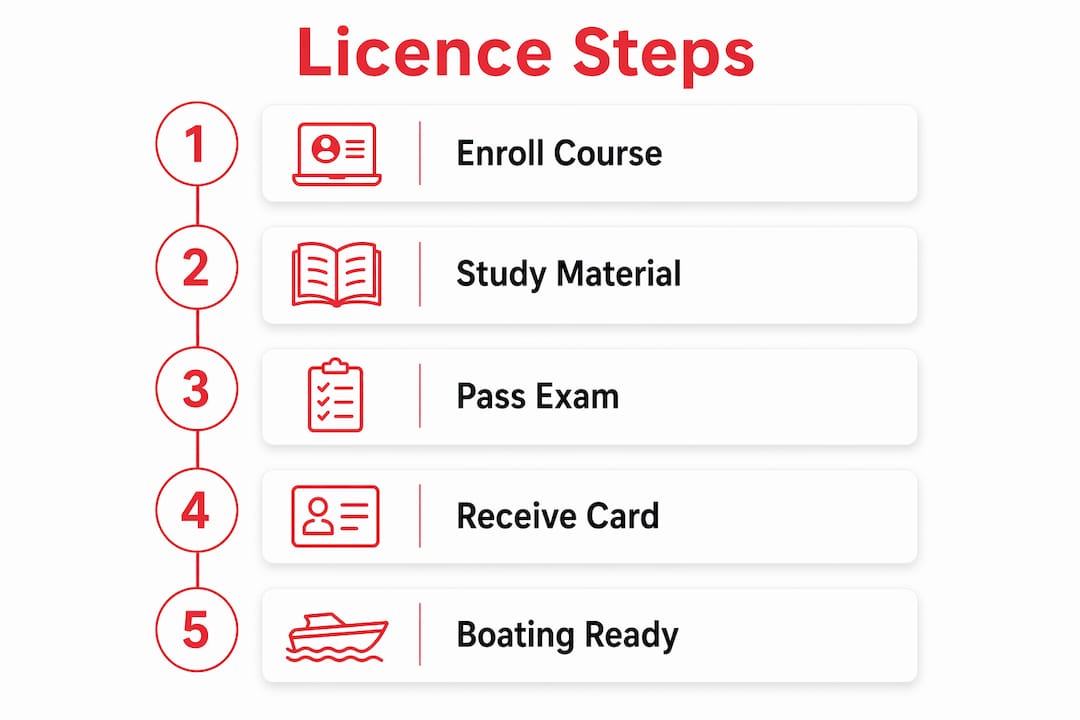
- Select a Transport Canada-approved course. Courses are available online and in person. Approved boating safety courses end with a proctored exam. Confirm the course carries government approval before enrolling.
- Study the course material. The exam covers navigation rules, safety equipment, emergency procedures, and Canadian boating laws. Most providers offer practice tests. Use them.
- Pass the Transport Canada-approved exam. The exam is available online or at a supervised testing location. A passing score is required to receive certification.
- Receive your PCOC. After passing, your card arrives by mail and is valid for life. Some providers issue a temporary card immediately so you can get on the water while the physical card ships.
- Apply for your PCL. Submit your vessel details to Transport Canada, pay the applicable fee, and display the assigned number on both sides of the bow.
| Step | Action | Timeline |
|---|---|---|
| 1 | Enroll in an approved course | Before exam |
| 2 | Study and take practice exams | 1–7 days |
| 3 | Pass the Transport Canada exam | Exam day |
| 4 | Receive PCOC card | Days to weeks by mail |
| 5 | Register vessel and get PCL | Concurrent with step 3–4 |
Pro Tip: Do not wait until the day before your first trip to start the process. Mail delivery for the physical PCOC card can take several weeks. Book your exam early and use the temporary certificate to stay legal while you wait.
Understanding boating safety education before you sit the exam gives you a real advantage. Operators who study the material rather than just memorizing answers perform better on the water and in enforcement encounters.
What are the ongoing compliance requirements for Canadian boaters?
Passing the exam is the beginning, not the end. Legal operation on Canadian waters requires active compliance with several ongoing obligations.
Operators must carry their PCOC on board at all times while operating any motorized pleasure craft. PCL numbers must be displayed on both sides of the bow in a visible location. Failure to meet either requirement gives enforcement officers grounds for a fine or vessel impoundment.
The PCL renewal cycle is five years. Mark the expiry date and renew before it lapses. A lapsed PCL means your vessel is technically unregistered, which creates legal exposure even if your PCOC is current.
Regulatory updates effective December 31, 2025 tightened the window for updating licence information. Licence information updates must now be filed within 30 days of any change to your name or address. The previous window was 90 days. That is a significant reduction, and many boaters are unaware of it.
Key ongoing obligations:
- Carry your PCOC on board every time you operate
- Display PCL numbers on both sides of the bow
- Renew your PCL every five years and pay the $24 fee
- Update name or address changes with Transport Canada within 30 days
- Maintain proof of vessel ownership when transferring a PCL
Failure to maintain current registration or carry a valid PCOC can result in fines or boat impoundment. Enforcement on Canadian waterways is active, particularly during peak summer months. Compliance protects you legally and helps emergency responders identify vessels quickly in an incident.
Updating your licence information through Transport Canada’s online licensing portal keeps your records current and prevents lapses that could result in penalties. The process takes minutes and removes the risk of a compliance gap.
Key Takeaways
The Canadian boating licence system requires both a PCOC for the operator and a PCL for the vessel, and failing to carry either document while on the water results in legal penalties under Transport Canada regulations.
| Point | Details |
|---|---|
| PCOC is lifetime certification | Pass a Transport Canada-approved exam once and the card never expires. |
| PCL applies to the vessel | Motorized boats with 10+ horsepower engines need a PCL renewed every 5 years for $24. |
| Both documents must be on board | Enforcement officers check for both; missing either can result in a fine or impoundment. |
| Update information within 30 days | As of December 31, 2025, name and address changes must be reported within 30 days, down from 90. |
| Wind-powered vessels face new rules | Sailboats over 6 meters will require a PCL starting in 2028. |
What I’ve learned from watching boaters get this wrong
The PCOC versus PCL confusion is the most common and most costly mistake I see new boaters make. They assume one document covers everything. It does not. The PCOC proves you know how to operate a boat. The PCL proves the boat is legally registered. You need both, and enforcement officers know exactly which one you are missing.
The second mistake is treating certification as a one-time event and then ignoring the regulatory environment. The 2026 updates are a good example. The 30-day update window for personal information is new, and most boaters I have spoken with had no idea the rule changed. Staying current with Transport Canada’s announcements is not optional if you want to stay compliant.
My honest advice: complete your boating certification process well before your first season on the water. Cramming the night before your exam produces operators who pass the test but freeze when a real situation develops. Study the material, understand the rules, and get on the water with confidence rather than anxiety.
One more thing that rarely gets mentioned: Indigenous rights holders can apply for fee exemptions on Pleasure Craft Licences when using vessels to exercise recognized traditional rights. That exemption exists and is worth knowing if it applies to you.
— Richard
Safeboatingamerica: get certified and get on the water
Safeboatingamerica offers government-approved boating safety courses and testing recognized across Canada, giving new boaters a clear path to legal certification without unnecessary complexity.
Courses are available online with flexible scheduling, so you can complete your certification on your timeline. Safeboatingamerica’s instructors use Transport Canada-approved materials, and the exam process is designed to prepare you for real conditions, not just the test. Whether you are pursuing your first certification or helping a family member get certified, start your boating license with a program built for accuracy, compliance, and confidence on the water.
FAQ
What is the difference between a PCOC and a PCL?
The PCOC is a lifetime operator certification proving boating competency, while the PCL is a vessel registration renewed every five years. Both are required for legal operation of a motorized pleasure craft in Canada.
Does the Canadian boating licence expire?
The PCOC never expires once earned. The PCL must be renewed every five years for a $24 fee as of 2026.
Who is required to have a PCOC in Canada?
Anyone operating a motorized pleasure craft in Canada must hold a valid PCOC, including operators of jet skis, speedboats, and motor-equipped sailboats.
Can non-residents operate a boat in Canada without a PCOC?
Non-resident visitors may use their home country’s equivalent boating certification in Canadian waters, but they must carry that documentation on board during all patrols and enforcement stops.
What happens if I operate a boat without a valid PCOC or PCL?
Operating without a valid PCOC or current PCL can result in fines or boat impoundment under Transport Canada enforcement rules.