Temporary Boating Certificate: How It Works by State

A temporary boating certificate is short-term proof that you passed a state-recognized boating safety test. It lets you operate or rent a boat while you do not yet hold a permanent card. Each state sets its own rules. Florida’s lasts 90 days, New Hampshire’s lasts 14 days, and Wisconsin’s runs to the end of the calendar year and only covers rentals. Many other states have no temporary option at all. If you boat more than once or twice, the permanent boating safety certificate is the better route.
TL;DR
- A temporary certificate is a short-term, state-specific document. It is not a nationwide boating license.
- Florida: pass the temporary exam (25 questions, 19 correct), and the certificate is valid for 90 days. It cannot be used to get the lifetime card.
- New Hampshire: 14 days, ages 16 and up, New Hampshire waters only, one per calendar year. Wisconsin: rental boats only, through the end of the year issued.
- Boating more than once or twice, or owning a boat or Jet Ski? Complete an approved course and get the permanent certificate.
- Always confirm current rules with the state agency before you travel or rent.
Table of Contents
- What a temporary boating certificate is
- How the main versions compare
- Temporary vs. permanent: what you give up
- Renting a boat in Florida without a boating license
- When the temporary route does not fit
- Getting the permanent certificate
- Our perspective
- Ready for the permanent certificate
- Practical tips for using any temporary certificate
- FAQ
- Sources
What a temporary boating certificate is
The terms “temporary boating certificate,” “temporary boating license” and “temporary boater education certificate” describe the same idea. A state accepts a quick exam or a course-completion record as short-term proof that you know the basics of safe operation.
Technically, most states do not issue a boating “license.” Florida’s motor vehicle agency states plainly that Florida does not have a boating license. Qualifying operators must complete approved education, pass an equivalent or temporary exam, and carry the required education identification and photo ID. The permanent document is a boater education card or boating safety certificate. For the difference in plain terms, see our guide to the boating safety certificate vs. license.
A temporary certificate usually serves one of three situations:
- A visitor wants to rent a boat or personal watercraft on vacation.
- A new boater has finished a course and is waiting for the permanent card to arrive.
- A boater needs short-term legal proof while the full course is still pending.
How the main versions compare
The research below comes from state statutes and agency pages. The details differ enough that a certificate valid in one state tells you nothing about the next.
| Feature | Florida | New Hampshire | Wisconsin |
|---|---|---|---|
| Validity | 90 days after issuance | Up to 14 days | Through the end of the calendar year issued |
| Minimum age | See FWC for age rules | 16 | 16 |
| Where it works | Florida | New Hampshire public waters only | Rented or leased motorboat only |
| Limit | Cannot be used to obtain the lifetime card | One per calendar year | Named holder only, on the boat rented by that holder |
| How you get it | Pass the approved temporary exam | Pass an approved exam with 80% or higher | Through a participating rental agent |
Florida: 90 days
Under Florida Statutes section 327.395, a temporary certificate comes from passing a temporary-certificate exam developed or approved by the Florida Fish and Wildlife Conservation Commission. It is valid for 90 days after issuance.
The FWC temporary certificate program explains the process. You take the online exam through an FWC-authorized vendor. It has 25 questions, and you need at least 19 correct. After you pass, the vendor provides an electronic certificate. You can show it to a rental business and, with photo ID, to law enforcement while operating in Florida.

People who already hold proof of a NASBLA-approved course or an equivalency exam from another state do not need the temporary exam, per the same FWC page.
New Hampshire: 14 days
New Hampshire’s rule is narrower. RSA 270-D:14 provides a temporary safe-boating certificate to a person 16 or older who passes an approved temporary exam. It is valid for up to 14 days, covers New Hampshire public waters only, and no one may receive more than one in a calendar year.
The New Hampshire State Police add the practical details: bring photo identification and score at least 80%.
Wisconsin: rentals only
Wisconsin ties the temporary certificate to renting. Under NR 5.19, it is limited to people 16 or older who are or will be renting or leasing a motorboat from a participating rental agent. It runs from issuance through the end of the calendar year. It is valid only for the named holder, operating the motorboat that holder rented or leased.
New Jersey: a temporary course-completion document
New Jersey works differently. According to the New Jersey State Police, for qualifying approved courses the instructor may provide a temporary certificate application. Meanwhile, the Marine Services Bureau sends the permanent Boat Safety Certificate to the instructor for delivery to the student. Here the temporary paper is a bridge to the permanent certificate, not a separate product.
Other states
Many states have no temporary certificate. Some issue a printable proof of completion after an online course, valid until the plastic card arrives. Others require the permanent card before you operate. Rules also change. Before you plan around a temporary document, check the state’s boating agency page for the current version.
Temporary vs. permanent: what you give up
The permanent card is the document most states want you to hold long term. In Florida, the boating-safety identification card follows an approved course and is valid for life. The temporary certificate follows a passed exam and expires in 90 days. It cannot be submitted to get the lifetime card.
That last point catches people. A temporary exam is built to answer one question: can this person be cleared to operate for a short period? It does not move you toward the permanent card. If you want that card, you complete an approved course.
| Question | Temporary certificate | Permanent certificate or card |
|---|---|---|
| Purpose | Short-term access, often for a rental | Ongoing proof of boater education |
| Validity | Days to months, depending on the state | Florida’s card is valid for life |
| Works in other states | Usually not, check each state | Many states honor NASBLA-approved courses |
| Best for | One vacation rental | Owners, regular renters, Jet Ski riders |
A lifetime education card is not the same as a lifetime registration. Vessel registrations still renew. We cover that in how boating licenses expire.
Renting a boat in Florida without a boating license
This is the most common reason people search for a temporary certificate. The short answer: you can rent in Florida if you hold the right proof. Because Florida has no “boating license,” what you need is education proof. For a visitor, the Florida DHSMV says you may use proof of a qualifying course or equivalent exam from another state instead of getting a Florida card. A visitor who wants to rent may obtain a temporary certificate valid for 90 days.
The rental business has duties too. FWC’s livery regulations say a livery renting motorboats, personal watercraft, paddlecraft, sailboats or houseboats on state waters must hold a state-issued, no-cost Livery Operator Permit. It must give pre-rental or pre-ride instruction, keep a written renter agreement, and refuse to rent a vessel that lacks required safety equipment or exceeds its capacity or horsepower limits. A rental that skips instruction, or an operator who will not check your proof, is a reason to choose a different dock.

For a deeper walk-through, read our post on renting a boat in Florida with the 90-day temporary certificate and our Florida temporary certificate tips.
Checklist before you rent
- Confirm the rental company holds its Livery Operator Permit and ask what proof it accepts.
- Carry your temporary certificate (electronic copy is fine under Florida’s program) and a photo ID.
- Ask for the pre-rental instruction and read the written renter agreement.
- Check life jackets and required equipment are aboard. Our Florida equipment guide lists what each vessel class needs.
- Renting a Jet Ski? Review the Florida PWC laws on age, education card and penalties.
When the temporary route does not fit
A temporary certificate suits a one-week trip. It is a poor fit in these cases:
- You own a boat or PWC. A 90-day document runs out in a season, and it cannot lead to the permanent card.
- You will boat in several states. Temporary documents are state-specific. New Hampshire’s works only on New Hampshire public waters.
- You are under the state’s age minimum. New Hampshire and Wisconsin both set 16 as the floor for their temporary certificates.
- Your state has no temporary option. Many do not, and the course is the only route.
- You want to skip repeat testing. Each time a temporary certificate lapses, you start over. In New Hampshire you cannot even get a second one in the same calendar year.
Getting the permanent certificate
The full course takes longer than a temporary exam, but you finish with a document that does not lapse. Formats include:
- Online, self-paced. Our nationwide online boating courses cover state-approved material you can finish at your own pace.
- Live Zoom. The Zoom Online 1-Day Class costs $75 and puts you in a live class with an instructor.
- In person in New York. The NYS Safe Boating Class costs $85.
- Florida. The Florida boating and PWC certification course is built around the Florida requirement, and our Florida license requirements guide explains who needs a card.
If exam nerves are the worry, our four-week study plan breaks the material down.
Our perspective
We see the same pattern every season. A boater picks the quickest paper they can find, uses it once, then has to start over the next time they want to go out.
A temporary certificate does its job for a vacation rental. It was never designed to be a long-term plan. In Florida it expires after 90 days and cannot be exchanged for the lifetime card. That means a boater who rents twice a year pays for and passes a fresh exam each time.
Our courses are taught by State Certified Instructors and USCG-Licensed Captains using NASBLA-approved material. The certificate you earn is the official boating safety certificate, often called a boating license. For New York students it can be added as an endorsement to a driver’s license.
Our advice: if you will be on the water more than once, take the course. Learn the rules, earn the permanent document, and carry one proof for years.
Richard
Ready for the permanent certificate
We offer state-approved boating license courses in every state, in online, live Zoom and in-person formats. Choose the class that matches your state and schedule, and finish with an official boating safety certificate. Start from our boating safety certification page, or pick a gift certificate for a new boater from our gift certificates, priced from $75 to $85.
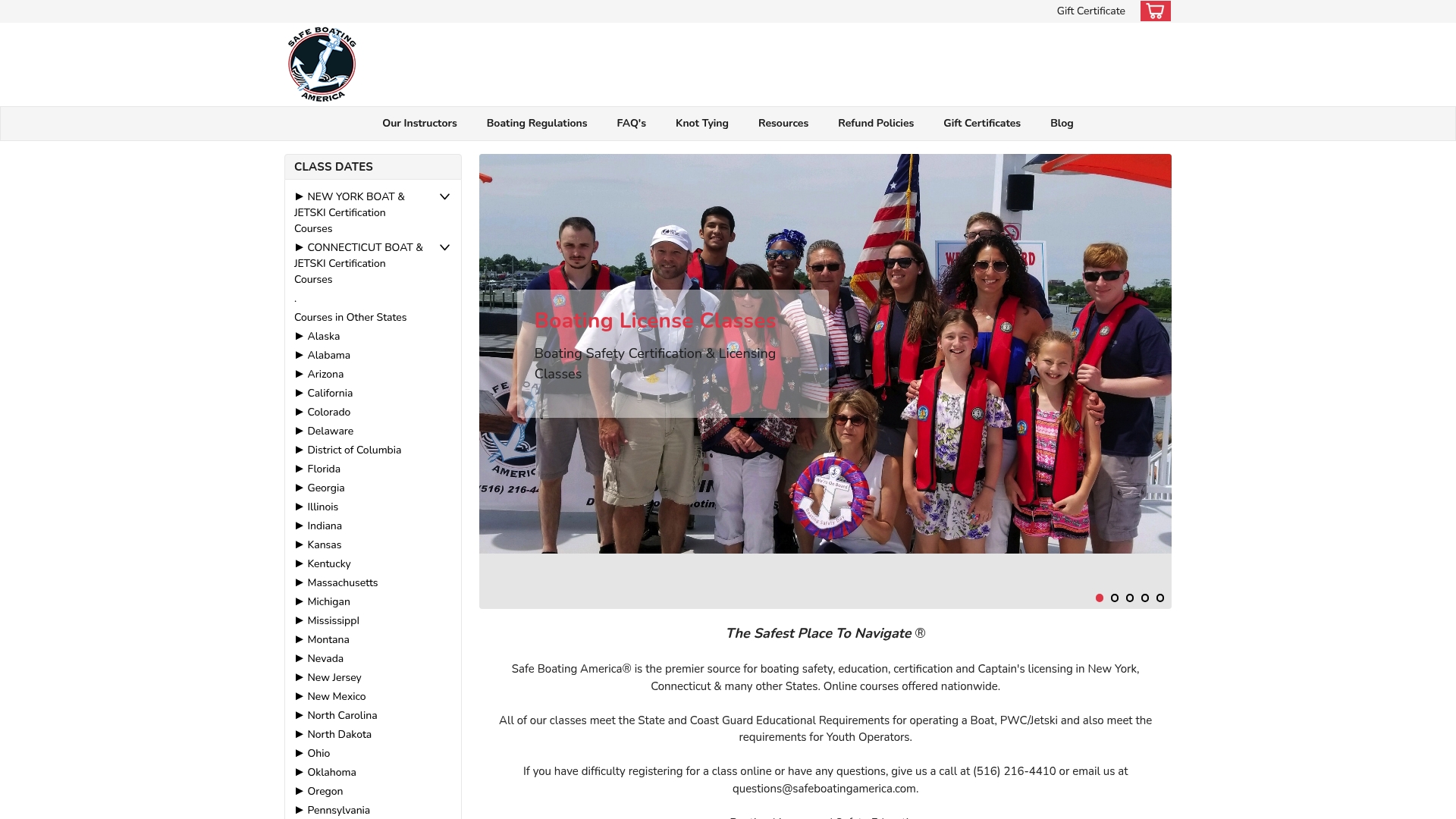
New Yorkers can register for the NYS Safe Boating Class. Boaters elsewhere can browse the online courses.
Practical tips for using any temporary certificate
- Know the expiry date. Put the day the certificate lapses in your calendar. Do not rely on memory.
- Keep proof on the boat. Florida’s program allows the electronic certificate to be shown with a photo ID to law enforcement.
- Stay in the state. New Hampshire’s certificate is for New Hampshire waters only, and Wisconsin’s covers only the boat you rented.
- Do not lend it. Wisconsin’s certificate is valid only for the named holder.
- Read the rental agreement. Livery rules about capacity, horsepower and equipment protect you as well as the operator.
- Plan the follow-up. If you will boat again, enroll in an approved course before the temporary document runs out.
FAQ
Is a temporary boating certificate the same as a boating license?
No. Most states, Florida included, do not issue a boating license in the way driver licensing works. They require approved education and proof of it. A temporary certificate is short-term proof, while the permanent boater education card or certificate is the lasting document.
How long is a temporary boating certificate good for?
It depends on the state. Florida’s is valid for 90 days after issuance. New Hampshire’s is valid for up to 14 days. Wisconsin’s runs through the end of the calendar year in which it was issued, for rentals only. Check the state agency for the current rule.
Can I use a temporary certificate to get the lifetime Florida card?
No. Florida law says the temporary certificate cannot be submitted for issuance of the lifetime boating-safety identification card. To get the card, you complete an approved boating safety course.
Do I need a certificate to rent a boat in Florida as a visitor?
You need acceptable proof. A visitor may use proof of a qualifying course or equivalent exam from another state, or may obtain the 90-day temporary certificate. Ask the rental company which proof it accepts before you arrive.
Sources
- Temporary Certificate Program, Florida Fish and Wildlife Conservation Commission
- Florida Statutes section 327.395 (2026)
- Boating Safety and Education, Florida DHSMV
- Livery Regulations and Safety Information, FWC
- New Hampshire RSA 270-D:14, Temporary Certificate
- 14 Day Temporary Safe Boating Certificate, NH State Police
- Wisconsin Administrative Code NR 5.19
- Boating Safety Certificate FAQ, New Jersey State Police