
Pass Your State Boating Exam: 4 Week Study Plan from Official Manuals

State boating exams draw from the same core subject pool nationwide: vessel basics, safety equipment, navigation rules, trip planning, and emergency response. This guide maps those exact topics against what state manuals and NASBLA-approved courses teach, then gives you a study sequence to move from open manual to certificate in hand. Start by matching this checklist against your own state’s official study guide.
TL;DR:
- State boating exams cover core topics such as boat systems, safety equipment, navigation rules, trip planning, and emergency response, with questions drawn equally from four main categories.
- Memorization of boat-specific facts, like hull classification, capacity plates, and navigation aid meanings, is crucial since these details frequently appear on tests.
- Understanding the proper procedures for emergencies, especially the sequence of actions to execute, significantly improves chances of passing and safe boating practices.
- Different states have varying certification processes, with some requiring a state exam and others accepting NASBLA-approved course certificates; verify your state’s rules beforehand.
- Preparing through practice exams, flashcards, and hands-on familiarity with equipment, ideally over four weeks, greatly increases success odds and confidence on test day.
Table of Contents
- What Topics Does a Boating Exam Study Guide Actually Cover?
- What Do You Need to Know About the Boat Itself?
- What Boating Safety Equipment Will Be on the Test?
- What Navigation Rules Show Up on the Boating Exam?
- How Do Exams Test Emergency Response and Prevention?
- How Do State Certification Requirements Differ?
- What’s the Exam Format and How Should You Prepare?
- What’s a Realistic Study Plan Before Test Day?
- Why State-Approved Courses Still Matter
- What Boating Terms Should You Know Before Test Day?
- An Instructor’s Take on What Actually Trips Students Up
- Ready to Get Certified? Here’s How Safe Boating America Fits
- Where to Verify Your State’s Exact Rules
- Sources
- FAQ
What Topics Does a Boating Exam Study Guide Actually Cover?
Every state exam draws from a similar topic pool, even though question counts and passing thresholds shift by jurisdiction. State manuals typically organize material into four blocks: foundations, before-you-boat prep, on-the-water rules, and emergency response, which mirrors how Texas structures its official boater safety manual.
Use this checklist to benchmark your own prep:
- Boat systems and classifications: hull types, capacity ratings, and registration basics.
- Required safety equipment: PFDs, fire extinguishers, visual and sound signaling devices.
- Trip planning: pre-departure checklists, weather checks, float plans.
- Navigation rules: right-of-way, buoys, lights, and aids to navigation.
- Emergency procedures: man overboard, fire, flooding, capsizing response.
- Laws and penalties: BUI statutes, age restrictions, required documentation.
State exams sample from each block rather than weighting one topic heavily, so skipping a category to cram another almost always backfires on test day. Pull up your state’s course syllabus now and cross off what you already know cold.
What Do You Need to Know About the Boat Itself?
Exam writers love boat-specific facts because they’re easy to test with a single precise answer. Hull shape affects handling directly: flat-bottom hulls offer stability in calm water but pound in chop, while V-hulls cut through waves more smoothly at the cost of some low-speed stability.
Expect questions built around these fixtures:
- Capacity plate: lists maximum persons, weight, and horsepower. Exams often ask you to read a sample plate and calculate safe load.
- Hull Identification Number (HIN): a 12-character code stamped on the transom, used for registration and theft recovery.
- Registration and documentation: what must be onboard, where decals go, and renewal timing.
- Routine maintenance checks: bilge pumps, fuel lines, and battery connections that examiners tie to pre-departure inspection questions.
Memorize the capacity plate format specifically. It shows up in some form on nearly every state test.
What Boating Safety Equipment Will Be on the Test?
Equipment questions test whether you know legal minimums, not brand preferences. Personal flotation devices come in five types, and exam writers frequently ask which type suits which activity, so know the difference between a wearable Type III and a throwable Type IV before test day.
Study these categories in this order:
- PFDs: Type I (offshore, best flotation), Type II (near-shore), Type III (general use), Type IV (throwable), Type V (special-use).
- Fire extinguishers: classification by vessel length and engine compartment presence.
- Visual distress signals: flares, orange flags, and when the U.S. Coast Guard requires them.
- Sound signaling devices: horns, whistles, bells, and the situations that require each.
Pro Tip: Build a simple flashcard for each equipment type listing “what it is,” “who needs it,” and “when it’s required.” Exam questions almost always test one of those three angles.
What Navigation Rules Show Up on the Boating Exam?
Right-of-way questions trip up more test-takers than any other category, mostly because states test multi-vessel scenarios that feel ambiguous under pressure. The core rule: a boat approaching from your right (the “danger zone”) generally has the right-of-way, and sailboats under sail typically have priority over powerboats.
Focus your review here:
- Right-of-way basics: power-gives-way-to-sail, overtaking vessel yields, head-on situations require both boats to turn right.
- Buoys and daymarks: red and green markers, “red right returning” for channel navigation.
- Navigation lights: red/green/white combinations that indicate a vessel’s heading at night.
- COLREGs vs. state rules: international rules govern open water; state-specific guidance covers inland lakes and waterways, so check which applies to your test.
A quick mnemonic that sticks: red markers stay on your right when heading upstream or into a harbor.
How Do Exams Test Emergency Response and Prevention?
Examiners want to see that you know the correct sequence of actions, not just the right vocabulary. A man-overboard question, for instance, usually tests whether you’d stop the engine before circling back, since a spinning propeller is the immediate danger.
Follow this sequence for the most commonly tested emergencies:
- Man overboard: stop the engine immediately, throw a flotation device, keep the person in sight, maneuver back slowly.
- Onboard fire: cut fuel supply, point the extinguisher at the base of the flame, alert other passengers.
- Flooding or swamping: locate the source, use bilge pumps or bailing, redistribute weight, radio for help if it worsens.
- Capsizing: stay with the vessel, account for all passengers, signal for assistance rather than swim to shore.
Prevention topics get tested just as heavily. Alcohol impairment, fatigue, and skipping a float plan before departure are the three causes exam writers return to again and again, largely because they’re the leading factors behind real accidents documented in state manuals.
Pro Tip: When a question describes an emergency, look for the answer that stops the immediate danger first (engine, fire, flooding source) before the answer that addresses the secondary problem.
How Do State Certification Requirements Differ?
States diverge on age cutoffs, required proof, and how certification gets issued, so a study guide that ignores those differences leaves gaps. Some states run the process through a state-administered exam at a DMV-style location; others accept a NASBLA-approved course completion certificate as the qualifying credential, a distinction spelled out in Alabama’s boat certification manual.
To find your own state’s exact rules:
- Search for your state’s official boating agency site (fish and wildlife, natural resources, or marine police department, depending on the state).
- Download the current official manual, which usually includes age restrictions and required proof in a dedicated section, similar to how the Texas manual lists age-based operator rules and pre-departure checklists.
- Confirm whether your state issues a physical card, a certificate, or a license endorsement.
Once certified, carry proof on the water. Depending on the state, that means a wallet card, a printed certificate, or in New York, an endorsement added directly to your driver’s license. When state guidance and a third-party source disagree, the official manual governs, not a summary site.
What’s the Exam Format and How Should You Prepare?
Most state boating exams run in a fairly predictable range: 25 to 50-plus questions, a 30 to 60-plus minute time limit, and a passing score between 70% and 80%, though your exact state may sit outside those bands. Multiple-choice format dominates, with questions often built around a scenario rather than a bare fact.
Sharpen your approach with these habits:
- Take a full-length practice test under timed conditions at least twice before your real exam.
- Review every missed practice question until you understand why the correct answer is right, not just what it is.
- Use flashcards for equipment types, light patterns, and buoy colors, the three categories most prone to memorization slips.
- Read each question fully before answering. Distance and speed questions often bury the key detail in the second half of the sentence.
Pro Tip: Common exam traps include misreading speed-and-distance math, confusing which light pattern belongs to which vessel type, and misapplying right-of-way in three-boat scenarios. Practice tests that deliberately include these traps prepare you far better than passive re-reading of the manual.
Repeated practice testing consistently outperforms passive review alone, according to guidance from boating exam preparation resources.
What’s a Realistic Study Plan Before Test Day?
A four-week runway gives most first-time test-takers enough room to absorb every topic without cramming. Compress it to two weeks if your test date is closer, just double up on weeks one and two.
- Week 1: Read your full state manual once, section by section. Take notes on anything unfamiliar.
- Week 2: Work through topic-specific practice quizzes (equipment, navigation, emergencies) and build flashcards for weak areas.
- Week 3: Take two full-length timed practice exams. Review every wrong answer and revisit that section in the manual.
- Week 4: Take a final mock exam, review missed questions one more time, and confirm your test appointment or online exam window.
Pre-exam checklist: bring valid photo ID, any required registration paperwork, and arrive (or log in) 15 minutes early. If your state allows an open-book or reference sheet, confirm that in advance rather than assuming.
Why State-Approved Courses Still Matter
A NASBLA-approved course gets you a certificate that satisfies state law immediately, without waiting on a separate state exam appointment. Safe Boating America offers state-approved online courses, live Zoom classes, and in-person sessions taught by certified instructors and USCG-licensed captains. Self-study plus practice tests works for confident readers; an approved course fits better if you want same-day certification and instructor support built in.
What Boating Terms Should You Know Before Test Day?
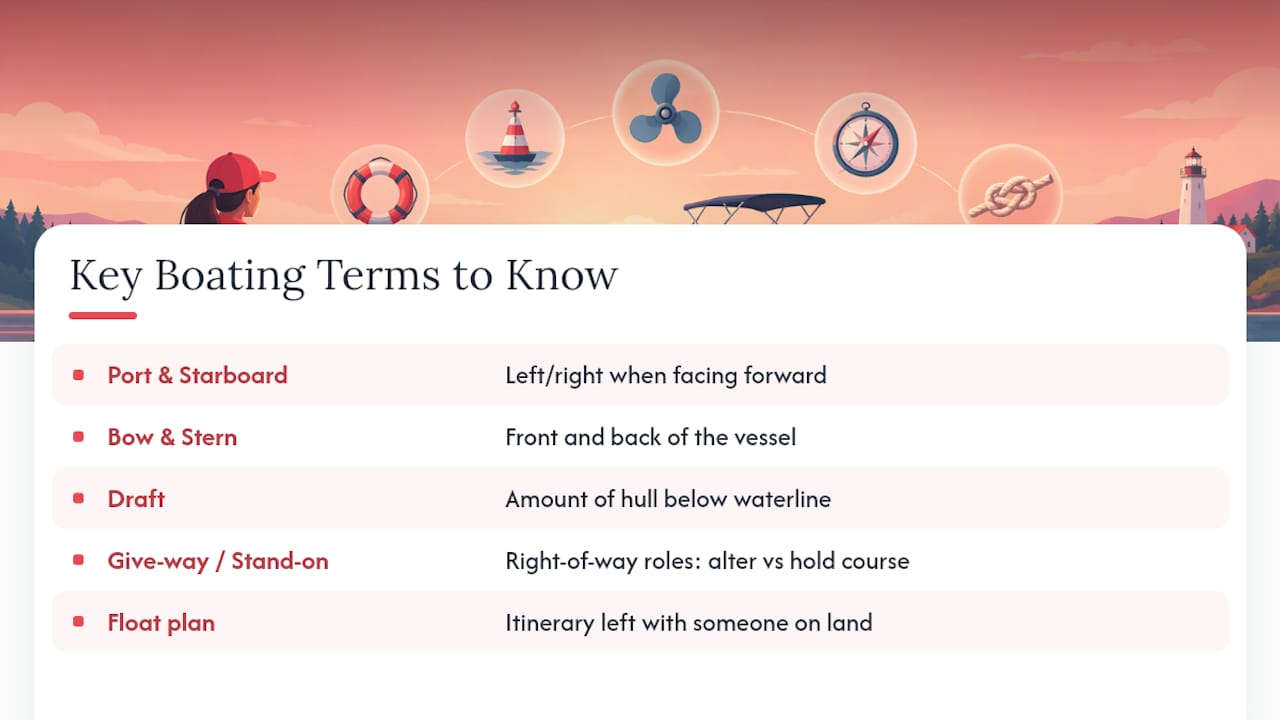
Exam questions rely on precise vocabulary, and a missed term can cost you a point even when you understand the underlying concept. “Port” and “starboard” refer to left and right when facing forward, not compass directions, a distinction that trips up a surprising number of test-takers on their first pass.
Learn these terms cold before you sit for the exam:
“Bow” and “stern” mark the front and back of the vessel. “Draft” describes how much of the boat sits below the waterline, which matters for shallow-water questions. “Wake” is the trailing water disturbance a moving vessel leaves behind, and several states test wake-related liability rules separately from navigation questions.
“Give-way vessel” and “stand-on vessel” describe right-of-way roles: the give-way vessel must alter course, while the stand-on vessel holds its heading and speed. “Aids to navigation” is the umbrella term for buoys, daymarks, and lights that mark channels and hazards. “PWC” stands for personal watercraft, covering Jet Skis and WaveRunners, which many states test under separate rules from traditional boats.
“Float plan” refers to a written itinerary left with someone on land before departure, covering destination, route, and expected return time. “Capacity plate” and “HIN” appear again here because vocabulary questions sometimes test the definition separately from the practical application. Knowing these terms cold means you spend your exam time on reasoning, not decoding the question itself. If a term feels unfamiliar during practice, look it up immediately rather than guessing your way past it.
An Instructor’s Take on What Actually Trips Students Up
Most students who fail don’t lack knowledge, they lack repetition. Reading the manual once feels productive, but it rarely sticks the way a missed practice question does. Combine study with hands-on habits: physically put on a PFD, locate a fire extinguisher’s pin, and practice reading a compass. Muscle memory backs up book memory.
— Richard
Ready to Get Certified? Here’s How Safe Boating America Fits
Self-study gets you knowledge; an approved course gets you a certificate the state actually recognizes on day one. State-approved classes are available in multiple formats: fully online at your own pace, live over Zoom in a single day, or in person with a certified instructor walking the room.
If you’re in New York, the NYS Safe Boating Class covers Brianna’s Law requirements and can add a boating endorsement to your driver’s license. Prefer a faster path? The Zoom Online 1-Day Class fits an entire certification into one sitting, with private classes and advanced sessions also available for readers who want extra on-water time before testing. Connecticut boaters can register directly for the private Connecticut boating course, and if you’re outside those states, the nationwide online course covers most state requirements from any location. Pick the format that matches your schedule and register today to lock in a certification date before your boating season starts.
Where to Verify Your State’s Exact Rules
Always confirm final requirements against your own state’s official manual before test day.
Sources
- Texas Boater Safety Manual 2026 (TPWD)
- Boating Certification Test Study Guide 2026 — Exam Format, Topics & Practice Questions
- Alabama Boat Certification Manual (ALEA)
FAQ
How Many Questions Are on the Boating License Test?
Most state exams run 25 to 50-plus multiple-choice questions, with a time limit typically between 30 and 60-plus minutes. Exact counts vary by state, so check your official manual for the specific number.
What Is the 1/3 Rule in Boating?
The 1/3 rule is a fuel management guideline: use one-third of your fuel to travel out, one-third to return, and keep one-third in reserve for emergencies or unexpected delays. It’s a planning habit rather than a strict legal requirement in most states, but exam questions sometimes reference it under trip planning topics.
Is the Boating License Exam Hard?
The exam isn’t difficult if you’ve studied the core topics: equipment, navigation, and emergency procedures. Passing scores typically fall between 70% and 80%, and repeated practice testing improves pass rates more than reading the manual alone.
Can You Provide a Study Guide for the NJ Boating Exam?
New Jersey follows the same core topics covered in this guide: equipment, navigation, trip planning, and emergency response, but always confirm exact question counts and age rules against New Jersey’s official boating manual. Safe Boating America offers state-approved courses that align with New Jersey’s certification requirements if you’d rather take an approved class than self-study.
What Does a Safe Boating America Course Cost?
The NYS Safe Boating Class is $85, and the Zoom Online 1-Day Class runs $75. Pricing for private and state-specific courses varies, so check the relevant course page for current details.