U.S. PWC Safety Rulebook: Wear a PFD, Use ECOS, Get Certified

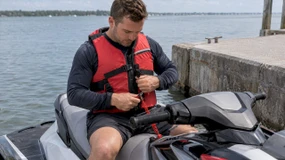
Three rules apply to every personal watercraft operator: wear a U.S. Coast Guard-approved wearable PFD at all times underway, use the engine cut-off switch link when your craft requires it, and complete a pre-departure inspection before leaving the dock. These are not suggestions. They form the legal baseline for operating a PWC safely in U.S. waters, and skipping any one of them raises both injury risk and legal exposure.
TL;DR:
- Wearing the correct U.S. Coast Guard-approved wearable PFD is mandatory for all riders, with inflatable types generally not accepted.
- The engine cut-off switch link must be attached while the craft is on plane, usually via a lanyard clipped to the rider or life jacket.
- A thorough pre-departure inspection should include checking fuel, oil, bilge plug, steering, throttle, battery, and ECOS link to prevent mechanical issues.
- Operators should maintain steady throttle through turns, avoid alcohol, and keep a safe distance from swimmers and other vessels.
- Completing an approved safety course ensures legal compliance and develops critical handling skills for safe PWC operation.
Table of Contents
- Federal and basic legal requirements for PWC operation
- Pre-departure checklist and required equipment
- Safe operation practices while riding a PWC
- Emergency procedures: falls, capsizes, collisions, and reboarding
- State rules, licensing, and common variations
- Why formal training matters for legal compliance and safety
- Nighttime operation rules and visibility requirements
- Communication devices and emergency signaling methods
- Environmental protection guidelines on PWC waterways
- The one habit most PWC riders skip
- Get certified before your next ride
- FAQ
- Sources
Federal and basic legal requirements for PWC operation
Federal rules set the floor for every state’s PWC laws. Every person aboard must wear one U.S. Coast Guard-approved wearable personal flotation device, sized correctly and kept in serviceable condition. Inflatable PFDs do not satisfy this rule on most PWCs; a wearable foam-style or hybrid vest is the standard.
A separate federal requirement governs the engine cut-off switch link. Operators of covered vessels under 26 feet with an installed cut-off device must attach the link while running on plane or above displacement speed. Manufacturers began installing these switches on new boats starting with model-year 2020, and the use requirement took effect April 1, 2021. For PWCs, this usually means the lanyard clipped to the operator’s wrist or life jacket, wired to cut the engine the moment contact breaks.
Beyond flotation and the cut-off switch, operators follow standard navigation rules: proper lighting after dark, right-of-way conventions with other vessels, and obedience to posted waterway markers and no-wake buoys. States layer their own licensing, age, and education requirements on top of these federal basics, so federal compliance is necessary but rarely sufficient on its own.
Pre-departure checklist and required equipment
A few minutes at the dock catches most mechanical surprises before they become water hazards. Work through the same sequence every time:
- Confirm fuel level and check that fuel and oil lines show no leaks or wet spots.
- Verify the bilge plug is seated and secure.
- Test steering response and throttle engagement at idle.
- Check battery connections and listen for unusual engine noise.
- Confirm the ECOS link matches your craft’s model year requirement; the Hull Identification Number’s characters 11 and 12 reveal that year.
Mandatory gear is short: a wearable PFD for every rider and the ECOS link when the craft requires one. Recommended gear extends further: neoprene riding shorts or a wetsuit bottom, eye protection against spray, and gloves for grip. These checks and the practice of briefing passengers on emergency gear location are standard in PWC safety seminar curricula and consistently shorten response time when something goes wrong. For a fuller rundown of required and recommended items, see our PWC safety gear guide.
Pro Tip: Clip the ECOS lanyard to your life jacket rather than your wrist when possible; a wrist attachment can slip during a hard fall, while a jacket mount stays put and still cuts the engine the instant you separate from the craft.
Safe operation practices while riding a PWC
PWC steering works through jet thrust, not a rudder in still water. Releasing the throttle removes steering control at the exact moment many riders instinctively let go, which is why throttle management matters more on a PWC than on most powerboats. Follow these habits on every outing:
- Keep light, steady throttle through turns instead of chopping power, since a dead throttle means no directional control.
- Scan continuously for blind spots behind and to the sides, and widen your path around swimmers, divers, and anchored boats well before you’re close.
- Hold a safe following and passing distance from other vessels, and slow to displacement speed in congested areas.
- Never operate after drinking alcohol or using drugs; impairment affects balance and reaction time more severely on a PWC than in a car.
- Seat passengers according to the manufacturer’s weight limit and keep noise reasonable near shorelines and anchorages.
Modern PWCs increasingly include deceleration or braking modes. Spend time learning your specific model’s stopping distance in open water before you ever need it in traffic.
Emergency procedures: falls, capsizes, collisions, and reboarding
Falling off is common; panicking afterward is the actual danger, which is why following an ocean safety checklist can be crucial in preventing and responding calmly to water incidents. Follow this sequence:
- Stay clear of the intake and nozzle area and let the ECOS link cut the engine the instant you separate from the craft.
- Swim to the PWC from the side, never approach from directly behind where the jet thrust exits.
- Use the reboarding step or aft platform, climbing on low and centered to avoid flipping the craft again.
- Keep throttle low while regaining control before resuming normal speed.
- Call for help immediately if anyone shows signs of serious injury, uncontrolled bleeding, or cold-water shock; control bleeding with direct pressure and get a hypothermic rider out of wet clothing and into warmth as fast as possible.
Pro Tip: Practice a slow-speed reboard in calm, uncrowded water before you ever carry passengers or ride at speed; a rehearsed recovery under calm conditions performs far better under real stress, a point echoed in PWC safety seminar materials.
State rules, licensing, and common variations
Federal law sets the minimum, but states diverge sharply on the details. Expect differences in minimum operator age, whether children must wear a PFD regardless of boat size, whether a state-approved education course is mandatory before operating, and whether inflatable PFDs are restricted on PWCs specifically. Some states also set stricter cut-off switch rules than the federal baseline.

Before heading out, confirm the rules for the specific waterbody and state where you’ll ride. NASBLA maintains contact information for every state boating agency, and having your state of residence, the waterbody name, and your craft’s HIN ready speeds up the lookup. Our guide on PWC license requirements and our breakdown of age rules for minor operators cover the most common variations in more depth. If your state requires certification, carry proof of completion on board and watch for local signage marking no-wake zones or restricted areas.
Why formal training matters for legal compliance and safety
Approved PWC courses cover navigation rules, craft-specific handling, emergency response, and the legal requirements specific to your state, all in one sitting. State-certified instructors and USCG-licensed captains bring practical, on-water context that a printed rulebook can’t, which is part of why NASBLA-aligned coursework remains the backbone of state boating education programs nationwide.
Completing an approved course satisfies the education requirement in many states outright, and it builds the muscle memory for throttle control and reboarding that matters far more than passing a test. See our breakdown of what a certification class actually teaches for a fuller picture.
Nighttime operation rules and visibility requirements
Most states restrict PWC operation after sunset or during periods of reduced visibility, and many prohibit it outright since PWCs typically lack the navigation lighting required for nighttime vessel operation. A standard powerboat must carry red, green, and white navigation lights to signal its position and direction of travel after dark; most PWCs are not equipped this way from the factory, which is part of why so many states simply bar nighttime PWC use rather than require add-on lighting.
Where nighttime or low-light operation is permitted, the same navigation rules of the road apply as with any powered vessel: show the correct lights, maintain a proper lookout, and reduce speed to account for reduced visibility of other boats, swimmers, and floating debris. Fog, heavy rain, and dusk conditions carry the same practical restrictions even when technically legal, since a PWC operator’s ability to spot a swimmer or another craft drops sharply once light fades.
Check your state’s specific hours of permitted operation before planning an evening ride, since cutoff times vary and some waterways impose their own restrictions beyond the state minimum. When visibility drops for any reason, whether from weather or time of day, the safest move is almost always to return to the dock rather than push through reduced-visibility conditions on a craft with no reliable running lights.
Communication devices and emergency signaling methods
A PWC has limited carrying capacity, but a way to call for help should never be left behind. A waterproof VHF marine radio, even a handheld unit, reaches other boaters and the Coast Guard far more reliably than a cell phone once you’re away from shore, since cell coverage drops quickly on open water and marine channels are monitored specifically for distress calls.

Visual signaling matters too. A brightly colored flag or a signal mirror can draw attention from a distance when a radio isn’t practical, and a simple waterproof whistle attached to your life jacket costs little and works even after a dunking that might disable electronics. For longer trips away from populated waterways, a personal locator beacon adds a layer of reliability that a phone alone can’t match.
Before departing, tell someone on shore your planned route and expected return time. This float plan habit, standard in PWC safety seminar materials, means that if you don’t check in, someone already knows where to start looking. Pair that with knowing the local emergency contact number for the waterway you’re on, since some lakes and coastal areas route marine emergencies through a dedicated channel rather than a general emergency line.
Environmental protection guidelines on PWC waterways
No-wake zones exist near docks, swimming areas, and narrow channels specifically because PWC and boat wakes erode shorelines and create hazards for swimmers and smaller craft. Running at displacement speed through these zones isn’t optional courtesy, it’s typically a posted and enforced rule, and the signage marking these areas is one of the waterway markers covered under basic navigation rules.
Wildlife protection rules layer on top of standard no-wake restrictions in many areas. Manatee zones along parts of the Gulf Coast and Florida coastline, for example, impose strict speed limits well beyond ordinary no-wake rules, and disturbing nesting shorebirds or marine mammals can carry separate penalties under state and federal wildlife law. Riding close to shoreline vegetation or shallow grass beds also risks prop damage to seagrass beds that take years to recover.
Fuel and oil discharge rules apply to PWCs just as they do to larger boats. Topping off fuel tanks at the dock rather than on the water reduces spill risk, and any sheen on the water from a leak should be reported rather than ignored. Checking local signage for seasonal closures, protected zones, or speed restrictions before heading out avoids both fines and unnecessary harm to the waterway you’re riding on.
The one habit most PWC riders skip
The most overlooked habit isn’t a law at all: wearing neoprene shorts or a wetsuit bottom under your PFD. Rare but serious injuries happen when a rider falls backward into the jet stream, and neoprene meaningfully reduces that risk. Pair it with clipping the ECOS link every single time, no exceptions, and you’ve closed the two gaps most riders leave open.
— Richard
Get certified before your next ride
Meeting the legal requirements above starts with completing an approved course, and we make that step straightforward. Our NYS Safe Boating Class covers PWC handling, navigation rules, and state-specific legal requirements for riders who want in-person instruction, while our Zoom Online 1-Day Class fits riders who need certification on a tighter schedule.
Private instruction, on-water training, and advanced navigation coursework are available for riders seeking hands-on practice beyond the legal minimum:
- NYS Safe Boating Class, in-person
- Zoom Online 1-Day Class for fast, remote certification
- Private Classes and On Water Training for riders who want individualized instruction
Whichever format fits your schedule, completing a state-approved course gets you certified and gives you the practical handling skills this guide covers. Visit our safety boating classes page to find the option that matches your state’s requirements.
FAQ
What are the 5 basic rules of water safety?
The core rules are: always wear a properly fitted, USCG-approved life jacket; never swim or ride alone; check weather conditions before heading out; avoid alcohol while operating a watercraft; and know how to call for help before you need it. For PWC riders specifically, using the ECOS link and completing a pre-departure check round out the list.
What are the new boating laws in Florida starting in 2026?
We don’t have a confirmed, published list of Florida-specific boating law changes taking effect in 2026. For the most current state-level requirements, check Florida’s state boating agency page or the NASBLA state contact directory directly, since state rules can change from year to year.
Which action is safe for a PWC operator?
Maintaining steady throttle through turns, scanning blind spots continuously, and keeping a safe distance from swimmers and other vessels are all safe practices. Releasing the throttle suddenly during a turn is unsafe, since PWC steering depends on jet thrust and cutting power removes directional control exactly when you need it most.
What is the 1/3 rule in boating?
The 1/3 rule is a fuel management guideline: use one third of your fuel to travel out, reserve one third to return, and keep the final third as a safety margin for wind, current, or detours. It’s a planning habit rather than a legal requirement, but it applies just as well to PWCs with limited tank capacity as it does to larger boats.
Do I need to take a course to operate a PWC legally?
Requirements vary by state, with many requiring a NASBLA-approved boating education course before you can legally operate a PWC. Our PWC license requirements guide breaks down common state patterns, and our safety boating classes page lists current course options.
Sources
- A Boater’s Guide to the Federal Requirements for Recreational Boats
- PWC-specific safety (Boating Magazine)
- PWC Safety Seminar