NY PWC Laws: Jet Ski Rules and License Requirements
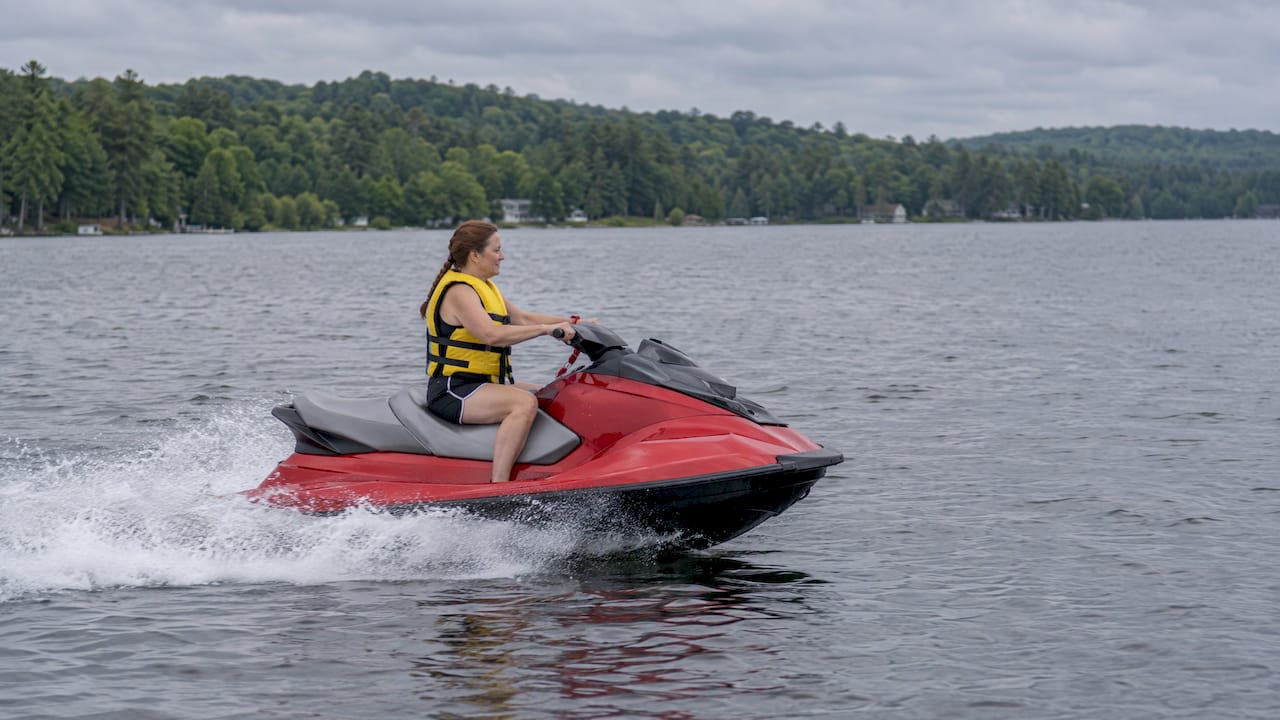
New York has no separate jet ski license. To operate a personal watercraft (PWC), such as a Jet Ski or WaveRunner, you must be at least 14 and hold a New York boating safety certificate, the document most people call a boating license. You get it by passing a state-approved safe boating course. Our NYS Safe Boating Class is $85 and leads to that certificate. The rest of this page covers the age rules, the certificate, the on-water rules and the gear a PWC must carry.
TL;DR
- Minimum operating age is 14, and the operator needs a boating safety certificate. Riders under 14 may operate only under supervision by a certificate-holding adult.
- Since January 1, 2025, every operator of a motorized boat in New York needs the certificate, regardless of age.
- PWCs may not be operated from sunset to sunrise or within 500 feet of a designated bathing area.
- Everyone aboard wears a USCG-approved life jacket sized and rated for PWC use. The cut-off lanyard stays attached to the operator.
- Local rules can be stricter than state law. The operator is responsible for knowing them.
Table of Contents
- What counts as a PWC in New York
- Age and certificate requirements
- Getting the certificate
- Operating rules on the water
- Required equipment and what to wear
- Local rules can be stricter
- Does a jet ski license from New York work elsewhere?
- Perspective
- Take the course
- FAQ
- Sources
What counts as a PWC in New York
New York State Parks treats a PWC as a motorized boat with special regulations. Jet Skis, WaveRunners and similar sit-down or stand-up jet craft fall under the same rules as other motorized vessels, plus the PWC-specific provisions below.
The same page states that waterjet-powered specialty craft are regulated like PWCs. That covers motorized surfboards, Jetpaks, Jetlevs, Flyboards and Jetovators. If your craft is propelled by a water jet and ridden rather than steered from a cabin, assume the PWC rules apply.
Age and certificate requirements
The core rule
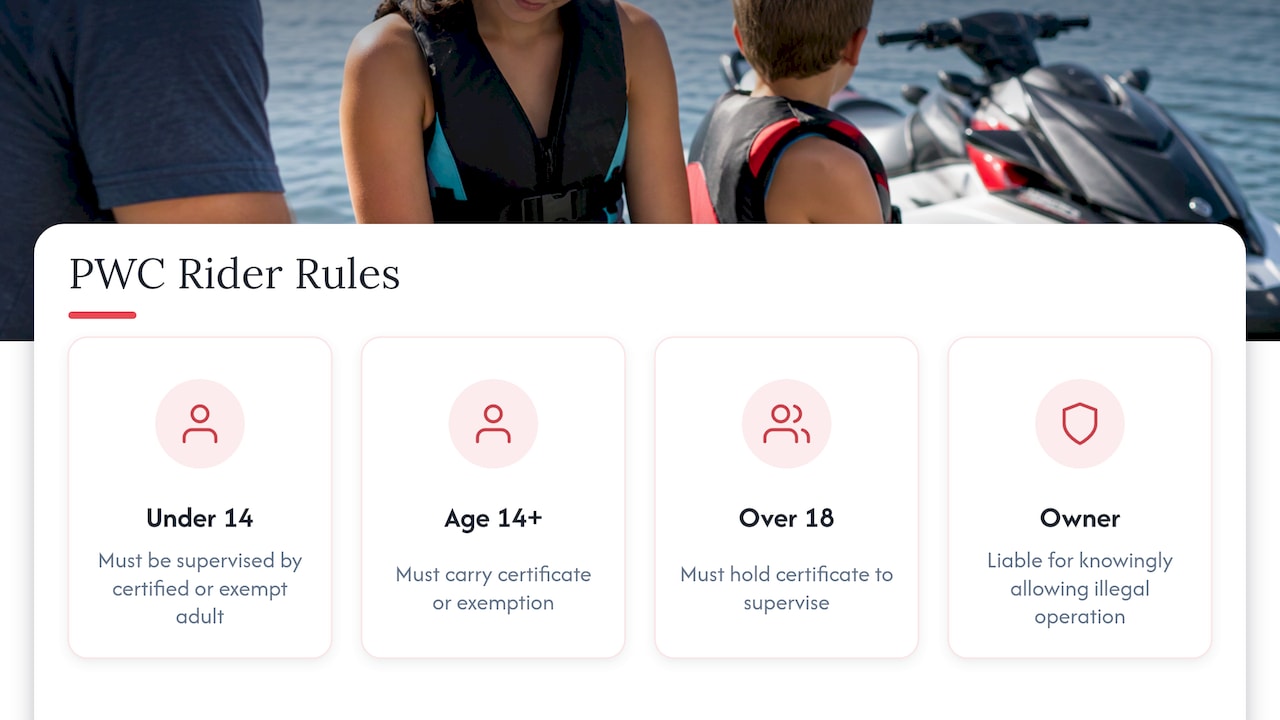
Under Navigation Law §49, no one may operate a PWC unless they are at least 14 and hold a boating safety certificate, or are accompanied on the vessel by a person over 18 who holds one. An owner who knowingly lets someone operate in violation is also liable.
The state’s safe boating education rules add the supervision point for younger riders: a youth under 14 must not operate a PWC without supervision by an adult who holds a certificate or exemption. A person 14 or older must obtain and carry the certificate or an exemption.
Brianna’s Law and the 2025 end of the phase-in
Brianna’s Law was named for Brianna Lieneck, who was 11 when she was killed in a boating collision off Long Island. It took effect January 1, 2020 and phased in the course requirement by birth year through 2024. New York State Parks confirms that as of January 1, 2025 a safe boating certificate is required of all motorized boat operators regardless of age.
PWC operators were already covered earlier. According to the state’s 2025 boating report, the law changed in 2000 to require PWC operators to hold a certificate before 2005. Older web pages that still cite birth-year cutoffs, such as 1988, 1993 or 1996, describe the phase-in period and no longer reflect the rule.
For a fuller walk-through of the statute, see our explainer on what Brianna’s Law requires.
Quick reference
| Situation | What New York requires |
|---|---|
| Operator age 14 or older | Boating safety certificate (or exemption), carried aboard |
| Operator under 14 | Supervision by an adult who holds a certificate or exemption |
| Minimum age to take the course | 10 |
| Certificate validity | Lifetime |
| Out-of-state boaters | New York recognizes a home-state safe boating certificate |
The course-age and validity details come from the NYS Parks boating page, which also says the original physical certificate must be carried.
Getting the certificate
The route is a state-approved safe boating course, followed by the certificate. Three facts from the state’s education rules matter in practice:
- The instructor issues a temporary certificate, valid for 90 days.
- The permanent certificate carries a $10 fee for adults 18 and over. Youths 10 to 17 receive theirs free by mail.
- A replacement certificate costs a $10 processing fee.
Our courses are taught by State Certified Instructors and USCG-Licensed Captains using NASBLA-approved material, and students complete the class and certification the same day. Formats:
- In-person class: the NYS Safe Boating Class, $85.
- Live Zoom class: the Zoom Online 1-Day Class, $75.
- Online course: computer-based courses available nationwide, for boaters who also use other states’ waters.
If you are choosing an online option for New York, make sure it is approved for the state first. Our guide to online boating courses accepted in New York explains how to confirm NASBLA approval. For the full process, the step-by-step guide to the NYS boaters certificate covers each stage, and Long Island and New York City residents can read about the Long Island boating license and the NYC boating license and DMV endorsement.
Operating rules on the water
Hours and distance from swimmers
Navigation Law §73-A sets the main PWC restrictions:
- No operation from sunset to sunrise.
- No operation within 500 feet of a designated bathing area.
- Narrow waters are an exception, where local speed rules apply and the maximum is 10 mph.
Separately, Madison County’s published water rules summarize the statewide baseline for all vessels: 5 mph within 100 feet of shore, a dock, pier, raft, float or anchored boat.
Reckless operation
The same section requires PWCs to be operated in a reasonable and prudent manner at all times. Three behaviors are named as reckless operation under section 45:
- Weaving through congested traffic.
- Jumping another vessel’s wake unreasonably close.
- Swerving at the last moment to avoid a collision.
Madison County describes reckless PWC operation such as wake jumping as a misdemeanor.
There is a handling reason behind these rules. The NYS Boater’s Guide explains that a PWC’s jet pump gives no directional control once the throttle is released, and the craft has no brakes. Plan your distance from other vessels accordingly, and stay out of congested areas.
Towing a skier or tuber
If you tow someone, Navigation Law §73 requires:
- An observer other than the operator, at least 10 years old.
- No towing from sunset to sunrise.
- A securely fastened USCG-approved life jacket on the person being towed.
Alcohol
The state’s 2025 boating report notes that motorized vessel operators age 16 or older are prohibited from operating under the influence with passengers 15 or younger aboard. Consequences include a Class E felony conviction, jail time and a fine of $1,000 to $5,000.
Required equipment and what to wear
The NYS Parks PWC page lists what must be on board or worn:
- A USCG-approved life jacket for every person, sized and intended for PWC use. Most inflatable life jackets are not approved for PWCs.
- Registration certificate and validation sticker.
- The operator’s safe boating certificate.
- A backfire flame arrestor, muffled exhaust and ventilation.
- An ignition safety switch with the cut-off lanyard attached to the operator.
- A horn or whistle.
- A daytime distress signal, such as a 3 by 3 foot orange flag.
The statute is specific on some of these. Section 73-A calls for at least two ventilators unless the bilges are open to the atmosphere. It also requires a sound-producing device capable of a two-second blast audible at least half a mile, and a fluorescent-orange distress flag of at least one square foot, or another USCG-approved visual distress signal.
On life jackets generally, the state’s boating page adds that one must be worn between November 1 and May 1 on any pleasure boat under 21 feet. It must also be worn by anyone under 12 aboard a motorboat under 65 feet (unless in an enclosed cabin) and by anyone being towed.
Local rules can be stricter
State law is the floor. NYS Parks states that municipalities may restrict PWC hours or distance from shore, or ban PWCs entirely, and that operators are responsible for knowing the rules for each waterway.
Lake George is a clear example. The Lake George Park Commission’s special navigation rules set PWC hours of 8 AM to 7 PM and a 5 mph limit within 500 feet of shore. They require the state safety certificate, for all ages, to be carried while operating. Operators must be at least 14, and PWC rentals require tour-guide supervision.
Before riding a new lake, river or bay, look up the local ordinance or the park commission rules for that water.
Does a jet ski license from New York work elsewhere?
The certificate is valid for life in New York. Other states set their own rules and may recognize or require their own courses. Boaters who ride in several states can review typical age and PWC requirements across the U.S.. We also offer state-specific courses, such as the Ohio and Oregon PWC certification courses online.
Perspective
The most common mistake we see in this topic is treating the law as an age question. It is a certificate question. Age 14 is the floor for operating a PWC, but since 2025 the certificate applies to every motorized boat operator in the state.
A certificate is also not the same as knowing a waterway. The state puts the burden on the operator to know local restrictions, and a one-day class is the right place to learn how those rules apply on the water where you actually ride.
That is why our courses are built around State Certified Instructors and USCG-Licensed Captains, with NASBLA-approved content, and why students leave with the certificate the same day. For riders who want more than the minimum, we also offer on-water training, local boating knowledge, and practical navigation and chart reading.
Richard
Take the course
If you operate a Jet Ski or WaveRunner in New York, the certificate is the one document that covers the law. Choose the in-person NYS Safe Boating Class at $85, or the Zoom Online 1-Day Class at $75. Both are taught by instructors certified to teach the state-approved material.
Giving the course to a new boater? Gift certificates are available at $75 to $85. For details specific to PWCs, see our guide to the New York jet ski license.
FAQ
Do I need a license to ride a jet ski in New York?
You need a boating safety certificate, which is what most people mean by a boating license. New York has no separate jet ski license. The operator must be at least 14 and carry the certificate, or be accompanied by a certificate-holding person over 18.
How old do you have to be to operate a PWC in New York?
The operator must be at least 14. Younger riders may operate only under supervision by an adult who holds a certificate or exemption. Anyone 10 or older can take the safe boating course.
Can you ride a jet ski at night in New York?
No. Navigation Law §73-A prohibits PWC operation from sunset to sunrise. Towing is also prohibited between those hours.
Does the New York certificate expire?
No. NYS Parks states that certificates are valid for life, but the original physical certificate must be carried while operating. A replacement carries a $10 processing fee.
Sources
- Personal Watercraft, New York State Parks
- Boating, New York State Parks
- Navigation Law §49, NYS Senate
- Navigation Law §73-A, NYS Senate
- Navigation Law §73, NYS Senate
- Safe Boating Education Rules and Regulations, NYS Parks
- Senate Bill S5685 (Brianna’s Law)
- Safe Boating Week press release, NYS Parks
- 2025 Recreational Boating Report, NYS Parks
- New York State Boater’s Guide
- Special Navigation Rules, Lake George Park Commission
- Water Rules & Regulations, Madison County, NY