Brianna’s Law: Get NYC Boating License, DMV Icon, PWC Age Rules
A “NYC boating license” is the New York State Boating Safety Certificate, and since the Brianna’s Law rollout finished in 2025, every operator of a motorized vessel or personal watercraft on New York waters must carry one. There’s no separate New York City permit. If you plan to operate a boat or PWC anywhere in the five boroughs or Long Island Sound, the move is simple: enroll in a state-approved, NASBLA-aligned course or confirm you qualify for an exemption.
TL;DR:
- The NYS Boating Safety Certificate must be physically carried on board by all operators of motorized vessels or PWCs in New York waters, with no renewal or expiration date.
- Certification requires completing a NASBLA-approved course, passing a final exam, and obtaining a permanent card mailed after a temporary certificate.
- PWC operators must be at least 14 years old, and exemptions exist only for specific credentials like Coast Guard certifications or law enforcement officers.
- Adding an Adventure License icon to your driver’s license is optional and allows skipping the physical certificate within state waters if approved and paid for.
- Enforcement agencies include NY State Police Marine units, county sheriffs, and the U.S. Coast Guard, with penalties for non-compliance including fines and vessel restrictions.
Table of Contents
- What Is the NYS Boating Safety Certificate?
- How Do I Get My NYS Boating Safety Certificate?
- Online, Classroom, or Instructor Led: Which Course Fits?
- Should I Add the Adventure License Anchor Icon?
- Who Is Exempt, and What Are the PWC Age Rules?
- What Do I Need Onboard, and Who Enforces This?
- Why Safe Boating America for Your NYC Course
- An Instructor’s Take on Your First Season
- Register for a NY-Approved Course Now
- Where to Verify These Rules Yourself
- Sources
- FAQ
What Is the NYS Boating Safety Certificate?
The certificate is a permanent, wallet-sized card issued after you pass an approved boating safety course. People call it a “boater card” or “boating license,” but it functions nothing like a driver’s license. There’s no renewal, no points system, no expiration date. Once you earn it, you carry it for life.
That permanence comes with a catch: the certificate must physically travel with you. Operators must carry the original card on their person or on board while running any motorized vessel, and that includes Jet Skis, WaveRunners, and other PWCs. The completed 2025 phase-in of Brianna’s Law erased the old birth-year exemptions. Age no longer matters. If you’re at the helm of a motorized boat in New York, you need the card.
A few essentials worth locking in before you register for a course:
- The certificate covers every motorized vessel, not just PWCs.
- It’s issued once and never expires, but must stay with you while boating.
- The DMV Adventure License anchor icon is an optional add on, useful only within New York State.
- Sailboats without motors and manually propelled vessels (kayaks, canoes, rowboats) fall outside this requirement.
How Do I Get My NYS Boating Safety Certificate?
Getting certified follows a predictable path, but a few steps trip people up if they skip ahead. Here’s the sequence:
- Confirm the course is approved. Look for NASBLA approval or direct NYS Parks recognition before you pay for anything. Not every “boating safety” course online meets New York’s standard.
- Register and verify your identity. Most providers ask for a government-issued ID and basic contact information tied to the certificate record.
- Complete the coursework. Expect modules on navigation rules, PWC-specific safety, emergency response, and required equipment, followed by a final exam.
- Pass the exam and receive your temporary certificate. This paper document is valid for 90 days while your permanent card gets processed.
- Wait for the permanent wallet card. It arrives by mail; keep the temporary certificate on you until it does.
If you’re moving to New York from another state and already hold a comparable boating certificate, you’re not starting from zero. New residents get a one-year grace period to obtain the NYS certificate, though Parks can request proof of equivalency sooner if asked.
Pro Tip: Photograph both sides of your temporary certificate the day you receive it. If the mailed permanent card gets delayed, that photo backs up your compliance while you sort it out.
Online, Classroom, or Instructor Led: Which Course Fits?
New York recognizes several course formats, and each suits a different kind of learner. Online self-paced courses let you finish over several sittings on your own schedule, which works well if you’re juggling work hours. Classroom courses compress the material into one or two long sessions and give you a live instructor to ask questions. Volunteer-instructor sessions, often run by local squadrons or auxiliary groups, blend the two: structured but informal.
Course length typically runs six to eight hours total, whether split across days online or condensed into a single classroom Saturday. Fees vary by provider, and some nonprofit-backed courses are offered free or at low cost, though you may still pay a small fee for card processing.
A short checklist before exam day:
- Confirm your provider submits completions directly to NYS Parks, not just to a third-party database.
- Bring a valid photo ID matching your registration information.
- Save your temporary certificate as both a photo and a printout.
- Ask about retake policies before you start, in case the exam doesn’t go your way the first time.
Should I Add the Adventure License Anchor Icon?
New York’s Adventure License lets you skip carrying the physical certificate within state waters by adding a small anchor icon to your driver’s license or non-driver ID. It’s a convenience feature, not a replacement for the certificate itself, and it only works on NYS-issued identification. Out-of-state IDs and NYC municipal IDs don’t qualify.
Adding the icon depends on how you got certified:
- If your course vendor offers a direct DMV upload link, you can request the icon online.
- If not, bring your original permanent certificate to a DMV office in person.
- Expect a $12.50 fee for immediate issuance, or wait until your next scheduled renewal to add it at no charge.
Before you request it, double check that your DMV photo and address are current. An outdated photo is a common reason applications stall.
Who Is Exempt, and What Are the PWC Age Rules?
Not everyone needs to sit through a course. New York recognizes a handful of legitimate exemptions: valid U.S. Coast Guard or Canadian Coast Guard credentials, U.S. Power Squadron certification, certified boating instructors, and people operating in certain official capacities like law enforcement. Documentation proving the credential is current typically needs to be on hand.
PWC rules run stricter than general boating rules. Operators must be at least 14 years old to run a personal watercraft, full stop. There’s no supervised-minor exception the way some states allow for other boat types. Rental businesses can offer short instructional exceptions for adult renters, but that doesn’t substitute for certification if you plan to own or regularly operate a PWC.
What Do I Need Onboard, and Who Enforces This?
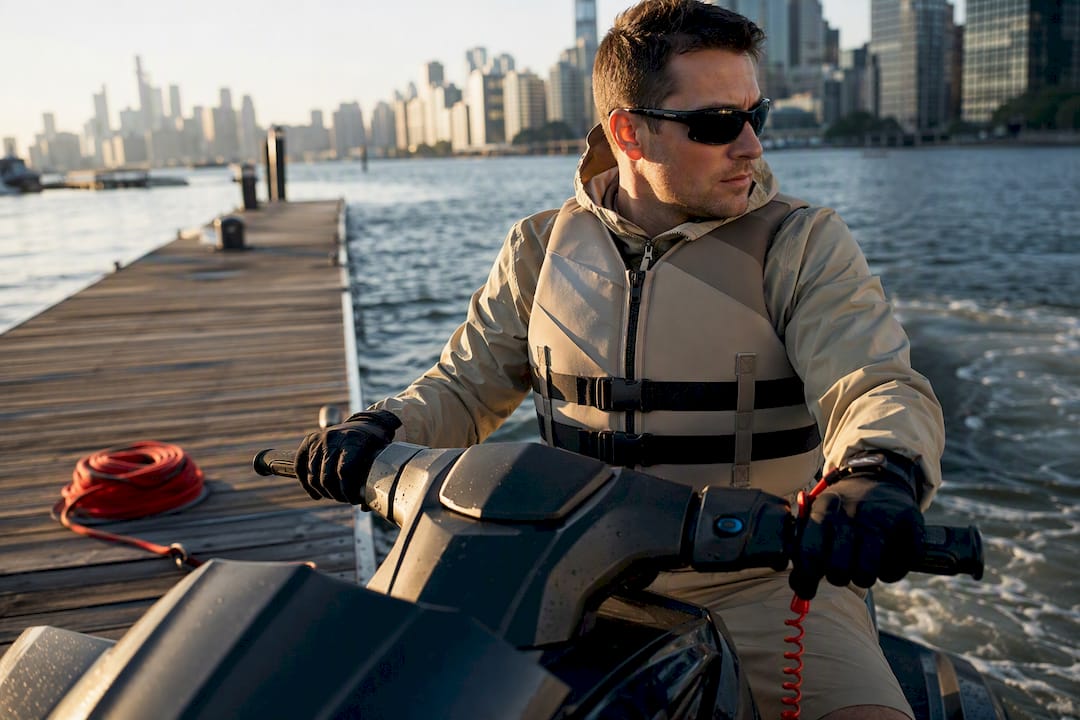
Carry either your original permanent certificate or show the DMV anchor icon if you added one. Beyond the certificate, keep your vessel registration, current validation sticker, personal flotation devices for every passenger, and for PWCs specifically, the ignition cutoff lanyard attached to the operator.
Also required: a sound-producing device and a visual distress signal for daytime use. Enforcement comes from NY State Police Marine units, county sheriffs’ marine patrols, and the U.S. Coast Guard, all of whom can stop vessels for safety checks. Typical penalties for missing certification include fines and being ordered ashore until you can produce proof of compliance.
- Renters: livery operators must provide safety briefings and equipment, but you still need to show ID and often a certificate for longer rentals.
- Keep documents in a waterproof pouch, not loose in a glove box or dry bag.
Pro Tip: Store a laminated copy of your certificate with your registration paperwork on board. Losing the original mid-season is a hassle you can avoid with a five-minute trip to any print shop.
Why Safe Boating America for Your NYC Course
Safeboatingamerica runs NASBLA-aligned, New York approved courses in online, live Zoom, and in-person formats, with dedicated options for boaters across NYC and Long Island. Students get same-day certification paths, guidance through the DMV anchor icon process, and instruction from experienced, state-certified teachers.
[Editorial note: instructor credentials and course-development background to be inserted here.]
An Instructor’s Take on Your First Season
Before your first outing, run through this: check registration and validation stickers, confirm PFDs fit everyone aboard, and test your PWC’s ignition cutoff lanyard. Update your DMV photo before requesting the anchor icon, and keep that 90-day temporary certificate somewhere you won’t lose it.
Practice docking and low-speed maneuvers in a quiet marina before you tackle open harbor traffic. New York waters get crowded fast, and confidence comes from reps, not the exam.
— Richard
Register for a NY-Approved Course Now
Safeboatingamerica is the direct path to full Brianna’s Law compliance for anyone who needs to operate a motorized vessel or PWC in New York City soon. Unlike piecing together a free online module and hoping it satisfies Part 451 recordkeeping rules, Safeboatingamerica’s online, live Zoom, and in-person courses are built specifically to New York’s approval standard, with instructors who help you through the DMV anchor icon steps if you want one.
Registration covers the full course, the exam, and issuance of your temporary certificate the moment you pass. Your permanent wallet card gets mailed automatically, and if your course includes a DMV vendor link, that submission happens on your behalf. If you’re planning to get on the water this season, register for a New York boating course now rather than scrambling the week before a trip.
Where to Verify These Rules Yourself
- NYS Parks Boating Education page for certificate basics and course finder tools.
- Part 451 regulatory text (PDF) for the full legal language behind Brianna’s Law.
- NY DMV Adventure License page to start the anchor icon request.
- Safe Boating America for a New York specific enrollment walkthrough.
This article is general information, not a substitute for advice from a qualified lawyer. Consult a qualified legal professional about your own circumstances before acting on anything here.
Sources
- Boating Education - New York State Parks & Historic Sites
- Safe Boating Education Rules and Regulations (Part 451) - NYS Parks
- Adventure Licenses - NY DMV
FAQ
Do I need a license to drive a boat in New York State?
Yes. As of the completed 2025 Brianna’s Law rollout, every operator of a motorized vessel, including PWCs, must hold and carry a NYS Boating Safety Certificate.
Is a NY boating certificate valid in other states?
It depends on the state. Many states accept a NASBLA-approved certificate from another state as equivalent, but you should check the destination state’s boating authority before relying on it, since standards and reciprocity rules vary.
Can I use my NY boating certificate in Florida?
Florida generally recognizes boating education certificates from other states that meet NASBLA standards, which New York’s does, but confirm current reciprocity rules with Florida’s boating authority before operating there.
Can you use a NY boating certificate in NJ?
New Jersey has its own boater education requirements and doesn’t automatically treat a New York certificate as a substitute for its own boating safety certificate. Check with New Jersey’s State Police Marine Services Bureau before operating a vessel there.
What happens if I only have a temporary certificate?
The temporary certificate is valid for 90 days and satisfies the carry requirement while your permanent card is mailed; keep it accessible on board or on your person during that window.