Maryland PWC Laws: Age, Certificate, Gear and Rules

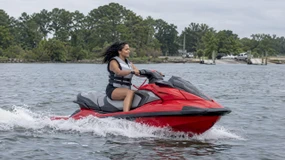
To operate a personal watercraft (PWC) in Maryland, the operator must be at least 16. An operator born on or after July 1, 1972 must also carry a boating safety education certificate. Everyone aboard wears a U.S. Coast Guard-approved life jacket, the craft needs an engine cutoff, and operation is banned between sunset and sunrise. This guide covers each Maryland jet ski rule, with the source for each.
TL;DR
- Age: The operator must be at least 16. A narrow grandfather clause covers certain 14-year-olds who met the old rules by January 1, 1996.
- Certificate: Operators born on or after July 1, 1972 must carry and show a certificate, with listed exemptions.
- Gear: A wearable Type I, II, III or V PFD for every person aboard, a B-I fire extinguisher, a sound-producing device and a working cutoff switch or self-circling device.
- Operation: No riding from sunset to sunrise, no speeds above idle in water under 18 inches deep, and 6 knots or less within 100 feet of shore, structures, swimmers or other vessels.
- Penalties: Fines apply. Impaired boating can bring up to $1,000 in fines, a year in jail and two years of lost boating privileges.
Table of Contents
- Who can operate a PWC in Maryland
- The Maryland boating safety certificate
- Required equipment on a Maryland PWC
- Where and when you can ride
- Towing skiers, tubes and other riders
- Prohibited conduct and penalties
- A pre-ride checklist for Maryland
- Our perspective
- Get certified
- FAQ
- Sources
Who can operate a PWC in Maryland
Maryland regulation COMAR 08.18.02.05 bars leasing, renting, operating or permitting the operation of a PWC unless the operator is at least 16. The only exception is a person at least 14 who met the former education requirement as of January 1, 1996. Almost no current rider falls under that clause, so plan on 16 as the floor.
The age limit is separate from the certificate. A 16-year-old who holds a certificate can ride. A 15-year-old with a certificate cannot. Parents often miss this: passing a course does not lower the age.

The same rule applies to owners who lend a craft. Permitting an underage person to operate your PWC is covered by the regulation, so the owner shares the responsibility.
The Maryland boating safety certificate
Under Natural Resources Article §8-712.2, a person born on or after July 1, 1972 must obtain, carry and show on demand a certificate of boating safety education when operating a numbered pleasure vessel. A PWC is a numbered vessel, so the rule applies to it.
Certificates Maryland accepts
The statute accepts qualifying certificates in place of a Maryland one. These include certificates issued by:
- The U.S. Coast Guard
- The Coast Guard Auxiliary
- The U.S. Power Squadron
- Local boards of education
- Another state, under National Association of State Boating Law Administrators (NASBLA) criteria
If you already hold a NASBLA-approved certificate from another state, that is the route the statute describes. Carry the physical card or the printed certificate, because the duty is to show it on demand.
Exemptions
The statute lists exemptions, including certain out-of-state visitors, foreign visitors, boating on private property and commercial operation. Read the statute text for the exact conditions before you rely on one. For a plain-language walkthrough of who needs a card, see our guide to Maryland boating license requirements.
Rentals
For a rented PWC, the livery regulation generally requires the renter to be at least 16 and, if born after July 1, 1972, to hold a certificate. A qualifying livery agreement can replace the certificate if the livery:
- Provides education materials.
- Administers a written test with a minimum 90% score.
- Uses certified guides where the Department of Natural Resources (DNR) requires them.
The 16-year minimum still applies to renters.
Required equipment on a Maryland PWC
The U.S. Coast Guard describes federal equipment rules as minimums, and operators may also need to meet state requirements. Maryland adds its own PWC items.
| Item | Maryland requirement | Source |
|---|---|---|
| Life jacket | Wearable USCG-approved Type I, II, III or V PFD on every person aboard | COMAR 08.18.02.05 |
| Engine cutoff | Self-circling device or lanyard-type cutoff switch; an installed lanyard must work and be attached to the operator, clothing or PFD | COMAR 08.18.02.05 |
| Fire extinguisher | Approved B-I, in working order | DNR PWC brochure |
| Sound device | Whistle or horn | DNR PWC brochure |
| Registration | Registered with DNR, numbers and validation decals displayed correctly | DNR PWC brochure |
| Papers | Vessel-number certificate on board, plus your boating safety certificate when it applies | DNR equipment checklist |
Life jackets
PWC riders fall and get thrown at speed, which is why Maryland requires a wearable jacket and not one stowed under the seat. Choose a jacket rated for water sports, fitted snugly. If you are comparing fits and ratings, our guide to life jacket regulations explains the types. Traveling with dogs and planning a rental? These pet-friendly boat rentals show how groups plan a day on the water, and life jackets stay on everyone who rides.
Cutoff lanyard
Attach the lanyard to your wrist, clothing or PFD every time you start the engine. If you fall off, the engine stops and the craft does not circle away or run over you. For a full checklist, see PWC safety gear and the U.S. PWC safety rulebook.
Where and when you can ride
Maryland sets operating conditions in COMAR 08.18.02.05.
Time and visibility
- No operation between sunset and sunrise.
- No operation in restricted visibility.
Plan the return leg early. Dusk comes sooner on the Chesapeake than most riders expect, and a late finish is a violation, not a close call.
Shallow water
A PWC may not go above idle speed in Maryland waters less than 18 inches deep. The regulation carves out one exception: maintaining speed in a crossing or overtaking situation under the federal navigation rules.
Distance and speed limits
| Waters | Rule |
|---|---|
| All Maryland waters except the Atlantic Ocean | 6 knots or less within 100 feet of shore, structures, people in the water or another vessel |
| Maryland Atlantic waters | At least 300 feet from people in the water and surf fishermen; 6 knots or less within 100 feet of a wharf, pier or jetty |
PWCs have no brakes or reverse for stopping forward momentum and no steering control at idle, according to DNR. Leave extra room around swimmers and docks, because releasing the throttle does not stop you from drifting forward.
Local and temporary restrictions
Counties, lakes and Coast Guard zones can add rules. Deep Creek Lake, for example, has its own regulations on vessel size and use. The Coast Guard also issues temporary special local regulations for events. In 2026 one covered Choptank River waters near Cambridge during a powerboat race, and nonparticipants needed authorization to enter. Check current Coast Guard notices and DNR guidance before riding near a regatta or race.
Towing skiers, tubes and other riders
Towing a person on water skis, an aquaplane or a similar device is allowed only with a PWC manufactured for three people. It must carry the driver, a rear-facing observer and the skier. The rule is in COMAR 08.18.02.05. DNR’s PWC brochure states that the observer must be at least 12 years old.
A two-seat craft cannot legally tow a skier, even with a spotter on shore. Count seats before you attach a rope.

Prohibited conduct and penalties
DNR lists these as prohibited:
- Jumping the wake of another vessel within 100 feet
- Reckless or negligent operation
- Speeding in shallow water
- Operating within 300 feet of people in the water or surf fishing in the Atlantic
Violations can carry fines up to $500. The DNR brochure gives further examples of negligent operation:
- Riding backward
- Standing on the seat
- Reckless operation in congested areas
- Splashing or buzzing swimmers, piers or boaters
Certificate violations are a misdemeanor. The statute sets a fine not exceeding $25 for a first offense and not exceeding $500 for a subsequent offense within two years of a prior conviction (§8-712.2).
Impaired boating is the heaviest penalty. DNR reported in July 2026 that a conviction can carry up to $1,000 in fines, one year in jail and two years of lost boating privileges. The same enforcement report recorded a negligent-PWC citation, which shows that these rules are enforced on busy weekends.
A pre-ride checklist for Maryland
- Confirm the operator is 16 or older.
- Confirm the certificate if the operator was born on or after July 1, 1972, and carry it.
- Check the registration decals and keep the vessel-number certificate aboard.
- Fit a wearable PFD on every passenger.
- Test the cutoff lanyard and attach it before starting.
- Check the B-I extinguisher and the horn or whistle.
- Plan the return before sunset.
- Look up local notices for the waters you will ride.
Our perspective
Most violations we hear about are not reckless. They are missed details: a 15-year-old with a card, a certificate left at home, a lanyard not clipped on, a ride that ran past sunset.
Our approach is to teach the law as a working routine. Our State Certified Instructors and USCG-Licensed Captains use NASBLA-approved materials, so students leave with the certificate and the habits behind it. We offer online, live Zoom and in-person formats because riders have different schedules.
Maryland riders who learn the rules once ride with more confidence, and that confidence is worth more than the course.
Richard
Get certified
If you need a certificate, we offer online computer-based boating safety courses that are designed to meet state education requirements. Our Zoom Online 1-Day Class is $75, and you take it live with an instructor. Before enrolling, confirm which format suits you and which certificate your state expects.
Buying for someone else? Our gift certificates are $75 to $85. Riding in other states? See our Florida PWC laws and California PWC laws guides.
FAQ
Do I need a license to ride a jet ski in Maryland?
Maryland issues a boating safety education certificate, not a separate license. If you were born on or after July 1, 1972, you must carry it while operating a PWC. Every operator must also be at least 16.
Can a 14-year-old or 15-year-old ride a PWC in Maryland?
Generally no. The minimum operating age is 16, even with a certificate. A narrow grandfather clause covers certain people at least 14 who met the former requirements by January 1, 1996.
Do I have to wear a life jacket on a jet ski in Maryland?
Yes. Every person aboard must wear a U.S. Coast Guard-approved Type I, II, III or V PFD. The jacket must be worn, not just carried.
Can I ride a jet ski at night in Maryland?
No. PWC operation is not allowed between sunset and sunrise, or in restricted visibility. Plan to be back on shore before sunset.
What is the penalty for breaking Maryland PWC rules?
DNR lists fines up to $500 for prohibited PWC conduct. Certificate violations carry a fine not exceeding $25 for a first offense. Impaired boating can carry up to $1,000 in fines and a year in jail.
Sources
- COMAR 08.18.02.05, Restrictions (Maryland regulations)
- Natural Resources Article §8-712.2 (Maryland General Assembly)
- COMAR 08.04.08.02, Personal Watercraft Livery Operation
- Maryland DNR, Personal Watercraft Regulations brochure
- Maryland DNR, Required Equipment Checklist
- Maryland DNR, Personal Water Craft
- U.S. Coast Guard, Boater’s Guide to the Federal Requirements
- Maryland DNR, NRP Independence Day weekend report (2026)
- Federal Register, Special Local Regulation, Choptank River, Cambridge, MD
- Pet-friendly boat rentals