California PWC Laws: Boater Card, Age Limits and Rules

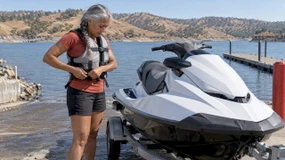
California requires anyone 16 or older to hold a California Boater Card to operate a personal watercraft (PWC) such as a Jet Ski or WaveRunner. Riders ages 12 to 15 may operate one only with a card-holding adult at least 18 years old on board. Every rider must wear a Coast Guard-approved life jacket, and PWC operation after sunset is prohibited. This guide covers the card, the age rules, the equipment, the operating rules and the penalties, with a link to the official source for each.
TL;DR
- A California Boater Card is required for operators 16 and older of any vessel with a motor of 15 hp or more, which includes nearly every Jet Ski.
- Ages 12 to 15 may operate a PWC only when supervised on board by someone 18 or older who holds a Boater Card.
- Everyone on a PWC wears a Coast Guard-approved life jacket. Operation between sunset and sunrise is prohibited.
- Operating with a blood alcohol concentration of 0.08% or more is illegal, and officers can arrest below that level if conditions are unsafe.
- Out-of-state certificates are not accepted for the card, but short-term visitors are exempt if they meet their home state’s requirements.
Table of Contents
- Do you need a license to ride a Jet Ski in California?
- California PWC age rules at a glance
- How to get a California Boater Card
- Who is exempt from the Boater Card?
- Equipment every PWC must carry
- Operating rules: where, when and how
- Alcohol and boating under the influence
- What happens if you ride without a card
- Common mistakes California PWC riders make
- Our perspective
- Getting certified with Safe Boating America
- Planning a trip outside California
- FAQ
- Sources
Do you need a license to ride a Jet Ski in California?
California does not issue a “license” in the driver’s-license sense. It issues the California Boater Card, which is proof that you completed an approved boating safety course and passed the exam. In everyday speech people call it a boating license or a Jet Ski license. The legal requirement is the card.
The state’s boating rules page says people 16 or older must have a California Boater Card to operate a vessel powered by a motor of 15 hp or more, and that includes a PWC. Most Jet Skis and WaveRunners are well above 15 hp, so in practice the answer for a rental, a borrowed machine or one you own is yes.
The requirement applies regardless of how experienced you are. A rider who has operated PWCs for twenty years still needs the card. The program is built around education rather than a skills test on the water, which is why the course and exam are the only hurdles.

The state’s boating education program summary describes the Boater Card as part of its boating safety education and outreach effort for operators of motorized vessels.
California PWC age rules at a glance
| Operator age | Can operate a PWC? | Condition |
|---|---|---|
| Under 12 | No | Cannot operate a vessel with a motor of 15 hp or more |
| 12 to 15 | Yes, supervised | A person at least 18 years old who holds a Boater Card must be on board |
| 16 and older | Yes | Must carry a California Boater Card |
The 12 to 15 rule comes from the state’s boating laws and license requirements page. Note what it says: the supervisor must be on board, not watching from shore or from another boat. The supervising adult must also have a Boater Card themselves.
For a closer look at how the age line moved, see our breakdown of California Jet Ski age rules. For how California compares with other states, our guide to boating license age across the U.S. shows the typical 12 to 16 range and how horsepower thresholds differ.
How to get a California Boater Card
The path is the same for Jet Ski operators and boat operators.
- Take an approved course. The course must be on the state’s approved list. The state’s own home study course is free to take and free to test, and private providers may charge their own fees.
- Pass the exam. Courses end in an exam. Keep the completion record.
- Apply for the card. The only required state fee is a one-time $10 application fee plus a $1 service fee, according to the state’s course page.
- Carry the card when you operate. Not carrying a required card can result in a fine.
One point trips up many riders. The California application requires a certificate from one of the state’s approved courses. A certificate or card from another state does not substitute for it. Check that the course you choose appears on the state’s approved list before you pay for it.
Choosing a course format
The formats you will see fall into three types:
- Self-paced online courses. Work through the material on your own schedule, then take the exam.
- Live online classes. An instructor teaches on video with scheduled start times, which suits people who learn better with questions answered in real time.
- In-person classes. A classroom with an instructor, usually completed in a day.
The state treats all approved formats the same: what counts is that the provider is approved. Pick the format that matches how you learn, and confirm the approval status first.
Who is exempt from the Boater Card?
Visitors get a window. Out-of-state residents who are temporarily in California for less than 60 days, and foreign residents here for less than 90 days, are exempt from the card requirement, provided they meet the boating requirements of their home state or country.
That last condition matters. If your home state requires a course for PWC operators and you have not taken it, the exemption does not cover you. A Nevada or Arizona resident who rents a Jet Ski at Lake Havasu’s California side or at a Southern California coastal rental must still satisfy the rules at home.
If you move to California or stay longer than the exemption window, the card requirement applies to you, and an out-of-state certificate will not satisfy the application.

Rental outfits often ask to see proof of certification before handing over keys. Having your card or home-state certificate ready avoids a denied rental.
Equipment every PWC must carry
The state’s boating rules set a short list of equipment that applies to a PWC:
- A Coast Guard-approved life jacket for each occupant. On a PWC, occupants must wear it while on the water, not just have it stowed.
- A whistle or other sound-producing device. The same state page lists this for powered vessels.
- Current registration. The PWC must be registered and the registration current.
Life jackets matter more than most riders assume. In 2023, 87 percent of drowning victims were not wearing life jackets, according to California State Parks. Falling off a PWC at speed is routine, and a jacket keeps you afloat if the fall stuns you.
Two practical notes from our own classes. First, fit matters: a jacket that rides up over your chin when you pull the straps is too big. Second, check the label for Coast Guard approval, since a swim vest or a pool toy does not qualify.
Operating rules: where, when and how
Sunset to sunrise
PWC operation is prohibited between sunset and sunrise, even if the craft is equipped with navigation lights. Plan your return trip with margin. Launch ramps get crowded in the last hour of daylight, and a delay at the ramp should not push you into a violation.
Speed and restricted zones
Local rules differ by waterway. At Folsom Lake, for example, the speed limit is 5 mph or idle speed within 200 feet of shore or designated swim areas. Other lakes, harbors and coastal areas have their own posted limits, no-wake zones and closures. Read the signs at the ramp and ask the rental staff or the park office.
Spraying and harassing
Spraying another vessel or person is illegal, as the state parks guidance for Folsom Lake states. The same page notes that a PWC at that lake must be off the water before sunset.
Same rules as other motorboats
PWCs operate under the same navigation rules as other motorized vessels. You yield, pass and keep clear of others exactly as a powerboat operator would. PWCs are fast and agile, and California State Parks points out that they are involved in a disproportionately high number of boating accidents, citing inexperience, excessive speed and operator inattention.
Quick operating checklist
| Rule | What to do |
|---|---|
| Life jacket | Wear a Coast Guard-approved jacket at all times on the machine |
| Daylight only | Be off the water by sunset, not at sunset |
| Speed near shore | Slow to idle speed where posted |
| Other vessels and people | Keep clear and never spray them |
| Alcohol | None before or during operation |
| Paperwork | Boater Card and registration on board |
Alcohol and boating under the influence
Operating a vessel, water skis or a similar device with a blood alcohol concentration of 0.08% or more is prohibited in California. Operating under the influence of intoxicating liquor or drugs is illegal regardless of the number.
The 0.08% figure is not a safe harbor. Officers may arrest boaters below 0.08% if conditions are deemed unsafe. Sun, wind, noise and vibration add fatigue on the water, so a drink does more than it would on land. The state notes that alcohol impairs judgment and reaction times, and on a PWC reaction time is the whole game.
The penalty is serious. A first-offense boating under the influence conviction can result in up to six months in jail and/or fines up to $1,000. Our guide to boating under the influence laws and penalties covers the federal and state picture in more detail.
What happens if you ride without a card
The state says that not carrying a required California Boater Card can result in a fine. The exact amount depends on the citation and the court, so check with State Parks or the agency that stopped you rather than relying on a figure from a forum.
The fine is the smaller risk. A rental company can refuse you on the spot, and if you are in an accident without a card, the lack of training becomes part of the story with insurers and investigators. Taking the course takes about a day and costs less than a tank of fuel for a weekend.
Common mistakes California PWC riders make
- Assuming a rental company covers you. The rental may give a short orientation, but the legal requirement for the card stays with you.
- Using a certificate from another state. California does not accept it for the card, even if the course was NASBLA-approved elsewhere.
- Letting a 14-year-old ride with a friend’s older sibling. The supervisor must be 18 or older and hold a Boater Card.
- Cutting the evening short by ten minutes. Sunset is a hard limit, not a suggestion.
- Treating one drink as harmless. Under-0.08% arrests are possible if conditions are unsafe.
Our perspective
We teach boating safety for a living, and PWC riders are the group we worry about most. The machines are easy to start and hard to control at speed. A new rider can reach 40 mph in seconds with no sense of how long it takes to stop, and a PWC has no brake. The Boater Card course is not a formality. The material on right of way, stopping distances and shoreline rules is what keeps people out of the accident statistics the state describes.
Our advice has three parts. Take the course before the season, not the week of your trip. Practice in open water away from other boats before you go anywhere busy. And treat the sunset and life jacket rules as non-negotiable, because they are the two that show up most often when something goes wrong.
We also encourage parents of 12 to 15-year-olds to ride with their child on board during the first several outings. The law sets the minimum. It does not say a child is ready for a busy lake. Learning local waterways with an experienced person beside you is worth more than any paragraph in a course.
— Richard
Getting certified with Safe Boating America
We offer state-approved boating safety courses for operators across the United States, including online computer-based courses and live Zoom classes with an instructor. Our instructors are state certified instructors and USCG-licensed captains. If you want a class on a schedule rather than a self-paced one, our Zoom online 1-day class and private classes are an option, and you can also ask about on-water training for practical skills. To compare formats, see our online boating courses.
Before you register for any course, confirm that it is on California’s approved list, since the Boater Card application requires a certificate from an approved California course. Gift certificates are also available if you want to cover a family member’s course. Our full walkthrough of PWC license requirements covers the process step by step.
Planning a trip outside California
Rules change at the state line. If you ride in more than one state, check each one before you launch. Florida has its own age, education card and penalty rules for PWCs, and states such as Arizona and Nevada set their own age and horsepower thresholds. A California card does not automatically satisfy another state’s rules, and the reverse is true as well.
FAQ
Do you need a jet ski license in California?
Yes. Anyone 16 or older operating a PWC, or any vessel with a motor of 15 hp or more, must have a California Boater Card. You earn it by completing an approved course and exam and applying to the state. Riders 12 to 15 can operate only with a Boater Card-holding adult at least 18 on board.
Can a visitor from another state ride a Jet Ski in California?
Yes, for a limited time. Out-of-state residents in California for less than 60 days, and foreign residents for less than 90 days, are exempt if they meet their home state’s or country’s requirements. Longer stays require the California card, and out-of-state certificates are not accepted for the application.
Can you ride a PWC at night in California?
No. PWC operation is prohibited between sunset and sunrise, even with navigation lights. Plan to be back on the trailer before sunset, not heading in at sunset.
What safety gear is required on a Jet Ski?
Every occupant must wear a Coast Guard-approved life jacket. The PWC also needs a whistle or other sound-producing device and current registration. Carry your Boater Card with you while operating.
Sources
- Boating laws, rules and license requirements, California State Parks
- DBW Commission Boating Education and Outreach Program Summaries
- Quick Codes, California Division of Boating and Waterways
- Boating Safety and General Information, California State Parks
- Boating Safety Classes and Courses, California State Parks
- Division of Boating and Waterways urges safe boating, California State Parks news release
- California Boating Laws fact sheet, DBW
- California Course for Safe Boating, DBW