Do These 5 Tasks This Week: First Time Boat Owner Checklist
Register the title first, activate insurance before the engine ever starts, verify every USCG-required safety item is aboard and accessible, then enroll in a state-approved boating safety course. Build a vessel data sheet with serial numbers and service contacts while you’re at it. Do those five things in your first week, and you’re legal, insured, and ready for calm-water practice.
TL;DR:
- Ensuring your boat is registered and the title transferred before the first outing is mandatory to avoid citations and legal issues.
- Purchasing insurance covering liability, hull damage, and trailer protection is essential, as most marinas and ramps require proof before launching.
- Meeting USCG baseline safety equipment requirements, including approved PFDs, fire extinguishers, signaling devices, and navigation lights, is non-negotiable for safety and compliance.
- Verifying that your tow vehicle exceeds the boat’s total weight and practicing trailer hookups in advance prevents accidents and logistical delays.
- Enrolling in a state-approved boating safety course and sharing a float plan significantly improves safety, legal compliance, and insurance discounts.
Table of Contents
- First Time Boat Owner Checklist: Day-One to Week-One Tasks
- Registration, Title, and Paperwork You Need Right Away
- Insurance: What to Buy and Why It Matters Now
- Required Safety Equipment and USCG Baseline Requirements
- Trailering and Tow-Vehicle Checks
- Storage and Berthing: Where Will the Boat Live?
- Maintenance and Service Schedule to Set From Day One
- Training and Education: State-Approved Courses and Practical Lessons
- Pre-Departure Routine and Launching Checklist
- Provisioning and the Vessel Data Sheet
- Common Rookie Mistakes and Quick Expert Tips
- Basic Handling Skills: Docking, Launching, and Anchoring
- Understanding Boat Types and Selecting the Right Boat
- Budgeting for Ongoing Costs: Fuel, Maintenance, Mooring, and Repairs
- Emergency Preparedness: Man Overboard and Mechanical Failure
- Navigation Basics: Marine Charts and GPS Devices
- Communication Equipment and VHF Radio Protocols
- Author Perspective: Using This Checklist Through Your First Season
- Get State-Approved Certification Before Your Next Trip
- Sources
- FAQ
First Time Boat Owner Checklist: Day-One to Week-One Tasks
New boat owners lose the most time chasing paperwork they should have grabbed at handover. Work through these steps in order, and you’ll be legally compliant and safety-checked before your first real outing.
- Audit the handover. Confirm you have the bill of sale, Hull Identification Number (HIN), all keys, and a full inventory list of what’s included.
- Handle admin first. Transfer the title, register the boat with your state, and check that the trailer has its own valid title and registration.
- Buy and activate insurance. Coverage needs to include the boat, the trailer, and every named operator before the boat touches water.
- Run a safety audit. Check PFDs, fire extinguishers, flares or other visual signals, a sound-signaling device, and navigation lights.
- Pack basic spares and tools. Fuses, a spare bulb, a spare impeller, and a compact toolkit belong on every first trip.
- Plan your first outings for calm conditions and file a float plan with someone on shore before you leave the dock.
Each step protects you legally, financially, or physically. Skipping the audit step is the most common mistake, since sellers rarely hand over a complete inventory unprompted.
Registration, Title, and Paperwork You Need Right Away
Title transfer and state registration come first because operating an unregistered vessel is a citable offense in most states. Keep the bill of sale and HIN documented and accessible, both onboard and in a digital backup.
- File the title transfer and complete state registration before your first outing.
- Store the original bill of sale and HIN paperwork in a waterproof pouch onboard.
- Build a vessel data sheet listing engine serial numbers, filter sizes, battery types, and service contacts.
- Save a digital copy of every document to your phone or cloud storage for fast retrieval.
Insurance: What to Buy and Why It Matters Now
Boat insurance isn’t optional if you plan to dock, launch, or tow legally at most marinas and ramps. Buy coverage before you activate anything else on this checklist.
- Liability coverage protects you if you damage another vessel, dock, or person.
- Hull or physical damage coverage protects your own investment against collision, fire, or sinking.
- Trailer coverage and towing/roadside assistance matter as much as hull coverage for trailerable boats.
- Check policy details like cruising area limits, named operators, and whether you’re getting agreed value or actual cash value (ACV) payouts.
Marinas and dealers frequently require proof of active insurance before they’ll release the boat or grant slip access.
Required Safety Equipment and USCG Baseline Requirements
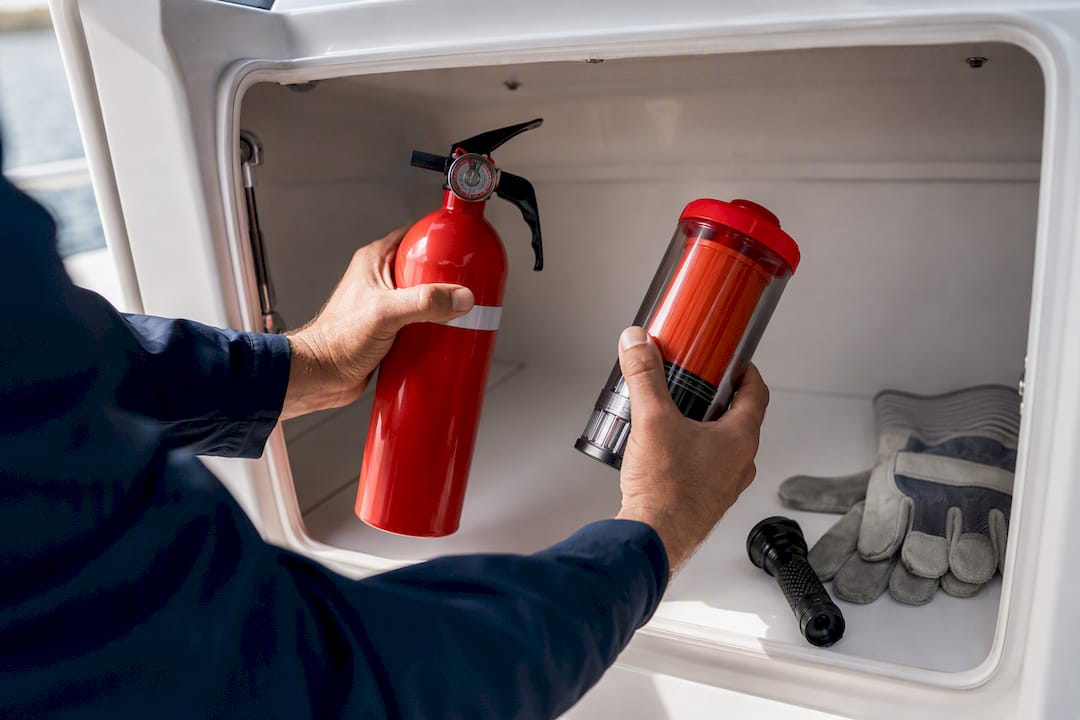
Federal and state regulations set the floor for what you need aboard, and skipping this step risks both a citation and your safety. USCG boating safety requirements mandate one USCG-approved personal flotation device per person, accessible fire extinguishers, a sound-signaling device, and visual distress signals.
- One USCG-approved PFD per person, sized correctly and stored where everyone can reach it fast.
- Visual distress signals appropriate for your waters.
- A sound-signaling device such as a horn or whistle.
- Fire extinguishers rated for your boat size, mounted where you can grab them in seconds.
- Working navigation lights if you’ll be out near dawn, dusk, or after dark.
Pro Tip: Add a VHF radio, a throwable flotation device, spare PFD lanyards, a real first-aid kit, and an EPIRB or PLB if you’ll ever run offshore. None of those are optional extras once you’re a mile from the ramp.
Check expiration dates on flares and extinguishers now, not the morning of your first trip.
Trailering and Tow-Vehicle Checks
Towing mismatches wreck more first trips than mechanical failures do. Discover Boating’s first-time owner guidance recommends verifying your tow vehicle’s maximum tow rating and Gross Combined Vehicle Weight Rating (GCVR) exceed the total loaded weight of boat, trailer, fuel, and gear.
- Confirm tow rating and GCVR against your actual loaded weight, not the boat’s dry weight alone.
- Inspect wheel bearings, brakes, lights, tires, and pack a proper spare tire.
- Check the hitch, ball size match, and safety chains before every tow.
Pro Tip: Practice hooking up, braking, and backing the trailer in an empty lot before your first real launch. A trailering checklist run through once at home saves you from doing it under pressure at a crowded ramp.
Storage and Berthing: Where Will the Boat Live?
A marina slip gives easy water access but costs more and exposes the hull to constant moisture. Dry stack storage protects the hull better and often speeds up launch service, but it usually costs more than trailer storage and limits spontaneous trips.
- Marina slip: convenient access, higher monthly cost, more exposure to weather and marine growth.
- Dry stack storage: strong hull protection, faster launch service, higher price tag.
- At-trailer storage: cheapest option, but it means towing every time you want to go out.
Confirm your berth agreement, verify your insurance covers that storage type, and check local parking rules before committing. Reserve or confirm your spot now, and exchange emergency contacts with the marina or storage facility.
Maintenance and Service Schedule to Set From Day One
A simple recurring calendar prevents small issues from becoming expensive ones. Set reminders now, before the season gets busy.
- Schedule oil and filter changes, fuel filter swaps, anode or zinc checks, battery tests, and bilge pump function tests on a recurring basis.
- Log every service with the date, parts used, and who performed the work on your vessel data sheet.
- Winterize the engine and systems if you’re in a cold climate, and follow an antifouling schedule if your hull requires it.
Recording detailed service history and part numbers on day one saves real time later, according to one experienced boater’s account of her first year of ownership — it prevents ordering the wrong filter twice.
Training and Education: State-Approved Courses and Practical Lessons
State boating education requirements exist because USCG federal regulations tie approved courses to lower accident rates, and many insurers recognize completion with premium discounts. NASBLA-aligned courses cover navigation rules, safety procedures, and emergency response, which makes them worth more than a quick read through your state’s boating handbook.
- Confirm the provider is state-approved and NASBLA-aligned before you register.
- Choose a format that fits your schedule: online self-paced, live Zoom, or in-person.
- Look for programs that add practical on-water instruction, not just a multiple-choice test.
- Check that instructors carry real credentials, such as USCG-licensed captain status.
Enroll in an approved course this week, then schedule your first calm-water practice session right after certification.
Pre-Departure Routine and Launching Checklist
A short, repeatable pre-departure routine prevents most of the errors that turn a fun trip into a bad one. Run through this list before every single outing, not just the first one.
- Check weather and tide conditions for your route and return time.
- Inspect the bilge, fuel level, and battery charge.
- Confirm safety gear is aboard and navigation lights work.
- Brief your crew and assign roles, then warm up the engine and test the radio.
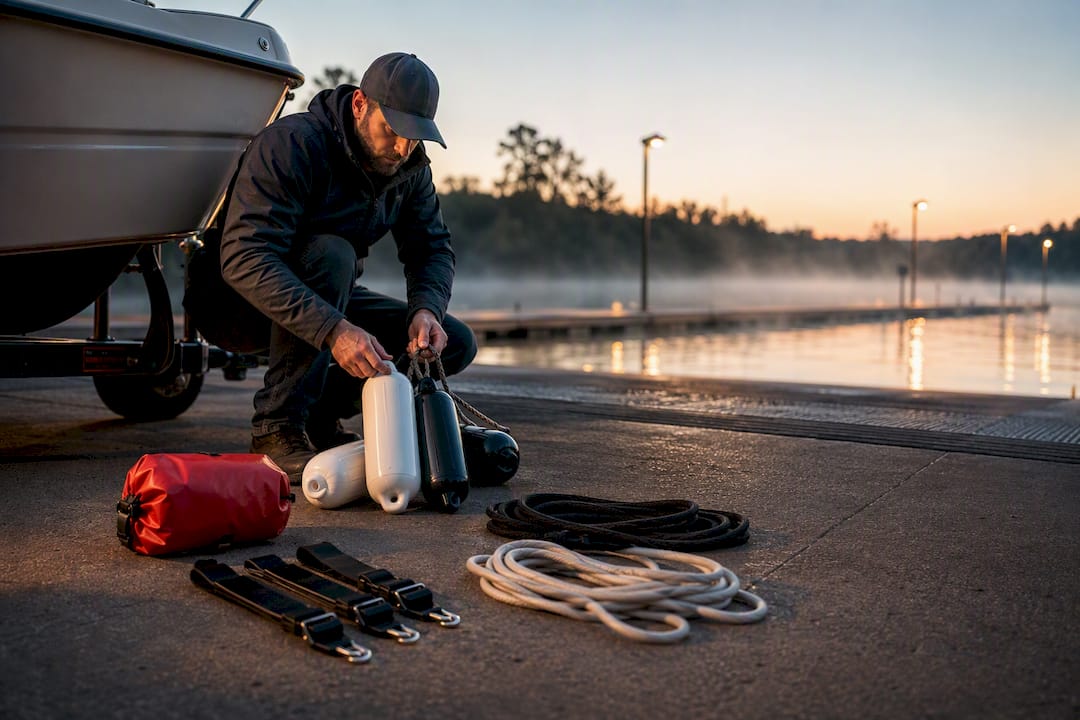
- Prep fenders and lines, file a float plan, and confirm the marina’s departure and return procedures.
Provisioning and the Vessel Data Sheet
Pack water, snacks, a basic tool kit, spare lines, spare fuses and bulbs, and a throwable flotation device for every outing. Your vessel data sheet should list the HIN, engine serial numbers, battery specs, filter and impeller sizes, and service contacts. Keep the original onboard and back it up digitally.
Common Rookie Mistakes and Quick Expert Tips
Learning to dock for the first time at a crowded public ramp is a rookie mistake that never ends well. Practice slow-speed maneuvering in quiet water first.
- Never assume included gear is compliant or even functional; audit everything yourself.
- Budget roughly 10% of your boat’s value annually for running costs as a planning guideline.
Pro Tip: Schedule your first dozen outings around simple maneuvers on calm, off-peak days. Muscle memory builds faster without an audience watching you fumble the dock line.
Basic Handling Skills: Docking, Launching, and Anchoring
Docking intimidates new owners more than any other skill, mostly because wind and current do things a classroom never mentioned. The fix is repetition in low-stakes conditions. Approach the dock slowly, angle in against the wind or current rather than fighting it, and use short bursts of throttle instead of long pushes. Keep a boat hook and extra line within reach before you commit to the approach.
Launching from a ramp runs smoother when you prep everything before backing the trailer down. Load the boat with fenders and lines ready, disconnect tie-downs at the top of the ramp (not at the water’s edge holding up a line of trucks), and back down slowly with a spotter if you have one. Start the engine and check for water flow from the exhaust before releasing the winch strap completely.
Anchoring correctly means matching anchor type and rode length to your bottom conditions and depth, not just tossing it over the side. A general rule is to let out five to seven times the water depth in rode for a solid hold in typical conditions, then back down gently to set the anchor before cutting the engine. Check your position against a fixed landmark for the first few minutes to confirm you’re not drifting.
None of these skills come from reading alone. Practicing docking and slow-speed handling on calm, off-peak days before attempting a busy marina builds the reflexes that keep a bad moment from becoming an expensive one.
Understanding Boat Types and Selecting the Right Boat
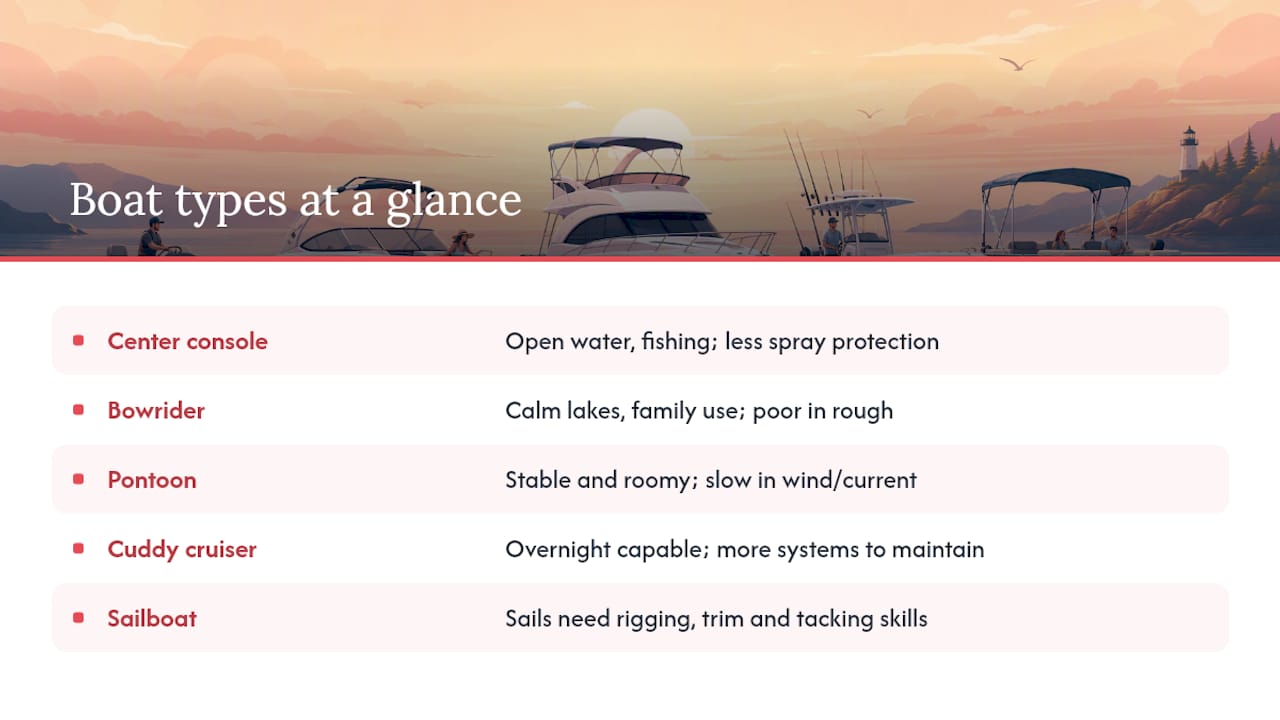
If you already own the boat, this section is really about understanding what you have and what it’s actually built for. Center console boats handle open water and fishing well but offer less protection from spray and weather. Bowriders suit calm lakes and family outings, with more seating but less capability in rough conditions. Pontoon boats prioritize stability and deck space over speed, which makes them forgiving for beginners but slower to respond in current or wind.
Deck boats split the difference between bowriders and pontoons, offering wider decks with a bit more performance. Cuddy cabins and small cruisers add overnight capability but bring more systems (plumbing, electrical, refrigeration) that need maintenance attention. Sailboats introduce an entirely different skill set: sail trim, tacking, and points of sail replace throttle control as the primary handling concern, and a first time sailing checklist should cover rigging inspection alongside standard safety gear.
Knowing your hull type changes how you approach every other item on this list. A deep-V hull handles chop better but rides rougher at slow speeds; a flat-bottom hull is smoother in calm water but pounds in waves. Match your handling practice and safety margins to what your specific hull actually does, not to generic advice written for a different boat class. If you inherited or bought used without full documentation, your vessel data sheet becomes even more valuable for identifying exactly what systems and specs you’re working with.
Budgeting for Ongoing Costs: Fuel, Maintenance, Mooring, and Repairs
Most new owners underestimate ongoing costs by focusing only on the purchase price. Fuel costs vary widely by engine size and how often you run at cruising speed versus idle, but they add up fast on larger outboards and inboards. Maintenance costs include the recurring items already covered (oil, filters, anodes) plus unexpected repairs that surface once you actually put hours on the engine.
Mooring or storage fees run monthly whether you choose a marina slip, dry stack, or trailer storage, and they’re often the largest recurring line item after insurance. Insurance premiums themselves shift based on boat value, coverage type, and where you keep the boat. Winterizing, seasonal haul-outs, and bottom paint (where required) add periodic costs that catch first-year owners off guard because they don’t happen monthly.
The 10% annual guideline from Boating Industry gives you a reasonable planning number: if your boat is worth $30,000, budget around $3,000 a year for berthing, insurance, maintenance, and fuel combined. That figure won’t match every situation exactly, since a boat kept at a cheap trailer yard costs less to run than one in a premium marina slip, but it beats guessing. Track actual spending against that number in your first year so your second-year budget reflects reality instead of assumption.
Emergency Preparedness: Man Overboard and Mechanical Failure
A man-overboard situation demands immediate, practiced response, not improvisation. The moment someone goes over, shout “man overboard,” point continuously at the person’s location, and throttle back immediately. Turn the boat back toward the person using a tight turn (a Williamson turn works well for larger vessels), approach from downwind or down-current so the boat drifts toward the person rather than away, and cut the engine before anyone reaches to pull them aboard. Practice this maneuver with a floating cushion on a calm day so your crew knows the drill before it matters.
Mechanical failure usually announces itself early: a warning light, an odd vibration, or a change in engine sound. Kill the throttle immediately if you notice smoke, unusual noise, or a sudden loss of power, and check the bilge for water intrusion. If the engine won’t restart, deploy your anchor first to hold position, especially near channels or rocks, then radio for assistance or signal with your visual distress signals if you’re out of radio range.
Every emergency plan works better when someone on shore knows where you are. Filing a float plan before departure, covered earlier in the pre-departure checklist, gives rescuers a starting point if you don’t return on schedule. Keep your first-aid kit accessible, not buried under gear, and make sure every person aboard knows where the PFDs and fire extinguisher are stored before you leave the dock.
Navigation Basics: Marine Charts and GPS Devices
Paper marine charts still matter even in a GPS-driven world, because electronics fail and batteries die. Learn to read depth soundings, buoy markers, and channel markings on a paper chart of your local waters before you rely entirely on a screen. Red and green markers indicate channel sides (remember “red right returning” when heading upstream or into a harbor), while numbered buoys mark specific hazards or channel edges.
A GPS chartplotter or a marine app on a waterproof phone case adds real value for route planning, tracking speed over ground, and marking waypoints like your favorite fishing spot or a safe return course. Cross-check your GPS position against visible landmarks and paper chart features periodically, especially in unfamiliar water, since GPS can occasionally show inaccurate positioning near shorelines or in areas with poor satellite reception.
Depth matters as much as direction. Watch your depth finder continuously in unfamiliar water, and know your boat’s draft (how much water it needs under the hull) before you approach a shallow inlet or sandbar. Running aground is one of the most common first-year mistakes, and it’s almost always preventable with basic chart awareness and a working depth finder.
Communication Equipment and VHF Radio Protocols
A VHF radio is the single most important communication tool aboard, more reliable than a cell phone once you’re out of signal range. Channel 16 is the international distress and calling channel, monitored by the Coast Guard and other vessels. Use it only for hailing another vessel briefly or for genuine emergencies, then switch to a working channel for extended conversation.
Learn the basic distress call format before you need it: state “Mayday, Mayday, Mayday,” your vessel name, your position, the nature of your emergency, and the number of people aboard. For non-emergency assistance, “Pan Pan” signals urgency without immediate danger to life. Test your radio during every pre-departure check, not just when you think you might need it.
A handheld VHF as backup, kept charged and accessible, covers you if your fixed-mount unit loses power. Cell phones work as a supplement in coastal areas with signal, but they’re not a substitute for a working VHF radio once you’re beyond reliable cell coverage.
Author Perspective: Using This Checklist Through Your First Season
Tackle one system a month rather than everything at once, and practice simple maneuvers early. Keep your vessel data sheet current, and always share a float plan before you leave the dock.
— Richard
Get State-Approved Certification Before Your Next Trip
Safe Boating America is the direct path to state-approved certification without the guesswork of piecing together your state’s exact requirements on your own. Course formats include online computer-based courses you complete at your own pace, a Zoom online 1-day class for a faster turnaround, and in-person options for hands-on learners who want direct instructor contact.
State approval matters beyond the legal requirement itself: many insurers recognize completed courses when calculating premiums, and marinas sometimes ask for proof of certification before granting slip access. Instructors are USCG-licensed captains and state-certified, teaching from NASBLA-approved materials that cover navigation rules, emergency procedures, and safe vessel operation, not just the minimum needed to pass a quiz.
If you need a New York class specifically, the NYS Safe Boating Class runs $85 one-time and satisfies Brianna’s Law requirements. Register for the course format that fits your state and your timeline, and get certified before your first real outing rather than after.
Sources
- Discover Boating: First-Time Boat Owners: How to Get Started
- Boating Industry: The essential beginner’s guide to buying your first boat (2026)
FAQ
What Should a First-Time Boat Owner Know?
Complete your title transfer and registration, activate insurance, and verify your USCG-required safety gear before your first trip. Enroll in a state-approved boating safety course and build a vessel data sheet with serial numbers and service contacts so you’re prepared for both legal compliance and basic maintenance.
What Is the 1/3 Rule in Boating?
The 1/3 rule is a fuel-management guideline: use one third of your fuel to get out, one third to get back, and keep one third in reserve for emergencies or unexpected conditions. It’s a simple way to avoid running out of fuel far from the dock, especially on longer trips or when weather changes unexpectedly.
Is Owning a Boat a Tax Write-Off?
Boat ownership can qualify for limited tax deductions in specific situations, such as mortgage interest on a boat that meets IRS criteria as a second home, or business-use deductions if the boat is used commercially. These rules are narrow and situational, so confirm your specific case with a tax professional rather than assuming general eligibility.
What Is the Best Boat for a First-Time Boat Owner?
There’s no single best boat, but pontoon boats and bowriders tend to suit beginners well because they’re stable, forgiving in mixed conditions, and simpler to handle at low speeds. The right choice depends on where you’ll boat most, whether you fish or entertain, and how much maintenance complexity you want to take on.
Do I Need a Boating License for My State?
Most states require some form of boating education certificate, though exact rules vary by age, boat type, and horsepower. Safe Boating America offers state-approved courses in online, Zoom, and in-person formats to help you meet your specific state’s requirement quickly and legally.