
Avoid 60 to 90 Day Surprises: NASBLA Reciprocity for U.S. Boaters
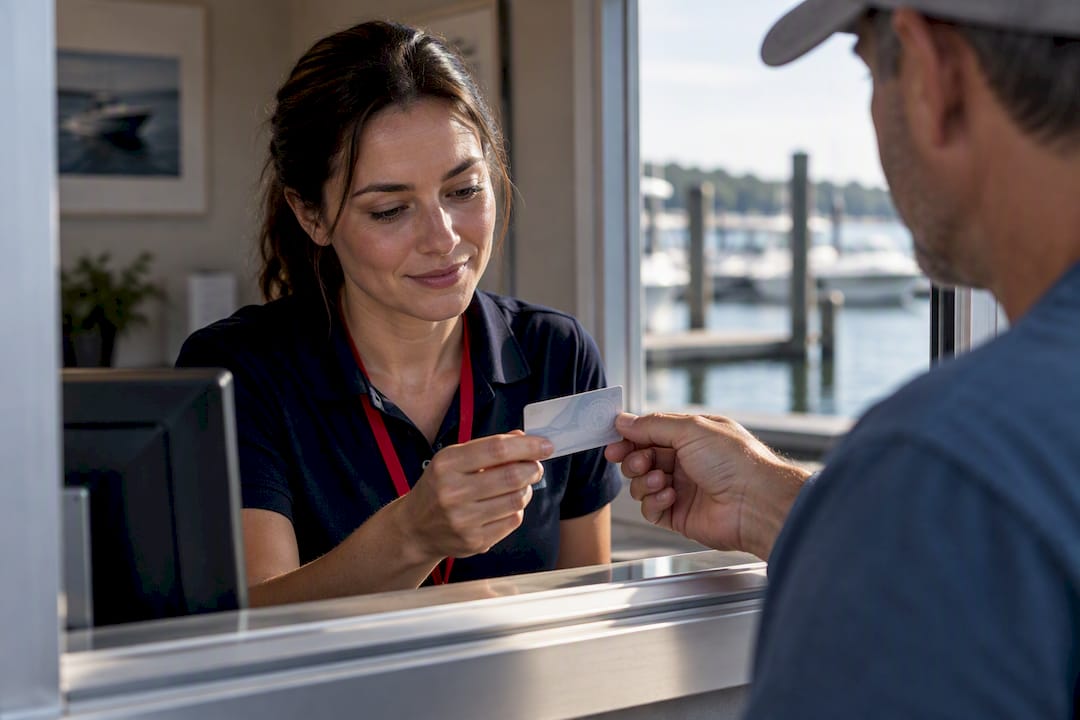
Yes. Most states that require boater education accept an out-of-state NASBLA-approved certificate, but they often attach conditions. NASBLA sets the common standard, the U.S. Coast Guard tracks which states accept what, and providers like Safe Boating America issue cards built to clear those checks nationwide.
TL;DR:
- Most states recognize out-of-state NASBLA-approved boater education certificates, but additional conditions like proctored exams or instructor-led courses may apply.
- States often require your certificate to display specific details, such as a NASBLA seal, your full name, birthdate, and completion date, and mandate carrying a photo ID whenever boating.
- Visitors generally have a grace period ranging from 60 to 90 days to operate with their out-of-state card, while establishing residency typically triggers a requirement to obtain a local certification.
- Age and horsepower restrictions can vary significantly, with some states imposing birth-year cutoffs or requiring certification for personal watercraft operators aged 14 and older.
- Choosing an approved course that explicitly lists your destination state and offers the necessary format (online, proctored, instructor-led) minimizes rejection risks at rental or water patrol checks.
Table of Contents
- What Boating License Reciprocity Actually Means
- Where States Add Their Own Conditions
- Visiting vs. Moving: When You Need a New Card
- Age Cutoffs and PWC Exceptions You Need to Know
- What to Carry, and What to Do if You Lose It
- How to Get a Boater Education Card That Travels Well
- How Safe Boating America Handles State-Specific Requirements
- An Instructor’s Quick Reciprocity Checklist
- Get a Card Built to Travel: Sign Up With Safe Boating America
- Sources
- FAQ
What Boating License Reciprocity Actually Means
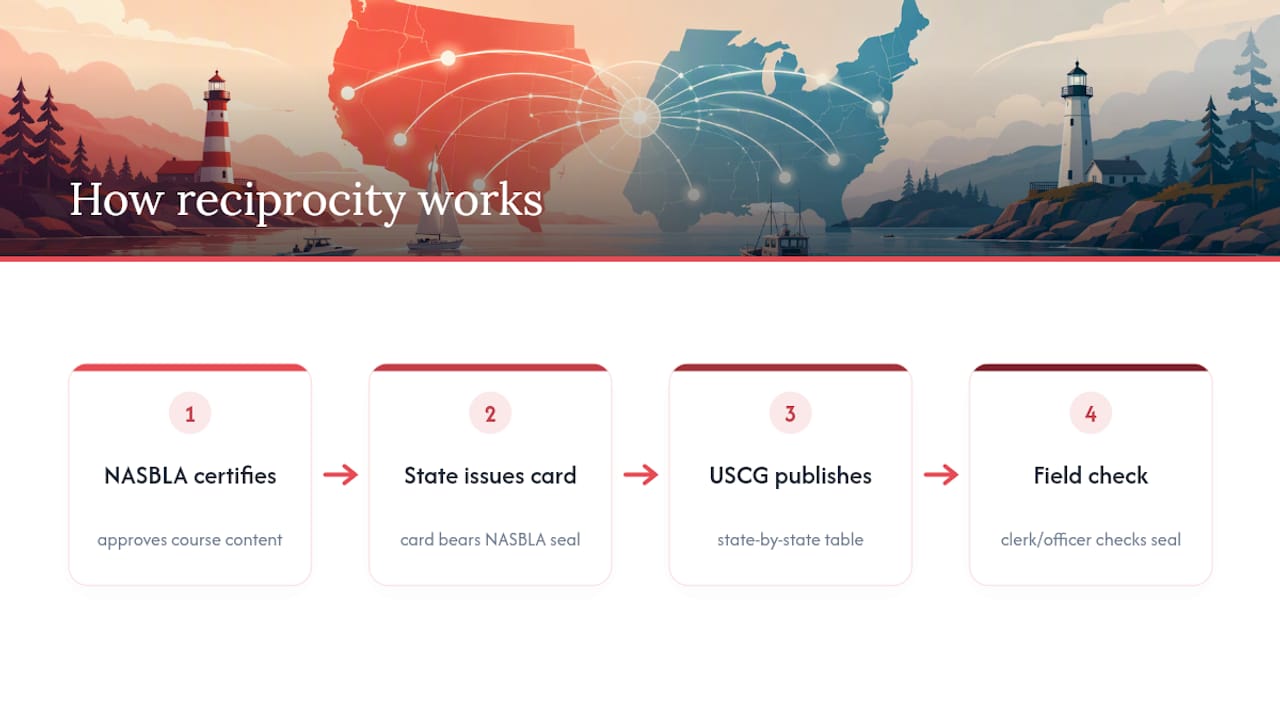
Boating license reciprocity is the practice of one state recognizing a boater education card issued by another state, instead of forcing every visiting boater to retest locally. In practice, it works because nearly every state built its education mandate on the same foundation: courses approved by NASBLA, the National Association of State Boating Law Administrators.
NASBLA doesn’t issue cards itself. It certifies course content against a shared curriculum, and states then agree to honor cards carrying that seal. The U.S. Coast Guard compiles this into a public state-by-state Education Reciprocity table, listing which states accept outside certificates and under what conditions. A boat rental clerk in another state, or a marine patrol officer, looks for that NASBLA identifier first. No seal usually means no acceptance, regardless of how much boating experience you actually have.
Where States Add Their Own Conditions
Reciprocity is common, but it isn’t automatic everywhere. Some states layer extra requirements onto out-of-state cards, and those requirements are exactly where boaters get tripped up.
A handful of states require a proctored final exam, meaning a self-paced online course without a supervised test won’t satisfy their rule, even with a valid NASBLA seal. Others restrict acceptance to instructor-led courses only, which rules out fully online options for certain vessel classes. A smaller group runs state-issued-only systems, where the state wants its own card issued regardless of prior certification elsewhere. Enforcement varies too. Some states treat an invalid card as a citation risk; others simply deny you access to a rental.
| Condition type | What it means for you | Example state |
|---|---|---|
| Proctored exam required | Self-paced online-only courses may not qualify | Varies by state, per USCG reciprocity table |
| Instructor-led requirement | Fully online cards may be rejected for that state | Check destination state before booking |
| State-issued-only rule | Out-of-state card not accepted; local card required | Confirm via state boating agency |
| Birth-year mandate | Requirement tied to when you were born, not where | Florida, born on/after January 1, 1988 |
Some states also exempt holders of a U.S. Coast Guard merchant mariner credential from the recreational education mandate entirely, since that credential already covers vessel operation knowledge.
Visiting vs. Moving: When You Need a New Card
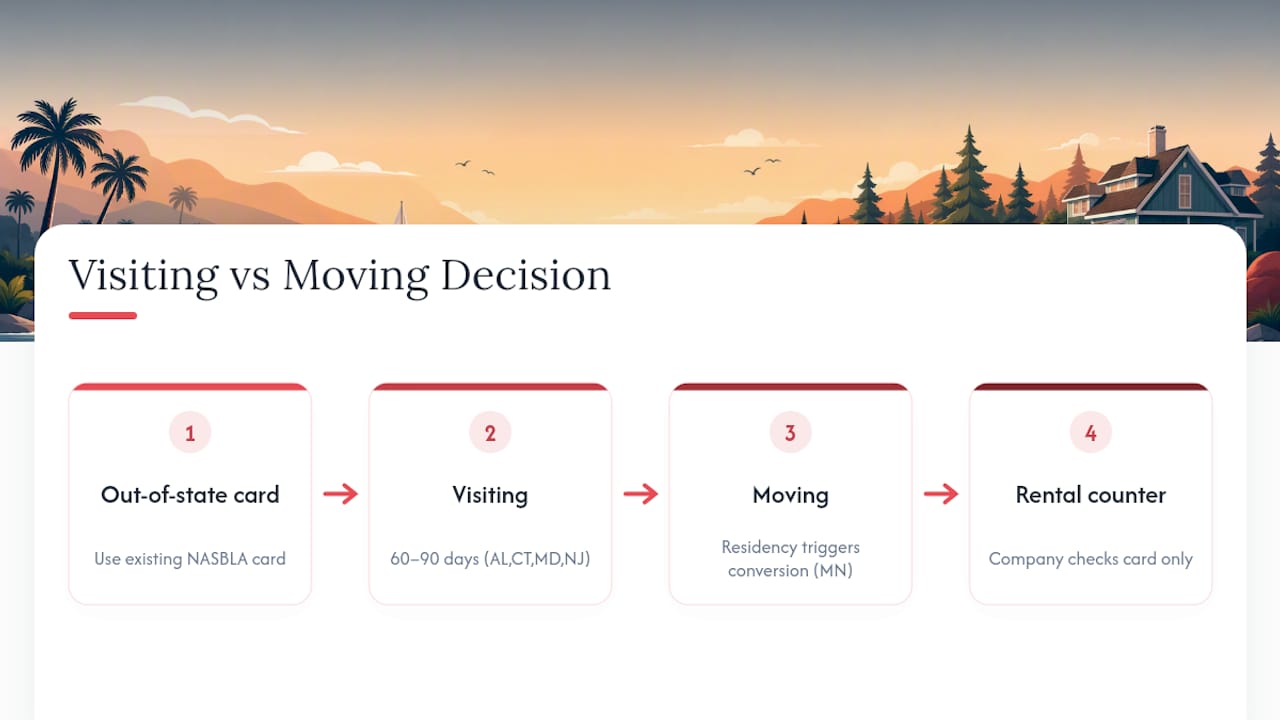
Most states offer a grace period for visitors, letting you operate a rented or borrowed boat on your existing out-of-state card for a set stretch, often somewhere between 60 and 90 days depending on the state. States including Alabama, Connecticut, Maryland, and New Jersey each define their own visitor windows, so check the specific state before you launch.
Moving is different. Establishing residency in a new state typically starts a clock on converting to that state’s education requirement, even if your old card is technically still NASBLA-approved. Minnesota’s 2025 watercraft operator’s permit law is a good current example: existing permits from other states remain valid, but the law spells out exactly how visitor status and residency conversion interact. Rental companies rarely check your residency status themselves. They just check the card, so an expired grace period usually surfaces at the counter, not on the water.
Age Cutoffs and PWC Exceptions You Need to Know
Age rules are where reciprocity gets confusing fast. Many states use a birth-year cutoff instead of a flat age minimum. Florida requires operators born on or after January 1, 1988 to carry a boating education ID, but that cutoff date is Florida’s, not universal. The destination state’s cutoff always governs, not your home state’s.
Personal watercraft face stricter treatment almost everywhere. Virginia requires PWC operators age 14 and up, plus anyone running a motorboat with 10 horsepower or more, to hold a completed safety course card. Horsepower thresholds like that show up in several states and can require certification even when age alone wouldn’t.
What to Carry, and What to Do if You Lose It
A valid card should show your full name, date of birth, course completion date, and the NASBLA identifier tying it to an approved course. Missing any of those fields is often enough for a rental counter or officer to question it.
Carry both the card and a photo ID, every time, not just one or the other:
- Rental operators typically ask for both, since name matching is how they confirm the card belongs to you.
- Officers on the water check the same two items during routine stops.
- A digital copy on your phone helps, but a physical card is safer where connectivity is spotty.
- Replace a lost card immediately before your next outing, not the morning of your trip.
If your card is lost or damaged, Safe Boating America’s guide on replacing a boating license walks through same-day replacement options so a missing card doesn’t cancel a planned trip.
How to Get a Boater Education Card That Travels Well
Getting a card that clears reciprocity checks in most states comes down to picking the right course upfront, not scrambling afterward.
- Check both states’ rules first. Look up your home state and your destination state’s accepted course formats before enrolling.
- Choose a NASBLA-approved course matching the format required. Some states demand proctored or instructor-led sessions; confirm before you pay for a self-paced option. Safe Boating America’s breakdown of what counts as an approved course covers this distinction clearly.
- Complete the course and pass the exam. Many providers issue certificates same-day, some digitally, which matters if a trip is coming up fast.
- If you relocate, confirm your new state’s conversion deadline right away rather than assuming your old card still counts indefinitely.
Pro Tip: Pick a course that lists your destination state explicitly in its “accepted by” notes, or one offering a proctored final. Both cut your rejection risk more than any other single choice.
How Safe Boating America Handles State-Specific Requirements
Safe Boating America runs state-approved courses in online, live Zoom, and in-person formats, which matters because destination states don’t all accept the same delivery method. New York’s Brianna’s Law compliance and dedicated Connecticut boating courses are built to each state’s actual rule, not a generic national template.
Picking an approved provider up front, then matching the format to what your destination state actually requires (proctored versus instructor-led versus self-paced), is the single biggest thing that separates a card that works everywhere from one that gets you turned away at a rental counter.
An Instructor’s Quick Reciprocity Checklist
Five things I’d check before any out-of-state trip: the NASBLA seal on your card, your destination state’s specific exceptions, a photo ID to match it, the rental company’s own posted rules, and a replacement plan if the card goes missing. PWC operators should double-check separately since personal watercraft rules run stricter almost everywhere.
— Richard
Get a Card Built to Travel: Sign Up With Safe Boating America
Safe Boating America is the alternative to hunting through fifty separate state agency sites trying to guess which course format your destination actually accepts. One provider, multiple formats, all NASBLA-approved: choose online nationwide courses if you need flexibility and broad state acceptance, or a live Zoom class if your destination state requires instructor-led or proctored instruction.
New York boaters can register directly for the NYS Safe Boating Class, built around Brianna’s Law compliance from the start. Not sure which format your travel plans need? Check your destination state’s rule first, then pick online for flexibility or Zoom for a proctored, instructor-led session. Either way, you walk away with a NASBLA-approved certificate designed to clear the conditions most states actually check.
Sources
- Reciprocity - NASBLA
- Do I need to take a boating safety course? — Virginia Department of Wildlife Resources
- New boater education law — Minnesota DNR
FAQ
What States Have Boating License Reciprocity?
Most states accept out-of-state NASBLA-approved certificates, though the specific conditions vary widely. The USCG’s state-by-state reciprocity table is the authoritative source for checking any individual state before you travel.
What Is the 1/3 Rule in Boating?
The “1/3 rule” isn’t a standard, nationally recognized boating education term, and definitions of it vary by source and region. If you’ve seen it referenced for a specific state’s rule, check that state’s own boating agency page rather than relying on a general definition.
Can I Use My Boater’s License in Another State?
Usually, yes, if your card carries a valid NASBLA approval, though some states add conditions like proctored exams or instructor-led course requirements. Visitors often get a grace period of several weeks to a few months before needing to convert, as outlined in state pages like Minnesota’s boater education law.
Is a Florida Boating License Valid in Other States?
Yes, in most cases, since Florida’s boating education ID follows the NASBLA-approved curriculum other states recognize. Florida also allows nonresidents visiting the state to show proof of an equivalent out-of-state course instead of getting a Florida card.
Does Safe Boating America Offer Courses That Work in Multiple States?
Yes. Safe Boating America issues NASBLA-approved certificates through online, Zoom, and in-person formats, letting boaters match the delivery method to whatever their destination state requires. Course pricing and formats are listed directly on Safeboatingamerica.