Boating Course Length by State: What Counts Toward the 3–8 Hours

A state-approved online boating course typically requires a minimum of about three hours, while classroom courses commonly run six to eight hours, with New York mandating a full eight hours. Format drives the real time commitment: online self-paced study, live classroom sessions, and on-water practicals each add their own scheduling demands, so total completion time can span a single day or stretch across several weeks.
TL;DR:
- State minimum instruction hours range from three hours online to eight hours for classroom courses, but total time also includes exams, breaks, and on-water training.
- Online courses enforce minimum study times with timers, preventing compression, while classroom courses follow fixed schedules with scheduled breaks and proctored exams.
- Different states have specific rules: New York requires eight hours with breaks and a proctored exam, whereas Pennsylvania requires only three hours of study, excluding the exam.
- Completing the minimum hours does not guarantee readiness; hands-on practice and sufficient preparation are essential for safe boating.
- The choice of course format should be based on your timeline, learning style, and whether on-water experience is legally required, not just the minimum instructional hours.
Table of Contents
- What “course length” actually means: minimums versus total time
- State examples: what the official rules actually require
- From hours to days: how format and prep change your calendar
- Choosing the right format for your timeline
- How our course formats align with state length requirements
- Balancing speed with real preparedness
- Get certified in a format that fits your schedule
- FAQ
- Sources
What “course length” actually means: minimums versus total time
States set a minimum instruction time, not a fixed course duration. That minimum covers the core material: navigation rules, safety equipment, emergency procedures, and boating law. It does not automatically include the time needed for breaks, the final exam, or any on-water training a state or provider adds.
Two numbers matter for planning purposes:
- Instruction hours: the state-mandated minimum time spent on course content, which online platforms track electronically and classroom instructors log manually.
- Total time: instruction hours plus exam time, scheduled breaks, and any practical or on-water sessions required by the state or chosen voluntarily.
Online minimums tend to sit near three hours in states that follow guidance similar to California’s approach, while classroom minimums commonly fall between six and eight hours depending on the state. Online platforms are not a shortcut around these minimums. Most systems enforce a chapter-by-chapter timer and will not unlock a quiz or the final exam until the required study time for that section has elapsed. That means a student cannot legally compress a three-hour online course into 45 minutes by skipping ahead, even if the material feels familiar.
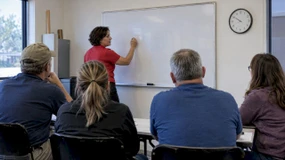
Classroom courses add a structural layer that online courses do not: fixed start and end times, mandated breaks, and a proctored exam administered in person. Those elements make classroom length more predictable but less flexible than self-paced online study.
State examples: what the official rules actually require
Course length rules vary by state, and the differences affect how readers should plan their schedule. The clearest way to see this is side by side.
| State | Format | Stated minimum | Notable procedural rule |
|---|---|---|---|
| New York | Classroom | 6 to 8 hours | Includes required breaks and a proctored final exam, per NYS Parks |
| Illinois | Instructor-led | 8 hours minimum | Online options also available, per Illinois DNR |
| Ohio | Classroom | 8 hours minimum | Proficiency exam alternative exists for qualified boaters, per Ohio DNR |
| Pennsylvania | Internet course | 3 hours minimum | Chapter study time is tracked and enforced, exam time not included, per Pennsylvania Bulletin |
New York’s rule is among the more detailed: the classroom minimum comes with specified break requirements and a proctored exam. The state issues a temporary certificate on completion. Illinois DNR frames its instructor-led option as typically running eight-plus hours while also listing online courses as a separate path for the same certification. Ohio follows a similar eight-hour classroom floor but offers a proficiency exam alternative, roughly an hour long, for boaters who can demonstrate existing knowledge. Pennsylvania’s bulletin sets a three-hour internet course minimum but requires chapter-level study time tracking, and that minimum does not include the time needed to complete the certification exam itself.
From hours to days: how format and prep change your calendar
A state-mandated hour count and a real-world completion timeline are not the same thing. Here is how the common formats typically play out:
- Same-day online completion: Motivated students who work through an online course in one sitting can often finish within the state minimum, roughly three hours in states like Pennsylvania, plus exam time.
- Weekend classroom sessions: Many in-person providers schedule the full eight-hour New York or Ohio requirement across a single Saturday, with built-in breaks and the exam at the end.
- Evening multi-week classes: Some classroom providers split the same total hours across two or three evening sessions, which extends calendar time without changing total instruction hours.
- On-water practicals: When a state or provider adds hands-on training, that component is scheduled separately from classroom or online hours and often requires its own date, instructor ratio, and location.
Reviewing course material in advance, including a boater exam practice test, will not shorten a state-mandated minimum time requirement, but it does help students move through required content with more confidence and fewer repeated attempts at the final exam.
Pro Tip: Ask your provider directly whether your certificate is issued immediately or mailed later; some states issue a temporary certificate on the spot while the permanent card arrives separately.
Choosing the right format for your timeline
The right format depends on how soon certification is needed, whether a state requires on-water experience, and how a person learns best. A quick checklist narrows the decision fast:
- Deadline: If certification is needed within days, same-day online options in states that allow them are the fastest legitimate path.
- On-water requirement: Confirm whether your state or intended activity (such as Jet Ski or PWC operation) requires a practical component beyond classroom hours.
- Learning style: Self-paced online study suits independent learners, while classroom settings help students who benefit from live instruction and immediate questions.
- State approval: Verify the course carries NASBLA or state approval before registering, since an uncertified course will not satisfy legal requirements regardless of how quickly it can be completed.
Treat any course promising completion far faster than the minimums described above as a red flag. Before paying, ask the provider for its state approval ID, its exam proctoring policy, and the expected timeline for receiving proof of completion. Our guide comparing in-person and online boating course formats covers these trade-offs in more detail.
How our course formats align with state length requirements
We structure our boating safety courses, offered online, via live Zoom sessions, and in person, to meet the instruction-hour minimums set by the states we serve. Our classes are taught by state-certified instructors and USCG-licensed captains, which keeps delivery consistent with the classroom and exam standards described above regardless of which format a student chooses.

Balancing speed with real preparedness
Meeting a state’s minimum hour requirement is not the same as being ready to handle a boat safely. A format that fits your schedule matters, but rushing through required material to finish faster serves the calendar, not your competence on the water.
— Richard
Get certified in a format that fits your schedule
Picking a course format should come down to your timeline, not guesswork about what each state allows. We offer the NYS Safe Boating Class for students who want an in-person or online path that meets New York’s eight-hour requirement, along with scheduled Zoom Online 1-Day Classes for those who prefer live instruction without travel.
- Same-day online certification where state rules allow it, through our nationwide online courses.
- Scheduled live-online and in-person sessions that fit various scheduling needs.
- State-specific options, including our Ohio and Oregon certification courses.
Check available dates and pick the format that matches your timeline at Safe Boating America.
FAQ
How long is the boat US course?
Most U.S. boating safety courses run between three and eight hours depending on the state and format, with online courses often set at a three-hour minimum and classroom courses commonly requiring six to eight hours. New York and Ohio both set an eight-hour classroom minimum. Exact timing always depends on the state where you plan to operate your boat.
What is the 1/3 rule in boating?
The 1/3 rule is a fuel management guideline, not a course length rule: boaters plan to use one third of their fuel heading out, one third returning, and keep one third in reserve. It is commonly taught as part of boating safety curricula but does not affect how long a certification course takes to complete.
What states don’t require a boating license?
Boating education requirements vary significantly by state, and some states have no mandatory boater education requirement for certain boat types or age groups. Because rules change and often depend on boat horsepower, operator age, or watercraft type, check your specific state’s boating authority before assuming no certification is needed.
How long does the Florida boating course take?
Florida boating course length follows the same general pattern as other states, with online courses typically meeting a multi-hour minimum similar to other state-approved programs. Our Florida boating and PWC certification course page lists current format options and timing for Florida-specific certification.
Does a longer course mean better preparation?
Not necessarily. A longer classroom course adds structured instruction time and live Q&A, while a shorter online course that meets the state minimum still covers the same required safety content, just in a self-paced format. The right choice depends on how you learn best rather than which option takes more hours.