Boat Trailer Backing: How to Back Down a Ramp

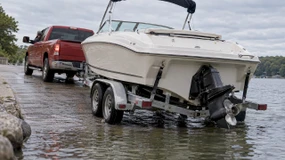
Backing a boat trailer comes down to one reversal and one habit. The reversal: the trailer turns opposite to the steering wheel. The habit: small, slow corrections, and a stop-and-reset whenever the angle gets away from you. Put one hand at the bottom of the wheel, move it toward the side you want the trailer to go, and watch the trailer in your mirrors. Everything else on this page builds on that. Safe Boating America teaches state-approved boating safety courses online, by live Zoom and in person, and a clean launch is part of operating a boat safely and legally.
TL;DR
- Steering is reversed with a trailer. Hand at the bottom of the wheel, move it the way you want the trailer to go.
- Start straight, back slowly, make small corrections, and use a spotter you can see in your driver’s side mirror.
- If the angle gets too sharp, stop, pull forward and start over. Do not keep reversing.
- At the ramp: disconnect wiring, remove stern tie-downs, stop when the stern floats, then park, set the brake and chock the wheels.
- Practice in an empty lot with cones before you ever face a busy ramp.
Table of Contents
- Why a trailer steers the opposite way
- The hand-at-the-bottom method
- Set up before you start backing
- Backing in a straight line
- Backing around a turn
- Backing down the ramp, step by step
- When the trailer turns too sharply
- Practice before the ramp
- Our perspective
- Take a state-approved course before your next launch
- FAQ
- Sources
Why a trailer steers the opposite way
When you back up a trailer, steering is backwards: turn the wheel left and the trailer swings right, and the other way around. The trailer pivots on the hitch ball. Your tow vehicle’s rear end pushes the front of the trailer sideways, so the trailer’s rear goes the opposite direction. One writer compares it to a wheelbarrow: to send the trailer left, the back of the vehicle has to go right.

This is why new trailer drivers over-correct. Your instinct from normal driving points the wrong way. The fix is not to think harder about it. It is to change what your hands do.
The hand-at-the-bottom method
Place one hand at the bottom of the steering wheel, the 6 o’clock position. Move that hand in the direction you want the trailer to go. Move it left and the rear of the trailer goes left. Move it right and the trailer goes right. Because the hand sits at the bottom, the wheel’s movement matches the trailer’s movement, so you stop translating in your head.
A few details make it work:
- Use your mirrors. Check both side mirrors often. The driver’s side mirror is your main view because that is the side you will favor when backing.
- Go slow. Speed is what turns a small error into a jackknife. Idle speed is enough.
- Use small inputs. Oversteering is the common cause of jackknifing, especially with shorter trailers.
- Use a spotter when you can. Mirrors cannot show everything. NHTSA’s towing guide advises having someone outside at the rear of the trailer to guide you whenever possible.
Set up before you start backing
Most bad backing jobs are decided before the vehicle moves. Work through this in the staging area, the lot near the ramp where you prepare the boat.
- Walk the ramp. Look for potholes and drop-offs before you commit the trailer to them. A ramp inspection on foot is a standard part of the routine.
- Line up straight. Starting with the tow vehicle and trailer in a straight line is the first key to a straight reverse. If the rig starts with a kink, you begin with an error to undo.
- Choose the dock side. If a dock is available, aim to back with it on the driver’s side so you can see the trailer and the dock together.
- Position your spotter. Have them stand where you can see them in your left mirror. Roll down the front windows and turn off the radio so you can hear them. Agree on hand signals first: stop, left, right, keep coming.
- Do the launch prep away from the ramp. Remove stern tie-downs, secure loose gear, lock the winch and disconnect the trailer wiring. A full pre-trip walkaround is covered in our boat trailering checklist.
Doing the prep in the staging area also helps everyone else. New Jersey’s Division of Fish and Wildlife ramp guide recommends having an established routine, moving gear to the boat while waiting in line and offering a hand if someone is struggling. A ramp moves faster when each boater arrives ready.
Backing in a straight line
Straight is harder than it looks, because the trailer drifts in small amounts that grow if you ignore them.
- Keep your eyes on the driver’s side mirror.
- When the trailer starts to drift to one side, palm the bottom of the wheel toward the side the trailer is drifting away from, which brings it back. Make only small adjustments.
- Another way to say it: turn the top of the wheel toward the direction of the drift and correct it immediately. Michigan’s commercial driver manual teaches this for combination vehicles.
- If the drift gets bigger than a small correction can fix, stop and pull forward.
The thumb test some drivers use is the same idea: hands on the bottom of the wheel, thumbs pointing the way you want the trailer to travel. Pick whichever version you can remember under pressure.
Backing around a turn
The reverse turn is a timing exercise. Mercury Marine describes it as directing the trailer and then following it with the tow vehicle. Here is their right-hand turn, in plain steps:
| Step | What you do | What it does |
|---|---|---|
| 1 | Palm the wheel right | Starts the trailer moving right |
| 2 | Ease the wheel back toward center as the trailer comes around | Stops the angle from growing |
| 3 | Move your palm left about halfway through | Swings the tow vehicle around the trailer’s arc |
| 4 | Center the wheel and back straight | Lines up the rig |
The key is step 3. You first steer to point the trailer, then steer the other way so the vehicle follows the trailer. The Michigan manual says the same thing: once the trailer starts to turn, turn the wheel the other way to follow it. It also advises backing on a curved path toward the driver’s side so you can see.
A left-hand turn is easier for most people because you can see the trailer. That is why experienced boaters set up ramps and parking spots to back to the left.

Backing down the ramp, step by step
Once you are lined up, the ramp is the same skill with a few extra checks.
- Check lights and brakes. Unplug trailer lights before backing into water unless they are sealed LED lights. Hydraulic or disc surge brakes need electricity, and will not engage when the reverse lights are on, so know what your trailer has.
- Use traction. On algae-slick ramps, four-wheel drive helps if your vehicle has it.
- Back slowly with your spotter. Stay straight. Small corrections only.
- Stop at the right depth. Back until the trailer tires touch the water, check whether the stern is deep enough to float, and back a little more if not. On a bunk trailer, the transom should be several inches deep in the water before launching.
- Secure the vehicle. Shift to park (or leave a manual in gear), turn off the engine and set the parking brake. Do not trust the transmission alone on a steep ramp: engage the emergency brake firmly. Place blocks behind the rear wheels before unhooking the boat. NHTSA also advises blocking the downhill side of the wheels when parked on a grade.
- Launch and clear the ramp. Move the boat away from the ramp, then pull the vehicle and trailer out and park so the next boater can use the ramp.
Retrieving the boat reverses this process. Back in to the same depth, load the boat, and take your time. Our launch checks guide lists what to confirm on the water, and the docking techniques guide covers what comes after you are floating.
When the trailer turns too sharply
Every driver gets a trailer angle they cannot fix. The response is the same each time.
- Catch it early. If the angle is getting away from you, stop, pull forward and start over. Pulling forward straightens the rig.
- Past the jackknife point. If steering cannot correct it, stop, shift to drive and pull forward. The truck cannot follow the trailer out of a severe kink, so reversing further makes it worse.
- The usual causes. Experienced drivers name oversteering and backing too fast as the biggest beginner mistakes.
- Do not rush because of the line. A line of boats behind you creates pressure. As Sea Tow puts it, slow and steady gives you a better chance to fix a misstep before it becomes a problem. Pulling forward to reset costs less time than a damaged trailer or a scraped fender.
Common reasons the trailer will not back straight
- You started with the rig already angled.
- You are using big wheel movements instead of small ones.
- You are looking only ahead, not at the mirrors.
- You are moving faster than your corrections can keep up with.
- Your hand is at the top of the wheel, so your instinct pulls you the wrong way.
Practice before the ramp
A busy ramp is the wrong place to learn. New Jersey’s guide says first-time boaters should practice between plastic cones or parking spaces before arriving. A simple progression in an empty lot:
- Back straight for about 50 feet.
- Back in gradual curves left, then right.
- Back into a cone-marked spot with tighter and tighter entry angles.
- Find your jackknife limit while stationary so you recognize the warning signs in a real maneuver. This progression comes from a trailer backing guide.
Watch other boaters launch before your own turn. Notice wind, current and any ramp problems, as one pontoon manufacturer’s owner manual recommends. If you are new to owning a boat, our first-time boat owner checklist and beginner’s safety guide cover the other tasks to handle early.
Our perspective
Most launch trouble we hear about starts before the boat touches the water. The driver is rushed, the rig is not straight, the spotter is out of sight, and the ramp is crowded. Backing a trailer is a skill, but it is also a routine, and routines are what keep people safe.
That is how we think about boating education. A state-approved course is built around the habits that prevent problems: preparation, communication, slow decisions and knowing what to do when something goes wrong. Our courses are taught by State Certified Instructors and USCG-Licensed Captains using NASBLA-approved material, and they are offered online, by live Zoom and in person so you can fit one into your schedule.
If you are new to a boat or a personal watercraft, take the course before your first launch. You get the certificate you need to operate legally and the safety knowledge to handle the ramp, the water and the return trip with confidence.
Richard
Take a state-approved course before your next launch
If you need a boating safety certificate, we offer state-approved boating license and safety courses for recreational boaters and personal watercraft operators in every state. The Zoom Online 1-Day Class is $75, and the NYS Safe Boating Class is $85. Our online boating courses cover state requirements nationwide, and gift certificates are available for a new boater in your life.
For New York and Connecticut boaters, we also run specialized classes, including a private Connecticut boating course. You can start from our main page and pick your state.
FAQ
How do you back up a boat trailer for the first time?
Start with the tow vehicle and trailer in a straight line. Put one hand at the bottom of the steering wheel and move it in the direction you want the trailer to go. Back slowly with small corrections, and stop and pull forward whenever the angle gets too sharp.
Why does the trailer turn the opposite way from the steering wheel?
The trailer pivots on the hitch ball. When you steer left in reverse, the back of your vehicle pushes the trailer’s front to the right, so the trailer’s rear swings the other way. Placing your hand at the bottom of the wheel lets the wheel’s motion match the trailer’s.
How far should I back the trailer into the water?
Back in until the trailer tires touch the water, then check whether the stern floats. If it does not, back a little more. On a bunk trailer, the transom should be several inches deep before launching. Then shift to park, set the parking brake and chock the wheels before you unhook the boat.
Do I need a spotter?
It is strongly advised. NHTSA’s towing guide says mirrors cannot provide all the visibility you need when backing, so have someone outside at the rear of the trailer to guide you whenever possible. Position them where you can see them in your left mirror.
Sources
- How to Back Up a Boat Trailer, Discover Boating
- Boating Basics: Towing Your Boat, Mercury Marine
- How to Drive with a Trailer, Mopar
- Michigan Commercial Driver License Manual, Combination Vehicles
- Towing Safety, NHTSA
- Boat Ramp Guide, New Jersey Division of Fish and Wildlife
- How to Back Up a Boat Trailer, Boatsetter
- How to Launch a Boat Properly, Carefree Boats
- How to launch your outboard boat, Skier’s Marine
- Owner’s Manual, Crest Pontoon Boats
- How to Back Up a Trailer, Big Rentals
- Learn how to back up your sailboat trailer, Simplify Sailing
- Backing up Your Boat Trailer, Sea Tow